The invention that made tall buildings possible was not the elevator but the safety brake, because hoists that raise loads had existed for centuries and nobody was willing to ride one. What changed was a demonstration that a car would stop rather than fall when its rope was cut.
Almost everything people assume about elevators is wrong in some respect. They are not lifted so much as balanced, the motor doing far less work than the height suggests. They cannot free-fall in any realistic scenario. And deciding which car answers which call turns out to be a genuinely difficult computational problem that buildings solve differently depending on how they are used.
Why the Brake Mattered More Than the Lift
Mechanisms for hoisting goods vertically existed long before passenger elevators, powered by animals, water, and later steam, and were used routinely in mines and warehouses.
The obstacle to carrying people was not power but trust, since a rope failure meant the load fell, which was acceptable for freight and obviously not for passengers.
A mid-nineteenth-century public demonstration in which the supporting rope was deliberately cut, and the platform held, is generally credited with making passenger elevators commercially viable.
How the Safety Gear Works
The core safety device is triggered by speed rather than by rope failure, using a governor that spins with the car and engages when rotation exceeds a set threshold.
Engagement pulls a linkage that drives wedges against the guide rails, gripping them progressively and bringing the car to a controlled stop rather than an abrupt one.
Because the mechanism responds to excess speed, it operates regardless of the cause, which means it protects against rope failure, brake failure, and control faults alike.
Why Elevators Are Counterweighted
A traction elevator is not simply hauled upward, since a counterweight hangs on the other side of the ropes and moves in the opposite direction as the car travels.
The counterweight typically equals the car's weight plus roughly half its rated load, meaning the two sides are close to balanced under normal occupancy.
The motor therefore only has to move the difference between the two, which is why the energy required is a small fraction of what lifting the full car would demand.
What Regenerative Drives Recover
When the heavier side descends, the motor is driven rather than driving, and modern systems capture that energy and return it to the building's supply rather than dissipating it as heat.
This happens on a full car going down and an empty car going up, both of which are common, so the recovery is meaningful rather than occasional.
Combined with the counterweight, this is why elevators consume far less of a building's energy than most people assume, typically a small percentage of total consumption.
How Traction Actually Holds
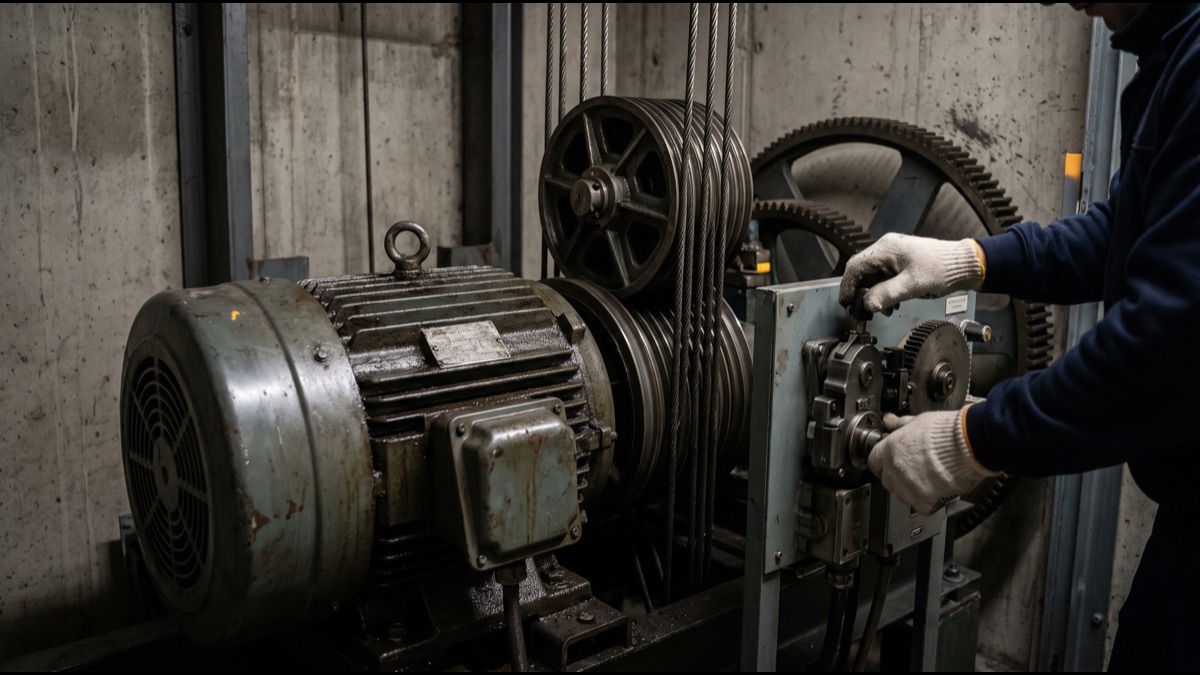
The ropes are not attached to the drive machine but pass over a grooved wheel, and the system relies entirely on friction between rope and groove to move the car.
This is a genuine safety feature, since if the car or counterweight becomes obstructed and tension is lost on one side, the ropes slip rather than the machine tearing something apart.
Groove geometry is designed to provide sufficient grip under normal loads while permitting slip under abnormal ones, which is a deliberate limit rather than a shortcoming.
Why Free Fall Is Effectively Impossible
Elevators are suspended by multiple independent ropes, each individually capable of supporting the fully loaded car, so a single failure does not release the car.
Even if all suspension failed simultaneously, the speed governor would engage the safety gear within a short distance, and buffers at the shaft bottom absorb residual impact.
Documented cases of cars actually falling are extremely rare and generally involve catastrophic structural damage to the building rather than failure of the elevator itself.
What Hydraulic Elevators Do Differently
Low-rise buildings frequently use hydraulic elevators, where a piston pushes the car upward directly and it descends by controlled release of fluid under its own weight.
These require no overhead machine room and are cheaper to install, but they consume considerably more energy since there is no counterweight and nothing is recovered on descent.
Travel height is limited by piston length and practical considerations, which is why hydraulic systems are essentially absent from tall buildings.
Why Machine Rooms Disappeared
Traditional traction elevators required a room above the shaft housing a large geared motor, which consumed valuable roof space and added construction cost.
Permanent magnet motors deliver high torque at low speed without gearing, and are compact enough to fit within the shaft itself alongside the guide rails.
This eliminated the machine room in most modern installations, and the same motors are substantially more efficient than the geared systems they replaced.
How Dispatching Became a Hard Problem
In a building with several elevators, deciding which car responds to each call is an optimisation problem with no simple correct answer, since choices affect all subsequent decisions.
The system cannot know how many people are waiting, where they intend to go, or whether more calls are about to arrive, so it is optimising under genuine uncertainty.
Different objectives conflict, since minimising average waiting time can produce very long waits for a few people, and systems must balance efficiency against fairness explicitly.
Why Destination Dispatch Changed the Interface
Conventional systems learn only that someone wants to go up or down, and discover the actual destination after they have boarded, which is very little information to plan with.
Destination dispatch asks passengers to enter their floor in the lobby, which lets the system group people going to the same place into the same car before anyone boards.
This substantially reduces the number of stops per trip and improves capacity in busy buildings, at the cost of an interface that confuses first-time visitors.
What Happens During Morning Peak
Traffic patterns in office buildings are strongly directional, with almost everyone travelling upward from the lobby during a concentrated period each morning.
Systems detect this and change strategy, parking empty cars at the lobby rather than distributing them, since virtually every call will originate there.
The morning peak is the binding constraint on how many elevators a building needs, which means the shaft count is determined by roughly an hour of daily demand.
Why Sky Lobbies Exist
Elevator shafts consume floor area on every level they pass, so in very tall buildings the shafts required would eventually consume the rentable space they were meant to serve.
Sky lobbies solve this by running express elevators to intermediate transfer floors, where passengers change to local elevators serving a limited range above.
This allows shafts to be reused vertically, with a local bank serving upper floors occupying the same shaft space as a different bank far below.
How Double-Deck Cars Increase Capacity
Some tall buildings use elevators with two stacked cars moving together, serving adjacent floors simultaneously from a shaft that would otherwise serve one at a time.
This roughly doubles capacity without additional shaft area, but requires lobbies on two levels and only works when demand is spread across both.
It also constrains operation, since the pair must stop where both decks have a reason to stop or accept that one deck stops unnecessarily.
Why Speed Is Limited by Ears Rather Than Motors
The fastest elevators travel at speeds that would cover a hundred metres in a few seconds, and motors capable of more are entirely feasible.
The binding limit is pressure change, since rapid altitude change causes ear discomfort, and beyond a certain rate passengers find the experience unpleasant regardless of smoothness.
Some very tall buildings actively manage cabin pressure to reduce this effect, which allows higher speeds than passengers would otherwise tolerate.
Why Descent Is Slower Than Ascent
Elevators in tall buildings frequently descend more slowly than they climb, which surprises passengers who assume gravity would make downward travel easier.
The reason is again pressure, since increasing pressure during descent is less comfortable than decreasing pressure during ascent for most people.
This asymmetry is a deliberate design decision rather than a mechanical limitation, and it is specified separately in the control system.
What Rope Weight Means for Tall Buildings
In a very tall shaft the suspension ropes themselves weigh a great deal, and their distribution changes as the car moves, which unbalances the system.
Compensation ropes or chains hang beneath the car and counterweight to offset this, keeping the load on the motor roughly constant regardless of position.
Steel rope weight ultimately limits how far a single elevator can travel, which is a substantial reason very tall buildings require transfer floors rather than direct runs.
How Carbon Fibre Changes the Limit
Ropes made from carbon fibre composite weigh a fraction of steel equivalents while providing comparable strength, which substantially extends the practical travel height.
This allows single runs roughly twice as long as steel permits, reducing the need for transfer floors and freeing floor area in tall towers.
Adoption has been gradual because the material is expensive and because building codes and inspection practices developed around steel rope characteristics.
Why Elevators Are Not Used in Fires
Standard practice directs occupants to stairs during a fire, because elevator shafts can carry smoke between floors and a car could open onto the fire floor.
Power failure is also a serious concern, as is water from sprinklers reaching electrical components, both of which could strand occupants in the shaft.
Buildings therefore include a fire service mode that recalls all cars to a designated floor and locks out normal operation, reserving the elevators for firefighters.
How Evacuation Elevators Are Changing That
Very tall buildings have made stair evacuation impractical, since descending dozens of floors takes a long time and is impossible for many occupants.
Newer designs include protected elevators with pressurised shafts, water-resistant components, and independent power, specifically intended for occupant evacuation.
This represents a significant change in fire strategy, and its adoption depends on regulatory acceptance as much as on the engineering itself.
What Happens When an Elevator Stops
Most entrapments result from the system detecting an abnormal condition and halting deliberately, which is the safety design working rather than failing.
Cars are ventilated and not airtight, and the primary risk in an entrapment is passengers attempting to exit through doors or hatches rather than waiting.
Modern installations include automatic rescue operation that moves the car to the nearest floor on battery power during an outage, which has substantially reduced entrapment duration.
How Door Sensors Actually Work
Early elevators used mechanical edges that reversed the doors on physical contact, which worked but meant the door had already struck whatever it detected.
Modern systems project infrared beams across the opening, detecting obstructions before contact and holding the doors open until the path is clear.
Doors account for a large share of elevator faults, since they cycle constantly and are the only part of the system passengers physically interact with.
Why Close Buttons Frequently Do Nothing
Accessibility regulations in several countries require doors to remain open for a minimum period, which means the close button cannot shorten that interval.
Many buttons remain installed and connected but are disabled in software, or function only in fire service and independent service modes used by staff.
Whether they work is therefore jurisdiction and building dependent, which is why experience varies so much and why the topic generates persistent confusion.
Why Escalators Fail Differently
Escalators carry far more people per hour than elevators but cannot be stopped safely at speed, since a sudden halt throws standing passengers forward.
They also degrade gracefully rather than failing outright, remaining usable as stairs when stopped, which is why they are preferred where continuous high volume matters more than reach.
Most escalator injuries involve the comb plate where steps flatten and disappear, which is why that section carries the majority of the safety sensors.
How Elevator Capacity Is Calculated
Rated capacity is set by floor area rather than by weight alone, on the reasoning that a car cannot physically hold more people than its floor accommodates.
This is why an elevator rarely reaches its stated weight limit in practice, and why overload alarms are triggered more often by freight than by passengers.
Planning a building uses handling capacity instead, meaning the percentage of occupants a system can move within five minutes, which is the figure that determines shaft count.
Why Mirrors Appear in Elevator Lobbies
Mirrors near elevators were introduced partly because complaints about waiting times fell sharply when people had something to occupy their attention.
The perceived wait matters more than the actual wait, and giving waiting passengers a reason to look somewhere reduces complaints without any change in performance.
Mirrors inside cars serve a separate function, allowing wheelchair users to see behind them when reversing out, which is required by accessibility rules in several countries.
What Maintenance Actually Involves
Elevators are inspected and serviced on regulated schedules covering ropes, brakes, safety gear, door mechanisms, and control systems, with testing that verifies safety devices actually engage.
Remote monitoring now reports fault conditions and usage patterns continuously, allowing intervention before a failure strands passengers.
Because the safety mechanisms are the point, inspection focuses disproportionately on components that never operate in normal service and would only matter once.
Why Ropeless Systems Are Being Developed
Systems using linear motors rather than ropes allow multiple cars to operate independently in one shaft, and to move horizontally between shafts.
This would remove the constraint that one shaft carries one car, which is the fundamental limit on how much vertical capacity a given floor area can provide.
Development has been slow, since the safety case is considerably harder without ropes and existing regulation is written entirely around suspended cars.
Why Modernisation Costs So Much
Elevator equipment typically outlasts the electronics controlling it, so buildings frequently replace controls and drives while retaining the shaft, rails and structure.
The work is disruptive because a shaft must be taken out of service for weeks, which in a building with few elevators removes a substantial share of its capacity.
Deferring modernisation is common and expensive, since obsolete control systems eventually become unsupportable when replacement parts stop being manufactured.
What Elevators Actually Enabled
Before reliable vertical transport, upper floors were the least desirable in a building, since everyone climbed, which is why older buildings rarely exceed a handful of storeys.
Elevators inverted this, making upper floors more valuable for their views and quiet, and removing the practical ceiling on how tall a usable building could be.
Dense urban form depends entirely on this, which makes the elevator one of the more consequential pieces of infrastructure hidden inside ordinary buildings.
Hoists that lifted heavy loads existed for centuries before passenger elevators, powered by animals and water. What was missing was not power but trust, and the invention that unlocked tall buildings was the safety brake — demonstrated publicly by cutting the rope and having the platform hold. That mechanism is still the core of the design, and it responds to excess speed rather than to rope failure, which means it protects against any cause. Combined with multiple independent ropes each able to hold the full car, plus buffers at the base, free fall is effectively impossible outside catastrophic damage to the building itself. Most entrapments are the system stopping deliberately because it detected something abnormal — the safety design working, not failing. The other counterintuitive part is that elevators are balanced rather than lifted. A counterweight roughly equal to the car plus half its load hangs on the other side of the ropes, so the motor moves only the difference, and modern drives recover energy whenever the heavier side descends. What actually limits performance in tall buildings is neither motors nor ropes but human ears — the rate of pressure change passengers will tolerate, which is also why many tall-building elevators descend more slowly than they climb.
Sources
- Wikipedia — history, mechanisms, and safety systems of elevators
- Council on Tall Buildings and Urban Habitat — research on vertical transportation in tall buildings
- National Institute of Standards and Technology — studies on elevator use in building evacuation
- ASME — safety code for elevators and escalators
- International Code Council — building code requirements for elevator fire service and evacuation
FAQ
Can an elevator actually free-fall?
Effectively no. Multiple independent ropes each support the full car, a speed governor engages wedges against the rails if the car moves too fast, and buffers absorb impact at the base.
Why don't elevators use much electricity?
A counterweight balances most of the car's weight, so the motor moves only the difference. Modern drives also recover energy whenever the heavier side is descending.
Do door close buttons work?
Sometimes. Accessibility rules require doors to stay open a minimum time, so in many buildings the button is connected but disabled, or works only in staff service modes.
Why are elevators slower going down?
Pressure change, not mechanics. Increasing pressure during descent is less comfortable for most people than decreasing pressure while ascending, so descent speed is capped separately.
What should I do if an elevator stops between floors?
Wait and call for help. Cars are ventilated, and the main danger comes from trying to climb out through doors or hatches rather than from remaining inside.
About the Author
We reference Wikipedia, Council on Tall Buildings and Urban Habitat, National Institute of Standards and Technology, ASME, and International Code Council to explain the background and current understanding of this topic.
Loved This Article?
Share it on WhatsApp → Share it on WhatsApp
Get more guides in your inbox — Subscribe to our newsletter for weekly surprising stories from Egypt, Saudi Arabia, Dubai, and beyond.