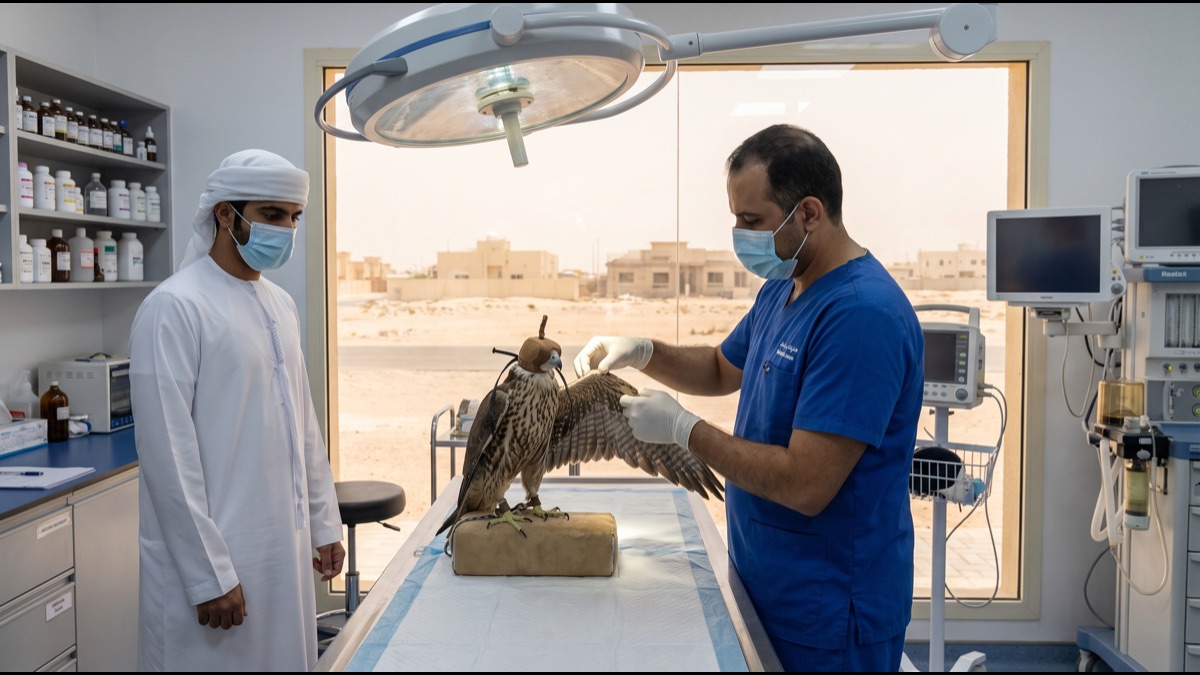
A falcon checking into a hospital in the UAE is issued its own passport, undergoes a physical examination more detailed than most house pets receive, and may leave wearing a small hood custom-fitted to its exact head shape. Behind what can look like extravagant pampering sits a genuinely sophisticated, specialized branch of avian veterinary medicine built specifically around a bird that occupies a central place in Emirati cultural heritage.
Understanding how falcon medicine actually works, from the specific injuries hunting falcons commonly sustain to why the birds require legal documentation most pets never need, reveals an industry that blends ancient falconry tradition with genuinely advanced modern veterinary technology, operating at a scale and sophistication most countries with a much larger general pet population never develop.
It also explains why Abu Dhabi built and continues to operate the largest falcon hospital in the world, treating tens of thousands of birds annually in a facility that would look, to an outside observer, more like a specialized human medical center than a typical veterinary clinic.
A Bird That Gets Its Own Passport
Every falcon legally kept in the UAE is required to carry an official falcon passport, a document recording the bird's species, its unique identification details, and its ownership history, a legal requirement that exists specifically to regulate falcon ownership and trade in line with international wildlife protection agreements governing birds of prey.
This documentation requirement, unusual for any animal outside formal livestock or breeding registries, reflects how seriously the UAE treats falconry as both cultural heritage and a regulated activity requiring genuine oversight, rather than treating falcon ownership as an informal private pastime outside any legal framework.
Why Falcons Occupy Such a Special Place in Emirati Culture
Falconry has deep historical roots across the Arabian Peninsula, originally developed as a practical hunting method used by Bedouin communities to supplement food supplies in a harsh desert environment, long before it evolved into the prestigious cultural and recreational tradition it represents in the Gulf today.
This historical depth is precisely why falconry received UNESCO recognition as an element of intangible cultural heritage, and why the UAE has invested heavily in institutions, including specialized hospitals, dedicated specifically to preserving both the practical skill of falconry and the health and welfare of the birds themselves.
What a Falcon Hospital Actually Looks Like Inside
A modern falcon hospital includes dedicated examination rooms, surgical suites, diagnostic imaging equipment, and recovery facilities scaled specifically for birds rather than adapted from general small-animal veterinary equipment, alongside specialized staff trained specifically in avian anatomy and the particular injuries and illnesses falcons commonly experience.
This degree of specialization reflects the fact that falcon anatomy and physiology differ substantially from the cats and dogs most general veterinary clinics are built around, meaning genuinely effective falcon care requires facilities and expertise purpose-built for birds of prey rather than a general veterinary practice simply extending its existing services to an unusual patient.
Why Falcons Need Such Specialized Veterinary Care
Falcons used for traditional hunting and falconry competitions face a genuinely distinct set of health risks compared to typical companion animals, including feather damage from repeated flight and contact with prey, foot injuries from perching and striking targets, and stress-related conditions tied to training, travel, and competition schedules.
Because a falcon's hunting performance depends directly on its physical condition in ways that do not apply to most pets, owners investing significant time and money in training a bird have strong practical incentive to seek genuinely specialized medical care rather than general veterinary treatment that might miss falcon-specific warning signs.
How a Routine Health Check Actually Works
A standard falcon health examination typically includes weighing the bird, checking feather condition across the entire body, examining feet and talons for early signs of infection or injury, assessing eye and beak health, and reviewing recent feeding and flight performance history the owner provides as context for the physical findings.
Veterinarians also routinely check for internal parasites and general nutritional condition, since falcons kept for active hunting and competition require carefully managed diets and are more susceptible to certain parasite-related conditions than birds living in a purely natural, wild setting with a more varied and self-regulated diet.
The Feather Problem That Ends Hunting Careers
Feather damage represents one of the most consequential health issues a hunting falcon can experience, since damaged or broken flight feathers directly compromise the aerodynamic performance a falcon depends on to hunt effectively, potentially ending a bird's competitive hunting season entirely until the feather naturally regrows during the next molt.
Because a full natural feather regrowth cycle can take months, a damaged feather during an active hunting season represents a genuinely significant setback for owners and trainers who have invested substantial time preparing a bird for competition or seasonal hunting, which is precisely the problem falcon hospitals developed a specific surgical solution to address.
How Falcon Imping Repairs a Damaged Feather
Imping, a repair technique with roots going back centuries in falconry tradition, involves precisely cutting a damaged feather and attaching a matching replacement feather section using a small internal splint, restoring the feather's aerodynamic function without waiting for a full natural regrowth cycle.
Modern falcon hospitals maintain organized libraries of donor feathers, typically collected from molted feathers of other falcons, carefully matched by species, size, and specific wing or tail position to ensure the repaired feather performs aerodynamically as close as possible to the bird's own original, undamaged feather.
Why Bumblefoot Is the Falcon Hospital's Most Common Case
Bumblefoot, a bacterial infection of the foot pad commonly caused by pressure sores from perching surfaces or minor injuries during hunting, ranks among the most frequently treated conditions at falcon hospitals, since a falcon's feet bear significant repeated stress from both perching and the physical impact of striking prey at speed.
Treatment typically involves cleaning and dressing the affected area, targeted antibiotic treatment, and in more advanced cases, surgical intervention, alongside management changes to perching surfaces and hunting schedule intended to prevent the same pressure-related injury from recurring once the bird has recovered.
How X-Rays and Endoscopy Actually Get Used on Birds This Small
Diagnostic imaging equipment at leading falcon hospitals has been specifically adapted or purpose-built to handle birds far smaller than the human or larger-animal patients such equipment was originally designed around, allowing veterinarians to identify internal fractures, foreign object ingestion, and organ abnormalities that a purely external physical exam could never detect.
Endoscopic examination, using a small camera inserted through a natural body opening, lets veterinarians directly inspect a falcon's digestive tract and respiratory system without invasive surgery, a genuinely advanced diagnostic capability that reflects how far dedicated avian veterinary medicine has progressed beyond basic external examination alone.
Why Falcon Passports Exist at All
Beyond domestic UAE regulation, falcon passports exist specifically to comply with the Convention on International Trade in Endangered Species, an international agreement regulating cross-border trade in protected wildlife, since several falcon species used in traditional falconry are subject to international trade restrictions intended to protect wild populations from overexploitation.
This documentation lets falcon owners legally travel internationally with their birds for hunting trips and competitions, since border authorities can verify a specific bird's legal ownership and origin against its passport record rather than treating every traveling falcon as a potential wildlife trafficking concern requiring separate investigation.
How the Falcon Hospital Fits Into Wildlife Conservation
Beyond treating privately owned hunting falcons, UAE falcon hospitals frequently participate in broader wildlife conservation efforts, including treating injured wild falcons found in the region and supporting captive breeding programs intended to reduce pressure on wild falcon populations that might otherwise be depleted by unregulated capture for the falconry trade.
This conservation dimension reflects a broader recognition that the long-term sustainability of falconry as a cultural practice depends directly on maintaining healthy wild falcon populations, rather than the traditional practice existing in isolation from genuine conservation concerns about the species themselves.
What a Falcon Owner Actually Pays For
Falcon medical care ranges from relatively modest routine checkup fees to substantial costs for advanced diagnostic imaging, surgical feather repair, or extended treatment for serious infections, with total costs varying considerably based on the specific bird's condition, the complexity of any required procedure, and the reputation and specialization level of the specific hospital or veterinarian involved.
Given the significant investment many owners have already made in acquiring and training a high-performing hunting falcon, medical costs are generally viewed as a necessary ongoing expense of falcon ownership rather than a discretionary luxury, similar to how serious competitive athletes or valuable racehorses receive medical investment proportional to their performance value.
Why Captive Breeding Changed the Entire Trade
Captive breeding programs, now supplying a substantial share of falcons used in modern falconry, have significantly reduced reliance on wild-caught birds, a shift that has both eased pressure on wild falcon populations and given breeders and veterinarians far more detailed genetic and health history for individual birds compared to a wild-caught falcon of unknown origin and background.
This detailed background information genuinely improves veterinary care quality, since knowing a specific bird's genetic lineage, known health predispositions, and breeding history gives veterinarians meaningfully more diagnostic context than they would have treating a wild-caught bird with no prior documented medical history at all.
How Falconry Training and Medicine Actually Intersect
Falcon trainers and veterinarians generally work in close, ongoing coordination rather than as separate, disconnected professions, since a training regimen that pushes a bird too hard physically can directly cause the kind of foot and feather injuries veterinarians most commonly treat, making injury prevention a genuinely shared responsibility between training practice and medical oversight.
Experienced trainers increasingly incorporate basic veterinary knowledge into their own daily practice, learning to recognize early warning signs of common conditions like bumblefoot or feather stress before they become serious enough to require hospital intervention, a preventive approach that reduces both treatment costs and time lost from active hunting or competition.
What Happens During Molting Season at the Hospital
Molting, the natural annual process during which falcons shed and regrow their feathers, brings a predictable seasonal pattern of hospital activity, since birds are generally not actively flown or hunted during this period, giving owners a natural window to schedule routine health checks and any elective procedures that do not require urgent immediate attention.
Hospitals use this seasonal lull in acute injury cases to focus more heavily on preventive care and detailed physical assessments, taking advantage of a bird's naturally lower activity level to conduct more thorough examinations than would be practical during active hunting season when a bird's schedule and physical condition are constantly shifting.
Why Dubai Built the World's Largest Falcon Hospital
Abu Dhabi's dedicated falcon hospital, widely recognized as the largest specialized avian medical facility of its kind anywhere in the world, reflects the sheer scale of falconry as a practiced tradition across the UAE, treating a patient volume that would be difficult to justify economically in a country without such deeply embedded cultural demand for the sport.
This facility has also become something of a cultural tourism attraction in its own right, offering public tours that let visitors observe falcon examinations and treatment up close, treating the hospital's specialized medical work as a point of genuine national pride rather than a purely private veterinary business operating out of public view.
How This Care Model Differs From Ordinary Veterinary Medicine
Unlike typical companion-animal veterinary practice, which generally treats a wide range of unrelated species with comparatively standardized equipment and training, falcon hospitals represent a genuinely narrow, deep specialization model, where veterinarians and facilities focus almost entirely on one category of bird, achieving a depth of species-specific expertise a general practice could rarely match.
This specialization model has parallels in human medicine's own move toward specialized centers of excellence for specific conditions, and it exists in falconry specifically because the cultural, economic, and conservation stakes tied to falcon health in the Gulf are significant enough to justify facilities and expertise this narrowly focused.
How Falcon Racing and Competitions Add Their Own Injury Patterns
Beyond traditional hunting, organized falcon racing and beauty competitions, judged on specific physical and performance criteria, have grown into a significant modern extension of falconry culture across the Gulf, and the intense physical demands of competitive training bring their own characteristic injury patterns that hospitals have had to study and treat systematically.
Competition-focused veterinary care increasingly emphasizes performance optimization alongside basic treatment, with some hospitals offering conditioning assessments and nutritional planning specifically geared toward keeping a competing falcon in peak physical condition through an entire competition season, a service model that borrows conceptually from human sports medicine.
Why Falconry Clubs Play a Quiet Role in Bird Welfare
Formal and informal falconry clubs across the UAE frequently serve as an early-warning network for animal welfare concerns, with experienced club members often the first to notice when a fellow owner's bird shows signs of neglect or inadequate care, informally encouraging proper veterinary attention before a situation deteriorates into a genuine welfare crisis.
This community-based oversight complements formal regulatory enforcement, reflecting how a tightly knit traditional practice community can reinforce welfare standards through social expectation and shared cultural pride in proper falcon care, alongside whatever official inspection and licensing requirements government authorities separately enforce.
Why This Tradition Continues Into a New Generation
Younger generations across the UAE continue to take up falconry, supported by formal training programs, cultural heritage initiatives, and the same specialized medical infrastructure that keeps hunting falcons healthy enough to compete and perform, ensuring the practical skills and cultural knowledge surrounding the sport continue passing forward rather than fading as a purely historical practice.
This continuity, a genuinely ancient tradition sustained by thoroughly modern veterinary science, medical imaging, and international wildlife documentation, illustrates how a cultural practice can remain both authentically rooted in its historical origins and fully integrated into a contemporary regulatory and scientific framework simultaneously, a balance the UAE has invested heavily and deliberately in maintaining.
Sources
- Wikipedia — overview of falconry history, practice, and cultural significance
- Abu Dhabi Falcon Hospital — background on the world’s largest specialized falcon medical facility
- UNESCO Intangible Cultural Heritage — recognition of falconry as intangible cultural heritage
- CITES Secretariat — international wildlife trade regulations covering falcon species
FAQ
Why do falcons in the UAE need their own passports?
Falcon passports exist to comply with international wildlife trade regulations and domestic UAE ownership rules, letting owners legally travel with their birds while allowing authorities to verify legal ownership and origin at borders.
What is falcon imping and why is it done?
Imping is a repair technique that attaches a matching donor feather section to a damaged flight feather using a small splint, restoring aerodynamic function immediately rather than waiting months for a full natural regrowth cycle during molt.
Why is bumblefoot such a common falcon health issue?
A falcon’s feet bear significant repeated stress from perching and striking prey at speed, making bacterial foot pad infections one of the most frequently treated conditions at falcon hospitals.
Has captive breeding changed how falcons are cared for medically?
Yes — captive-bred falcons come with detailed genetic and health history unavailable for wild-caught birds, giving veterinarians meaningfully more diagnostic context and reducing pressure on wild falcon populations at the same time.
Why did Abu Dhabi build the world’s largest falcon hospital?
The facility reflects the significant scale of falconry as a practiced cultural tradition across the UAE, treating a patient volume that reflects deep-rooted national demand for specialized avian medical care, and it also serves as a cultural tourism attraction offering public tours.
About the Author
We reference Wikipedia and other authoritative sources to explain the background and current understanding of this topic.
Loved This Article?
Share it on WhatsApp → Share it on WhatsApp
Get more guides in your inbox — Subscribe to our newsletter for weekly surprising stories from Egypt, Saudi Arabia, Dubai, and beyond.