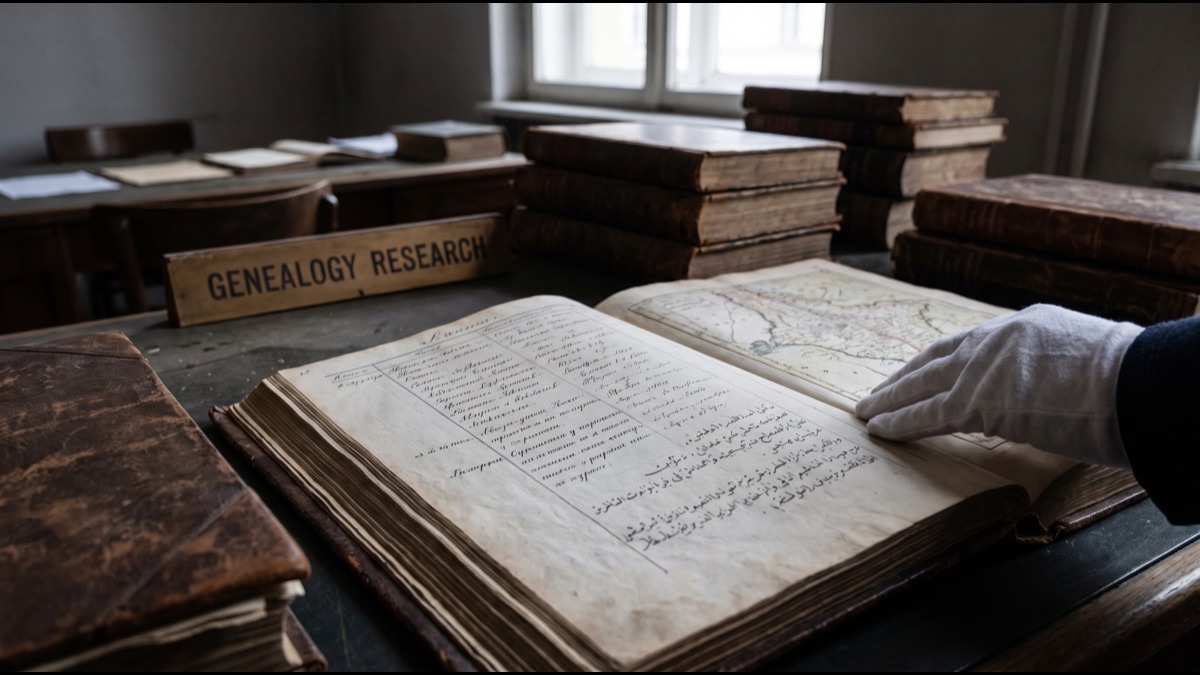
Surnames feel like one of the most permanent things about a person's identity, yet across most of the world they are a surprisingly recent invention. For the majority of human history, a single given name was entirely sufficient, because most people lived and died within small communities where nobody needed a second identifier to tell two people apart.
What eventually forced the emergence of hereditary family names was not a sudden cultural preference for tidier identity, but a series of very practical pressures: growing towns where multiple people shared the same given name, tax and legal systems that needed to track individuals reliably across a lifetime, and inheritance rules that needed to establish who belonged to which lineage. How each culture solved that problem, and when, produced naming systems that still look strikingly different today.
Why Surnames Are a Newer Invention Than People Assume
In much of medieval Europe, a single name was the norm well into the eleventh and twelfth centuries. A village might have had several men named John, William, or Robert, and disambiguation was handled informally and locally rather than through any fixed, inherited label passed down through a family.
The shift toward fixed surnames tracked urbanization closely. As towns grew and record-keeping expanded, distinguishing "John the miller" from "John, son of Robert" from "John of the hill" became administratively necessary rather than merely socially convenient, and these descriptive tags gradually calcified into names that children began inheriting from their parents regardless of whether the description still applied to them.
How Occupational Surnames Formed in Europe
A large share of common English surnames trace directly to a medieval trade: Smith for blacksmiths, Baker for bakers, Fletcher for arrow-makers, Cooper for barrel-makers, and Mason for stoneworkers. These names originated as literal descriptions of what a specific man did for a living, attached to him personally rather than to his family line.
The freezing of these descriptive tags into inherited surnames happened gradually and unevenly. A son might genuinely follow his father into the same trade, in which case the surname remained descriptively accurate for another generation, but as social mobility increased and sons increasingly took up different work, the name stopped describing the bearer's actual occupation while continuing to be passed down anyway, exactly the same process that produced toponymic surnames describing a family's place of origin long after that family had moved away.
How Patronymic Surnames Formed and Then Froze
A second major surname family across Northern Europe derives from patronymics, meaning a name built from the father's given name plus a suffix meaning "son of." Names like Johnson, Peterson, and Andersson all originated this way, as did the Scottish and Irish "Mac-" and "O'-" prefixes, and Russian patronymic middle names still functioning this way today.
Crucially, in most of these cultures the patronymic eventually froze into a fixed, inherited surname rather than continuing to regenerate every generation. A family named Johnson today is very unlikely to be descended from someone who was literally the son of a man named John within living memory; the name simply stopped updating at some point, usually as governments began requiring fixed, recorded surnames for legal and taxation purposes.
Why Iceland Never Froze Its Patronymic System
Iceland stands out as one of the few places where the patronymic system never froze into fixed hereditary surnames, and it remains fully active today by law. An Icelandic child's surname is typically built from a parent's first name plus "-son" for a son or "-dóttir" for a daughter, meaning siblings in the same family can have entirely different surnames from each other and from both of their parents.
This creates situations that look unusual to outsiders using fixed-surname systems: an Icelandic phone directory is alphabetized by first name rather than surname, since the surname does not reliably group members of the same family together across generations, and Icelandic law actively restricts the adoption of fixed family surnames precisely to preserve this centuries-old naming tradition against creeping standardization.
How the Arabic Nasab Records Lineage Without a Fixed Surname
Traditional Arabic naming historically relied on a nasab, a chain of names using "ibn" or "bin" (son of) and "bint" (daughter of) to trace a person's paternal lineage backward through as many generations as the speaker wished to specify, functioning as a spoken genealogical record rather than a single fixed inherited surname in the modern administrative sense.
A full traditional Arabic name could also include a kunya (a name referencing one's own child, such as "Abu Khalid," father of Khalid), a laqab (an honorific or descriptive epithet), and a nisba (a name indicating tribal, geographic, or professional origin, often ending in "-i"). Modern government identification systems across the Arab world have generally standardized around a fixed family surname for legal purposes, but the nasab structure remains culturally significant and is still commonly used in formal introductions and genealogical contexts.
Why Family Names Come First in China, Korea, and Vietnam
In China, Korea, Vietnam, and Hungary, the family name is traditionally written and spoken before the given name, reflecting a cultural framing in which the lineage or family unit is treated as the primary identity and the individual given name simply specifies a particular member within it, the reverse emphasis of the Western convention.
Chinese surnames are also unusually old and stable compared to most of the world's naming systems, with many tracing back well over two thousand years and a relatively small pool of surnames — historically estimated at only a few hundred in common use — being shared across an enormous population, which is part of why a given name typically carries far more individually distinguishing weight in Chinese naming culture than the surname does.
How Spanish and Portuguese Double Surnames Work
Spain, Portugal, and most of Latin America use a naming convention in which a person carries two surnames from birth, traditionally the father's first surname followed by the mother's first surname, meaning genealogical information from both parental lines is preserved in every generation rather than being erased in favor of a single inherited name.
This structure has a direct practical consequence for marriage: because a person's own surnames never derive from a spouse in the first place, there is no single "maiden name" to give up or "married name" to adopt in the way Western single-surname systems generally expect, and many Spanish-speaking countries have historically restricted or discouraged women from formally changing their legal surname upon marriage at all.
How Colonialism and Slavery Disrupted Naming Systems
Colonial administrations frequently imposed European-style fixed surnames onto populations that previously used entirely different naming conventions, sometimes assigning names arbitrarily during censuses or requiring conversion to Christianity to include the adoption of a European surname, permanently altering naming traditions across large parts of Africa, Asia, and the Americas.
The transatlantic slave trade produced a particularly severe rupture, as enslaved people were frequently stripped of their original names entirely and assigned the surname of an enslaver, a practice whose consequences persist directly in the surname distribution still visible across the descendant population in the Americas today, and which has driven a significant modern interest in genealogical and genetic research aimed at reconstructing severed ancestral lines.
Why Married Women Changing Surnames Is a Relatively Recent Western Norm
The now-familiar Western custom in which a woman adopts her husband's surname upon marriage derives from the English common-law doctrine of coverture, under which a married woman's separate legal identity was historically subsumed into her husband's for most legal purposes, making a shared surname a visible marker of that legal absorption rather than a purely sentimental gesture.
As coverture was dismantled across the nineteenth and twentieth centuries and married women regained independent legal standing, the surname-changing custom persisted as social tradition even after its original legal justification had disappeared entirely, and it remains far from universal worldwide; many countries, including several in continental Europe, either default to each spouse retaining their own surname or place formal restrictions on changing it at all.
How Governments Standardized Surnames for Taxation and Records
A recurring pattern across very different cultures is that fixed, inherited surnames became mandatory largely because a government needed them, not because families organically decided to adopt them. Napoleonic France required permanent registered surnames in the early nineteenth century partly to make conscription and taxation administratively tractable, and the Ottoman Empire's successor states, including Turkey under the 1934 Surname Law, mandated fixed hereditary surnames for broadly similar bureaucratic reasons.
This pattern repeats across the world wherever a modern centralized state has needed to reliably identify, tax, and conscript individuals across their entire lifetime and across generations: the emergence of the fixed surname is, in a very real sense, as much a story about state capacity and administrative record-keeping as it is a story about family identity.
What Surnames Reveal to Genealogists Today
Because surnames encode information about historical occupation, geography, paternal lineage, or the administrative moment at which a naming system froze, genealogists and historical linguists can extract real information from surname distribution and etymology, tracing migration patterns and even estimating the regional origin of a family line from surname clustering data.
Modern consumer DNA testing has added a genetic layer to this analysis, occasionally revealing that a family's oral surname history does not match its genetic ancestry, a discrepancy which itself is informative, since it can reveal historical adoption, an unrecorded change of surname, or a paternity event that was never part of the family's remembered history, underscoring that a surname has always been a social and administrative label first, and a strictly biological record only as a byproduct.
Why Noble Particles Like "Von" and "De" Signaled Status
Across much of Europe, a small linking word attached to a surname historically functioned as a visible marker of noble or landed status rather than as a purely grammatical connector. The German "von," the French "de," the Dutch "van," and the Spanish "de" all originally indicated that a family held land at the place named, so "von Habsburg" identified a person as being of the Habsburg estate specifically, not merely someone who happened to share that surname.
Because these particles carried genuine social weight, some later republics actively legislated against them. Austria abolished hereditary titles and their associated "von" particles by law after the First World War, and similar reforms occurred elsewhere in Europe as monarchies gave way to republican governments that saw inherited noble markers as incompatible with formal legal equality, even though the underlying surnames themselves generally survived the reform.
Why the Ellis Island Name-Change Story Is Mostly a Myth
A widely repeated story holds that immigration officials at Ellis Island routinely altered arriving immigrants' surnames, simplifying or anglicizing names that clerks found difficult to spell or pronounce. Historians who have examined the actual records have found this account to be largely a myth: Ellis Island inspectors worked from ship manifests prepared before departure, and had little practical incentive or opportunity to unilaterally rewrite a name during processing.
Genuine name changes did happen extremely often among immigrant families, but the evidence suggests immigrants themselves usually initiated the change afterward, often to sound less foreign in daily life, to ease pronunciation for employers and neighbors, or simply to distance themselves from an old-world identity while building a new one, rather than having a spelling imposed on them at the port of entry itself.
Understanding how differently these systems evolved is a useful corrective against treating any single naming convention as the natural or default one. The instinct to arrange a name as given-name-then-surname, to inherit a father's fixed surname unchanged across generations, or to expect a married woman to take her husband's name are all specific historical outcomes of specific pressures in specific places, not universal facts about how human identity has always worked.
Every naming system in use today, from Icelandic patronymics that refresh each generation to Chinese surnames that have persisted for millennia to Spanish double surnames that preserve both parental lines, represents a workable solution its culture arrived at for the same underlying problem: how to identify one person reliably among many, across a lifetime, and often across generations that a government, a family, or a genealogist still needs to be able to trace.
None of these solutions is more "natural" than another; each simply reflects the specific mix of family structure, state power, religious practice, and social hierarchy that shaped it. A traveler moving between an Icelandic patronymic system, a Chinese lineage-first convention, an Arabic nasab, and a Spanish double-surname household is not moving from a correct system to increasingly exotic variants, but between four equally coherent answers to the same very old human problem of telling one family, and one person within it, apart from all the others.
Sources
- Wikipedia — overview of surname systems and their historical development worldwide
- Encyclopaedia Britannica — historical background on naming conventions and patronymic systems
- Library of Congress — genealogical and historical naming records
- Smithsonian Institution — anthropological context on naming and identity across cultures
FAQ
When did most people in Europe get surnames?
Surnames spread across most of Europe roughly between the twelfth and sixteenth centuries, though the timing varied enormously by region and social class, with nobility adopting them first.
Why do some countries put the surname before the given name?
In China, Korea, Vietnam, and Hungary, the family name traditionally comes first because the family or lineage is treated as the primary unit of identity, with the individual name specifying a person within it.
Does Iceland really not use fixed family surnames?
Correct — most Icelanders use a patronymic or matronymic system where a child's surname is built from a parent's first name plus -son or -dóttir, so surnames change every generation rather than passing down fixed.
What does the Arabic nasab actually record?
A nasab is a chain of ibn or bint (son of, daughter of) names tracing a person's paternal lineage, historically functioning as a genealogical record rather than a single fixed family surname.
Why do some married women keep two surnames in Spanish-speaking countries?
Spanish and many Latin American naming systems give each person two surnames from birth, one from each parent, so there is no single inherited family name to change or keep upon marriage.
About the Author
We reference Wikipedia, Encyclopaedia Britannica, the Library of Congress, and the Smithsonian Institution to explain the background and current understanding of this topic.
Loved This Article?
Share it on WhatsApp → Share it on WhatsApp
Get more guides in your inbox — Subscribe to our newsletter for weekly surprising stories from Egypt, Saudi Arabia, Dubai, and beyond.