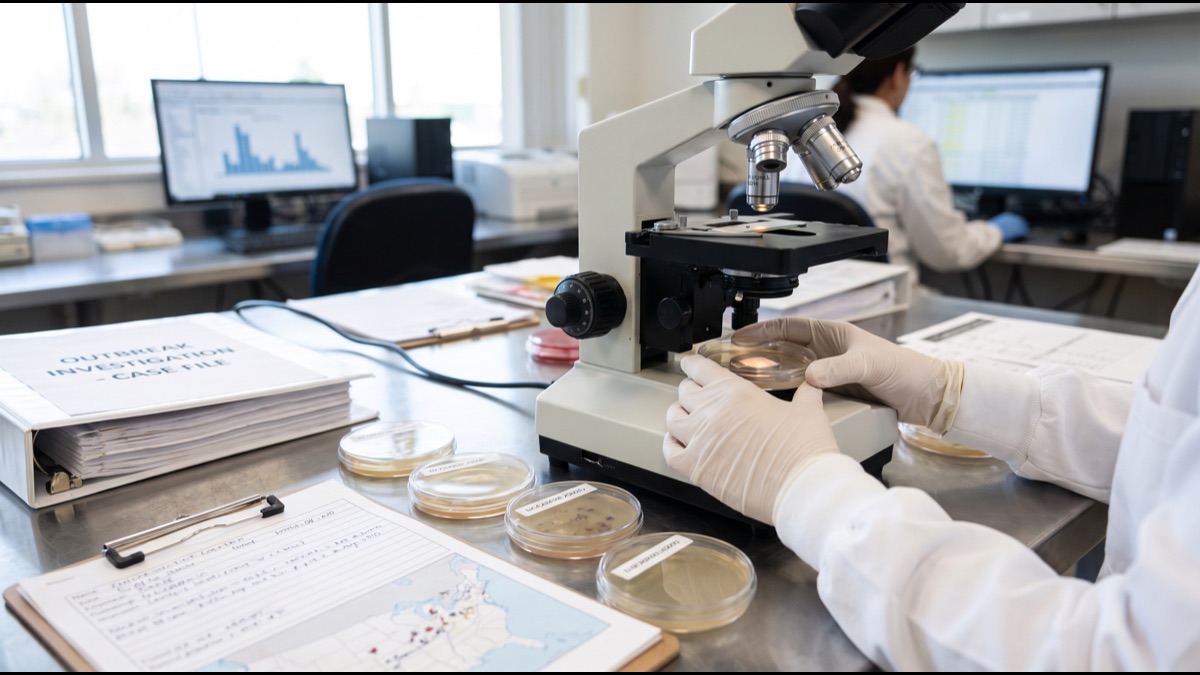
When dozens of people scattered across several states or cities start showing up in emergency rooms within days of each other with the same unusual combination of symptoms, nobody starts by assuming they ate the same thing. That connection has to be built piece by piece, through a process that looks far more like methodical detective work than the instant lab-confirmed verdict most people imagine when they hear a food has been recalled.
Tracing a foodborne outbreak back to its actual source is one of the more quietly impressive routines in public health, combining laboratory science, statistics, and old-fashioned interviewing to answer a question that sounds simple but rarely is: what did all of these unrelated people actually eat in common.
Why a Cluster of Illnesses Is Not Automatically an Outbreak
Health departments receive a constant, low-level background hum of individual foodborne illness reports every week of the year, the great majority of which are never connected to anything beyond the person who happened to get sick. Distinguishing a genuine outbreak from this ordinary noise is the first and, in some ways, hardest step of the entire process.
Investigators look for cases that cluster in a way normal background illness would not, whether that is an unusual spike in a specific pathogen within a short window, an unexpected geographic pattern, or a strain of bacteria that laboratory testing shows to be genetically identical across multiple unrelated patients.
A handful of cases sharing a surname or a household is expected and uninteresting. A handful of cases sharing a genetic fingerprint despite living in different cities and having no contact with each other is the kind of signal that pulls an outbreak investigation into motion.
How the First Signal Actually Reaches Investigators
The earliest signal rarely comes from a single dramatic event. It usually comes from routine laboratory reporting, where clinical labs that test a sick patient's stool sample are required to report certain confirmed pathogens, such as salmonella or E. coli, to local or national health authorities as a matter of course.
Those individual reports accumulate in a shared surveillance system, and it is the pattern across many separate reports, not any single case, that first draws an epidemiologist's attention. A slightly elevated count of a particular strain in a particular week is often the entire starting point.
Increasingly, this detection also happens through genomic surveillance systems that automatically flag when the DNA sequence of a pathogen isolated from one patient closely matches sequences isolated from patients in an entirely different part of the country, sometimes before anyone has consciously noticed a cluster at all.
Why Every Sick Person Gets the Same Detailed Interview
Once a possible cluster is identified, investigators begin interviewing the confirmed patients using a long, highly structured questionnaire that asks about dozens of specific foods eaten in the days before symptoms began, not just a general question about what they had for dinner.
These interviews are demanding because human memory for routine meals is genuinely unreliable across a window of a week or more, and patients frequently cannot recall every ingredient in a restaurant dish or every item picked up during a routine grocery trip, which is precisely why the questionnaire prompts for dozens of specific categories rather than relying on open recall.
The value of any single interview is limited, but the value of dozens of interviews compared against each other is considerable, because a food item that keeps appearing across unrelated patients far more often than ordinary consumption patterns would predict starts to stand out statistically from the surrounding noise.
Investigators also account for the incubation period of the specific pathogen involved, since different bacteria and viruses take different amounts of time to produce symptoms after exposure, and interviewers deliberately narrow their questions to the specific window in which the confirmed pathogen is known to typically incubate rather than asking generally about the past month.
Shopping receipts, loyalty-card purchase histories, and photographs of a patient's own refrigerator contents are increasingly used to supplement memory-based recall, since these records can confirm a specific purchase date and product far more reliably than a patient's own recollection of a meal eaten a week or more earlier.
Interview fatigue is a genuine practical constraint as well: patients who are still recovering from a serious illness are not always able to sit through a lengthy structured questionnaire immediately, so investigators sometimes conduct interviews in stages or rely on a caregiver to help reconstruct a timeline the patient cannot recall clearly.
Cluster interviews are also compared against baseline dietary survey data collected from the general population, so investigators can judge whether a food's appearance among sick patients is genuinely unusual or simply reflects how common that food already is in everyone's regular diet.
Where a community has an unusually narrow or distinctive local diet, this baseline comparison becomes especially valuable, since a food that would look unremarkable in one region's ordinary eating patterns might stand out sharply against another region's typical grocery basket.
How a Genetic Fingerprint Links Cases Nobody Thought Were Connected
The single biggest advance in modern outbreak detection has been the routine use of whole genome sequencing on the pathogen isolated from each patient's sample, which produces something close to a genetic fingerprint rather than just identifying the general species of bacteria involved.
Two patients infected with ordinary salmonella from entirely unrelated sources will typically carry meaningfully different genetic strains, while two patients infected from the same contaminated batch of food will typically carry strains that are extremely close or identical, even if those two patients live hundreds of kilometres apart and have never met.
This genomic matching is what allows investigators to confidently treat a case in one city and a case in another as part of the same outbreak, transforming what would otherwise look like two coincidental, unrelated illnesses into a single connected investigation worth pursuing seriously.
What a Case-Control Study Actually Proves
Interviews alone cannot prove that a food caused an outbreak, because almost any common food will show up in the diet history of some sick people simply by chance. Investigators address this by comparing what sick patients ate against what a matched group of healthy people, who were not part of the outbreak, ate over the same period.
If a particular item, such as a specific brand of packaged salad, appears dramatically more often among the sick group than among the healthy comparison group, that statistical gap is what actually elevates a food from a vague possibility to a genuine suspect worth pursuing with regulatory action.
This case-control method is the same basic statistical logic used across much of epidemiology, and it is deliberately conservative, generally requiring a fairly strong and consistent signal before investigators are willing to publicly name a specific food or brand.
Why the Suspect Food Is Often Named Before It Is Proven
Public health agencies frequently issue a warning naming a suspect food, such as a variety of melon or a type of leafy green, well before laboratory testing has confirmed the exact pathogen on an actual sample of that product still sitting on a shelf or in a warehouse.
This can look premature from the outside, but it reflects a genuine tension in outbreak response: waiting for absolute laboratory certainty before warning the public means more people continue eating a genuinely contaminated product in the meantime, so agencies generally act once the statistical and traceback evidence together clears a fairly high threshold of confidence.
Later laboratory confirmation on an intact product sample, when investigators manage to obtain one before it is all sold or consumed, provides the strongest possible evidence, but outbreaks are frequently resolved and recalls completed using epidemiological evidence alone, because the contaminated batch has often already left store shelves by the time testing would otherwise conclude.
How Traceback Investigators Follow a Product Backward Through the Supply Chain
Once a food is strongly suspected, a separate team works the problem from the opposite direction, starting with receipts, loyalty-card records, and purchase histories from sick patients and working backward through distributors, packers, and processing facilities toward a common point of origin.
Modern packaged food carries lot codes and shipping records that, in principle, allow investigators to trace a specific bag or box back to the exact facility and even the specific day it was processed, though in practice these records are often incomplete, inconsistently kept, or scattered across multiple companies that do not share data automatically.
When traceback succeeds, it can reveal that products sold under several completely different retail brand names were actually packed from the same underlying batch of raw ingredient at a single supplier, which is why a single contamination event can trigger recalls that appear, to a shopper, to involve unrelated products.
Why Fresh Produce Shows Up So Often in Outbreak Lists
Leafy greens, melons, and other fresh produce feature disproportionately often in foodborne outbreak investigations for a combination of structural reasons rather than because these foods are inherently more dangerous than any other category.
Produce is typically eaten raw, with no cooking step available to kill any pathogen that made it onto the food before purchase, unlike meat or poultry where a properly followed cooking instruction can eliminate most bacterial contamination even if it was present.
Produce also passes through an unusually complex supply chain involving field irrigation water, soil, animal intrusion near growing areas, and multiple points of manual handling during harvest and packing, any one of which can introduce contamination that then rides along with the product all the way to a consumer's kitchen.
What Actually Happens Inside a Processing Plant Once It Is Named
When traceback investigation points to a specific facility, regulatory inspectors typically arrive to conduct an on-site environmental assessment, swabbing drains, equipment surfaces, and water sources throughout the plant in an attempt to find the pathogen actually present in the physical environment rather than relying solely on the epidemiological evidence.
Finding the exact matching genetic strain somewhere inside the facility, such as in a floor drain near a packing line, provides very strong confirmation, though its absence does not necessarily clear the facility, since a genuine contamination event from weeks earlier can leave no detectable trace by the time inspectors arrive to sample.
Inspectors also review the facility's own internal testing records, water treatment logs, and employee illness policies, since a plant's failure to follow its own documented food-safety procedures is often what regulators identify as the underlying cause once an investigation is complete.
Why a Recall Does Not Always Mean the Danger Is Over
A recall notice typically covers products with specific lot numbers and date ranges tied to the period investigators believe was affected, but products already purchased and sitting in a consumer's refrigerator or freezer before the recall was announced are not automatically removed from anyone's kitchen by the notice itself.
Because recalls depend heavily on public awareness to be effective, health agencies frequently continue seeing new illness reports for weeks after a recall is announced, simply because not everyone who purchased an affected product saw the news or checked their own pantry against the recalled lot numbers.
An outbreak is generally not declared over until the rate of new confirmed cases with the matching genetic fingerprint has dropped back down to the ordinary background level for a sustained period, rather than at the moment the recall notice itself is issued.
How International Outbreaks Get Coordinated Across Borders
Food supply chains routinely cross national borders, meaning an outbreak traced to a specific growing region or processing facility in one country can simultaneously affect consumers in several others who received products from the same source through international trade.
International bodies maintain shared reporting mechanisms specifically so that a genomic match identified in one country's laboratory can be compared against cases reported by another country's health authority, allowing what would otherwise look like two unrelated national outbreaks to be recognised as a single international event.
This cross-border coordination is considerably harder than domestic tracing, since different countries maintain different testing capacity, different reporting timelines, and different willingness to share commercially sensitive supply-chain information with foreign regulators during an active investigation.
What Closes an Outbreak Investigation
Outbreak investigations do not end with a single dramatic announcement but rather wind down gradually as new case reports slow to the background rate, the suspected product is fully cleared from the market, and the traceback team either confirms or fails to confirm an exact point of contamination.
A meaningful share of outbreaks are formally closed without ever identifying the single definitive point of contamination, particularly when the contaminated product has a short shelf life and is entirely gone from the supply chain by the time investigators reach the relevant facility, leaving strong circumstantial evidence but no final physical confirmation.
What makes the entire system work despite these persistent gaps is that each investigation, whether fully solved or not, adds to a growing body of genomic and supply-chain data that makes the next outbreak, however unrelated it might first appear, somewhat faster to recognise and trace.
Sources
- U.S. Centers for Disease Control and Prevention — foodborne outbreak surveillance and investigation methodology
- World Health Organization — global foodborne disease burden and outbreak response guidance
- U.S. Food and Drug Administration — traceback investigations and product recalls
- Wikipedia — overview of foodborne illness and outbreak epidemiology
- European Food Safety Authority — foodborne disease monitoring across EU member states
FAQ
How do investigators know a group of illnesses is actually one outbreak?
Laboratories compare the genetic fingerprint of the pathogen isolated from each sick person; if the strains match closely enough, the cases are treated as connected even if the patients never met.
Why do outbreak investigations sometimes take weeks to name a food?
Patients often cannot recall everything they ate days earlier, and a food only becomes a suspect once enough interviews statistically point to it more often than chance would explain.
Does a recall mean the source has been proven with certainty?
Not always — regulators can issue a recall based on strong statistical association and supply-chain tracing even before a laboratory confirms the pathogen on the actual product.
Why does the same pathogen sometimes trace back to unrelated products?
A single contaminated ingredient, like diced onions or a specific irrigation source, can be distributed into many different finished products carrying different brand names.
Why do outbreaks tied to fresh produce seem to happen so often?
Produce is generally eaten raw with no cooking step to kill pathogens, and it passes through complex supply chains with many points where contamination from soil, water, or handling can occur.
About the Author
We reference the U.S. Centers for Disease Control and Prevention, World Health Organization, U.S. Food and Drug Administration, Wikipedia, and European Food Safety Authority to explain the background and current understanding of this topic.
Loved This Article?
Share it on WhatsApp → Share it on WhatsApp
Get more guides in your inbox — Subscribe to our newsletter for weekly surprising stories from Egypt, Saudi Arabia, Dubai, and beyond.