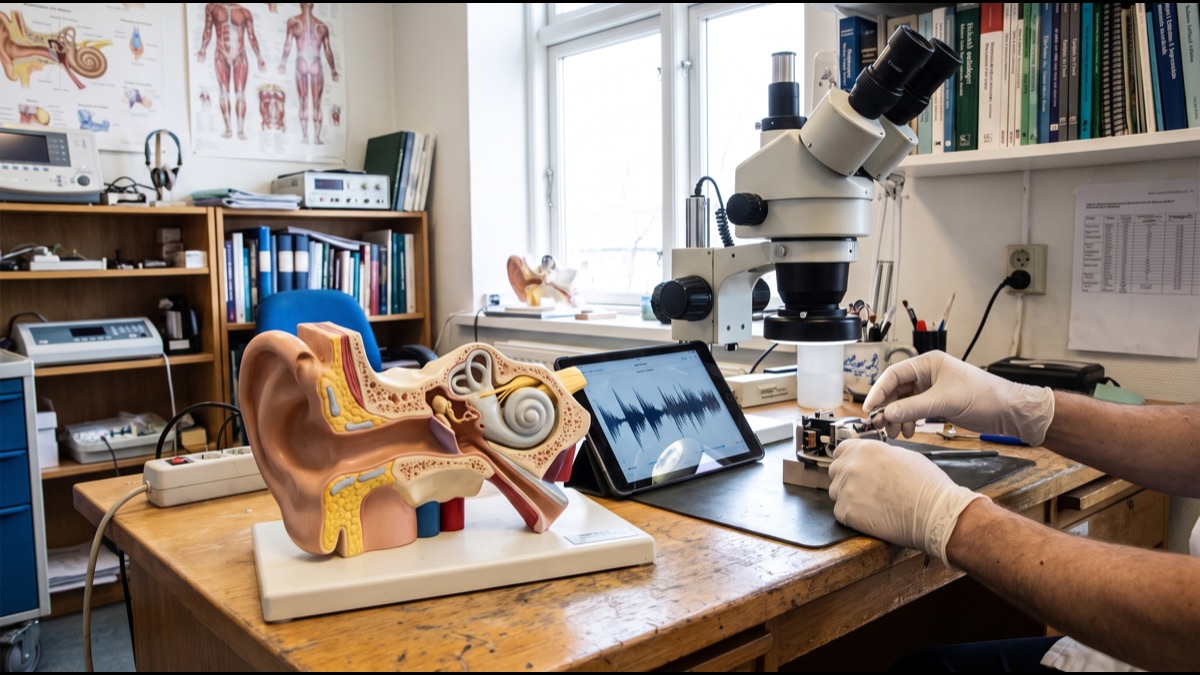
The cells that convert sound into nerve signals do not regenerate in humans, which is the single fact that makes hearing loss different from most other injuries. Damage accumulates permanently, and by the time someone notices difficulty in conversation, a substantial proportion of those cells are typically already gone.
The loss also begins in frequencies that carry relatively little of everyday speech, which is why it goes unnoticed for years. Understanding the actual mechanism explains why volume is not the only thing that matters, why hearing aids are a poor analogy to glasses, and why most noise damage is entirely preventable while none of it is reversible.
How Sound Becomes a Nerve Signal
Sound arrives as pressure waves that vibrate the eardrum, which transmits motion through three small bones in the middle ear to a fluid-filled structure called the cochlea.
Inside the cochlea, vibration travels along a flexible membrane, and because that membrane varies in stiffness along its length, different frequencies produce peak movement at different positions.
Cells sitting along the membrane detect this motion and convert it into electrical signals, which means position along the cochlea encodes frequency before any processing occurs in the brain.
What Hair Cells Actually Do
The sensory cells are named for the bundles of tiny projections on their surface, which bend when the surrounding fluid moves, opening channels that generate an electrical response.
There are two types with distinct roles, with one transmitting information to the brain and the other actively amplifying quiet sounds by physically changing shape in response to vibration.
This active amplification is why healthy hearing has such an enormous dynamic range, and its loss is a substantial part of why damaged hearing struggles disproportionately with quiet sounds.
Why They Do Not Grow Back
Humans are born with a fixed number of these cells, and unlike skin or liver tissue, they are not replaced when destroyed, which makes every loss cumulative across a lifetime.
Birds and fish regenerate them routinely, which has made the mechanism a major research target, since understanding why mammals lost this capacity might allow it to be restored.
Several experimental approaches aim to trigger regeneration, and some have shown effect in animals, but nothing has yet translated into a treatment that restores human hearing.
How Loud Noise Causes Damage
Excessive sound damages these cells mechanically, with extremely loud exposure physically breaking the delicate structures that detect motion.
More common is metabolic damage, where sustained overstimulation exhausts the cells and generates reactive molecules that injure them from within over hours after exposure ends.
This delayed component is why damage continues after leaving a loud environment, and it is also why some experimental protective treatments target the period immediately following exposure rather than the exposure itself.
Why Duration Matters as Much as Volume
Damage depends on total sound energy received, which combines intensity and time, so a moderately loud sound over hours can cause harm comparable to a very loud sound briefly.
Because sound intensity is measured on a logarithmic scale, each small increase in the number represents a large increase in actual energy, meaning safe exposure time falls sharply as volume rises.
Occupational guidelines encode this by halving permitted exposure time for each fixed increase in level, which is why a sound safe for eight hours may be unsafe within minutes when louder.
What Temporary Threshold Shift Reveals
After a loud event, hearing is often measurably worse for hours before apparently recovering, a phenomenon long treated as harmless because thresholds return to normal.
Research has since found that recovery of thresholds does not necessarily indicate full recovery, since the connections between hair cells and nerve fibres can be permanently lost even when the cells survive.
This hidden damage does not appear on standard hearing tests, which is why people can have genuine difficulty understanding speech in noise while being told their hearing is normal.
Why High Frequencies Go First
Damage typically appears first in the region of the cochlea responding to high frequencies, which sits nearest the entrance and receives the full energy of incoming vibration.
Because most vowel energy in speech is low frequency, early loss does not make speech quieter, and people frequently report that they can hear but cannot understand.
The consonants that distinguish similar words are high frequency and relatively quiet, which is exactly the combination early damage removes, producing confusion rather than reduced volume.
Why It Goes Unnoticed for Years
Because the loss is gradual and affects frequencies that carry less obvious information, the brain compensates by using context to fill gaps without conscious awareness.
Difficulty usually surfaces first in noisy environments, where context is less reliable and the missing information cannot be reconstructed, which is why restaurants become the common complaint.
The typical delay between onset and seeking help spans several years, during which further damage accumulates and the brain's speech processing adapts to degraded input.
How Age-Related Loss Differs
Hearing declines with age in nearly everyone, though the extent to which this is intrinsic ageing rather than accumulated noise exposure remains genuinely difficult to separate.
Studies of populations with low lifetime noise exposure have found considerably less age-related decline than in industrialised societies, suggesting much of what is attributed to ageing is cumulative damage.
Genuine ageing effects do exist, including changes to blood supply and to the nerve fibres themselves, but the practical implication is that much apparently inevitable decline is partly preventable.
What Conductive Loss Is
A separate category of hearing loss involves sound failing to reach the cochlea efficiently, due to blockage, fluid, eardrum damage, or problems with the middle ear bones.
This type is frequently treatable, whether by removing an obstruction, resolving an infection, or surgically repairing or replacing the affected structures.
The distinction matters because conductive loss makes sound quieter without distorting it, so amplification restores hearing far more completely than it does for sensory damage.
Why Hearing Aids Are Not Like Glasses
Glasses correct an optical error precisely, restoring focus, whereas hearing aids amplify sound into a system whose sensory cells are damaged and cannot be repaired by louder input.
Because damaged hearing loses the active amplification that gave healthy ears their dynamic range, quiet sounds need much more boost than loud ones, requiring complex frequency-specific processing rather than simple volume.
Even well-fitted aids cannot restore the ability to separate speech from background noise, which depends on neural processing that amplification does not repair, and this is the most common source of disappointment.
How Modern Hearing Aids Actually Work
Contemporary devices split incoming sound into frequency bands and apply different amounts of amplification to each, shaped to the specific pattern of an individual's loss.
They compress the dynamic range, boosting quiet sounds substantially while amplifying loud ones little, so that the full range of everyday sound fits within the reduced range the damaged ear can use.
Directional microphones and noise reduction algorithms attempt to improve speech in noise, which helps meaningfully but does not approach the performance of undamaged hearing.
Why Delay Makes Aids Less Effective
Prolonged deprivation of sound input changes how the brain processes speech, and these changes do not immediately reverse when amplification is finally provided.
This is a substantial reason for encouraging earlier intervention, since outcomes are generally better when aids are fitted before extensive adaptation to degraded input has occurred.
New users typically require a period of adjustment during which amplified sound feels unnatural, and abandonment during this period is common enough to be a recognised clinical problem.
What Cochlear Implants Do Differently
When too few hair cells survive for amplification to help, an implant bypasses them entirely, stimulating the auditory nerve directly with electrical signals from an electrode array.
The signal is far coarser than natural hearing, using a limited number of channels compared to the thousands of positions along a healthy cochlea, which is why music frequently sounds poor to recipients.
Despite this crudeness, most recipients achieve good speech understanding, because the brain adapts remarkably well to the degraded but consistent signal over months of use.
Why Early Intervention Matters for Children
Language acquisition depends on auditory input during early development, and prolonged deprivation during this period has effects that later intervention cannot fully undo.
Newborn hearing screening was introduced specifically to identify loss within weeks rather than years, since the difference in language outcomes between early and late identification is substantial.
This is also why cochlear implantation is performed in very young children, where the developing brain adapts to the artificial signal far more readily than a mature one does.
How Personal Audio Changed Exposure
Listening through headphones for extended periods has become widespread, and surveys consistently find a substantial proportion of users choose levels that would be restricted in workplaces.
The risk is not primarily from occasional loud listening but from sustained daily exposure, since damage depends on total accumulated energy rather than peak level alone.
Noise-cancelling headphones genuinely help by removing the background noise that drives people to raise volume, which makes them a protective technology rather than merely a comfort feature.
Why Some People Are More Vulnerable
Susceptibility to noise damage varies considerably between individuals given identical exposure, and a meaningful portion of this variation appears to be genetic.
Certain medications are also toxic to these cells, including some antibiotics and chemotherapy drugs, which is why hearing is monitored during treatment where alternatives are unavailable.
Combined exposures interact, so noise alongside certain drugs or solvents produces more damage than either alone, which occupational guidelines have historically underweighted.
How the Ear Protects Itself and Why It Fails
A small muscle in the middle ear contracts reflexively in response to loud sound, stiffening the chain of bones and reducing how much energy reaches the cochlea.
This reflex takes tens of milliseconds to engage, which means it offers no protection at all against sudden impulses such as gunfire or fireworks, the exposures most likely to cause immediate damage.
It also fatigues during sustained noise, so the natural defence is weakest precisely in the two situations that matter most, which is why external protection is not optional.
Why Sudden Hearing Loss Is an Emergency
A rapid loss of hearing in one ear over hours or days is a recognised medical emergency, though it is frequently mistaken for wax or congestion and left untreated.
Prompt treatment with steroids improves the chance of recovery substantially, and the benefit falls sharply with delay, making the first days genuinely decisive.
The cause is often never identified, but the practical rule is unambiguous: unexplained sudden loss warrants same-week assessment rather than waiting to see whether it resolves.
What Tinnitus Indicates
Persistent ringing frequently accompanies noise damage and is generally understood as the brain generating activity in response to missing input rather than a sound produced in the ear.
The pitch typically corresponds to the frequency region where hearing is most damaged, which supports the interpretation that it reflects compensation for absent signal.
Because it can appear before measurable threshold changes, it sometimes functions as an early warning that exposure is causing harm not yet visible on a standard test.
How Hearing Is Actually Tested
Standard testing presents tones at various frequencies and reduces volume to find the quietest level detectable, producing a chart of thresholds across the frequency range.
This measures sensitivity but not clarity, which is why speech-in-noise testing has become increasingly emphasised, since it reflects the difficulty people actually report.
Testing also distinguishes conductive from sensory loss by comparing sound conducted through the air with sound delivered through the skull, which bypasses the outer and middle ear.
Why Untreated Loss Has Broader Effects
Hearing loss is associated with social withdrawal, since effortful listening is exhausting and conversation in groups becomes difficult enough that people gradually avoid it.
Large studies have found associations between untreated hearing loss and cognitive decline, though whether the relationship is causal remains actively debated among researchers.
Proposed explanations include the cognitive load of continuous effortful listening, reduced social engagement, and the possibility that both reflect a shared underlying process.
What Over-the-Counter Availability Changed
Regulatory changes in several countries have permitted hearing aids to be sold directly for mild to moderate loss, removing the requirement for a professional fitting.
This substantially reduced cost, which had been a major barrier given that devices were frequently not covered by health insurance despite the impairment being widespread.
The tradeoff is that self-fitting produces worse results for many users, since matching amplification to an individual loss pattern is genuinely difficult without measurement.
Why Prevention Is the Only Real Cure
Since damaged cells do not regenerate, no treatment restores natural hearing, and every intervention available works around the loss rather than repairing it.
This makes noise-induced hearing loss unusual among common conditions in being almost entirely preventable while being entirely irreversible once it occurs.
Protection is straightforward and effective, with properly fitted earplugs reducing exposure enough to prevent damage in most recreational and many occupational settings.
How to Judge Whether Something Is Too Loud
A practical rule is that if speech at arm's length must be raised to be understood, the environment is loud enough that extended exposure carries risk.
Ringing or muffled hearing after an event indicates that damage has occurred, and repeated episodes accumulate even when hearing appears to return to normal each time.
Sound level meters are now available as phone applications, which are imprecise but sufficient to distinguish clearly safe environments from clearly hazardous ones.
What Research May Eventually Deliver
Regenerative approaches aim to restore hair cells by manipulating the developmental signals that prevent mammals from replacing them, and have produced partial success in animal studies.
Protective compounds given before or immediately after loud exposure aim to interrupt the delayed metabolic damage, which is a more tractable target than regeneration.
Neither has produced an approved treatment, which means that for the present the practical situation is unchanged: prevention works and repair does not exist.
What This Means Practically
Hearing loss is cumulative, largely painless, and initially affects the frequencies that make speech intelligible rather than the ones that make it audible.
The gap between onset and recognition typically spans years, during which the damage worsens and the brain adapts in ways that make later intervention less effective.
The two actions that genuinely matter are protecting hearing before damage occurs and addressing loss promptly once it does, since neither the cells nor the intervening years can be recovered.
The defining fact about hearing loss is that the sensory cells do not regenerate in humans. Birds and fish replace them routinely; we do not. Every episode of damage is therefore permanent and cumulative, which makes noise-induced loss unusual among common conditions — almost entirely preventable, and entirely irreversible once it happens. It also hides. Damage starts in the high frequencies, which carry the consonants that distinguish similar words rather than the vowel energy that makes speech loud. So people hear but cannot understand, first in noisy rooms where context stops filling the gaps. The typical delay before seeking help runs to several years, and connections between hair cells and nerve fibres can be lost without any change appearing on a standard hearing test. This is also why hearing aids disappoint people who expect them to work like glasses. Glasses correct an optical error precisely; aids amplify sound into a system whose sensors are damaged. They can restore audibility but not the neural processing that separates a voice from background noise. Since nothing available repairs the underlying loss, the two things that genuinely change outcomes are protecting hearing beforehand and acting promptly afterward — because neither the cells nor the intervening years come back.
Sources
- Wikipedia — overview of types, mechanisms, and treatment of hearing loss
- World Health Organization — global hearing loss prevalence and prevention guidance
- National Institute on Deafness and Other Communication Disorders — research on cochlear function and noise-induced damage
- US Centers for Disease Control and Prevention — occupational noise exposure limits and hearing conservation
- Nature — research on hair cell regeneration and hidden hearing loss
FAQ
Can damaged hearing recover on its own?
No. The sensory cells in the cochlea do not regenerate in humans, so damage is permanent and accumulates over a lifetime. Apparent recovery after loud exposure can mask lasting nerve damage.
Why can I hear people but not understand them?
Damage starts in high frequencies, which carry the consonants distinguishing similar words. Vowels are low frequency and stay loud, so speech sounds audible but unclear.
Are hearing aids like glasses for the ears?
Not really. Glasses correct an optical error precisely; aids amplify sound into a damaged system. They restore audibility but not the neural processing that separates speech from noise.
Is age-related hearing loss inevitable?
Partly. Populations with low lifetime noise exposure show considerably less decline, suggesting much of what is attributed to ageing is actually accumulated noise damage.
Do noise-cancelling headphones protect hearing?
Indirectly but genuinely — by removing background noise they reduce the impulse to raise volume, and sustained high-volume listening is the main risk from personal audio.
About the Author
We reference Wikipedia, World Health Organization, National Institute on Deafness and Other Communication Disorders, US Centers for Disease Control and Prevention, and Nature to explain the background and current understanding of this topic.
Loved This Article?
Share it on WhatsApp → Share it on WhatsApp
Get more guides in your inbox — Subscribe to our newsletter for weekly surprising stories from Egypt, Saudi Arabia, Dubai, and beyond.