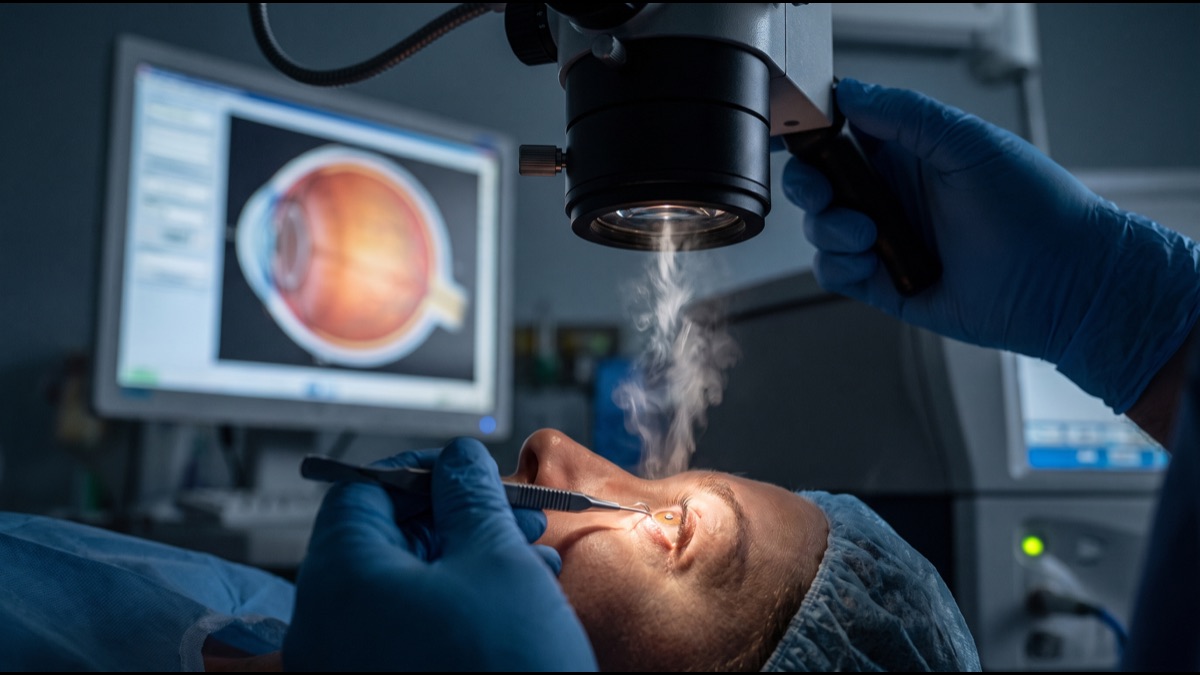
Laser vision correction has become common enough that most people know someone who has had it, yet the actual mechanism remains widely misunderstood. A frequent assumption is that the laser somehow strengthens or repairs the eye, when in reality the procedure does something considerably more mechanical: it removes a precisely calculated amount of tissue to change the shape of the surface light passes through on its way in.
Understanding that distinction clarifies a great deal, including why the procedure has hard limits, why not everyone is a suitable candidate, why it does not prevent the age-related changes that eventually send most people back to reading glasses, and why the various procedure names describe genuinely different approaches to the same underlying optical problem rather than competing brand names for one thing.
Why Vision Blurs in the First Place
Clear vision requires light entering the eye to be focused precisely onto the retina at the back, and this focusing is performed by two structures working together: the cornea, the transparent dome at the front, and the lens sitting behind the pupil.
The cornea does considerably more of this work than most people assume, providing roughly two thirds of the eye's total focusing power, with the lens contributing the remainder and providing the adjustable component that allows focus to shift between near and distant objects.
Refractive error occurs when the combination of corneal shape, lens power, and the physical length of the eyeball fails to place the focal point exactly on the retina, producing an image that is focused either in front of or behind the surface meant to receive it.
What Short and Long Sight Actually Are
In short sight, light is focused in front of the retina rather than on it, most commonly because the eyeball is slightly longer than the focusing system was calibrated for, meaning distant objects blur while near ones remain clear.
In long sight, the opposite geometry applies, with the focal point falling behind the retina, typically because the eyeball is comparatively short, which affects near vision most noticeably though it can affect distance vision as well depending on severity.
Astigmatism is a genuinely different problem, arising when the cornea is shaped more like a rugby ball than a sphere, meaning it focuses light differently along different axes and produces blur at all distances rather than at one particular range.
How Reshaping the Cornea Fixes This
Because the cornea contributes most of the eye's focusing power, altering its curvature changes where light converges, which means a refractive error can be corrected by changing the corneal shape rather than by placing a lens in front of the eye.
Correcting short sight requires flattening the central cornea, reducing its focusing power so the focal point moves backward onto the retina, while correcting long sight requires steepening the central cornea to move the focal point forward.
Astigmatism is corrected by removing tissue unevenly across different axes to produce a more uniformly curved surface, which is why modern treatment planning maps the cornea in considerable detail rather than working from a single prescription figure.
What the Laser Actually Does to Tissue
The laser used in these procedures operates in the ultraviolet range and works through a process that breaks the molecular bonds holding tissue together rather than by burning or cutting, allowing extremely precise removal with minimal heat damage to surrounding tissue.
Each pulse removes an extraordinarily thin layer, measured in fractions of a micrometre, which is what permits the shaping to be controlled precisely enough to produce optical surfaces accurate to a standard that mechanical cutting could not approach.
The pattern of pulses is calculated in advance from detailed measurements of the individual eye, and modern systems track eye movement continuously during treatment, adjusting delivery in real time so the pattern remains correctly positioned despite small involuntary movements.
How the Main Procedures Differ
The best-known procedure involves creating a thin hinged flap in the surface of the cornea, folding it aside, applying the laser to the tissue beneath, then repositioning the flap, which adheres without stitches and allows unusually rapid visual recovery.
Surface procedures instead remove the outermost corneal layer entirely, apply the laser directly to the surface beneath, and allow that layer to regenerate over subsequent days, which avoids creating a flap but involves considerably more discomfort and slower recovery.
A newer approach uses a different laser to cut a small lens-shaped piece of tissue within the cornea, which is then removed through a small incision, avoiding both a large flap and the removal of the surface layer entirely.
Why the Flap Matters for Recovery and Risk
The flap approach delivers markedly faster recovery because the corneal surface is largely undisturbed, with many patients seeing well within a day, which is a substantial part of why it became the dominant procedure despite the additional structural intervention involved.
The tradeoff is that the flap never fully heals back to original strength, remaining a potential weak point indefinitely, which means significant trauma to the eye years later can in rare cases displace it in a way that would not occur after a surface procedure.
This is a genuine consideration for people in occupations or sports involving substantial risk of eye impact, and it is a recognised reason surgeons sometimes recommend a surface procedure despite the slower and more uncomfortable recovery it entails.
How Candidates Are Assessed
Suitability assessment measures far more than the prescription itself, including detailed mapping of corneal shape, measurement of corneal thickness, pupil size in dim conditions, tear film quality, and overall eye health including retinal examination.
Corneal thickness is genuinely critical because the procedure removes tissue permanently, and sufficient thickness must remain afterward to preserve structural stability, which places a hard ceiling on how much correction can safely be performed on any given eye.
Prescription stability matters as well, with surgeons generally requiring that vision has not changed meaningfully for a period before treatment, since operating on an eye still changing would simply produce a result that drifts out of correction afterward.
Why Some People Are Not Suitable
Common reasons for exclusion include corneas too thin to permit the required tissue removal, prescriptions beyond the range the procedure can safely correct, and irregular corneal shape suggesting an underlying condition that surgery would worsen rather than help.
Certain systemic conditions affecting healing, along with some autoimmune disorders, are relative contraindications because the corneal response to treatment depends on predictable healing, and unpredictable healing produces unpredictable optical outcomes.
Severe dry eye is a particular concern because the procedure temporarily worsens tear production by cutting corneal nerves involved in the reflex that stimulates tearing, meaning someone with significant existing dryness may find it becomes considerably worse.
What Actually Happens During the Procedure
The procedure is performed under anaesthetic drops rather than general anaesthesia, with the patient awake and asked to look at a fixation light, and the laser application itself typically takes well under a minute per eye.
A device holds the eyelids open and a suction ring stabilises the eye during flap creation, which produces a brief period of pressure and temporary dimming of vision that patients frequently describe as the most unsettling part of the experience.
Total time in the treatment room is generally short, and most people can see reasonably well within hours for flap procedures, though vision typically continues refining over subsequent weeks as the cornea settles into its new shape.
What the Outcome Data Actually Shows
Published outcomes for appropriately selected patients are genuinely good, with the substantial majority achieving vision sufficient for driving without correction and high reported satisfaction across large series of cases.
It is important to note that these figures apply to carefully screened candidates, and outcomes depend heavily on the quality of that screening, which is a substantial part of why assessment thoroughness matters as much as surgical technique.
A minority require an additional treatment to fine-tune the result, generally possible provided sufficient corneal thickness remains, and this should be understood as a normal part of the process rather than as a failure of the original procedure.
Why Night Vision Changes Are Common
Visual disturbances in low light, including halos around lights and starbursts, are among the most commonly reported side effects, arising because the treated zone has a defined edge and light entering through the untreated periphery is focused differently.
This is why pupil size in dim conditions forms part of the assessment, since a pupil that dilates beyond the treatment zone allows more peripheral light through and correspondingly increases the likelihood of noticeable disturbance.
These effects typically diminish over months as the visual system adapts, though a small proportion of patients report persistent symptoms, which is a genuine risk that should be discussed explicitly rather than mentioned only in passing.
Why Dry Eye Is the Most Common Complaint
Dry eye following treatment is genuinely common in the initial period, occurring because the procedure cuts corneal nerves that participate in the feedback loop stimulating tear production, temporarily reducing the eye's ability to maintain its own tear film.
These nerves regenerate over subsequent months and symptoms generally resolve, though the timeline varies considerably between individuals and a minority experience prolonged difficulty requiring ongoing management with lubricating drops.
This is a substantial reason surgeons assess tear film quality before treatment and frequently recommend addressing existing dryness beforehand, since starting from a compromised baseline makes a difficult period considerably worse.
Why It Does Not Stop Reading Glasses
A genuinely common disappointment is discovering that treatment does not prevent the need for reading glasses later in life, because the age-related loss of near focus results from the lens gradually stiffening rather than from anything about corneal shape.
Because the procedure alters the cornea and not the lens, it cannot address this process at all, meaning someone treated for short sight in their twenties will still require reading correction in their forties or fifties like anyone else.
Some people who were short-sighted find this transition particularly frustrating, since uncorrected short sight actually helps with near vision, meaning correcting it removes a compensation they had been relying on without necessarily realising it.
What Monovision Offers and Costs
One approach to the reading problem deliberately corrects one eye for distance and leaves or sets the other for near, allowing the brain to select whichever image is sharper, which can genuinely reduce dependence on reading glasses.
The tradeoff is some loss of depth perception and a period of adaptation that not everyone completes successfully, which is why surgeons generally recommend trialling the arrangement with contact lenses before committing to it surgically.
Satisfaction varies considerably between individuals, with some adapting so completely they forget the arrangement exists and others finding the mismatch persistently uncomfortable, which is genuinely difficult to predict without trialling it first.
How to Evaluate a Provider Sensibly
Because outcomes depend heavily on candidate selection, the thoroughness of pre-operative assessment is arguably a better indicator of quality than any claim about the specific laser platform being used, since the best equipment cannot compensate for treating an unsuitable eye.
A provider willing to decline treatment is genuinely a positive signal, since a meaningful proportion of people who seek the procedure are not good candidates, and a practice that appears to accept everyone raises reasonable questions about its screening.
Clarity about what happens if further treatment is needed, including whether it is included and what the criteria are, matters practically, as does having a specific named surgeon accountable for the outcome rather than an anonymous rota.
What the Alternatives Offer
For people unsuitable for corneal reshaping, implantable lenses placed inside the eye in front of the natural lens can correct substantial refractive errors without removing corneal tissue, which makes them genuinely useful for high prescriptions or thin corneas that rule out laser treatment.
Lens replacement, essentially the same operation performed for cataracts but carried out on a clear lens, removes the natural lens entirely and replaces it with an artificial one of calculated power, which additionally eliminates any future cataract and can address near vision depending on the lens chosen.
Each alternative carries its own risk profile involving intraocular surgery rather than surface treatment, which is a genuinely different category of intervention, and the appropriate choice depends heavily on age, prescription, corneal measurements, and what the individual most wants to achieve.
Why Night Vision Can Worsen
The pupil widens in darkness, which can expose the edge of the treated zone, producing halos and starbursts around lights that are not present in daylight.
Modern treatments use wider optical zones specifically to reduce this, which is a substantial part of why outcomes have improved since the technique was introduced.
People with naturally large pupils are more affected, which is why pupil size is measured in dim conditions during assessment rather than in a lit consulting room.
What Dry Eye After Surgery Involves
Creating the corneal flap or removing surface tissue severs nerves that signal tear production, which reduces the eye's own response to dryness for a period.
Most people recover within months as nerves regenerate, but a minority experience symptoms that persist considerably longer and require ongoing management.
Pre-existing dry eye substantially raises this risk, which is why it is assessed carefully beforehand and treated before surgery rather than after.
Why Reading Glasses Still Become Necessary
Laser correction reshapes the cornea but does nothing to the lens inside the eye, which stiffens with age and gradually loses the ability to focus at close range.
This means someone treated in their twenties will still need reading glasses in their forties, on the same timetable as everyone else.
The misunderstanding is common enough that clinics address it explicitly, since patients frequently expect a permanent result and experience the later change as a failure.
How Enhancement Procedures Work
A minority of patients do not reach the intended correction, or drift over subsequent years, and can be treated again if sufficient corneal tissue remains.
Retreatment is generally straightforward where a flap was created originally, since the same flap can frequently be lifted rather than made again.
The limiting factor is corneal thickness, which is why the initial treatment leaves a margin rather than correcting to the maximum the measurement would allow.
Why Some People Are Not Suitable
Corneas that are too thin, irregularly shaped, or showing early signs of progressive weakening are excluded, since treatment removes tissue and would accelerate the problem.
Unstable prescriptions are also a reason to defer, because correcting to a measurement that is still changing produces a result that will not last.
Screening exists to identify these cases rather than to sell the procedure, and a clinic that declines to treat someone is generally applying the criteria correctly.
What Recovery Actually Looks Like
Vision is usually functional within a day for flap-based procedures, though it continues to sharpen over several weeks as the cornea settles into its new shape.
Surface treatments take considerably longer and are more uncomfortable initially, because the outer layer must regrow before vision stabilises.
Fluctuation during the first months is expected rather than concerning, and judging the final result before that period has passed frequently produces unnecessary alarm.
Laser vision correction does not strengthen or repair the eye. It removes a precisely calculated quantity of corneal tissue to change the curvature of the surface light passes through, flattening the centre to correct short sight, steepening it for long sight, or evening out an irregular shape to correct astigmatism. The laser works by breaking molecular bonds rather than cutting or burning, which is what allows removal in layers thin enough to shape an optical surface accurately. That mechanism explains the limits directly. Tissue removal is permanent and enough cornea must remain for structural stability, which caps how much correction is possible. It addresses the cornea and not the lens, so it does nothing about the age-related stiffening that sends nearly everyone to reading glasses eventually. And because outcomes depend so heavily on whether an eye was suitable in the first place, the rigour of the assessment matters at least as much as the technology, which is why a clinic willing to turn people away is telling you something useful.
Sources
- Wikipedia — overview of refractive surgery techniques and outcomes
- U.S. Food and Drug Administration — regulatory information and patient guidance on laser eye surgery
- National Institutes of Health — research on corneal biomechanics and refractive outcomes
- American Academy of Ophthalmology — clinical guidance on refractive surgery candidacy and risks
- World Health Organization — global data on refractive error and vision impairment
FAQ
Does laser eye surgery strengthen the eye?
No — it removes a calculated amount of corneal tissue to change the shape of the surface light passes through, which is a mechanical change to focusing rather than any repair.
Why can't everyone have it?
Common reasons include corneas too thin for the required tissue removal, prescriptions outside the safe range, irregular corneal shape, unstable prescription, or significant existing dry eye.
Will it stop me needing reading glasses?
No — age-related loss of near focus comes from the lens stiffening, not from corneal shape, so the procedure cannot address it and most people still need reading correction later.
Why do people see halos at night afterward?
The treated zone has a defined edge, so light entering through the untreated periphery focuses differently — which is why pupil size in dim light forms part of the assessment.
Why is dry eye so common after treatment?
The procedure cuts corneal nerves involved in the reflex stimulating tear production. They regenerate over months, though a minority experience prolonged symptoms.
About the Author
We reference Wikipedia, U.S. Food and Drug Administration, National Institutes of Health, American Academy of Ophthalmology, and World Health Organization to explain the background and current understanding of this topic.
Loved This Article?
Share it on WhatsApp → Share it on WhatsApp
Get more guides in your inbox — Subscribe to our newsletter for weekly surprising stories from Egypt, Saudi Arabia, Dubai, and beyond.