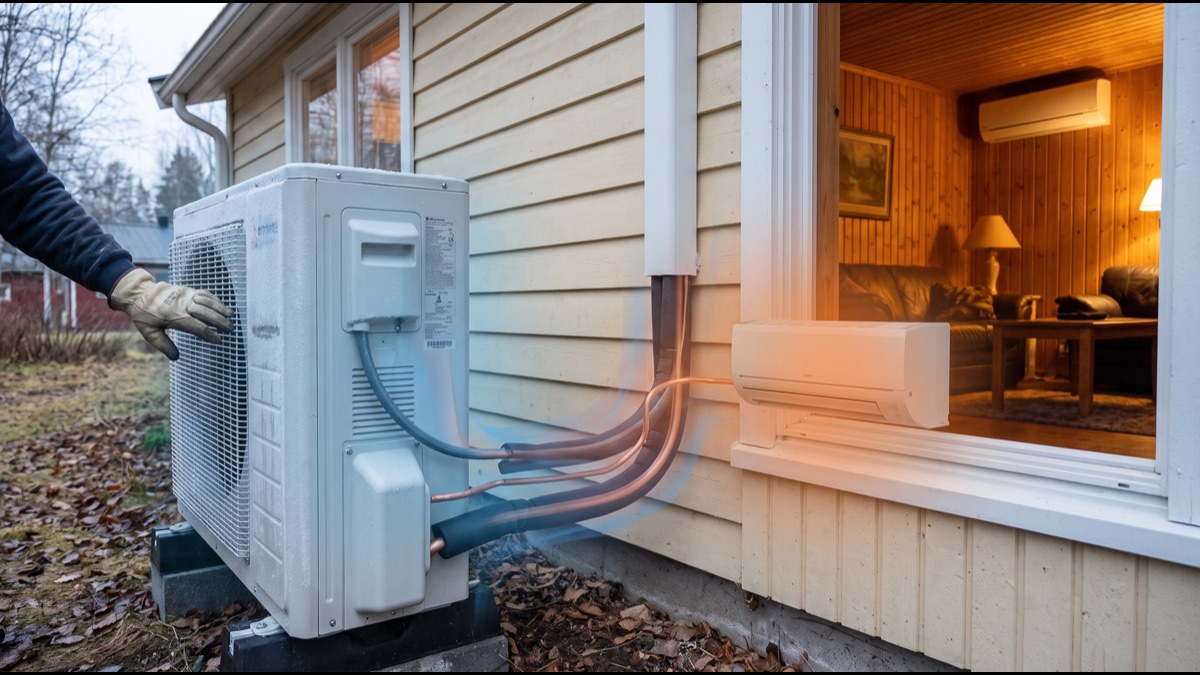
A heat pump does not create heat the way a furnace, a space heater, or an electric water heater does. It moves heat that already exists from one place to another, which sounds like a small technical distinction until you realize it is the entire reason heat pumps can be three or four times more efficient than the heating technology most people grew up with. The same basic machine that keeps a home cool in Dubai in July can, run in reverse, keep a home warm in Stockholm in January, and understanding the physics behind that dual role clarifies both why heat pumps are spreading so fast and where their real limits actually are.
What "Moving Heat" Actually Means
Heat always flows naturally from a warmer object to a cooler one, never the other way around without some external work being done, a basic rule of thermodynamics that governs everything from a cup of coffee cooling on a desk to the entire climate system of the planet. A heat pump's entire function is to force heat to flow the "wrong" way, from a cooler space to a warmer one, by doing mechanical work on a working fluid called a refrigerant.
This is a fundamentally different approach from combustion-based heating, which generates new thermal energy by burning fuel, or resistive electric heating, which generates new thermal energy by forcing electrical current through a resistive element. A heat pump generates comparatively little new heat itself; instead, it acts more like a heat conveyor belt, relocating thermal energy that already exists in the outdoor air, the ground, or a body of water into the space that needs warming.
Because a heat pump is moving existing energy rather than manufacturing new energy from scratch, it can deliver considerably more heating output than the electrical energy it consumes to run its compressor and fans, a fact that surprises many people encountering the concept for the first time and that sits at the core of why heat pumps matter for both household bills and national energy demand.
The Refrigerant Cycle, Step by Step
Every heat pump relies on a closed loop of refrigerant, a fluid engineered to boil and condense at convenient, relatively low temperatures, cycling continuously through four core stages: evaporation, compression, condensation, and expansion.
In the evaporator, located outside the building when the unit is heating, liquid refrigerant absorbs heat from the surrounding air, ground, or water and boils into a low-pressure gas, even when that outdoor air feels cold to a person, because refrigerants are chosen specifically to boil at very low temperatures.
That low-pressure gas then travels to a compressor, which does the actual mechanical work of the cycle, squeezing the gas into a smaller volume and, in doing so, dramatically raising both its pressure and its temperature, producing hot, high-pressure refrigerant gas ready to release its heat indoors.
The hot gas passes through the condenser, located indoors during heating mode, where it releases heat into the room air or a water system and condenses back into a liquid; that liquid then passes through an expansion valve that drops its pressure and temperature sharply, resetting it to begin the cycle again at the evaporator.
Why Compressing a Gas Raises Its Temperature
The temperature rise during compression is not a side effect or an engineering trick; it follows directly from basic gas physics, specifically the relationship between pressure, volume, and temperature described by the ideal gas law, where squeezing a gas into a smaller volume without letting heat escape necessarily raises its temperature.
This is the same phenomenon anyone can feel by pumping up a bicycle tire quickly and noticing the pump barrel gets warm, or by observing that a can of compressed air used to clean electronics gets cold as gas rapidly expands out of it, the reverse process of compression.
The compressor is genuinely the only major point in the cycle where significant external energy, almost always electricity, is deliberately added to the system, and it is precisely this modest energy input that makes it possible to pump a much larger quantity of ambient heat from outside to inside.
The Reversing Valve: How One Machine Heats and Cools
A single heat pump can provide both heating and cooling because of a component called a reversing valve, which can redirect the flow of refrigerant through the system, effectively swapping which coil, indoor or outdoor, acts as the evaporator and which acts as the condenser.
In cooling mode, the indoor coil becomes the evaporator, absorbing heat from the room air, while the outdoor coil becomes the condenser, releasing that absorbed heat outside, which is exactly how a standard split-system air conditioner already works, since an air conditioner is functionally a heat pump running in one fixed direction.
In heating mode, the reversing valve flips this arrangement so the outdoor coil becomes the evaporator, pulling heat from outside air even when it feels cold, and the indoor coil becomes the condenser, releasing that heat into the room, meaning the exact same hardware and refrigerant loop serves both purposes with no separate heating system required.
Coefficient of Performance: Why Heat Pumps Beat Resistive Heating
Heat pump efficiency is measured using a metric called the coefficient of performance, or COP, which expresses how many units of heat energy the system delivers for every single unit of electrical energy it consumes; a heat pump with a COP of 3.5 delivers 3.5 units of heat for each unit of electricity used.
This is possible precisely because the heat pump is not creating that energy from the electricity alone, it is using the electricity to move a much larger quantity of ambient thermal energy that was already present outdoors, so the "extra" energy delivered comes from the environment rather than from the power grid.
Typical modern air-source heat pumps achieve COPs in the range of roughly 2.5 to 4.5 depending on the outdoor temperature and system design, meaning they routinely deliver two-and-a-half to four-and-a-half times more heating energy than the electrical energy consumed, a multiplier no combustion or resistive system can match.
Why Resistive Electric Heating Is So Inefficient by Comparison
A standard electric resistance heater, such as a baseboard heater or a simple electric space heater, converts electrical energy directly into heat with essentially no intermediate step, which sounds efficient but is actually capped at a maximum coefficient of performance of exactly 1.0 by the laws of physics, since it cannot output more heat energy than the electrical energy it consumes.
Practically, this means a resistive heater rated at one kilowatt produces roughly one kilowatt of heat, full stop, while a heat pump drawing the same one kilowatt of electricity might produce two-and-a-half to four kilowatts of heat, simply because it is harvesting additional thermal energy from the surrounding environment rather than generating all of it from the electricity itself.
This gap is precisely why energy agencies and utilities in cold-weather countries have pushed hard for heat pump adoption over resistive heating and older fuel-oil furnaces: for the same amount of useful heat delivered to a home, a heat pump can cut electricity or fuel consumption dramatically, with corresponding reductions in both household energy bills and associated carbon emissions.
How Cold-Climate Heat Pumps Still Extract Heat From Freezing Air
A common and reasonable-sounding objection to heat pumps is that outdoor air in winter feels far too cold to contain usable heat, but this misunderstands the physics involved; air at, say, -10°C still contains substantial thermal energy above absolute zero, roughly -273°C, and a correctly designed refrigerant loop can extract a meaningful share of it.
Modern cold-climate heat pumps use refrigerants engineered to remain effective at very low evaporator temperatures, along with enhanced vapor injection compressor technology that boosts capacity specifically in cold conditions, and field testing by organizations including the U.S. Department of Energy has demonstrated usable heating performance from cold-climate units at outdoor temperatures as low as roughly -25°C to -30°C.
Efficiency does decline as outdoor temperatures fall further, since there is genuinely less thermal energy available to extract and the compressor has to work harder to achieve the necessary temperature lift, which is why some cold-climate installations pair a heat pump with a smaller backup resistive or fuel-based system for the very coldest days of the year rather than relying on the heat pump exclusively at every temperature extreme.
Ground-Source and Water-Source Heat Pumps
Rather than exchanging heat with outdoor air, ground-source heat pumps, sometimes called geothermal heat pumps, circulate fluid through pipes buried in the ground, where temperatures a few meters down remain relatively stable year-round, generally warmer than winter air and cooler than summer air.
Because the ground provides a more stable and often more favorable heat source or heat sink than outdoor air, ground-source systems typically achieve higher and more consistent coefficients of performance than air-source units, particularly in climates with extreme seasonal temperature swings, though they require substantially higher upfront installation costs due to the excavation or drilling involved.
Water-source heat pumps work on a similar principle, exchanging heat with a lake, pond, aquifer, or even a body of seawater when a suitable water source is available nearby, offering many of the same stability advantages as ground-source systems without necessarily requiring extensive excavation, though site availability obviously limits how widely this option can be deployed.
Why Heat Pumps Are Especially Relevant to Hot Climates Like the Gulf
Discussion of heat pumps tends to focus heavily on cold-climate heating, but the underlying technology is arguably even more relevant to hot climates like the Gulf, since essentially every split-system and central air conditioner already installed across the UAE, Saudi Arabia, and neighboring countries is, mechanically, a heat pump running permanently in cooling mode.
In extreme ambient heat, the same reversing-valve hardware that lets a unit heat a cold-climate home can instead be used to provide reversible heating and cooling from a single system, which matters increasingly for Gulf buildings that need occasional heating in winter months or for climate-controlled storage and industrial applications alongside the dominant cooling demand.
Regional utilities and building-efficiency programs across the Gulf have also pushed high-efficiency heat pump-based air conditioning as a direct lever against summer peak electricity demand, since cooling accounts for a very large share of total electricity consumption in the region, and even modest efficiency gains in heat pump-based cooling translate into meaningful reductions in grid strain during the hottest months.
Heat Pumps for Water Heating, Not Just Space Conditioning
Heat pump water heaters apply exactly the same refrigerant-cycle principle to heating domestic hot water rather than air, typically extracting heat from the surrounding air, often in a utility room or basement, and transferring it into a water storage tank, rather than heating the water directly with a resistive element or gas burner.
Because they move existing ambient heat rather than generating it from scratch, heat pump water heaters commonly achieve efficiency multiples of two to three times that of a standard electric resistance water heater, representing one of the largest realistic efficiency gains available for a typical household's overall energy use, since water heating is often among the largest individual energy loads in a home.
A tradeoff worth noting is that heat pump water heaters cool the surrounding air as they extract heat from it, which is a benefit in a hot climate utility room but can be a drawback in an already-cold basement in winter, a factor installers typically account for when recommending placement.
The Refrigerants Themselves: From CFCs to Low-GWP Alternatives
The refrigerant chemistry inside a heat pump has changed substantially over recent decades, moving away from chlorofluorocarbons, or CFCs, which were phased out globally under the Montreal Protocol after being identified as the primary cause of stratospheric ozone depletion, toward hydrofluorocarbons, or HFCs, which don't harm the ozone layer but do carry significant global warming potential if leaked.
More recently, the industry has been shifting again toward lower-global-warming-potential refrigerants, including hydrofluoroolefins and natural refrigerants like propane and carbon dioxide, driven by the Kigali Amendment to the Montreal Protocol, which specifically targets a phase-down of high-GWP HFC refrigerants over the coming decades.
This ongoing refrigerant transition matters for consumers mainly in terms of long-term equipment compatibility and servicing, since older units using phased-out refrigerants can become more expensive to service over time as the specific refrigerant becomes harder to source, a genuine practical consideration when choosing or maintaining a heat pump system today.
Installation, Sizing, and Why Bigger Isn't Always Better
Heat pump performance depends heavily on correct sizing for the specific building, since an oversized unit will cycle on and off more frequently, reducing both efficiency and equipment lifespan, while an undersized unit will struggle to maintain comfortable temperatures during the most extreme weather of the year.
Proper sizing calculations, often called a Manual J load calculation in the heating and cooling trade, account for a building's insulation levels, window area and orientation, local climate data, and occupancy patterns, rather than simply matching a new heat pump's capacity to whatever furnace or air conditioner it is replacing.
Installation quality, including correctly sized refrigerant lines, proper refrigerant charge, and airflow balancing across indoor coils, has a measurable and sometimes substantial effect on real-world efficiency, meaning two identical heat pump models installed by different contractors can perform quite differently in practice, which is part of why industry guidance consistently emphasizes selecting an experienced, certified installer over simply choosing the cheapest quote.
Common Performance Myths About Heat Pumps
A persistent myth holds that heat pumps "don't really work" in cold weather, a belief largely inherited from older-generation equipment from decades ago that genuinely did struggle below roughly 0°C; modern cold-climate heat pump models have substantially closed that performance gap through improved compressor and refrigerant technology.
Another common misconception treats heat pumps as an entirely new or unproven technology, when in fact the underlying refrigeration cycle has been standard engineering since the 19th century and is the exact same physics already running inside every household refrigerator and virtually every air conditioner in hot climates worldwide.
A third misconception assumes heat pumps and air conditioners are competing, separate technologies, when a reversible heat pump is, mechanically, simply an air conditioner with an added reversing valve, meaning many buildings that already have central air conditioning are only one component away from also having efficient electric heating.
The Economics: Upfront Cost Versus Running Cost
Heat pumps generally carry a higher upfront purchase and installation cost than a comparable furnace or resistive heating system, driven by the added complexity of the compressor, reversing valve, and dual indoor-outdoor heat exchanger arrangement, and this higher sticker price is often the first thing that gives buyers pause.
Over the equipment's operating lifetime, however, the substantially lower running costs from a high coefficient of performance frequently offset that higher initial investment, particularly in regions with moderate climates and reasonable electricity prices, and many governments now offer rebates or tax incentives specifically to help close the upfront cost gap given the broader energy and emissions benefits.
The exact payback period varies considerably by climate, local electricity and fuel prices, building insulation quality, and available incentives, so a genuinely useful cost comparison requires looking at a specific building's numbers rather than a single universal average often quoted in general media coverage.
Heat pumps are, at their core, a straightforward application of well-understood refrigeration physics rather than an exotic new invention, moving existing thermal energy rather than manufacturing it from scratch, which is precisely what allows them to deliver more heating or cooling energy than the electricity they consume. That same physics explains both their growing role in decarbonizing home heating in cold countries and their long-standing, almost invisible role in cooling homes across the Gulf, since a heat pump and an air conditioner are, fundamentally, the same machine viewed from two different directions. Understanding the refrigerant cycle underneath both roles makes it much easier to evaluate the real, situation-specific tradeoffs between upfront cost, climate, and long-term efficiency rather than relying on outdated assumptions about what the technology can and cannot do.
Sources
- U.S. Department of Energy, Office of Energy Efficiency and Renewable Energy — Technical guidance on heat pump systems and cold-climate performance.
- International Energy Agency — Global data and analysis on heat pump adoption and efficiency.
- United Nations Environment Programme, Ozone Secretariat — Background on the Montreal Protocol and Kigali Amendment governing refrigerants.
- ASHRAE — Engineering standards for heating, ventilation, air conditioning, and refrigeration systems.
FAQ
Do heat pumps actually create heat?
No. Heat pumps move existing heat from one place to another using a refrigerant cycle and a compressor, rather than generating new heat through combustion or electrical resistance, which is why they can deliver more heating energy than the electrical energy they consume.
Can heat pumps work in freezing weather?
Yes. Modern cold-climate heat pumps can extract usable heat from outdoor air well below freezing, in some cases down to around -25°C, though their efficiency does decline as outdoor temperatures drop further.
What is a coefficient of performance?
Coefficient of performance, or COP, measures how many units of heat a heat pump delivers per unit of electrical energy consumed; a COP of 3 means three units of heat are delivered for every one unit of electricity used, compared with a maximum of 1 for resistive electric heating.
Are heat pumps useful in hot climates like the Gulf?
Yes. The same reversible refrigerant cycle that lets a heat pump provide efficient heating also lets it provide efficient cooling, which is effectively how most modern split and central air conditioning systems in hot climates already operate.
Why do heat pumps cost more upfront than furnaces?
Heat pumps require more complex components, including a compressor, reversing valve, and outdoor and indoor heat exchangers, which raises upfront cost, but their significantly lower running costs and dual heating-cooling function often offset that difference over the equipment's lifetime.
About the Author
We reference the U.S. Department of Energy, the International Energy Agency, the United Nations Environment Programme's Ozone Secretariat, and ASHRAE to explain the background and current understanding of this topic.
Loved This Article?
Share it on WhatsApp → Share it on WhatsApp
Get more guides in your inbox — Subscribe to our newsletter for weekly surprising stories from Egypt, Saudi Arabia, Dubai, and beyond.