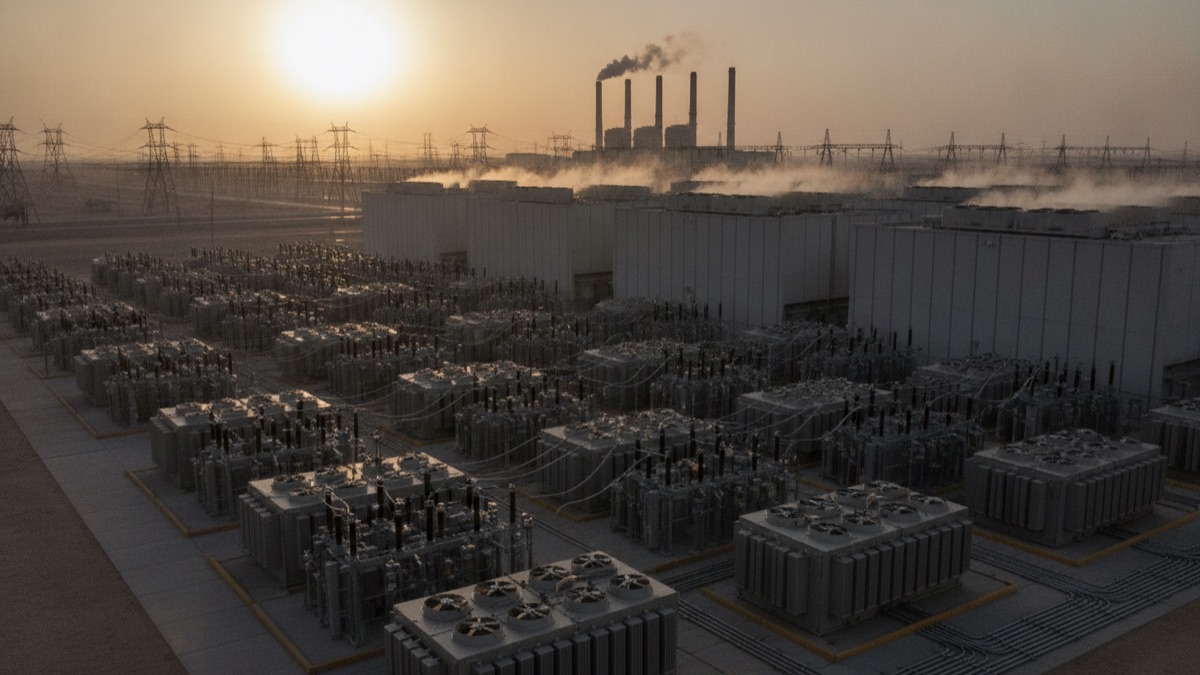
The rapid expansion of artificial intelligence has brought an unexpected topic into mainstream conversation: electricity. Reports of data centers straining regional power grids, utilities delaying retirement of older power plants, and technology companies signing long-term agreements for dedicated energy supply have made the energy footprint of computing a genuine infrastructure and policy question rather than a narrow technical concern of interest only to engineers.
Understanding why these facilities consume so much power, and which specific parts of the operation actually account for that consumption, helps separate the genuine engineering and infrastructure challenges from the more speculative claims that circulate in both directions, whether dismissing the concern entirely or projecting alarming growth indefinitely into the future without accounting for the efficiency improvements that have historically accompanied every previous computing expansion.
What a Data Center Actually Contains
A modern data center is fundamentally a large, purpose-built warehouse filled with rows of server racks, each rack holding many individual computers stacked vertically, connected together by high-speed networking equipment and supported by extensive electrical distribution systems, backup power generators, and industrial-scale cooling infrastructure designed to keep everything within safe operating temperatures.
These facilities are built specifically for continuous, uninterrupted operation, meaning they run twenty-four hours a day every day of the year, with redundant power supplies and backup generators designed to keep critical systems running even during a complete grid failure, a reliability requirement that itself contributes meaningfully to the overall energy profile of the operation.
The scale of a single large facility can be genuinely difficult to picture from the outside, since a large modern data center campus can occupy an area comparable to several dozen football fields and draw electrical power on a scale comparable to that of a small city, making the siting and grid connection of these facilities a substantial planning and infrastructure question in its own right.
Why AI Workloads Differ From Traditional Computing
Traditional data center workloads, including web hosting, email, file storage, and ordinary business software, generally involve relatively modest computational demands per individual request, with server capacity sized to handle peaks in user traffic rather than sustained maximum computational intensity across every machine simultaneously.
Artificial intelligence workloads, particularly the training of large models, are fundamentally different in character, involving enormous volumes of mathematical calculation running continuously across thousands of specialized processors operating at or near their maximum capacity for extended periods measured in weeks or even months rather than seconds or minutes.
This sustained maximum-intensity operation is precisely why AI workloads draw so much more power per unit of physical rack space than traditional computing did, and why facilities designed for older workload patterns often cannot simply be repurposed for AI without substantial electrical and cooling upgrades to handle the considerably higher power density involved.
The Difference Between Training and Inference
AI energy consumption divides into two broadly distinct categories that behave quite differently from one another: training, meaning the initial process of building a model by processing enormous datasets, and inference, meaning the ongoing process of actually using that finished model to answer individual user requests once it has been deployed into production.
Training a large model is an extremely energy-intensive but essentially one-time event for any given model version, consuming a very large amount of electricity concentrated into a defined period, after which that particular training run is complete and the resulting model can be used indefinitely without repeating the training process from scratch.
Inference consumes far less energy per individual request than training does in total, but because a popular model may serve many millions or even billions of individual requests every single day across a global user base, the cumulative energy footprint of inference across a model's operational lifetime can substantially exceed the energy consumed during its original training.
Why Specialized AI Chips Draw So Much Power
The specialized processors used for AI workloads, commonly graphics processing units or purpose-built AI accelerator chips, are designed to perform an enormous number of mathematical operations in parallel, an architecture that delivers dramatically better performance for AI tasks than general-purpose processors but which also draws considerably more electrical power per individual chip.
Individual high-end AI accelerator chips can draw several hundred watts each under sustained full load, and because a single server typically holds multiple such chips and a single rack holds multiple servers, the power draw concentrated into a single rack of AI hardware can exceed what an entire row of traditional servers would have consumed in an earlier generation of data center design.
This dramatic increase in power density per unit of floor space is one of the central engineering challenges facing data center operators today, since electrical distribution systems, backup power capacity, and especially cooling infrastructure all have to be substantially redesigned to handle concentrations of heat and power that older facility designs were simply never intended to accommodate.
How Much of the Energy Goes to Cooling
Essentially all electrical energy that enters a computer chip is eventually converted into heat, which means a data center drawing a large amount of electricity for computation is simultaneously generating an equivalent amount of waste heat that has to be actively removed from the building to prevent equipment from overheating and failing.
Cooling has historically represented a very substantial share of total data center energy consumption, in some older facility designs approaching a proportion comparable to the computing equipment itself, though this share has fallen considerably in modern well-designed facilities through improved airflow management, higher permitted operating temperatures, and more efficient cooling technology.
The industry commonly measures this overhead using a metric called power usage effectiveness, which compares total facility energy consumption against the energy actually delivered to computing equipment, with a perfect theoretical score of one representing a facility where no energy at all is spent on cooling, lighting, or other supporting infrastructure.
Why Liquid Cooling Has Become Increasingly Necessary
Traditional data centers cooled equipment primarily by circulating chilled air through the facility, an approach that works adequately at moderate power densities but becomes progressively less effective and less efficient as the amount of heat generated within a given volume of space continues rising toward the levels that dense AI hardware now produces.
Liquid cooling approaches, which circulate a coolant directly to heat-generating components rather than relying on ambient air, transfer heat considerably more efficiently than air does and have consequently become increasingly common in facilities specifically designed for high-density AI workloads that air cooling alone cannot practically handle.
The transition toward liquid cooling represents a substantial change in how data centers are physically built and maintained, requiring different plumbing infrastructure, different maintenance procedures, and different facility layouts, which is part of why purpose-built new AI facilities are frequently constructed from scratch rather than retrofitting older buildings originally designed around air cooling.
Where the Water Consumption Question Fits In
Many large data centers use water as part of their cooling systems, commonly through evaporative cooling processes that take advantage of the substantial cooling effect produced when water evaporates, an approach that can be considerably more energy-efficient than purely mechanical refrigeration but which consumes meaningful quantities of water in the process.
This water consumption has become a genuine point of local concern in regions where data centers have been sited in areas already experiencing water scarcity, creating real tension between the economic benefits a large facility brings to a region and the competing demands on a constrained local water supply from agriculture, industry, and residential use.
Some operators have responded by shifting toward closed-loop cooling systems that recirculate the same water repeatedly rather than continuously consuming fresh supply, or by siting new facilities specifically in cooler climates where ambient outside air can provide much of the necessary cooling for a substantial portion of the year without heavy water use.
Why Location Choices Matter So Much
Data center siting decisions weigh a genuinely complex combination of factors, including the availability and cost of electrical power, the reliability of the local electrical grid, ambient climate conditions affecting cooling requirements, proximity to major network infrastructure, local tax and regulatory conditions, and increasingly the availability of low-carbon electricity sources.
Cooler climates offer a genuine efficiency advantage because outside air can be used directly for cooling during a much larger portion of the year, a technique known as free cooling that substantially reduces the energy required for mechanical refrigeration and which has driven considerable data center development toward northern regions with consistently cool ambient temperatures.
Proximity to abundant low-cost electricity, particularly hydroelectric, geothermal, or wind generation, has also become a major siting consideration, since electricity represents such a substantial share of ongoing operating cost that even modest differences in per-unit energy price translate into very large differences in total facility operating expense across a multi-decade facility lifetime.
How Efficiency Has Improved Despite Growing Demand
A frequently overlooked aspect of the data center energy story is that efficiency per unit of computation has improved dramatically over the past two decades, meaning the industry now performs vastly more computing work per unit of electricity consumed than it did in earlier generations of hardware and facility design.
For a substantial period, these efficiency improvements were rapid enough to largely offset growth in total computing demand, meaning overall data center electricity consumption grew far more slowly than the underlying growth in computing workload would otherwise have implied, a genuinely important context often missing from more alarming projections.
The current concern among energy analysts is specifically that the recent growth in AI workload demand has accelerated faster than efficiency improvements can offset, breaking the previous pattern where the two roughly balanced one another, which is precisely why total data center electricity consumption has become a more prominent grid planning concern than it was previously.
What Grid Operators Are Actually Concerned About
Electrical grid operators plan capacity years in advance based on projected demand, and the arrival of individual facilities requesting very large amounts of power on relatively short timelines creates genuine planning difficulty, since building new generation capacity and transmission infrastructure typically takes considerably longer than constructing a data center does.
The concentration of this demand also matters considerably, since a large facility represents a very substantial load appearing at one specific point on the grid rather than distributed demand spread across many locations, which can require targeted transmission upgrades in that specific area regardless of whether overall regional generation capacity is adequate.
Grid operators are also concerned with the consistency of the load profile, since AI training workloads can draw close to maximum power continuously for extended periods and then drop substantially when a training run completes, creating swings in demand that are considerably harder to balance than the more predictable daily patterns of residential and commercial consumption.
How Companies Are Responding on the Energy Supply Side
Major technology companies have increasingly entered into long-term power purchase agreements directly with electricity generators, committing to buy a specified quantity of power over many years, an arrangement that provides the generator with the revenue certainty needed to justify building new generation capacity that might not otherwise have been financed.
Interest in nuclear power has grown notably in this context, since nuclear generation provides large amounts of consistent low-carbon electricity without the intermittency that affects wind and solar generation, a characteristic that aligns unusually well with the continuous around-the-clock demand profile that data centers present.
Some companies have also invested directly in renewable generation projects, energy storage systems, or on-site generation capacity, approaches that vary considerably in how much they genuinely reduce net grid impact versus primarily shifting the accounting of where a facility's electricity is nominally sourced from on paper.
Why Carbon Accounting Here Is Genuinely Complicated
Claims that a particular data center runs entirely on renewable energy frequently rest on the purchase of renewable energy certificates or contractual arrangements rather than on a physical guarantee that the specific electrons powering that facility at any given moment originated from a renewable source, since electricity flowing through a shared grid cannot be physically separated by origin.
This distinction between contractual and physical sourcing has prompted a shift among some operators toward what is often described as hourly matching, meaning an attempt to actually align consumption with renewable generation on an hour-by-hour basis rather than simply balancing total annual consumption against total annual renewable purchases.
The difference between these two accounting approaches is genuinely substantial in practice, since a facility that consumes power continuously while purchasing an equivalent annual quantity of solar generation is in reality drawing considerably on whatever else the grid is running overnight, which in many regions still includes substantial fossil generation.
What Realistic Projections Actually Suggest
Energy analysts producing projections for data center electricity demand generally present a wide range of possible outcomes rather than a single confident figure, precisely because the result depends heavily on assumptions about how rapidly AI adoption continues growing and how quickly efficiency improvements in both hardware and model design continue advancing.
The considerable uncertainty in these projections is genuine rather than evasive, since the field has repeatedly seen substantial efficiency gains from improved chip design, better model architectures requiring less computation for equivalent capability, and software optimizations that reduce the computational cost of both training and inference.
Treating any single dramatic projection as a settled forecast generally misrepresents the actual state of analytical understanding, which is better characterized as a genuine recognition that demand is growing meaningfully alongside substantial uncertainty about the specific trajectory over the coming decade.
What This Means for Ordinary Electricity Consumers
The practical concern for ordinary residential and commercial electricity consumers is whether large new industrial loads connecting to a shared grid ultimately affect their own electricity prices or service reliability, a genuinely reasonable question that regulators in several regions have begun examining much more actively than they did previously.
Regulatory approaches under active discussion include requiring large new loads to fund the specific transmission and generation infrastructure needed to serve them rather than spreading those costs across all ratepayers, an approach intended to ensure that existing consumers are not effectively subsidizing infrastructure built primarily for a single large industrial customer.
How these regulatory questions are ultimately resolved will likely vary considerably between different regions and jurisdictions, and represents an area where the broader public policy conversation is genuinely still developing rather than having settled into any established consensus about how the costs and benefits should be fairly distributed across everyone connected to the same shared electrical infrastructure.
The energy footprint of AI data centers comes down to a fairly straightforward physical reality wrapped in genuinely complex infrastructure questions. Specialized AI processors draw substantially more power than traditional computing hardware, they run at sustained high intensity for extended periods rather than in short bursts, and essentially all the electricity they consume converts to heat that then requires additional energy to remove from the building. Multiply that across facilities holding many thousands of such processors, running continuously every hour of every day, and the resulting demand becomes large enough to matter genuinely at the level of regional electrical grid planning rather than remaining an internal operating detail. What the more alarming coverage often omits is that computing efficiency has historically improved dramatically and continues improving, that the distinction between training and inference energy matters considerably for understanding the actual footprint, and that projections vary widely precisely because the trajectory genuinely remains uncertain. What the more dismissive coverage often omits is that the recent growth has been fast enough to outpace efficiency gains in a way that previous computing expansions did not, creating real and immediate infrastructure planning challenges that grid operators and regulators are actively working to address right now.
Sources
- Wikipedia — overview of data center design, infrastructure, and energy use
- International Energy Agency — global analysis of data center and electricity demand trends
- U.S. Department of Energy — research on data center efficiency and grid infrastructure
- Lawrence Berkeley National Laboratory — independent research on data center energy consumption
- Nature — peer-reviewed research on computing energy use and efficiency
FAQ
Does AI training or AI inference use more total energy?
Training uses far more energy per event, but because popular models serve billions of requests over their lifetime, cumulative inference energy can substantially exceed original training energy.
Why do AI chips use so much more power than regular processors?
They perform enormous numbers of calculations in parallel at sustained maximum load, with individual high-end chips drawing several hundred watts each and many chips packed into a single rack.
How much data center energy goes to cooling rather than computing?
Historically cooling was a very substantial share, though modern well-designed facilities have reduced this considerably through better airflow, higher operating temperatures, and liquid cooling.
Why do data centers use water?
Many use evaporative cooling, which is more energy-efficient than mechanical refrigeration but consumes water, creating genuine local tension in water-scarce regions.
Does a data center claiming 100% renewable energy actually run on renewables?
Often this reflects contractual renewable energy purchases rather than physical sourcing, since electricity on a shared grid cannot be separated by origin — which is why some operators now pursue hourly matching instead.
About the Author
We reference Wikipedia, International Energy Agency, U.S. Department of Energy, Lawrence Berkeley National Laboratory, and Nature to explain the background and current understanding of this topic.
Loved This Article?
Share it on WhatsApp → Share it on WhatsApp
Get more guides in your inbox — Subscribe to our newsletter for weekly surprising stories from Egypt, Saudi Arabia, Dubai, and beyond.