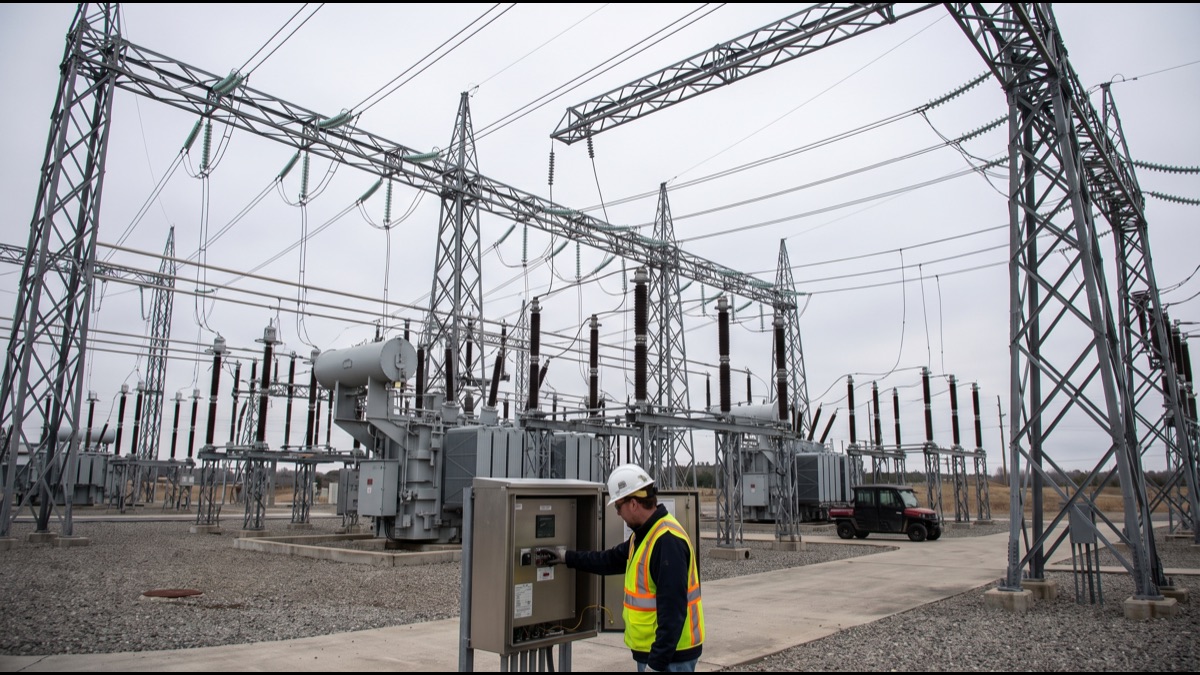
The electricity you are using right now was generated a fraction of a second ago, because the grid stores almost nothing. Supply and demand must match continuously, not on average over a day but at every moment, and a mismatch lasting seconds can bring down a region.
What makes this possible is a single shared signal. The frequency of the alternating current is identical everywhere on a connected network, and it rises when there is too much generation and falls when there is too little. Everything about grid operation follows from using that number as a real-time measure of whether the balance is holding.
Why the Grid Stores Almost Nothing
Unlike gas or water networks, an electricity system holds a negligible quantity of energy relative to what flows through it in a given moment.
This means generation must track consumption continuously, since there is no buffer to draw down when demand rises unexpectedly.
Every operational practice, from reserve capacity to demand forecasting, exists because this instantaneous matching cannot be avoided by storing anything in the network itself.
What Frequency Actually Indicates
Generators spin in synchrony across an entire connected network, and the frequency of the current reflects how fast they are turning.
When demand exceeds generation, the extra load acts as a brake, the machines slow slightly, and frequency falls in proportion to the shortfall.
This gives operators a continuously available measurement of system balance that requires no communication, since every generator experiences the same signal simultaneously.
Why Inertia Buys Time
Large spinning generators store kinetic energy in their rotating mass, which is released automatically when they begin to slow under increased load.
This slows the rate at which frequency falls, giving operators seconds rather than milliseconds to respond, which is what makes control possible at all.
Inertia is a physical property rather than a decision, and it exists as a by-product of using rotating machines to generate electricity.
How Renewables Changed the Problem
Solar panels and most wind turbines connect through power electronics rather than by spinning in synchrony, so they contribute little or no inertia.
As their share grows, frequency changes faster after a disturbance, which compresses the time available for any response to take effect.
This is a genuine engineering challenge distinct from intermittency, and it is why grid operators now procure inertia as a service rather than assuming it exists.
What Synthetic Inertia Provides
Power electronics can be programmed to inject power rapidly when frequency falls, mimicking the response a spinning machine would produce.
Batteries are particularly suited to this because they respond within milliseconds, far faster than any mechanical system can.
The response is not identical to true inertia, since it depends on measurement and control rather than on physics, but it addresses the same problem effectively.
How Reserves Are Layered
Grid operators hold several categories of reserve, distinguished by how quickly they can respond rather than by how much power they provide.
The fastest acts automatically within seconds, the next within minutes as operators dispatch it, and slower reserves replace the fast ones so they are available again.
This layering means a sudden loss of generation is covered immediately by automatic response and then progressively handed over to slower, cheaper sources.
Why Demand Is Forecast So Precisely
Operators predict consumption in advance so that generation can be scheduled, since large plants cannot be started instantly and must be committed hours ahead.
Forecasts use weather, day of week, holidays and historical patterns, and they are accurate to within a small percentage under normal conditions.
Errors are covered by reserves, which means forecast accuracy directly determines how much expensive standby capacity must be held.
What Causes Demand Spikes
Synchronised behaviour produces sharp increases, with the classic example being large numbers of people switching on appliances simultaneously after a shared broadcast event.
Operators plan for these explicitly, scheduling additional generation and in some cases arranging imports in advance of a known event.
Temperature is the largest driver overall, since heating and cooling demand responds to weather far more strongly than any other category of consumption.
How Merit Order Determines Who Generates
Generators are dispatched in order of operating cost, with the cheapest running first and progressively more expensive plants brought on as demand rises.
Wind and solar have almost zero running cost once built, so they displace fuel-burning plants whenever they are available.
This is why wholesale prices fall sharply when renewable output is high, and why the same plants can be highly profitable in some hours and idle in others.
Why Negative Prices Occur
Prices sometimes fall below zero, meaning generators pay to supply electricity, which appears absurd until the alternatives are considered.
Some plants are expensive or slow to shut down and restart, so paying briefly to keep running can cost less than stopping.
Subsidy structures that pay per unit generated can also make it rational to continue producing at a negative price, which has prompted redesign of several support schemes.
What Transmission Constraints Do
Electricity cannot always flow where it is needed, since lines have thermal limits and exceeding them risks sagging conductors and equipment damage.
This means cheap generation in one region may be unusable elsewhere, forcing more expensive local plants to run instead.
The cost of these constraints is substantial in systems where generation has moved to windy or sunny regions faster than the network connecting them has been built.
Why High Voltage Is Used
Transmitting the same power at higher voltage means lower current, and losses in a conductor rise with the square of current rather than proportionally.
This is why long-distance transmission uses extremely high voltages and why transformers exist at every stage between generation and consumption.
The practical effect is that losses across a national network amount to a modest percentage rather than the large fraction that low-voltage transmission would incur.
How Direct Current Links Fit
Undersea cables and very long overhead links frequently use direct current, because alternating current suffers from effects that make long cable runs impractical.
Direct current links also allow connection between networks that are not synchronised, since they decouple the two systems electrically.
The conversion equipment at each end is expensive, which is why these links are used where distance or synchronisation makes the alternative unworkable rather than as a default.
Why Blackouts Cascade
When one line fails, its power redistributes onto others, which may push them beyond their limits and cause them to disconnect protectively.
Each disconnection redistributes power again, and the process can propagate across a network within seconds, far faster than human operators can intervene.
This is why automatic protection is designed to shed load deliberately, since disconnecting some customers quickly prevents the loss of the entire system.
What Load Shedding Actually Is
When frequency falls beyond a defined threshold, relays automatically disconnect blocks of demand to restore balance before generators are forced offline.
This is a controlled failure rather than a malfunction, and it is why a regional outage is preferable to allowing frequency to collapse entirely.
The alternative is generators tripping to protect themselves, which removes supply and accelerates the collapse rather than arresting it.
How a Grid Is Restarted
Restoring a collapsed network requires generators capable of starting without external power, since most large plants need electricity to begin operating.
These black start units energise a small section, which is then used to start larger plants, progressively rebuilding the network in stages.
The process takes many hours and must balance load against generation at every step, since reconnecting too much demand at once collapses the fragment again.
Why Synchronisation Is Delicate
Connecting two energised sections requires their frequencies and phases to match almost exactly, or the resulting current surge can damage equipment severely.
This is why restoration proceeds carefully rather than by simply closing switches, and why the sequence of reconnection is planned in advance.
The same requirement applies whenever a generator joins the network, which is why bringing a plant online involves matching to the grid before connecting.
What Storage Actually Contributes
Batteries have grown rapidly and are exceptionally good at fast response, which makes them valuable for frequency regulation rather than primarily for bulk energy.
Most installed capacity provides power for a few hours, which addresses daily variation but not extended periods of low renewable output.
Pumped hydro remains the largest form of grid storage globally, though suitable sites are limited and construction takes far longer than battery installation.
Why Interconnection Helps
Linking networks across regions allows surplus in one area to serve shortfall in another, and weather patterns differ enough that this is frequently the case.
It also reduces the reserve each system must hold individually, since a large interconnected system needs proportionally less spare capacity than several small ones.
The tradeoff is that disturbances can propagate across borders, which is why interconnected systems require coordinated operating standards.
How Demand Response Works
Rather than adjusting generation to meet demand, some demand can be adjusted to meet generation, particularly industrial processes and heating that tolerate brief interruption.
Participants are paid to reduce consumption when instructed, which is frequently cheaper than building generation used only at peak times.
Electric vehicle charging is a substantial opportunity, since most vehicles sit connected far longer than they need to charge and timing is largely flexible.
Why Rooftop Solar Complicates Operation
Generation connected at the distribution level is frequently not visible to the system operator, so it appears as a reduction in demand rather than as supply.
This makes forecasting harder, since a cloudy afternoon produces an apparent demand increase that the operator must anticipate without measuring the cause.
It also reverses power flow in networks designed to deliver electricity outward, which requires equipment and protection settings that were not originally specified for it.
What Capacity Markets Are For
Energy markets pay for electricity produced, which provides little revenue to plants that run rarely but are needed during extreme conditions.
Capacity mechanisms pay for availability rather than output, ensuring sufficient plant exists to cover peak demand even if it operates for few hours annually.
These are contested, since critics argue they subsidise existing fossil plants, while proponents note that no market has yet demonstrated adequacy without some such mechanism.
How Grids Handle Extreme Weather
Extreme cold raises demand sharply while simultaneously impairing generation through fuel supply constraints and equipment failure, which is a particularly dangerous combination.
Heat reduces transmission capacity because conductors sag when hot, while cooling demand peaks, again pushing supply and demand in opposite directions.
These correlated failures are why planning uses extreme scenarios rather than average conditions, and why several major outages have occurred during weather events rather than equipment faults.
Why Electrification Raises the Stakes
Moving heating and transport onto electricity increases both total consumption and the seasonal and daily variation the system must handle.
Heat pumps in particular concentrate demand in cold periods, which shifts the annual peak in systems that previously peaked in summer.
This makes flexibility more valuable, since the alternative is building generation and network capacity used for a handful of hours each year.
What Operators Actually Do All Day
Control room work involves continuously comparing forecast against actual, adjusting dispatch instructions, and ensuring adequate reserve is positioned for credible failures.
Planning assumes the largest single loss the system could sustain and holds enough fast reserve to survive it without shedding load.
Most of the work is anticipatory rather than reactive, since anything requiring a human decision within seconds has already been automated.
Why the System Works at All
A grid is one of the largest machines ever built, operating continuously with no meaningful storage while balancing millions of independent decisions to switch things on and off.
It functions because aggregate demand is far more predictable than any individual's behaviour, which allows scheduling despite the underlying randomness.
The frequency signal ties it together, giving every participant the same real-time information about whether the balance is holding without any of them needing to communicate.
Why Reactive Power Matters
Alongside the power that does useful work, networks carry a component that does none but is required to sustain the voltages that let power flow at all.
This reactive component cannot travel far efficiently, so it must be supplied locally rather than transmitted from distant generators.
Managing it is a substantial part of network operation, and inadequate reactive support has been a contributing factor in several major blackouts.
How Voltage Differs From Frequency
Frequency is identical everywhere on a synchronised network, which is why it works as a system-wide balance signal.
Voltage is local, varying from one point to another depending on load and network configuration, so it must be managed regionally rather than centrally.
This division is fundamental: frequency tells operators about overall energy balance, while voltage tells them about conditions at particular locations.
What Smart Meters Enable
Measuring consumption in short intervals rather than as a single periodic total allows pricing that reflects when electricity was actually used.
This makes time-varying tariffs practical, which is the mechanism by which households can be given a reason to shift flexible consumption away from peak periods.
It also gives network operators visibility into low-voltage networks that were historically unmonitored, which matters increasingly as solar and electric vehicles proliferate.
Why Microgrids Are Growing
A microgrid can operate connected to the main network or disconnect and run independently, which provides continuity when the wider system fails.
This is valuable for hospitals, military sites and remote communities where an outage is unusually costly or where connection is unreliable.
The engineering difficulty is the transition, since disconnecting and reconnecting requires the same careful balancing and synchronisation the main grid performs continuously.
How Nuclear Plants Fit the Mix
Nuclear generation has high construction costs and low running costs, which makes it economic to run continuously rather than to follow demand.
Some designs can adjust output meaningfully, though doing so raises the cost per unit generated because the fixed costs are spread over less output.
This makes nuclear a poor match for balancing variable renewables directly, while remaining valuable as a source that does not depend on weather.
What Curtailment Actually Costs
When renewable output exceeds what the network can carry or the system can absorb, generators are instructed to reduce output despite having energy available.
This wasted potential is a direct signal that transmission or storage is inadequate, and curtailment volumes have risen sharply in regions where renewables grew faster than the network.
Operators generally compensate curtailed generators, which means the cost appears on consumer bills rather than being absorbed by the projects concerned.
An electricity grid stores essentially nothing, which is the fact everything else follows from. Generation must match consumption continuously — not on average, but at every instant — and there is no buffer to draw on when demand shifts unexpectedly. What makes this manageable is that the whole connected network shares one number. Frequency reflects how fast the generators are spinning, and it falls when demand exceeds supply because the extra load acts as a brake. Every generator sees the same signal simultaneously, with no communication required. The kinetic energy stored in those spinning machines also slows the rate of change, buying operators seconds instead of milliseconds — which is the only reason control is possible at all. This is why the shift to renewables poses a challenge separate from intermittency. Solar and most wind connect through power electronics rather than spinning in synchrony, so they contribute little inertia, and frequency moves faster after a disturbance. Batteries help precisely because they respond in milliseconds, which is why their main value to grids is fast frequency response rather than bulk energy storage. And it explains why blackouts cascade: when a line fails its power redistributes onto others, which trip in turn, propagating faster than any human can intervene.
Sources
- Wikipedia — grid structure, frequency control and stability
- International Energy Agency — system flexibility, storage and renewable integration
- National Grid ESO — balancing services, inertia procurement and black start
- US Department of Energy — grid reliability, transmission and extreme weather events
- ENTSO-E — European interconnection operating standards and incident reports
FAQ
Where is electricity stored on the grid?
Essentially nowhere. The network holds a negligible amount relative to what flows through it, which is why generation must match consumption continuously rather than on average.
What does grid frequency actually tell you?
Whether supply and demand are balanced. Generators spin in synchrony, and excess demand acts as a brake, so frequency falls when there is not enough generation.
Why do renewables make grid stability harder?
Separately from intermittency, solar and most wind connect through electronics rather than spinning machines, contributing little inertia, so frequency changes faster after a disturbance.
Why do blackouts spread across whole regions?
When a line fails, its power redistributes to others, pushing them past their limits so they disconnect too. This cascades within seconds, faster than operators can react.
Why do electricity prices sometimes go negative?
Some plants cost more to stop and restart than to keep running briefly at a loss, and subsidies paid per unit generated can make continued output rational.
About the Author
We reference Wikipedia, International Energy Agency, National Grid ESO, US Department of Energy, and ENTSO-E to explain the background and current understanding of this topic.
Loved This Article?
Share it on WhatsApp → Share it on WhatsApp
Get more guides in your inbox — Subscribe to our newsletter for weekly surprising stories from Egypt, Saudi Arabia, Dubai, and beyond.