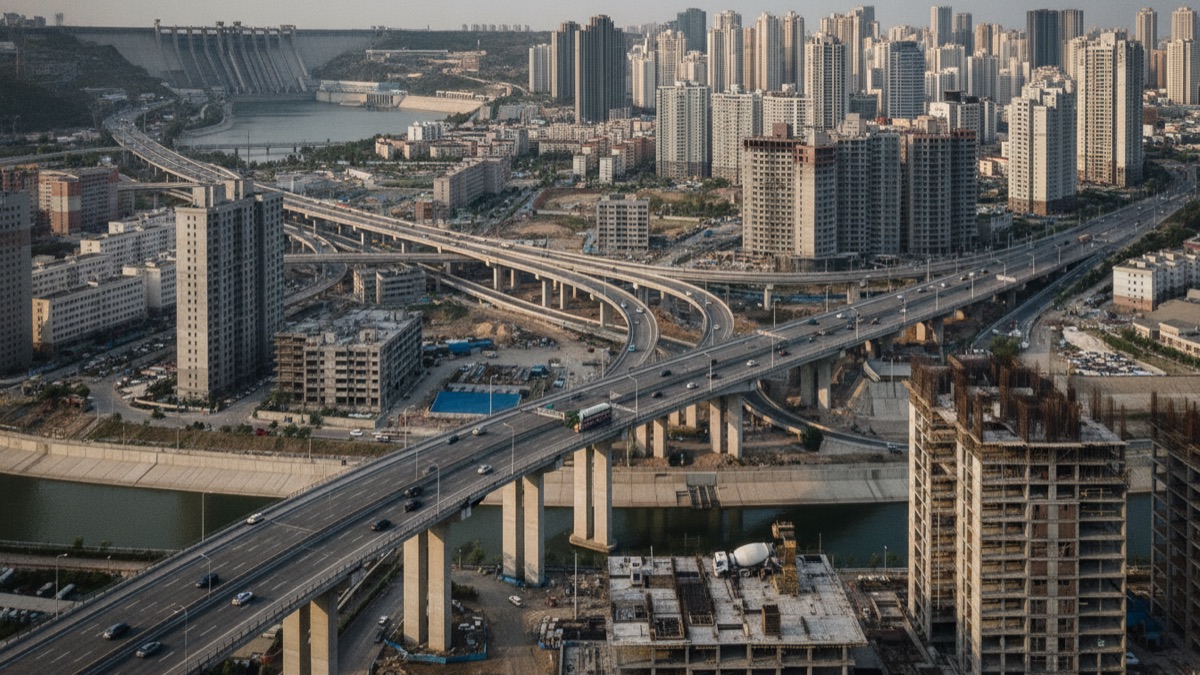
By weight, humanity consumes more concrete than any other material except water, and by a considerable margin. More of it is produced each year than steel, plastic, aluminium and timber combined, which makes it the most quantitatively significant thing people manufacture.
It is also responsible for a share of global carbon emissions larger than aviation and shipping together, and the emissions come mostly from chemistry rather than from fuel, which means they cannot be eliminated by switching energy source. Understanding why concrete is so dominant, and why the emissions are so stubborn, explains one of the harder problems in reducing industrial carbon.
What Concrete Actually Is
Concrete is not a single substance but a composite, consisting of aggregate such as sand and gravel bound together by cement paste, which forms when cement reacts with water.
The aggregate makes up the large majority of the volume and provides most of the strength and stability, while the cement functions purely as the binder holding it together.
Cement and concrete are therefore not interchangeable terms, and the distinction matters because nearly all the environmental impact comes from the cement, which is the smaller component.
How Cement Is Made
Limestone is heated with clay and other materials in a kiln to around fourteen hundred degrees, producing hard nodules called clinker which are then ground into fine powder.
This process transforms the raw minerals chemically rather than merely melting them, creating compounds that will react with water in a way the original limestone does not.
The resulting powder is stable indefinitely while dry, which is what makes cement transportable and storable, and is a substantial part of why it became a global commodity.
Why Concrete Does Not Dry
Concrete hardens through a chemical reaction called hydration rather than by drying out, which means water is consumed and incorporated into the structure rather than evaporating away.
This is why concrete can and does cure underwater, and why premature drying is actually a defect that weakens the material by halting the reaction before it completes.
Construction practice therefore involves keeping fresh concrete damp for days, which is counterintuitive to anyone assuming the goal is to get it dry as quickly as possible.
How Strength Develops Over Time
Hydration proceeds rapidly at first and then slows dramatically, with most usable strength developing within weeks but the reaction continuing at a diminishing rate for years.
Standard specifications reference strength at a fixed number of days as a practical benchmark, though the material continues strengthening well beyond that point.
This slow continuation means very old concrete structures are frequently stronger than when they were built, provided the reinforcement inside them has not deteriorated.
Why It Is Strong in Compression but Weak in Tension
Concrete resists being crushed extremely well, since the aggregate and cement paste transfer compressive force efficiently through direct contact.
It performs poorly when pulled apart, because the bonds holding it together are far weaker than the resistance to compression, and it cracks at a small fraction of its compressive capacity.
This asymmetry defines nearly everything about how concrete is used, since any structure where concrete would be stretched requires something else to carry that force.
What Reinforcement Solves
Embedding steel bars into concrete produces a composite where concrete handles compression and steel handles tension, which is far more capable than either material alone.
The combination works partly because steel and concrete expand at almost the same rate when heated, so temperature changes do not tear the composite apart.
Concrete also chemically protects the steel, since the alkaline environment inside it forms a passive layer on the metal surface that prevents corrosion under normal conditions.
Why Reinforced Concrete Eventually Fails
Carbon dioxide from the air gradually penetrates concrete and reduces its alkalinity, and once this reaches the steel, the protective chemistry breaks down and corrosion begins.
Rusting steel expands substantially, and that expansion cracks the surrounding concrete from within, which admits more moisture and accelerates the process.
This is why reinforced concrete has a finite service life measured in decades rather than centuries, and it is the main reason large-scale infrastructure renewal is a recurring cost.
Why Salt Makes It Much Worse
Chloride from de-icing salt or seawater penetrates concrete and attacks the protective layer on reinforcement directly, without needing to reduce alkalinity first.
Structures in marine environments or in regions that salt roads therefore deteriorate considerably faster, which is a major maintenance issue for bridges and coastal buildings.
Mitigation involves denser concrete mixes, thicker covering over the steel, coated or stainless reinforcement, and in some cases applied electrical protection.
How Roman Concrete Lasted So Long
Certain Roman marine structures remain intact after two thousand years, which is far longer than modern reinforced concrete achieves, and the reason has been actively researched.
Their mixes used volcanic ash, which reacts with seawater over time to form additional mineral crystals within the material, meaning exposure strengthens rather than degrades it.
Crucially, Roman concrete contained no steel reinforcement, which removes the failure mechanism that limits modern structures, though it also limited what shapes could be built.
Why Self-Healing Is Being Rediscovered
Research into ancient mixes found that lumps of unreacted lime within the material dissolve when cracks admit water, then recrystallise and seal the crack.
This self-healing behaviour has inspired modern approaches, including deliberately included healing agents and even bacteria that precipitate minerals when activated by water.
Practical adoption remains limited by cost and by the difficulty of verifying that healing has actually occurred inside a structure that cannot be inspected internally.
Where the Carbon Emissions Come From
Cement production accounts for a large share of global industrial emissions, and roughly half of that comes from the chemical reaction itself rather than from heating the kiln.
Converting limestone into the reactive compound cement requires releases carbon dioxide as a direct product of the reaction, which happens regardless of how the heat is supplied.
This is the fundamental difficulty, since switching to renewable energy addresses only the fuel portion and leaves the process emissions entirely untouched.
Why Substitution Is So Difficult
No other material combines concrete's low cost, local availability of raw materials, mouldability into any shape, durability, and fire resistance.
Timber and steel each substitute in specific applications, but neither can replace concrete at the scale required for foundations, dams, tunnels and road infrastructure.
The volumes involved are also enormous, meaning any substitute would need supply chains capable of billions of tonnes annually, which no alternative material currently approaches.
What Supplementary Materials Achieve
A substantial proportion of cement can be replaced by industrial byproducts including blast furnace slag and coal ash, which react similarly and reduce emissions proportionally.
These materials have been used for decades and are well understood, frequently producing concrete that is more durable than pure cement mixes.
Supply is the constraint, since both byproducts come from industries that are themselves shrinking, meaning the most established emissions reduction is becoming less available over time.
How Alternative Cements Work
Several chemistries can produce a binder without the limestone conversion step, including formulations activated by alkali and those based on different mineral systems entirely.
These have been demonstrated at commercial scale in specific applications, but face difficulties in raw material availability, cost, and the extensive standards testing construction requires.
The conservatism of construction is itself a barrier, since structures must last decades and builders are reasonably reluctant to adopt materials without a long performance record.
Why Carbon Capture Is the Main Proposal
Because process emissions are chemically unavoidable with conventional cement, capturing the carbon dioxide at the plant is the most direct route to reducing them.
Cement kilns produce a relatively concentrated exhaust stream compared with many industrial sources, which makes capture technically more feasible than in some other sectors.
The obstacles are cost and the requirement for transport and storage infrastructure that mostly does not exist, which means deployment depends on policy rather than economics alone.
How Concrete Reabsorbs Carbon
The carbonation process that eventually threatens reinforcement also reabsorbs carbon dioxide, since the reaction incorporates atmospheric carbon back into the material.
Over the life of a structure and particularly after demolition, when surface area increases enormously, this reabsorbs a meaningful fraction of the original process emissions.
This does not resolve the problem, since the reabsorption is slow and partial, but it means lifecycle accounting for concrete is more favourable than production figures alone indicate.
Why Sand Is Becoming Scarce
Concrete requires angular sand that binds properly with cement, and desert sand is too smooth and rounded from wind erosion to work, which is why sand-rich countries still import it.
Demand has driven extensive extraction from riverbeds and coastlines, causing erosion, damage to aquatic habitats, and in several regions the disappearance of small islands.
Illegal extraction has become a significant criminal enterprise in some countries, which is an unusual consequence for a material generally assumed to be effectively unlimited.
What Recycled Concrete Can Do
Demolished concrete can be crushed and reused as aggregate, which reduces demand for extracted material and diverts a substantial waste stream from landfill.
Recycled aggregate generally produces slightly weaker concrete because old cement paste adheres to it, so it is commonly used in applications with lower structural demands.
The cement itself is not recovered by this process, so recycling addresses the aggregate and waste problems while leaving the emissions problem essentially unchanged.
Why Concrete Buildings Are Hard to Modify
A reinforced concrete structure is monolithic, with elements chemically bonded and reinforcement continuous through joints, which makes selective alteration far harder than with steel frames.
This durability advantage becomes a disadvantage when a building's use changes, since adapting it frequently costs more than demolition and rebuilding.
Growing awareness of embodied carbon has shifted thinking toward designing for adaptability, since the emissions from constructing a building are increasingly significant relative to its operational energy.
How Prestressing Changed What Is Possible
Prestressed concrete is compressed in advance using tensioned steel cables, so that applied loads must first overcome that compression before the concrete experiences any tension.
This allows far longer spans and thinner sections than conventional reinforcement, and it is the technique behind most large bridges and long-span floor structures.
It also uses material more efficiently, which reduces both cost and embodied carbon per unit of structural capacity, making it relevant to emissions as well as engineering.
Why Large Pours Have to Be Cooled
The hydration reaction releases heat, and in a large mass the interior cannot shed it fast enough, so the centre becomes far hotter than the surface.
The resulting temperature difference makes the outside contract while the inside is still expanding, which cracks the structure from thermal stress rather than from any applied load.
Major dams are built in separate blocks with cooling pipes cast into them, and some pours use chilled water or ice in the mix specifically to limit the peak temperature.
How Admixtures Changed What Is Possible
Small quantities of chemical additives dramatically alter behaviour, allowing concrete to flow into complex formwork without adding the extra water that would weaken it.
Others delay or accelerate setting, which is what makes it possible to transport ready-mixed concrete for an hour and still place it properly on arrival.
Air-entraining agents deliberately introduce microscopic bubbles that give expanding ice somewhere to go, which is the main reason concrete survives repeated freezing in cold climates.
Why Fire Resistance Is a Structural Property
Concrete does not burn and conducts heat slowly, which means it shields the reinforcement inside it from reaching temperatures at which steel loses most of its strength.
This is why structural steel usually requires applied fire protection while concrete frames generally do not, and it is a substantial part of concrete's dominance in tall buildings.
The protection is not unlimited, since prolonged intense heat causes trapped moisture to expand and blow fragments off the surface, progressively exposing the steel beneath.
What Precasting Changes
Casting components in a factory rather than on site allows curing under controlled conditions, which produces more consistent quality than pouring in variable weather.
It also decouples production from construction sequence, so elements can be manufactured while site work proceeds, compressing overall project duration considerably.
The tradeoff is transport cost and the need for connections between elements, which reintroduces the joints that monolithic in-situ construction avoids entirely.
How Concrete Behaves in Earthquakes
Unreinforced or poorly reinforced concrete performs badly in earthquakes, since seismic loading reverses direction repeatedly and puts the material into tension it cannot resist.
Modern seismic design relies on detailing the reinforcement so that structures deform substantially without collapsing, absorbing energy through controlled damage rather than resisting rigidly.
Most earthquake fatalities in concrete buildings involve structures built before such requirements existed or where they were not enforced, which makes it a regulatory failure more than a material one.
Why Concrete Dominates Global Construction
Raw materials are available almost everywhere, which means production can be local and transport costs stay low relative to the value of the finished material.
It requires no highly specialised workforce for basic applications, which matters enormously in rapidly urbanising regions where construction demand vastly exceeds skilled labour supply.
It also performs well in fire, resists insects and rot, and needs little maintenance, which collectively explain its dominance far better than cost alone would.
What Urbanisation Means for Demand
The majority of cement consumption now occurs in developing economies undergoing rapid urbanisation, where housing and infrastructure needs are growing quickly.
This creates a genuine tension, since reducing concrete use conflicts directly with providing adequate housing and infrastructure to populations that currently lack both.
Any credible emissions strategy therefore has to reduce the carbon intensity of concrete rather than the quantity used, because the quantity is driven by needs that are difficult to defer.
How Mix Design Reduces Impact
Considerable emissions reduction is achievable simply by using less cement, since mixes are frequently specified more conservatively than the structural requirement demands.
Better admixtures, more precise aggregate grading, and designing for the strength actually needed rather than a default specification all reduce cement content meaningfully.
These measures require no new technology and are among the cheapest available reductions, which is why they feature prominently in near-term decarbonisation plans.
What the Material Actually Represents
Concrete is the physical substrate of modern urban life, forming the foundations, roads, tunnels, dams and buildings that almost everything else depends on.
Its dominance reflects a combination of properties no alternative matches at scale, which is why it has survived every technological shift since its industrial adoption.
The emissions problem is therefore not a matter of replacing a bad material with a good one, but of finding a way to keep making something genuinely irreplaceable with less carbon.
Concrete's dominance is not an accident of habit. Raw materials are available almost everywhere, it can be moulded into any shape, it resists fire and rot, it needs little maintenance, and it requires no specialised workforce for basic use. Nothing else combines those properties at anything close to the volumes required — billions of tonnes a year, mostly now in rapidly urbanising economies where the demand comes from housing and infrastructure that people genuinely need. The carbon problem is unusually stubborn because roughly half the emissions come from chemistry rather than fuel. Converting limestone into cement releases carbon dioxide as a direct product of the reaction, so switching the kiln to renewable energy leaves that half untouched. This is why proposals concentrate on carbon capture, alternative binders, and simply using less cement per cubic metre — the last being the cheapest and most immediately available. There is a second problem the Romans avoided by accident. Their marine structures survive after two thousand years partly because they contained no steel. Modern reinforced concrete has a service life measured in decades, because carbon dioxide slowly neutralises the alkalinity protecting the steel inside, and rusting reinforcement cracks the concrete from within. Durability and reinforcement pull against each other, which is why infrastructure renewal is permanent rather than occasional.
Sources
- Wikipedia — composition, history, and properties of concrete and cement
- International Energy Agency — cement sector emissions data and decarbonisation pathways
- UN Environment Programme — reports on sand extraction and construction material demand
- Nature — research on Roman concrete durability and self-healing mechanisms
- US Geological Survey — global cement and aggregate production statistics
FAQ
Are cement and concrete the same thing?
No. Cement is the binder; concrete is the composite of aggregate held together by cement paste. Aggregate is most of the volume, but nearly all the emissions come from the cement.
Does concrete dry out to harden?
No. It hardens through a chemical reaction that consumes water, which is why it cures underwater and why letting it dry too early actually weakens it.
Why can't we just use renewable energy to make cement?
Roughly half of cement emissions come from the chemical reaction converting limestone, not from heating. Those emissions occur regardless of the energy source used.
Why did Roman concrete last longer than modern concrete?
Partly volcanic ash that keeps reacting with seawater, but crucially it contained no steel. Modern reinforcement corrodes over decades and cracks the concrete from inside.
Is the world really running out of sand?
Usable sand, yes. Concrete needs angular sand that bonds with cement — desert sand is too rounded — and extraction from rivers and coasts is causing serious environmental damage.
About the Author
We reference Wikipedia, International Energy Agency, UN Environment Programme, Nature, and US Geological Survey to explain the background and current understanding of this topic.
Loved This Article?
Share it on WhatsApp → Share it on WhatsApp
Get more guides in your inbox — Subscribe to our newsletter for weekly surprising stories from Egypt, Saudi Arabia, Dubai, and beyond.