Introduction
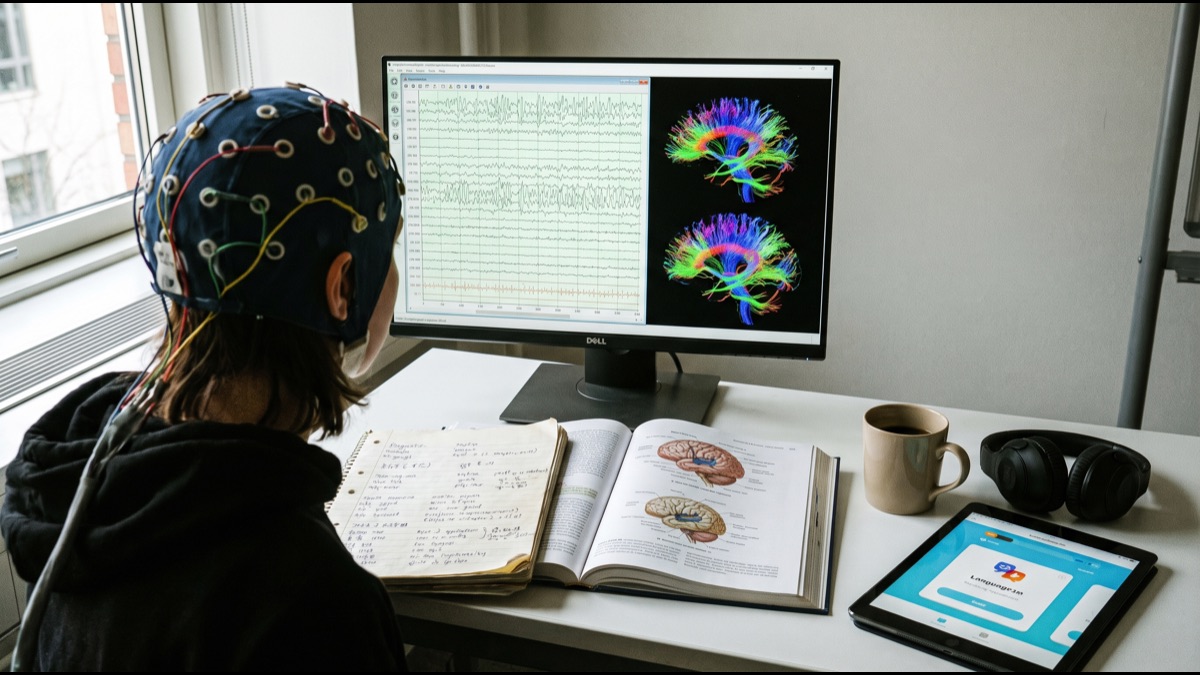
The widespread observation that children seem to acquire new languages more easily than adults reflects a genuine neurological reality, though the underlying mechanisms are more nuanced than the popular notion of a single 'critical period' that closes abruptly at a fixed age. Neuroscience and linguistics research has identified specific brain regions, developmental windows, and learning mechanisms that together explain how language acquisition actually works.
Understanding these mechanisms helps explain not just why children learn languages differently than adults, but also why certain language-learning methods tend to be more effective than others at any age.
The Key Brain Regions Involved
Language processing relies heavily on two specialized brain regions, both typically located in the left hemisphere for most right-handed people: Broca's area, involved primarily in language production and grammatical processing, and Wernicke's area, involved primarily in language comprehension, with damage to either region historically providing key evidence for their distinct roles through documented cases of specific language impairments following brain injury.
Beyond these classic regions, modern neuroimaging research has revealed that language processing actually engages a broader, more distributed network across the brain, including regions involved in memory, auditory processing, and even motor control, challenging the older, simpler model of language as confined to just two isolated brain areas.
The Critical Period Hypothesis
The critical period hypothesis, most associated with linguist Eric Lenneberg's 1967 research, proposes that there's a biologically limited window, roughly ending around puberty, during which the brain is optimally structured for acquiring native-like language proficiency, particularly for achieving accent-free pronunciation and fully intuitive grammatical processing.
More recent research has refined rather than overturned this idea: studies, including a large-scale 2018 analysis of language-learning data from millions of people, suggest language-learning ability doesn't decline sharply at one fixed age but rather declines gradually, with grammatical learning ability remaining relatively strong until around age 17-18, later than the traditional critical period model suggested, though achieving fully native-like pronunciation does appear to become measurably harder after early childhood specifically.
Why Children's Language Learning Differs From Adults'
Children acquire their first language largely implicitly, through constant immersive exposure and interaction, without explicit grammar instruction, a process supported by heightened neural plasticity, the brain's capacity to form and reorganize neural connections, which is measurably higher in early childhood than in adulthood.
Adults, by contrast, typically rely more heavily on explicit, conscious learning strategies, engaging brain regions associated with general problem-solving and working memory alongside dedicated language regions, which can actually provide certain advantages, including generally faster initial vocabulary acquisition and better use of existing knowledge (like grammatical concepts from a first language) to accelerate learning, even if achieving a fully native-sounding accent proves more difficult.
What This Means for Language Learners of Any Age
Neuroscience research on language learning offers practical guidance regardless of age: immersive, contextual exposure to a language (through conversation, media, and real-world use) tends to more effectively engage the brain's implicit learning systems than isolated vocabulary memorization alone, mirroring aspects of how children naturally acquire language.
For adult learners specifically, research suggests combining structured grammar study, which leverages adults' stronger explicit reasoning abilities, with substantial immersive practice, which engages implicit learning mechanisms, tends to produce better outcomes than relying exclusively on either approach alone, since adult brains retain meaningful language-learning capacity throughout life, even if the process looks somewhat different than a child's language acquisition.
Sources
- US National Institutes of Health — Neuroscience research on language processing brain regions
- Science journal (AAAS) — Publication of large-scale critical period research on language acquisition
- Linguistic Society of America — Reference on language acquisition research and the critical period hypothesis
FAQ
What are Broca's area and Wernicke's area?
Broca's area is involved primarily in language production and grammatical processing, while Wernicke's area is involved primarily in language comprehension, both typically located in the brain's left hemisphere for most right-handed people.
Is there really a 'critical period' for language learning that closes at a fixed age?
Recent research suggests language-learning ability declines gradually rather than at one fixed cutoff, with grammatical learning ability remaining relatively strong until around age 17-18, though native-like pronunciation becomes harder after early childhood.
Why do children seem to learn languages more easily than adults?
Children benefit from heightened neural plasticity and largely implicit learning through immersive exposure, while adults rely more on explicit, conscious learning strategies that offer different advantages and disadvantages.
Do adults have any advantages when learning a new language?
Yes. Adults generally show faster initial vocabulary acquisition and can use existing knowledge, like grammatical concepts from their first language, to accelerate learning, even if achieving native-like pronunciation proves harder.
What learning approach works best based on the neuroscience?
Research suggests combining structured grammar study with substantial immersive, contextual practice tends to produce better outcomes for adult learners than relying exclusively on either approach alone.
About the Author
doyouknow.app Editorial Team — We reference neuroscience and linguistics research to explain how the brain acquires and processes language across the lifespan.
Loved This Article?
Share it on WhatsApp → Share on WhatsApp
Get more guides in your inbox — Subscribe to our newsletter for weekly surprising stories from Egypt, Saudi Arabia, Dubai, and beyond.