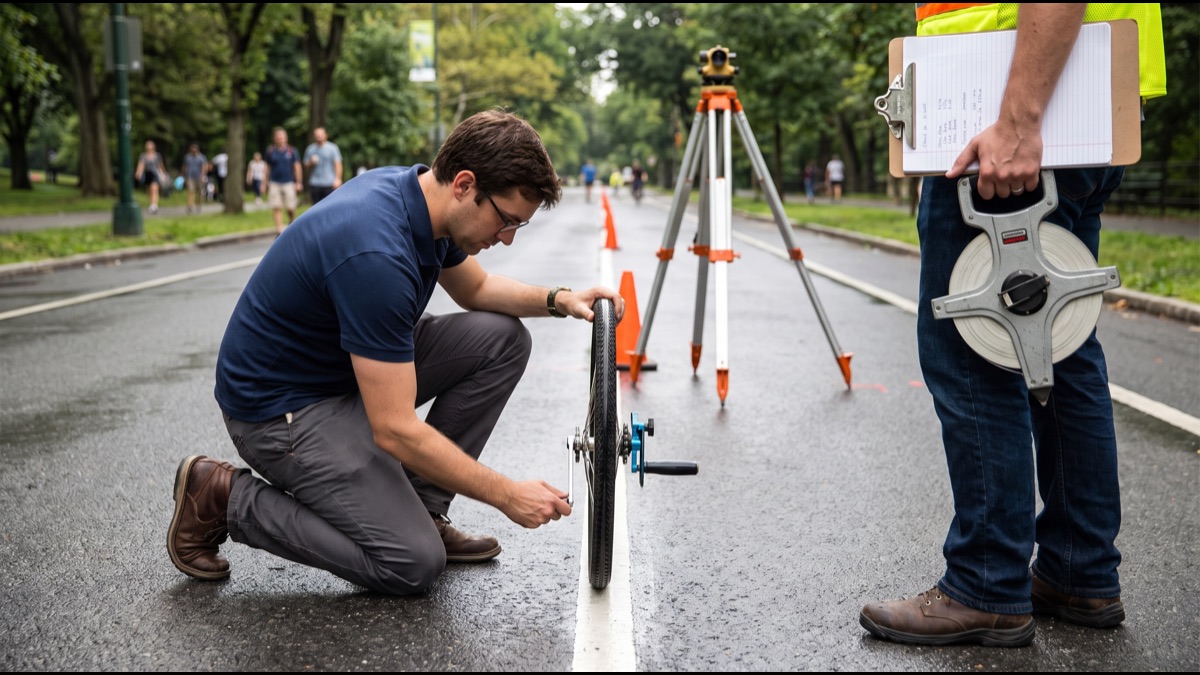
A marathon course that is even a few meters shorter than the official 42.195-kilometer distance can disqualify every single finishing time from that race for official record purposes, regardless of how fast anyone actually ran. Preventing that outcome requires a measurement process considerably more rigorous than simply trusting a GPS watch or a rough map estimate, one built around a surprisingly analog technique involving a specially calibrated bicycle ridden along the exact racing line.
Understanding how course certification actually works, from why GPS measurement is considered too imprecise for official purposes to the specific mathematical safety margin measurers deliberately build into every certified distance, reveals a genuinely rigorous scientific discipline operating quietly behind an activity most spectators experience as a purely athletic event.
It also explains why a world record performance can occasionally be thrown out entirely after the fact, and why race organizers investing in a properly certified course are making a decision with real consequences for whether their event can ever host a record-eligible performance at all.
Why a Few Meters Can Erase a World Record
Official marathon record recognition depends entirely on the race being run over a course whose exact distance has been independently verified and certified according to strict international standards, since a record time run on a course that turns out to be even slightly short would represent an unfair, invalid comparison against records set on courses of the genuine full distance.
This strict requirement exists specifically because running performance is so distance-sensitive at elite levels that even a small measurement error, a course a few dozen meters short, could meaningfully affect finishing times, making accurate certification not a bureaucratic formality but a genuine requirement for any comparison between performances to mean anything at all.
The stakes involved explain why certification bodies treat the process with such rigor, since a single measurement error discovered after the fact can force embarrassing retroactive record invalidation, a scenario every major certifying body and race organizer works hard to avoid entirely.
What Certification Actually Guarantees
A certified course carries a formal guarantee that its measured distance meets or exceeds the official marathon distance by a specific, deliberately calculated margin, verified through an approved measurement methodology and documented in a certificate that record-keeping bodies and race organizers can reference when validating results.
This certification is course-specific and route-specific rather than a general approval of a race event overall, meaning any change to the actual physical route, even a seemingly minor rerouting around construction or a road closure, technically invalidates the existing certification and requires new measurement before the altered course can again be considered record-eligible.
Race organizers hosting record-eligible events treat this certification requirement as a serious ongoing administrative responsibility rather than a one-time box to check, since maintaining valid certification requires re-verification whenever the course changes in any way that could affect its measured distance.
Why GPS Alone Cannot Certify a Course
Consumer GPS devices, including the sports watches many runners wear, have inherent accuracy limitations of several meters or more due to satellite signal characteristics, urban terrain interference, and device-specific measurement algorithms, an error margin that sounds small but is genuinely too large for official record-eligible course certification purposes.
This is precisely why a runner's GPS watch showing a slightly different distance than the official marathon length is not considered evidence of a mismeasured course; consumer GPS technology, however useful for personal training feedback, simply was not designed to the precision standard official course certification actually requires.
Certification bodies have consistently rejected proposals to use GPS as a primary certification method precisely because of this accuracy gap, insisting instead on a physical measurement technique capable of achieving accuracy far beyond what any consumer-grade satellite positioning technology can currently guarantee.
The Calibrated Bicycle Method Explained
The internationally recognized standard measurement technique uses a specially prepared bicycle fitted with a mechanical counter called a Jones Counter attached to the front wheel, which records the exact number of wheel rotations as a trained measurer rides the entire course along the specific racing line runners will actually follow.
Before measuring the actual course, the bicycle and counter combination is calibrated against a precisely known reference distance, typically a professionally surveyed calibration course, establishing an exact conversion factor between wheel rotations and physical distance that accounts for that specific bicycle's tire size, pressure, and the measurer's own riding characteristics.
This calibration step is repeated before and after the actual course measurement ride to check for any drift in the bicycle's rotation-to-distance relationship caused by tire wear, pressure changes, or temperature effects during the measurement process, ensuring the final calculated distance remains genuinely accurate throughout.
Why Measurers Ride the Shortest Possible Line
Certified measurers deliberately ride along the shortest possible legal path a runner could take through the course, generally hugging the inside edge of every curve and turn, since this represents the shortest distance any runner could legitimately cover while staying within the course boundaries.
This shortest-line approach exists specifically because certification needs to guarantee the course is at least the official distance for every runner, including elite competitors who will themselves tend to run the tightest possible line through corners to minimize their own effective distance, meaning the certified measurement has to account for that optimal racing line rather than an average or wider path.
Measuring anything other than this theoretical shortest line would risk certifying a course that could turn out to be shorter than the official distance for a runner executing perfect tangent lines through every turn, precisely the scenario certification is designed to prevent from ever happening.
How the Short Course Prevention Factor Works
Beyond precise measurement itself, certification standards require adding a small additional safety margin, commonly referred to as the short course prevention factor, deliberately making the certified course very slightly longer than the exact official distance rather than measuring to the precise minimum and risking any error resulting in an officially short course.
This deliberate slight overmeasurement, typically a very small percentage of the total distance, reflects an intentional bias toward certainty: race organizers and certifying bodies would rather a course be confirmed slightly long than risk any possibility of it being invalidated later as short, given how much more damaging a retroactive short-course finding would be.
This is precisely why elite marathon courses are essentially never found to be exactly the minimum legal distance, and why runners' GPS watches typically show a slightly longer distance than the official marathon length by race end, a difference explained by both this deliberate safety margin and the runner's own actual path deviating somewhat from the exact certified tangent line.
What Happens on Certification Day Itself
A certification measurement ride typically involves multiple complete passes over calibration segments and the full course itself, with a trained, accredited measurer following detailed international measurement protocols and recording precise data at multiple points along the route to support the final certified distance calculation.
This process generally takes considerably longer than simply riding the course once, since accurate calibration checks before and after the measurement ride, careful navigation of the exact tangent line through every turn, and detailed documentation all add meaningfully to the total time required to complete a proper certification measurement.
Race organizers typically schedule this certification well in advance of race day, since the process, documentation, and formal certificate issuance by the relevant national or international athletics federation all take time to complete before the course can be officially listed as certified for the upcoming event.
Why Elevation Drop Rules Exist for Records
Beyond pure distance accuracy, record-eligible courses must also meet specific rules limiting the net elevation drop from start to finish and the maximum allowable separation between start and finish points, restrictions designed specifically to prevent a course from gaining an unfair performance advantage through excessive net downhill running or point-to-point wind assistance.
These additional rules exist because pure distance certification alone would not prevent a technically accurate course from still producing artificially fast times through a significant net elevation drop, meaning distance measurement and course elevation and geometry rules work together as a complete package of requirements for genuine record eligibility.
Race organizers designing a new course specifically intending to host record-eligible performances have to consider these elevation and point-to-point rules from the earliest planning stages, since a scenic but excessively downhill route might measure perfectly accurately yet still fail to qualify for record eligibility under these separate geometric restrictions.
How Course Changes Force Re-Certification
Any meaningful alteration to a previously certified course, whether from permanent road changes, construction detours, or a deliberate route redesign by organizers, technically invalidates the existing certification, requiring a new measurement ride and updated certificate before the altered course can again be considered valid for record purposes.
This strict re-certification requirement means race organizers cannot simply assume a course remains certified indefinitely once initially measured, particularly in rapidly developing urban areas where road infrastructure changes are common enough that even a well-established annual race may periodically need to re-verify its course remains accurately measured.
Experienced race organizers build this potential re-certification need into their long-term event planning, maintaining relationships with accredited measurers and monitoring any planned infrastructure changes along their course specifically to catch and address certification issues before they become a problem discovered too late.
Why Record-Eligible Races Face Extra Scrutiny
Major marathons specifically positioning themselves as venues for elite record attempts undergo particularly careful course verification and monitoring, since the reputational and practical consequences of a certification problem are considerably higher for a race actively marketing itself around record-setting potential compared to a smaller community race with no serious record ambitions.
This extra scrutiny often includes independent verification measurements by multiple accredited measurers, detailed public documentation of the certified route, and ongoing monitoring for any physical changes along the course that could affect its certified status between certification and the actual race date.
Elite athletes and their management teams also frequently do their own due diligence on a course's certification status before committing to attempt a record there, since a serious professional runner has genuine career and financial incentive to avoid running a record-pace performance on a course whose certification later proves questionable.
What Happens When a Certified Course Is Found Short
In the rare cases where a previously certified course is later discovered to have been measured incorrectly and found to be short of the official distance, any record performances achieved on that course face retroactive review and potential invalidation, an outcome considered a serious, embarrassing failure for the certifying process involved.
These incidents, while uncommon precisely because of how rigorous standard certification protocols are, have occurred historically enough to reinforce why certifying bodies maintain such strict measurement standards and safety margins, treating every certification as carrying genuine reputational and competitive stakes rather than being a routine administrative formality.
When such a case does emerge, athletics governing bodies typically conduct a formal review process examining the original measurement documentation, potentially remeasuring the course independently, before making any final determination about whether affected performances should be formally invalidated from the official record books.
How Gulf Marathons Fit Into This Global System
Major marathons across the UAE and wider Gulf region seeking international recognition and elite participation follow the same internationally recognized certification standards and processes used worldwide, engaging accredited measurers trained in the standard bicycle measurement methodology to ensure their courses meet the same rigorous requirements as established marathons elsewhere.
This adherence to global standards is part of what allows Gulf marathons to attract serious elite competition and be taken seriously within international athletics, since a course lacking proper certification would simply be ineligible to host any record-eligible performance regardless of how well-organized or well-funded the broader event might otherwise be.
As the region's marathon and running event calendar has grown substantially in recent years, proper course certification has become a genuine competitive differentiator between events seeking to attract serious elite fields versus purely recreational participation-focused races without the same certification investment.
Why Certification Bodies Operate Independently of Race Organizers
Course certification is deliberately performed by measurers accredited through international or national athletics federations independent of the race organizing committee itself, a structural separation designed specifically to prevent any conflict of interest between an organizer's desire to advertise a record-eligible course and objective, accurate measurement of that course's actual distance.
This independence is treated as a genuinely important safeguard within the broader certification system, since an organizer directly measuring and certifying their own course would create an obvious incentive problem, particularly for organizers eager to market their event specifically as record-eligible to attract elite competitors and media attention.
Accredited measurers themselves generally build professional reputations specifically around the accuracy and reliability of their certification work, giving them a strong independent incentive to maintain rigorous standards regardless of what a particular race organizer might prefer to hear about their course's measured distance.
How the Measurement Community Trains New Certified Measurers
Accredited measurers typically learn the calibrated bicycle methodology through formal training programs run by national athletics federations, combining classroom instruction on measurement theory with supervised practical measurement rides, before being certified themselves to independently measure and certify race courses on their own.
This structured training pipeline exists specifically to maintain consistent measurement quality across a global network of independent measurers working in different countries and conditions, ensuring a course measured in one country meets the exact same rigorous standard as a course measured anywhere else in the world.
The relatively small, specialized global community of accredited measurers also maintains active professional communication, sharing updated best practices, unusual measurement challenges, and lessons learned from any certification disputes, helping the entire discipline improve collectively rather than each measurer working in isolation.
What Happens to Record Claims During the Verification Window
After an apparent record performance, official ratification typically takes weeks or months while governing bodies verify anti-doping compliance, review course certification documentation, and confirm the performance meets every other technical requirement, meaning a headline-grabbing record announced immediately after a race is technically provisional until this full review concludes.
This verification window exists precisely to catch any issue, whether a doping violation or a course measurement question, before a record becomes permanently enshrined in the official record books, treating record ratification as a deliberate, thorough process rather than an instant declaration based purely on a finish-line clock reading.
Athletes and their teams generally understand and accept this delay as a necessary part of the system, recognizing that the same rigorous verification protecting the integrity of their own potential record also protects them from having their achievement unfairly undermined by someone else's improperly verified claim.
What Runners Actually Gain From a Certified Course
Beyond enabling official record eligibility, course certification gives every runner, not just elite competitors chasing records, genuine confidence that their personal finishing time reflects an accurately measured distance, meaningful for anyone tracking personal progress, qualifying for other events based on time standards, or simply wanting confidence in what their result actually represents.
This broader value to everyday participants is part of why course certification has become a standard, expected feature of any serious marathon event rather than a specialized concern relevant only to elite-level competition, since accurate distance measurement genuinely matters to the credibility of every single finisher's result, not only those setting or chasing records.
That combination, rigorous scientific measurement serving both elite record integrity and everyday runner confidence simultaneously, is what makes marathon course certification a genuinely essential, if largely invisible, piece of infrastructure underlying every serious distance running event held anywhere in the world.
Sources
- Wikipedia — overview of marathon course measurement and certification standards
- World Athletics — official international standards for record-eligible course certification
- Association of International Marathons and Distance Races — background on global marathon course certification practices
- USA Track & Field — detailed background on the calibrated bicycle measurement methodology
FAQ
Why can’t a marathon course just be measured using GPS?
Consumer GPS devices have inherent accuracy limitations of several meters due to satellite signal characteristics and terrain interference, an error margin too large for official record-eligible certification, which requires a calibrated bicycle measurement method instead.
What is the Jones Counter and how is it used?
It is a mechanical counter attached to a bicycle’s front wheel that records exact wheel rotations as a trained measurer rides the shortest legal racing line through the entire course, converting rotations into precise distance using a pre-calibrated conversion factor.
Why are certified marathon courses always slightly longer than 42.195 kilometers?
Certification standards deliberately add a small safety margin called the short course prevention factor, making the course very slightly longer than the exact official distance rather than risking any measurement error resulting in an officially short course.
What happens if a road construction project changes a certified course?
Any meaningful alteration to a previously certified route technically invalidates the existing certification, requiring a new measurement ride and updated certificate before the altered course can again be considered valid for record purposes.
Can a marathon world record be invalidated after the race is over?
Yes — in rare cases where a certified course is later discovered to have been measured incorrectly and found short, any record performances achieved on it face retroactive review and potential invalidation by the relevant athletics governing body.
About the Author
We reference Wikipedia and other authoritative sources to explain the background and current understanding of this topic.
Loved This Article?
Share it on WhatsApp → Share it on WhatsApp
Get more guides in your inbox — Subscribe to our newsletter for weekly surprising stories from Egypt, Saudi Arabia, Dubai, and beyond.