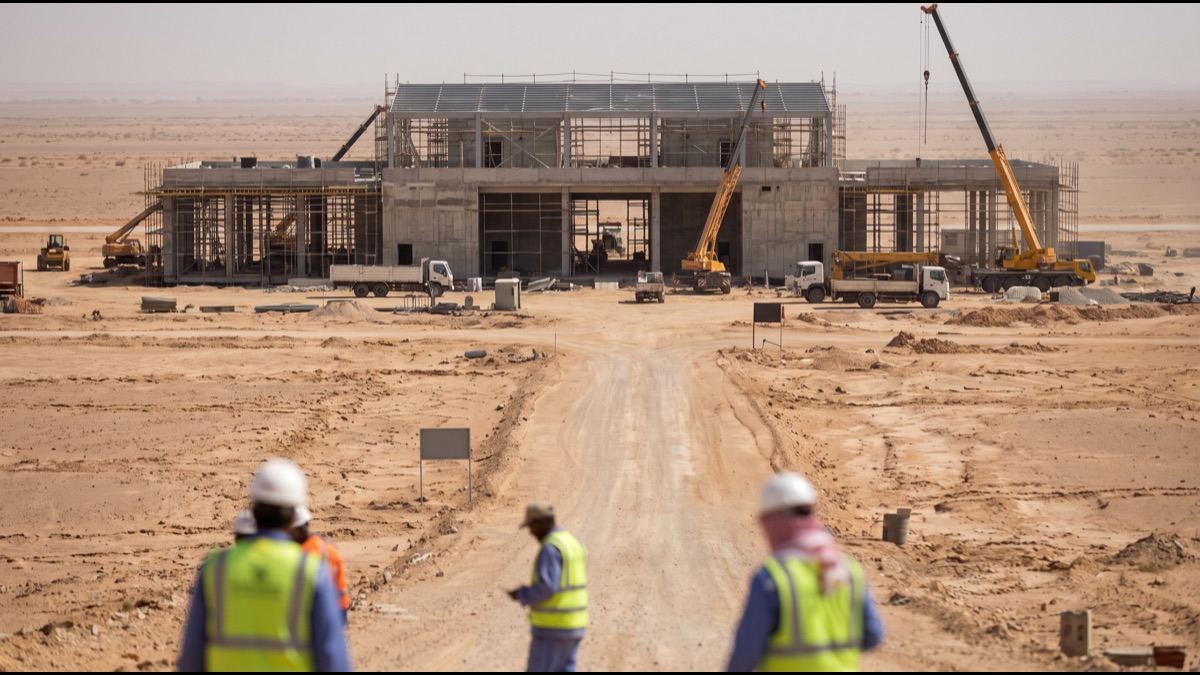
Airports are normally the last major piece of infrastructure a region builds, arriving only once a city has enough people, businesses, and tourism demand to justify the investment. NEOM Airport inverts that sequence entirely. Construction on the airport began while the city it is meant to serve, including the widely discussed linear development known as The Line, was still in early phases of planning and construction. Understanding why NEOM's developers made this choice, and how they are managing the very real risks of building infrastructure ahead of demand, says a lot about how giga-projects are financed, phased, and justified in ways ordinary urban development rarely requires.
Why Airports Usually Come Last, Not First
In conventional urban development, transport infrastructure follows population and economic activity rather than leading it. A region typically grows through smaller-scale industry, housing, and local transport networks first, and only once passenger and cargo volumes reach a certain threshold does building a full international airport become financially justifiable.
This sequencing exists because airports are extraordinarily expensive to build and even more expensive to operate at a loss. Runways, terminals, air traffic control systems, customs and immigration facilities, and ground transport connections all require significant ongoing staffing and maintenance regardless of how many flights actually use them.
Building an airport before there is a city to fill it therefore represents a deliberate reversal of normal risk management, betting that demand will eventually catch up to the infrastructure rather than building infrastructure in response to demand that already exists.
NEOM's Unusual Development Logic
NEOM as a whole was conceived not as an incremental expansion of an existing city but as a from-scratch development across a large stretch of northwestern Saudi Arabia, intended to eventually house a substantial resident population alongside major new industries and tourism.
Because there was no existing urban base to build outward from, the project's planners faced a genuine chicken-and-egg problem: without transport access, it is difficult to bring in the construction workforce, engineers, and early residents needed to build the city, but without a city, there is no obvious passenger base to justify major transport infrastructure.
The airport was positioned as a way to break that cycle, providing access for the tens of thousands of workers and specialists needed during the construction phase itself, long before the project reaches anything resembling its intended final population.
The Phased Construction Approach
Rather than being built all at once to its eventual full specification, NEOM Airport has been developed and opened in stages, with earlier phases focused on serving a limited volume of official, business, and construction-related travel rather than full commercial passenger traffic.
This phased approach allows the airport to become operational and useful well before the surrounding city is complete, supporting the practical logistics of the broader construction effort while keeping the scale of initial operations proportional to actual near-term demand rather than the eventual long-term vision.
As surrounding development progresses and population and business activity in the area grow, the expectation is that airport capacity, routes, and commercial passenger services will expand correspondingly, rather than the airport sitting idle at full scale waiting for demand to arrive.
Who Uses the Airport in Its Early Phase
In its initial operating phase, an airport built ahead of its city primarily serves a narrow but essential set of users: government officials, project executives, international engineering and architecture teams, investors touring the site, and skilled workers rotating in and out of the construction effort.
This is a fundamentally different passenger profile from a typical commercial airport, which serves a broad mix of tourists, business travelers, and residents visiting family. Early-phase infrastructure like this is closer in function to airports built to serve remote industrial sites, such as mining operations or oil and gas facilities, than to a conventional city airport.
Over time, as hospitality, tourism, and residential elements of the broader project come online, the passenger mix is expected to broaden, gradually shifting the airport's role from a construction-support facility toward something resembling a conventional gateway airport.
The Financial Logic Behind Building Ahead of Demand
Building infrastructure before it is needed is normally considered poor financial practice, since idle capacity represents money tied up in assets that are not generating a proportional return. Giga-projects like NEOM justify this differently, treating early infrastructure as an enabling investment rather than a standalone revenue-generating asset.
The logic is that the airport's early value comes not from ticket revenue or landing fees, but from the acceleration it provides to the entire project timeline, by making it dramatically faster and cheaper to move people, equipment, and expertise into a remote and previously undeveloped region.
This framing shifts the airport from being judged purely on its own operating economics to being judged as part of the total cost and schedule of the broader development, similar to how a construction site's temporary access roads are not expected to be profitable in themselves.
Comparisons to Other Airports Built Ahead of Demand
NEOM Airport is not the first example of transport infrastructure built substantially ahead of the population it will eventually serve. Several planned capital cities around the world, and a number of large-scale industrial or resource-extraction developments, have taken a similar approach of building an airport early to enable subsequent development.
What distinguishes NEOM's situation is primarily scale and ambition: the city it is meant to eventually serve is intended to be far larger and more economically diverse than the typical remote industrial outpost, meaning the gap between the airport's early-phase usage and its eventual intended capacity is unusually wide.
This wide gap makes NEOM Airport a useful case study in infrastructure sequencing more broadly, illustrating both the potential benefits of accelerating development timelines and the genuine financial risk of infrastructure that may take many years to reach its intended utilization.
The Engineering Challenges of a Remote Desert Location
Beyond the unusual demand timing, building an airport in a remote, largely undeveloped desert region presents its own engineering challenges that would not apply to expanding an airport within an already-developed city.
Power, water, fuel supply, and connecting road infrastructure often need to be built essentially from scratch alongside the airport itself, rather than tapping into existing regional utility networks, adding both cost and complexity relative to airport expansions in established metropolitan areas.
Extreme heat, blowing sand, and the general logistics of supplying a remote construction site with materials and labor also shape the construction timeline and methods in ways that airport projects closer to existing supply chains and infrastructure do not typically face to the same degree.
How This Fits Into Saudi Arabia's Broader Development Strategy
NEOM sits within a wider Saudi Vision 2030 strategy aimed at diversifying the national economy away from oil dependence, in part by creating new hubs for tourism, technology, and advanced industry in previously undeveloped regions of the country.
Within that strategy, building transport infrastructure ahead of full urban development is a recurring pattern rather than a one-off decision specific to NEOM, reflecting a broader approach of using major infrastructure investment to catalyze regional development rather than waiting for organic growth to justify it.
This approach carries higher upfront financial risk than incremental development, but is intended to compress development timelines that might otherwise take many decades under a conventional, demand-led approach to urban and transport planning.
What Success Would Actually Look Like
Because the airport was built ahead of its city rather than in response to it, evaluating its success requires a different timeline and different metrics than would apply to a conventional airport expansion project.
In the near term, success looks like the airport reliably supporting the logistics of an enormous, sustained construction effort, reducing travel time and cost for the workforce and specialists the broader project depends on, rather than achieving high passenger volumes or strong commercial revenue.
In the longer term, success would mean the airport's capacity utilization gradually catching up to its built infrastructure as the surrounding city genuinely develops, closing the gap between the facility's design capacity and its actual usage rather than leaving that gap permanently unfilled.
The Genuine Risk of Underutilized Infrastructure
The most significant risk in this build-ahead-of-demand approach is straightforward: if the broader city development slows, is scaled back, or takes substantially longer than planned, the airport risks remaining underutilized relative to its built capacity for an extended period.
This is not a hypothetical concern specific to NEOM; large infrastructure projects built in anticipation of future demand have, in other parts of the world, sometimes taken far longer than expected to reach meaningful utilization, representing a real opportunity cost on the capital invested.
Saudi Arabia's ability to sustain the broader giga-project timeline, including funding, workforce availability, and continued policy commitment over what will likely be a multi-decade horizon, is therefore closely tied to whether this kind of ahead-of-demand infrastructure investment ultimately proves justified.
How This Differs From a Typical Airport Expansion Project
A conventional airport expansion, such as adding a new terminal or runway to an existing facility, is usually justified by clear, measurable current demand: existing flight delays, capacity constraints, or documented passenger growth trends that make the case for investment straightforward.
NEOM Airport instead relies on projected future demand tied to a development that is itself still being built, meaning the investment case rests on assumptions about the pace and eventual success of the broader city rather than on data from current operations.
This distinction matters for how the project should be evaluated by outside observers: judging it purely against the metrics used for conventional airport expansions, such as current passenger throughput, risks missing the actual strategic purpose the airport is intended to serve in its early years.
The Role of International Aviation Partnerships
Developing a new international airport from scratch typically involves partnerships with established aviation authorities, airlines, and airport-operations firms that bring the technical expertise needed for air traffic control, safety certification, and operational management.
For a giga-project airport built ahead of an established passenger base, these partnerships are particularly important, since the operator needs to design systems and staffing levels that can scale efficiently as demand grows, rather than either overbuilding capacity that sits unused or underbuilding in a way that constrains growth later.
These partnerships also help establish the airport's credibility with international carriers who might eventually consider adding routes, since airlines generally look for evidence of professional, internationally certified operations before committing to serve a new destination.
What Travelers and Businesses Should Understand Today
For travelers and businesses considering the region in its current, early-development phase, it is worth understanding that access via NEOM Airport reflects the project's construction-phase priorities rather than the full range of commercial services a completed international airport would eventually offer.
Flight availability, route options, and passenger services are likely to expand gradually and unevenly as different parts of the broader NEOM development come online, rather than arriving all at once in a single completed state.
Anyone planning travel connected to the region should expect to check current, official information directly rather than assuming the airport already operates at the scale or with the commercial route network that a mature, fully developed international airport would typically provide.
A Broader Lesson in Infrastructure Sequencing
NEOM Airport offers a genuinely unusual real-world case study in a question infrastructure planners debate more often in theory than in practice: whether it is better to build capacity in anticipation of growth, or to let growth justify capacity as it happens organically.
Both approaches carry real trade-offs. Building ahead of demand accelerates development but risks significant underutilization if growth disappoints, while waiting for demand to materialize avoids that risk but can slow overall development considerably, particularly in a remote region with no existing infrastructure to build from.
How this particular experiment plays out over the coming years, as the broader NEOM development either accelerates, slows, or evolves, will likely become a widely referenced example in discussions of large-scale infrastructure planning well beyond Saudi Arabia itself.
Why Air Cargo Logistics Matter Just as Much as Passengers
An early-phase airport serving a large, remote construction project isn't just about moving people; it also needs to handle a substantial and steady flow of construction materials, specialized equipment, and supplies that would otherwise require much longer overland transport.
This cargo function is arguably just as important as passenger service in the airport's early years, since keeping a massive, remote construction effort supplied efficiently is itself a major logistical challenge that benefits enormously from direct air access.
As the project matures, the balance is expected to shift gradually from cargo and workforce logistics toward more conventional passenger and tourism traffic, mirroring the broader transition the entire development is meant to undergo over time.
How Air Traffic Control Infrastructure Gets Built for a Region, Not Just One Airport
Establishing aviation infrastructure in a previously undeveloped region typically requires more than just a runway and terminal; it involves building out air traffic control coverage, navigation aids, and airspace management systems for what has historically been a low-traffic area.
This regional infrastructure build-out is a less visible but essential part of the overall project, since a single new airport cannot operate safely and efficiently without the surrounding air traffic management ecosystem being upgraded to match.
This is one of the reasons airport development timelines in genuinely new locations often extend well beyond what the physical construction alone would suggest, since the supporting aviation infrastructure has to be built essentially from scratch.
Why Comparisons to Failed 'Ghost Airport' Projects Are Often Raised
Critics and skeptics sometimes point to airports built elsewhere in the world that ended up significantly underused relative to their planned capacity, cautioning that ambitious infrastructure built ahead of proven demand carries real financial and reputational risk if the anticipated growth doesn't materialize.
Proponents counter that NEOM's airport differs from those cautionary examples because it exists to serve an active, ongoing megaproject with committed long-term government investment behind it, rather than a speculative bet on future tourism or business growth with no anchor development.
Whether this distinction proves meaningful in practice will depend heavily on execution over the coming years, which is exactly why independent observers continue to treat the project's ultimate outcome as genuinely uncertain rather than a foregone conclusion in either direction.
What Environmental and Land-Use Considerations Come Into Play
Building aviation infrastructure in a previously undeveloped coastal desert region raises environmental review questions similar to those faced by any large-scale infrastructure project sited in a relatively untouched natural landscape, including impacts on local ecosystems and land use.
Project planners have described environmental and sustainability considerations as part of the broader NEOM development philosophy, though independent, third-party assessment of how these commitments translate into actual construction practices is still an evolving picture as the project progresses.
This is a common tension in any large greenfield infrastructure project: the scale that makes ambitious development possible is the same scale that makes environmental impact a serious and legitimate consideration worth ongoing scrutiny.
How Workforce Housing Ties Into the Airport Timeline
A project of this scale requires housing tens of thousands of construction workers and staff near the site, and the airport's early operational phase is closely tied to supporting this workforce logistics chain rather than serving tourism or business travel from day one.
Coordinating workforce transport, housing construction, and airport operations simultaneously is itself a significant planning challenge, since all three systems depend on each other functioning smoothly during a period when none of the surrounding infrastructure is yet fully mature.
This interdependency is a good illustration of why building a city essentially from nothing requires solving many infrastructure problems in parallel rather than sequentially, which is part of what makes NEOM's overall development approach unusual compared to how most cities historically grew.
How Phased Airport Construction Actually Works
Rather than building full commercial capacity upfront, phased airport development typically starts with a smaller operational footprint scoped to immediate needs — supporting construction logistics, official visits, and early workforce travel — with runway, terminal, and support infrastructure designed for later expansion rather than built to final scale from day one.
This staged approach lets planners avoid the capital risk of building maximum capacity for a population and travel demand that does not yet exist, while still ensuring the airport can scale relatively quickly once the surrounding development reaches a stage where commercial passenger and cargo volumes justify additional capacity.
Aviation planners describe this as demand-responsive infrastructure design, a departure from the more traditional model of building airports to serve an already-established population, and one that requires more sophisticated long-range forecasting since the infrastructure has to anticipate demand years or decades ahead of it materializing.
Why This Model Carries Distinct Risks
Building transportation infrastructure ahead of demand carries a structural risk that traditional demand-following infrastructure does not: if the city or population the airport is meant to eventually serve develops more slowly than planned, or in a different form than originally envisioned, the airport's design assumptions may need significant revision well after major capital has already been committed.
Economists studying large-scale, demand-ahead infrastructure investment note that this approach essentially bets public and private capital on a forecast rather than responding to a proven, already-existing need, a bet that can pay off significantly if the underlying development succeeds on schedule but carries real downside if it does not.
Project planners typically try to manage this risk by keeping the earliest phases of construction modest and flexible relative to the most ambitious long-term plans, preserving the option to slow, redirect, or scale back later phases based on how the broader development actually unfolds rather than locking in an inflexible full build from the outset.
Building an airport for a city that does not yet fully exist inverts the normal logic of infrastructure development, and NEOM Airport is a rare, large-scale example of that reversal actually being attempted in practice. Its early years are best understood not as a conventional commercial airport judged on passenger volume, but as a piece of enabling infrastructure designed to accelerate an enormous and still-unfolding construction effort. Whether the bet pays off depends on factors well beyond aviation itself, including the pace, funding, and ultimate scale of the broader NEOM development it was built to serve. For now, it stands as one of the more visible illustrations of how giga-projects choose to sequence infrastructure investment differently than conventional urban development ever would.
Sources
- NEOM Official Website — Primary source for NEOM's stated development plans and project updates.
- Saudi Vision 2030 Official Portal — Government source for the broader economic diversification strategy NEOM sits within.
- International Civil Aviation Organization (ICAO) — Background on standard airport planning and certification practices referenced for comparison.
- General Authority of Civil Aviation, Saudi Arabia — Saudi civil aviation regulatory body overseeing airport certification and operations.
FAQ
Why would anyone build an airport before the city it serves is finished?
Because the surrounding area had no existing transport access, developers used the airport to move in the construction workforce, engineers, and officials needed to build the city itself, rather than waiting for population to justify the airport first.
Who actually uses NEOM Airport right now?
In its early phase, the airport primarily serves government officials, project executives, international engineering teams, investors, and workers rotating in and out of the construction effort, rather than typical tourist or resident traffic.
Is this kind of build-ahead-of-demand approach unique to NEOM?
No — several planned capital cities and remote industrial developments elsewhere have built airports ahead of population, though the eventual scale intended for NEOM makes the early demand gap unusually wide.
What is the biggest risk of building infrastructure this far ahead of demand?
If the broader city development slows or is scaled back, the airport risks staying underutilized relative to its built capacity for an extended period, representing a real opportunity cost on the investment.
Will the airport eventually operate like a normal international airport?
That is the intended trajectory as surrounding development progresses, with routes, capacity, and commercial passenger services expected to expand gradually, though the timeline depends on the pace of the broader NEOM project.
About the Author
We reference NEOM Official Website, Saudi Vision 2030 Official Portal, International Civil Aviation Organization (ICAO), and General Authority of Civil Aviation, Saudi Arabia to explain the background and current understanding of this topic.
Loved This Article?
Share it on WhatsApp → Share it on WhatsApp
Get more guides in your inbox — Subscribe to our newsletter for weekly surprising stories from Egypt, Saudi Arabia, Dubai, and beyond.