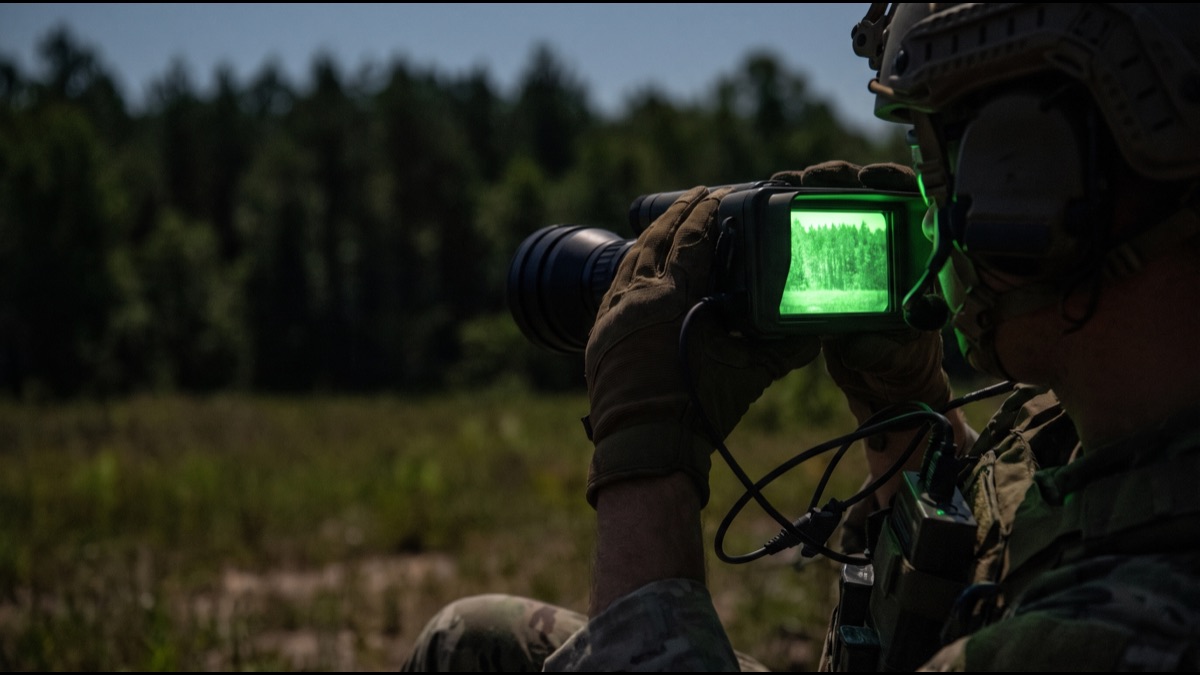
Night vision is not one invention but two genuinely different technologies wearing the same green-tinted reputation, and mixing them up is the single most common misunderstanding people carry about how machines actually see in the dark. One family of devices, image intensification, works by grabbing every scrap of faint visible light already present in a scene and amplifying it tens of thousands of times until a human eye can finally make sense of it. The other, thermal imaging, ignores visible light entirely and instead builds a picture out of the infrared heat that every object, living or not, is constantly radiating.
These two approaches solve overlapping but distinct problems, and understanding which one is actually doing the work in a given pair of goggles explains almost everything else about how the device behaves: what it needs to function, what defeats it, what it costs, and why a soldier, a hunter, and a wildlife researcher might each reach for a completely different type of unit despite all three describing what they own as simply "night vision."
The core trick behind image intensification is deceptively simple to state and remarkably intricate to execute: convert incoming photons into electrons, multiply those electrons enormously, and convert them back into visible light on a small screen pressed close to the eye. Thermal imaging skips light altogether and instead measures temperature differences across a scene precisely enough to render them as a recognizable picture, which is why it keeps working in total darkness, through smoke, and even through certain kinds of camouflage that would completely defeat a light-amplifying device.
What follows walks through both technologies from the ground up, the physical components involved, why each one has genuine limitations the other does not share, and how the two are increasingly fused into single devices that give operators the advantages of both at once.
How Image-Intensifier Tubes Actually Amplify Ambient Light
An image-intensifier tube, the heart of classic green-glow night vision, works by converting a trickle of incoming photons into a flood of electrons and then multiplying that electron stream by a factor that can exceed thirty thousand before turning it back into visible light. The entire process happens inside a sealed glass and ceramic tube roughly the size of a small flashlight, mounted directly behind the objective lens of a set of goggles or a rifle scope.
Photons from starlight, moonlight, or distant artificial light sources enter the tube and strike a photosensitive surface, triggering the release of electrons in rough proportion to how much light hit that particular point. Those electrons are then accelerated across a voltage gap and multiplied dramatically before striking a phosphor-coated screen, which glows in response and reproduces the original scene, just far brighter than what the naked eye alone could ever perceive.
Because the entire chain depends on genuine physical light actually entering the tube, an image intensifier is fundamentally an amplifier rather than a light source, and this single distinction explains both its greatest strength, extraordinary sensitivity to faint natural light, and its most fundamental weakness, complete uselessness in a scene with no ambient light present whatsoever.
Why Night Vision Still Needs Some Light to Work at All
A common misconception holds that image-intensifier night vision lets a person see in absolute total darkness, but the technology actually depends entirely on some baseline quantity of ambient light already existing in the environment, even if that quantity is far too small for an unaided human eye to detect. Starlight alone, on a clear night away from artificial lighting, provides enough photons for a good-quality tube to build a usable image.
Moonlight dramatically improves image quality, which is precisely why night-vision-equipped forces have historically planned operations around lunar phase, favoring darker nights for genuine concealment while still relying on the residual illumination a moonless but starlit sky reliably provides. Overcast conditions that block starlight, combined with no moon and no artificial lighting nearby, can push even excellent tubes toward the very edge of their performance.
This is exactly why many image-intensifier devices are paired with an infrared illuminator, a small light source invisible to the naked human eye but clearly visible to the tube, which effectively manufactures the ambient light the tube requires in an otherwise truly pitch-black space such as a windowless building interior or a cave.
Inside the Photocathode, Microchannel Plate, and Phosphor Screen
The photocathode is the first critical component light actually strikes inside the tube, a thin layer of material specifically chosen because it reliably ejects electrons when struck by photons, a phenomenon known as the photoelectric effect. The efficiency of this specific layer, how many electrons it releases per incoming photon, is one of the single biggest factors separating a mediocre tube from an exceptional one.
Those newly freed electrons are then funneled into a microchannel plate, a wafer-thin disc containing millions of microscopic glass channels, each acting as its own tiny electron multiplier. As electrons cascade down these channels, they repeatedly strike the channel walls, knocking loose additional electrons with every collision, so a single incoming electron can emerge from the far side of the plate as thousands.
Those multiplied electrons finally strike a phosphor screen, a coating that converts the electron energy back into visible light, precisely reproducing the spatial pattern of the original scene but at dramatically greater brightness. A small lens then relays that glowing phosphor image to the viewer's eye, completing a chain that takes a scene too dark for a human to perceive and renders it clearly visible within a fraction of a second.
Why the Image Glows Green, and Sometimes White
Classic night-vision green comes from a deliberate design choice about which phosphor compound coats the tube's output screen, not from any property of the light being amplified itself. Phosphor formulated to glow green was chosen specifically because the human eye can distinguish more subtle shades of green than of almost any other color, meaning a green-tinted image preserves more usable visual detail and contrast than a comparably bright image rendered in another hue.
Green phosphor also fatigues the eye considerably less than white or other colors during extended viewing sessions, an important practical consideration for military and law-enforcement users who may spend hours at a time looking through a scope or a set of mounted goggles during an operation.
Newer digital and some higher-end analog systems increasingly use white phosphor instead, which many users report as offering better contrast, sharper edges, and a more natural-feeling picture that more closely resembles familiar black-and-white photography, even though the underlying image-intensification physics generating that picture remains essentially unchanged.
How Thermal Imaging Works in a Completely Different Way
Thermal imaging abandons visible light amplification entirely and instead detects infrared radiation, the heat energy that every object above absolute zero constantly emits regardless of whether any visible light is present in the scene at all. A specialized sensor called a microbolometer array, typically composed of thousands of individual heat-sensitive pixels, measures tiny temperature differences across the field of view.
Each pixel in the array changes its electrical resistance slightly in response to the infrared energy striking it, and onboard electronics convert those countless tiny resistance changes into a detailed thermal map that gets rendered as a viewable image, usually with warmer objects appearing in brighter tones and cooler surfaces in darker ones, or sometimes in vivid false-color palettes designed to make subtle temperature differences easier to interpret at a glance.
Because thermal imaging measures heat rather than reflected or ambient light, it requires absolutely no illumination of any kind to function, which fundamentally separates it from image intensification and explains why thermal cameras remain fully operational in environments where light-amplifying night vision becomes completely useless.
Why Thermal Cameras See Through Smoke and Total Darkness
Smoke, light fog, and foliage scatter and block visible light quite effectively, which is precisely why a person using image-intensifier goggles in a smoke-filled room typically sees very little useful detail. Infrared radiation, however, generally passes through many of these same obstructions with considerably less scattering, allowing a thermal camera to often resolve a warm human silhouette clearly even when the room is visually opaque to the naked eye.
This particular property makes thermal imaging genuinely indispensable for firefighters searching smoke-filled structures for trapped occupants, for search-and-rescue teams working through dense forest canopy, and for border and maritime patrol operations scanning open terrain or water for a person's distinctive heat signature against a cooler background.
Total darkness poses no challenge whatsoever to thermal imaging precisely because it was never relying on light in the first place, which is why thermal cameras function identically at high noon and at midnight, a genuine advantage over image intensification that depends entirely on residual light being present somewhere in the scene.
The Generational Tiers: Gen 1 Through Gen 3 and Beyond
Image-intensifier tubes are commonly classified into generations, a rough industry shorthand for the underlying technology and manufacturing approach rather than a strict, universally standardized scale, and each successive generation generally delivers meaningfully better sensitivity, resolution, and operational lifespan than the one before it.
Generation 1 tubes, the earliest widely available consumer type, offer only modest light amplification and noticeable image distortion toward the edges of the field of view, making them serviceable for casual use but genuinely limited in truly low-light conditions. Generation 2 introduced the microchannel plate as a distinct component, dramatically boosting amplification and image clarity over the earlier design.
Generation 3, the current standard for most military-grade equipment, uses a gallium arsenide photocathode that converts photons to electrons far more efficiently than earlier materials, along with an ion barrier film that substantially extends tube lifespan. Some manufacturers now market a Generation 4 designation for further-refined variants, though the term is used less consistently across the industry than the earlier generational tiers.
Military-Grade Night Vision Versus Consumer Devices
Military-specification night vision typically uses the highest available tube generation, undergoes rigorous testing for durability against shock, moisture, and extreme temperature, and is manufactured to exacting optical tolerances that meaningfully increase both performance and cost compared to devices built for hunting, camping, or general civilian use.
Export controls further separate the two markets in many countries, since the clearest, most sensitive tube generations are frequently classified as controlled technology restricted from unrestricted civilian sale or international export, meaning genuinely top-tier military-grade tubes are often simply unavailable to ordinary consumers regardless of budget.
Consumer-grade devices, by contrast, increasingly rely on digital image sensors rather than analog tubes, trading some of the extreme low-light sensitivity that defines premium military equipment for considerably lower cost, easier manufacturing, and features like video recording and smartphone connectivity that traditional analog tubes simply cannot offer.
Why Bright Lights Cause Blooming and Flare
Image-intensifier tubes amplify all available light indiscriminately, which means a single bright point source suddenly entering the field of view, such as a car headlight, a muzzle flash, or a streetlight, can overwhelm the tube and produce a distracting bright halo called blooming that temporarily obscures detail in the surrounding area.
Modern tubes include automatic gain control circuitry specifically designed to reduce amplification instantly when it detects a sudden bright light source, protecting both the tube itself from potential damage and the user's vision from being overwhelmed, though this protective response can also temporarily dim the rest of the scene while the bright source remains in view.
Thermal imaging is largely immune to this specific problem since it measures heat rather than visible brightness, meaning a bright but relatively cool light source, like certain LED fixtures, produces comparatively little disruption on a thermal display even though that same light would cause significant blooming through a traditional image-intensifier tube.
Digital Night Vision Versus Analog Image Intensification
Digital night-vision devices capture the scene with a conventional digital image sensor, similar in principle to the one inside a regular camera, then electronically amplify the resulting signal and display it on a small internal screen, rather than relying on the photon-to-electron-to-photon physical chain used inside an analog tube.
This digital approach offers several genuine practical advantages: the ability to record video and photos directly, straightforward daytime use without risking tube damage from bright light, simpler manufacturing that meaningfully lowers cost, and often useful features like digital zoom or wireless streaming that analog tubes cannot provide at all.
Analog tubes, however, still generally outperform digital sensors in genuinely extreme low-light conditions and typically display less visible lag and fewer digital artifacts, which is precisely why professional and military users continue favoring analog image intensification for demanding, safety-critical applications despite digital technology steadily closing the performance gap between the two approaches.
Fusion: Combining Thermal Detection With Light Amplification
Fusion devices combine a thermal sensor and an image-intensifier tube within a single housing, electronically blending both feeds into one composite image that displays the fine detail image intensification captures alongside the heat-signature detection thermal imaging provides, giving the user meaningfully more information than either single technology could deliver on its own.
This fused approach proves particularly valuable for detecting camouflaged or partially concealed targets, since a person or vehicle might be genuinely difficult to distinguish visually through image intensification alone but still produces a distinct, hard-to-hide heat signature that the thermal component picks up clearly and overlays directly onto the visible-light image.
Fusion systems remain considerably more expensive and mechanically complex than either single-technology device, and the added weight, additional battery drain, and higher price point mean fusion units are currently used mostly by specialized military and law-enforcement teams rather than typical civilian buyers.
Why Night Vision Devices Cost So Differently From Each Other
Price varies enormously across the night-vision market, ranging from a few hundred dollars for an entry-level digital device up to tens of thousands of dollars for top-tier military-specification thermal or fusion equipment, and tube generation is generally the single biggest factor driving that dramatic difference in cost.
Manufacturing a genuinely high-performance Generation 3 tube involves specialized materials, precise vacuum sealing, and rigorous individual quality testing that a mass-produced digital sensor simply does not require, and thermal sensor arrays carry their own separate manufacturing complexity and cost driven largely by detector resolution and sensitivity.
Export regulations on high-performance tubes further restrict supply in ways that keep prices elevated for the most capable analog equipment, while growing competition and improving manufacturing efficiency in the digital and lower-tier thermal segments have steadily pushed entry-level night-vision pricing down over the past decade.
Practical Limits: Range, Weather, and Battery Life
Even the best night-vision equipment has real, practical limits: effective identification range for image intensifiers typically tops out somewhere between roughly one hundred and several hundred meters depending on ambient light and tube quality, well short of the popular assumption that night vision offers effectively unlimited visibility in darkness.
Heavy rain, dense fog, and falling snow degrade both image-intensifier and thermal performance, though generally for different underlying reasons: precipitation scatters visible light much like smoke does, while it can also mask the subtle temperature differences a thermal sensor depends on by coating surfaces in water or snow at a roughly uniform temperature.
Battery life is a genuinely practical, often underestimated constraint as well, since image-intensifier tubes typically sip very little power and can run for tens of hours on small batteries, while thermal sensors and any attached digital display and recording electronics tend to draw considerably more power, meaning thermal and fusion devices generally require more frequent battery changes during extended field use.
Sources
- Wikipedia — overview of image-intensifier and thermal night-vision technology and device generations
- NASA — background on infrared radiation and how thermal sensing technology detects heat energy
- U.S. Army — public information on military night-vision equipment generations and field applications
- National Institute of Standards and Technology — technical reference on infrared sensor and detector measurement standards
FAQ
Can night vision work in complete, total darkness?
Image-intensifier night vision cannot work in true total darkness since it amplifies existing ambient light, though a small infrared illuminator can supply the light it needs; thermal imaging, by contrast, works fine in absolute darkness since it detects heat rather than light.
What is the actual difference between thermal and regular night vision?
Regular night vision, using image intensification, amplifies faint visible light already present in a scene, while thermal imaging detects infrared heat radiation instead and requires no ambient light of any kind to produce a usable image.
Why does night vision typically appear green?
The green tint comes from a phosphor coating chosen because human eyes distinguish more shades of green than other colors, preserving more visual detail, though some newer systems use white phosphor instead for a different, often sharper look.
Does night vision get worse in rain, fog, or smoke?
Yes, in most cases; heavy rain and fog scatter light and degrade image-intensifier performance, and smoke does the same, though thermal imaging generally sees through smoke far more effectively since it relies on heat rather than visible light.
What is the difference between Gen 2 and Gen 3 night vision?
Generation 3 tubes use a more efficient gallium arsenide photocathode and an ion barrier film that extends tube life, generally delivering noticeably better sensitivity and image clarity than Generation 2 equipment, especially in very low ambient light.
Why is military-grade night vision so much more expensive than consumer models?
Higher tube generations require specialized materials, precise manufacturing, and individual quality testing, and export restrictions on the most capable tubes further limit supply, while many consumer devices use cheaper digital sensors instead of premium analog tubes.
About the Author
We reference Wikipedia and other authoritative sources to explain the background and current understanding of this topic.
Loved This Article?
Share it on WhatsApp → Share it on WhatsApp
Get more guides in your inbox — Subscribe to our newsletter for weekly surprising stories from Egypt, Saudi Arabia, Dubai, and beyond.