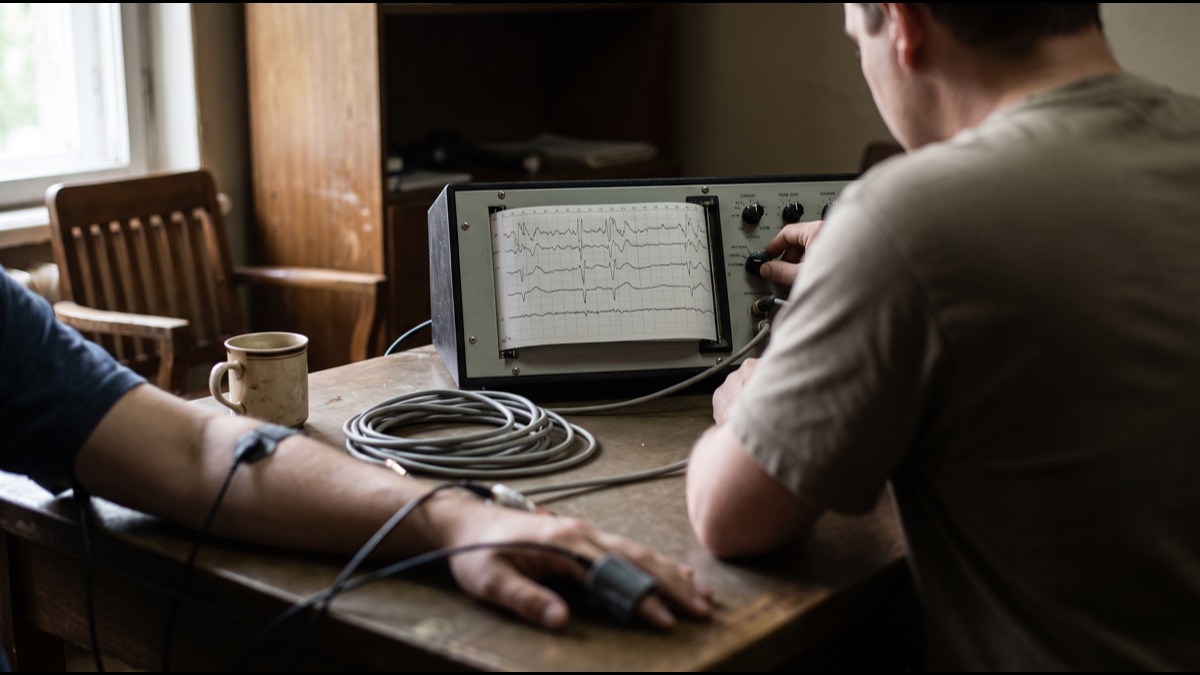
A polygraph has never once measured a lie, and it cannot, because lying leaves no distinct trace in the body for any machine to find. What the device actually records is a bundle of ordinary physiological signals, heart rate, blood pressure, breathing rate, and the skin's electrical conductivity, that shift whenever a person becomes stressed, anxious, or aroused for almost any reason at all. The leap from "this person's body is reacting" to "this person is lying" is made entirely by a human examiner interpreting a pattern, not by the instrument itself, which is precisely why the polygraph's scientific reputation has never matched its cultural one.
That gap between reputation and evidence matters because polygraphs still shape real decisions: job applications rejected, security clearances denied, confessions extracted in interrogation rooms, and in a handful of countries, government positions granted or withheld based on a chart of squiggly lines an examiner reads by eye. Understanding what the machine is actually doing, mechanically and statistically, is the only way to understand why it keeps getting used despite decades of research chipping away at its core claims.
The story also runs through nearly a century of American criminal justice, corporate hiring practice, and now Gulf security-sector screening, each borrowing legitimacy from the device's clinical appearance, the wires, the chart paper, the calm examiner in a lab coat, while the underlying science has stayed stubbornly unresolved the entire time.
None of this means polygraphs are useless in every context; interrogation researchers argue the test's real power may lie less in physiology and more in psychology, the belief that a lie will be caught often changes how people behave before the machine even starts recording.
What a Polygraph Actually Records During a Test
A standard polygraph, more accurately called a psychophysiological detection of deception instrument, attaches several sensors to a subject's body simultaneously. Pneumograph tubes stretched across the chest and abdomen track the rate and depth of breathing. A blood pressure cuff on the upper arm, or a similar plethysmograph sensor on a finger, continuously records cardiovascular activity including heart rate and relative blood pressure changes. Small metal electrodes attached to two fingers measure galvanic skin response, the skin's electrical conductivity, which rises within a second or two whenever sweat gland activity increases.
None of these channels was designed to detect deception specifically; each one is a well-established measure of the autonomic nervous system's "fight or flight" activation, the same physiological cascade that occurs during a job interview, a first date, or a near-miss on the highway. The polygraph simply digitizes and charts these signals in real time so an examiner can compare a subject's response to one question against the response to another, looking for relative spikes rather than any absolute "lying" reading.
Modern computerized polygraphs replaced the old rolling paper chart with software that overlays the three channels on a screen and, in some systems, applies a scoring algorithm to quantify the size of each reaction. Even so, the underlying data being captured has not fundamentally changed since the instrument's early twentieth-century predecessors; it is still breathing, cardiovascular activity, and sweat, nothing more exotic than that.
The Theory That Deception Itself Causes Measurable Stress
The polygraph rests on a specific psychological premise: that consciously lying to someone in a position of authority, particularly about something consequential, provokes a fear of detection strong enough to produce a measurable, involuntary physiological response. Proponents argue this fear response is largely outside conscious control, meaning even a well-composed liar's body will supposedly betray a spike in arousal at the precise moment a deceptive answer is given.
This premise, often called the "fear of detection" hypothesis, is distinct from claiming a machine can literally read thoughts or detect falsehood as a discrete signal; the polygraph never claims to see a lie, it claims to see the anxiety that supposedly accompanies telling one. That distinction is subtle but critical, because anxiety is not unique to lying. Someone telling the complete truth, but frightened of being wrongly disbelieved, can produce an identical physiological spike to someone who is actually lying, a problem examiners call a false positive.
The reverse failure mode is just as real. A pathological liar, a sociopath with blunted fear responses, someone deeply practiced at deception, or simply someone who has convinced themselves their lie is true, may show little to no measurable reaction at all, producing a false negative. Both failure directions stem from the same root issue: the machine measures a proxy for guilt, generalized anxiety, rather than guilt or deception directly.
How the Comparison Question Technique Actually Works
Modern polygraph examinations, particularly in criminal investigations, typically use a format called the Comparison Question Technique, sometimes referred to as the Control Question Technique. The examiner asks a mix of three question types interspersed throughout the test: relevant questions directly about the matter under investigation, irrelevant neutral questions used as a physiological baseline, and comparison questions deliberately broad and slightly accusatory, designed to provoke a reaction in nearly anyone regardless of guilt.
A comparison question might ask something like whether the subject has ever lied to get out of trouble, phrased so broadly that almost everyone technically has a truthful "yes" buried somewhere, yet most subjects answer "no" to avoid admitting it, producing a small deceptive response to that comparison question itself. The theory holds that a guilty subject will react more strongly to the relevant question, about the actual crime, than to the comparison question, while an innocent subject will react more strongly to the comparison question because it is, relatively speaking, the more threatening thing they are being forced to falsely deny.
Scoring then becomes a matter of comparing the magnitude of physiological response across paired relevant and comparison questions, several times across the test, and computing a numerical score that determines whether the examiner calls the result "deceptive," "non-deceptive," or "inconclusive." Critics point out that this entire structure depends on the comparison question working exactly as intended for every individual subject, an assumption that does not hold uniformly across different personalities, cultural backgrounds, and levels of anxiety about the testing situation itself.
The Relevant-Irrelevant Method and Why Examiners Largely Abandoned It
An older and considerably simpler approach, the Relevant-Irrelevant Technique, alternates only between direct relevant questions, "Did you take the missing money?", and neutral irrelevant ones, "Is today Tuesday?", without ever including a deliberately provocative comparison question. This method dominated early twentieth-century polygraph practice and is still occasionally used in less formal screening contexts.
Its central weakness became obvious fairly quickly: virtually anyone, guilty or innocent, tends to react more strongly to a direct accusation about a specific crime than to a bland factual question about the day of the week, simply because being asked point-blank whether you committed a crime is inherently more stressful than confirming the calendar, regardless of whether the answer is truthful.
Because the Relevant-Irrelevant Technique produces a strong built-in bias toward false positives, most contemporary licensed examiners in criminal justice and government settings have shifted almost entirely toward comparison-question formats, even though those formats carry their own, differently shaped set of validity problems that critics have never stopped documenting.
Why Polygraph Results Are Not Admissible in Most Courtrooms
In the United States, polygraph evidence is generally inadmissible in federal courts and in the courts of most individual states, a legal position rooted in the 1923 case Frye v. United States, which established that scientific evidence must be generally accepted within its relevant scientific community before a court will admit it. Polygraph testimony has repeatedly failed that bar because mainstream psychological and physiological science has never reached consensus that the technique reliably distinguishes truth from deception.
Later evidentiary standards, including the Daubert standard adopted by federal courts and many states after 1993, require judges to assess the underlying methodology's testability, known error rate, peer review, and general scientific acceptance, and polygraph evidence has continued to struggle against nearly every one of those specific criteria, particularly the documented error rate.
Some jurisdictions permit polygraph results into evidence only if both prosecution and defense stipulate in advance to their admissibility, an unusual arrangement that effectively acknowledges the technique is not reliable enough to be trusted by default, only by mutual agreement between opposing sides who each believe the outcome will favor their argument.
How Trained Subjects Actually Beat a Polygraph
Documented polygraph countermeasures generally fall into two broad categories: physical techniques that artificially inflate the physiological response during comparison questions, and mental techniques that suppress or dampen the response during relevant, potentially incriminating questions. Physical countermeasures include biting the tongue, pressing toes against the floor, or subtly contracting a sphincter muscle during comparison questions, each designed to produce an artificial spike that makes the comparison question appear more threatening than the relevant one.
Mental countermeasures include deliberately controlled breathing patterns, counting backward silently by sevens, or recalling a calming, dissociative memory during the relevant question specifically, all aimed at keeping the physiological baseline artificially flat exactly when a genuine reaction would otherwise appear. Research from the 1980s onward, including studies commissioned by U.S. government agencies, found that subjects given even brief instruction in these techniques could substantially reduce examiner accuracy, in some documented studies cutting correct detection rates close to chance levels.
This vulnerability is precisely why polygraph results are treated with such caution by security and intelligence agencies internally, even those that continue using the test operationally; officials have publicly acknowledged that a sufficiently motivated and informed subject, including individuals later convicted of espionage after passing polygraph exams, can defeat the instrument without leaving any obvious trace of having done so.
Why No Unique Physiological Signature for Lying Actually Exists
The core scientific criticism leveled against polygraph testing, repeated in nearly every major independent review including a landmark 2003 report from the U.S. National Academy of Sciences, is that no study has ever identified a physiological response pattern unique to deception itself, as opposed to general emotional arousal, fear, anger, embarrassment, or even simple excitement.
Heart rate, blood pressure, respiration, and skin conductance all shift in broadly similar directions under many different emotional and cognitive states, meaning a truthful person who is furious at being accused, terrified of not being believed, or simply nervous by temperament can generate readings indistinguishable from a genuinely deceptive one, and vice versa for a calm, practiced liar.
The National Academy of Sciences report concluded that polygraph accuracy in specific-incident criminal investigations, while measurably better than chance under certain controlled conditions, fell well short of the level needed to justify its use for large-scale security screening of people with no specific incident to investigate, precisely the context in which many government and private employers actually deploy it.
The Accuracy Numbers Polygraph Advocates Actually Cite
Polygraph proponents, including many professional examiner associations, cite accuracy figures in controlled laboratory and field studies ranging roughly from the mid-80s to low-90s percent when the Comparison Question Technique is properly administered by a well-trained examiner under ideal conditions with a genuinely guilty or genuinely innocent subject and a clearly defined single incident.
Independent academic reviewers, including the National Academy of Sciences panel, have consistently argued these figures are inflated by favorable study design, small sample sizes, and the difficulty of establishing objective ground truth outside a laboratory, where researchers can never be entirely certain which real-world subjects were actually lying, unlike a staged mock-crime experiment where the answer is already known.
Even taking the more optimistic accuracy figures at face value, an error rate in the range of ten to twenty percent applied across large-scale screening of thousands of job applicants or government employees means hundreds of truthful people would be wrongly flagged as deceptive, a real-world consequence critics argue is routinely underweighted in public discussion of the technology.
Where Polygraphs Are Still Legally and Practically Used Today
In the United States, the Employee Polygraph Protection Act of 1988 banned most private employers from using polygraphs on employees or job applicants, but carved out significant exceptions for government agencies, security service firms, and companies handling pharmaceuticals or other controlled substances, meaning the test remains legally common in specific regulated industries.
Federal law enforcement and intelligence agencies, including the FBI, CIA, and NSA, continue to administer polygraph examinations as part of pre-employment screening and periodic reinvestigation, treating the test less as a definitive lie-detection tool and more as an interview aid that, whether or not it reliably measures deception, tends to prompt admissions from subjects who believe the machine can catch them.
Some U.S. states and many other countries also permit or require polygraph testing in specific contexts, including certain sex-offender treatment and monitoring programs, where the goal is explicitly framed less around courtroom-grade accuracy and more around behavioral deterrence and structured disclosure during supervision.
Polygraph Use Across the Gulf and Wider Middle East
Several Gulf countries maintain active polygraph programs within specific security-sector and government-vetting contexts, often modelled procedurally on American law-enforcement practice, since many regional examiners trained through American Polygraph Association-affiliated programs or received instruction from U.S.-trained specialists during the technique's regional expansion from the late twentieth century onward.
Private-sector use in the region tends to be considerably more limited than in parts of the United States, partly because labor regulations across Gulf states vary widely on what pre-employment screening methods employers may legally require, and partly because polygraph examiners remain a genuinely scarce professional specialty locally, requiring dedicated certification training generally unavailable without traveling abroad.
Regional security agencies that do use the polygraph tend to treat it the same way American federal agencies do, as one input feeding a broader vetting process that also includes background investigation, reference verification, and financial disclosure, rather than as a single automatic pass-or-fail determinant on its own.
The Early History of the Polygraph and Its Inventors
The modern polygraph's direct lineage traces to 1921, when John Larson, a physiologist and police officer working with the Berkeley, California police department, combined continuous blood pressure, pulse, and respiration measurement into a single instrument specifically intended for criminal interrogation, building on earlier isolated blood-pressure deception experiments conducted by psychologist William Marston roughly a decade before.
Larson's assistant, Leonarde Keeler, refined the device considerably through the 1930s, adding the galvanic skin response channel that measures sweat gland activity and developing the portable case design that became the industry standard for decades, while also founding some of the earliest formal polygraph examiner training programs in the United States.
William Marston, notably, later achieved far greater fame as the creator of the comic book character Wonder Woman, whose signature "Lasso of Truth" was a direct, explicit homage to his earlier lie-detection research, an unusual cultural footnote that has helped cement the polygraph's mythic, almost superheroic reputation in American popular imagination ever since.
How the Polygraph Became a Cultural Symbol of Truth
Decades of television courtroom dramas, daytime talk shows staging on-air polygraph "reveals," and true-crime documentaries have repeatedly presented polygraph results as if they were definitive, courtroom-grade proof of guilt or innocence, a portrayal wildly out of step with the device's actual, heavily contested scientific standing among researchers.
This cultural mythology creates a feedback loop that examiners themselves sometimes rely on deliberately: subjects who believe, correctly or not, that the machine can reliably catch a lie often become measurably more anxious and more likely to confess or make incriminating admissions during questioning, regardless of whether the instrument's underlying physiological readings are actually being scored with any real precision.
Some interrogation specialists argue this psychological effect, sometimes called the "bogus pipeline" phenomenon in academic literature, may represent the polygraph's single most genuinely reliable function, not detecting deception directly through physiology, but leveraging a subject's belief in the machine's power to extract confessions and admissions that might not otherwise surface during ordinary questioning.
What Actually Replaces the Polygraph in Modern Investigations
Contemporary interrogation researchers increasingly favor structured behavioral interviewing techniques, such as cognitive load manipulation, where investigators ask subjects to recount events in reverse chronological order or add unexpected sensory detail, on the theory that fabricated stories are measurably harder to sustain consistently under this kind of cognitive strain than genuine memories are.
Functional MRI-based deception detection has been explored in academic research settings, attempting to identify neural activation patterns associated with deliberate deception rather than peripheral physiological arousal, though this approach remains experimental, expensive, and, so far, no more legally admissible in most jurisdictions than the traditional polygraph it aims to eventually replace.
Voice stress analysis, another commercially marketed alternative that claims to detect deception-related micro-tremors in speech, has faced the same fundamental scientific criticism as the polygraph itself, namely the absence of any demonstrated unique signature for deception, and multiple controlled studies have found it performs no better than chance under rigorous testing conditions.
Sources
- Wikipedia — overview of polygraph history, technique, and scientific criticism
- U.S. National Academy of Sciences — 2003 report reviewing the scientific evidence on polygraph testing accuracy
- Federal Bureau of Investigation — background on polygraph use in federal law enforcement screening
- U.S. Congress — text and background of the Employee Polygraph Protection Act of 1988
FAQ
Can a polygraph actually detect a lie directly?
No, it detects physiological arousal signals like heart rate, breathing, and sweat, and an examiner infers deception from the pattern; no study has found a response unique to lying itself.
Why aren't polygraph results allowed in most courts?
Courts require scientific evidence to meet reliability standards like general acceptance or a known, acceptably low error rate, and polygraph testimony has consistently failed to meet those bars.
Can someone be trained to beat a polygraph?
Yes, documented physical and mental countermeasures, including controlled breathing and subtle muscle tension during comparison questions, have been shown in research to substantially reduce examiner accuracy.
Why do employers still use polygraphs if they're unreliable?
U.S. law bans most private employers from requiring them, but government agencies, security firms, and some regulated industries are exempt, and some agencies value the test's psychological pressure as much as its readings.
Who invented the modern polygraph?
John Larson built the first combined-measurement instrument in 1921; his assistant Leonarde Keeler later added the skin-conductance sensor and standardized the portable design used for decades afterward.
What accuracy rate do polygraph examiners actually claim?
Proponents cite roughly 85 to 90 percent accuracy under ideal controlled conditions, but independent reviewers argue these figures are inflated and that error rates are far higher in real-world screening use.
About the Author
We reference Wikipedia and other authoritative sources to explain the background and current understanding of this topic.
Loved This Article?
Share it on WhatsApp → Share it on WhatsApp
Get more guides in your inbox — Subscribe to our newsletter for weekly surprising stories from Egypt, Saudi Arabia, Dubai, and beyond.