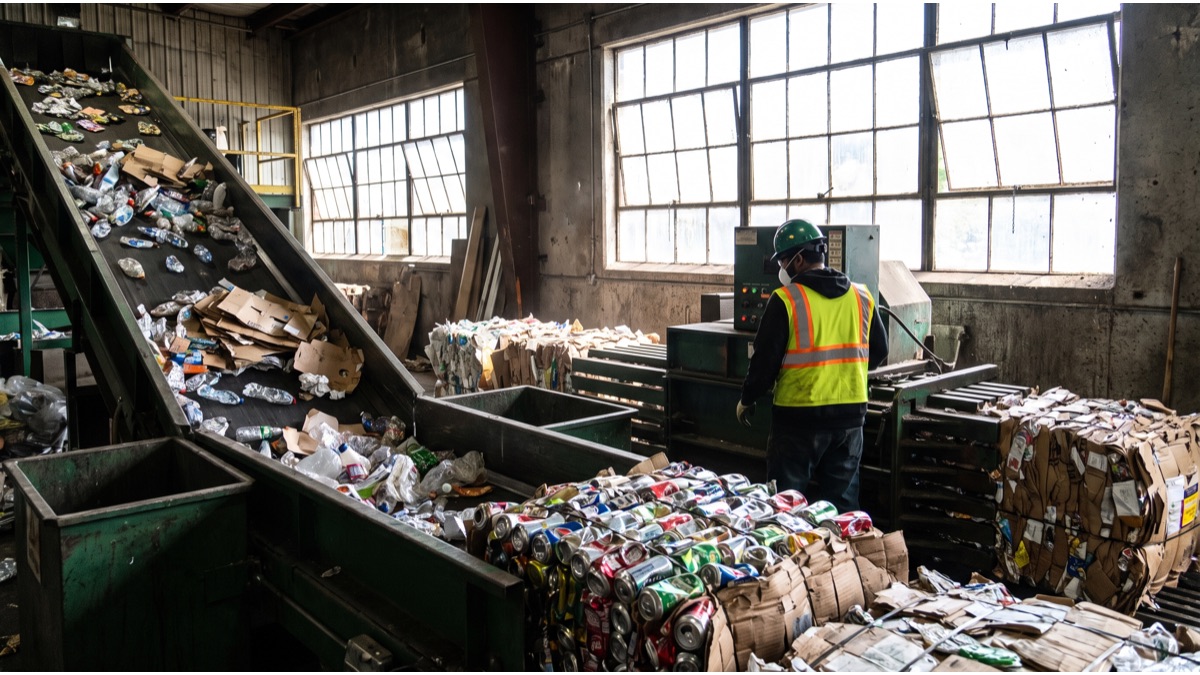
Recycling is not one process but several unrelated ones, and their success varies so enormously by material that treating them as a single activity is the source of most public confusion.
Aluminium can be melted and reused indefinitely at a fraction of the energy needed to make it new, which is why it has been recycled profitably for decades without any environmental motivation. Most plastic degrades each time it is processed, is worth less than it costs to collect, and was promoted for recycling by the industries that produce it. Understanding which category a material falls into explains nearly everything about what actually happens to it.
Why Materials Differ So Much
Metals and glass can be melted and reformed without their fundamental structure changing, which means recycled material is chemically identical to new material.
Paper fibres shorten each time they are processed, so paper can be recycled several times before the fibres become too short to bind, at which point it leaves the system.
Most plastics degrade in molecular structure with each cycle and are difficult to separate by type, which is why their outcomes differ so sharply from metals.
Why Aluminium Is the Success Story
Producing aluminium from ore requires an enormous quantity of electricity, while remelting existing aluminium requires a small fraction of that energy.
This gap makes recycling profitable without subsidy, which is why aluminium has high collection rates and why scrap has real market value.
The metal does not degrade through remelting, so a can can become another can indefinitely, which is the property most people mistakenly assume applies to everything.
What Happens to Steel
Steel is the most recycled material by weight globally, helped enormously by being magnetic, which makes automated separation straightforward and cheap.
A substantial share of new steel is produced in furnaces that run largely on scrap, and the economics work without any environmental requirement.
The main limitation is contamination by other metals, particularly copper from wiring, which accumulates through cycles and downgrades what the steel can be used for.
Why Glass Recycling Is More Marginal
Glass melts and reforms without degradation, so the material property is ideal, yet the economics are considerably worse than for metals.
Glass is heavy relative to its value, so transport cost frequently exceeds what the recovered material is worth unless a processing plant is nearby.
Colour separation matters, since mixed colours can only become dark glass, which is why some collection systems separate by colour and others accept lower-grade outcomes.
What the Plastic Numbers Actually Mean
The numbered symbol on plastic identifies which polymer it is, and it was never a statement that the item is recyclable in any particular place.
It was introduced by the plastics industry, and its resemblance to the recycling symbol has been widely criticised as producing exactly the confusion it created.
In practice only a couple of the categories have reliable markets, while the rest are collected in some places and landfilled or burned regardless.
Which Plastics Actually Get Recycled
Clear drinks bottles and milk-type containers have genuine established markets, because they are produced in large uniform volumes and are easy to identify.
Films, pouches, multi-layer packaging and mixed items generally do not, since separating the layers is impractical and the recovered material has no buyer.
This is why guidance frequently accepts bottles while rejecting bags and wrappers, which appears arbitrary but reflects whether a market exists rather than whether recycling is theoretically possible.
Why Plastic Degrades When Recycled
Heating and mechanical processing shorten polymer chains, which reduces strength and clarity, so recycled plastic is generally inferior to new material.
This means most plastic is downcycled into lower-value products such as textiles or plastic lumber, which are themselves rarely recycled again.
The result is that plastic recycling typically delays disposal by one cycle rather than creating a loop, which is a fundamentally different outcome from metals.
What Chemical Recycling Promises
Chemical processes break plastic down into its constituent molecules, which can then be rebuilt into material indistinguishable from new.
This would solve degradation entirely, and it is the basis of most industry commitments to future recycling rates.
Deployment has been slower and more expensive than projected, with several facilities closing, and the energy required is substantial enough to affect the environmental case.
Why Contamination Ruins Batches
A single incompatible item can degrade an entire batch, with food residue, liquids and certain plastics causing whole loads to be rejected.
Greasy cardboard is the classic example, since oil cannot be separated from paper fibre during pulping and contaminates the resulting product.
This is why rinsing containers matters more than most people assume, and why adding doubtful items in hope is actively harmful rather than neutral.
What Wishcycling Costs
Placing non-recyclable items in recycling because it feels preferable is common and causes measurable harm to the system.
Sorting facilities must remove these manually or mechanically, which raises costs, and items like plastic bags and cables physically jam machinery.
The counterintuitive conclusion is that placing a doubtful item in general waste is usually better than placing it in recycling, since the alternative risks contaminating material that would otherwise have been recovered.
How Sorting Facilities Actually Work
Mixed recycling passes through a sequence of automated stages, with screens separating by size and shape, magnets removing steel, and eddy currents ejecting aluminium.
Optical sorters identify plastics by the infrared signature of the polymer and use air jets to separate them at high speed.
Manual sorting still handles what machines miss, which is why contamination translates directly into labour cost rather than merely into lost material.
Why Black Plastic Was a Problem
Optical sorters identify plastics by reflected infrared light, and the carbon black pigment used in many food trays absorbs that light almost entirely.
This made black plastic effectively invisible to sorting equipment, so it was rejected regardless of what polymer it was made from.
Manufacturers have shifted to detectable pigments in response, which is a clear example of packaging design determining recyclability more than consumer behaviour does.
What Single-Stream Collection Traded
Collecting all recyclables together substantially increased participation, since it removed the effort of separating materials at home.
It also increased contamination considerably, since materials mix and break during collection, with glass fragments embedding in paper.
The net effect is more material collected but of lower quality, which was acceptable while export markets accepted mixed loads and became a problem when they stopped.
Why Export Markets Collapsed
For decades a large share of collected recyclables was shipped abroad for processing, which was economic partly because ships returning from delivering goods had spare capacity.
Import restrictions introduced by major receiving countries excluded contaminated material, which most mixed collection could not meet.
This left exporting countries without capacity to process their own material, and substantial quantities were landfilled or burned while alternative arrangements were built.
How Deposit Return Systems Change Outcomes
Charging a refundable deposit on containers produces collection rates far above what kerbside systems achieve, frequently exceeding nine in ten.
The material recovered is also cleaner, since containers are returned separately rather than mixed, which makes it genuinely suitable for reuse in the same application.
Beverage producers have historically opposed these schemes on cost grounds, though several countries have introduced them successfully with high public support.
Why Extended Producer Responsibility Matters
Making producers financially responsible for the disposal of their packaging shifts cost from local authorities to the companies choosing the materials.
When fees vary by how recyclable a material is, this creates a direct commercial incentive to design packaging that can actually be processed.
This addresses the fundamental issue that recyclability is determined at design time, while responsibility has historically fallen on consumers and councils afterwards.
What the Waste Hierarchy Ranks
Reducing consumption comes first, reuse second, recycling third, energy recovery fourth and disposal last, and this ordering reflects environmental benefit.
Recycling sits well down the list because it still requires collection, transport, processing and energy, all of which are avoided by not producing the item.
Public attention has concentrated overwhelmingly on the third tier, which is a substantial part of why overall material consumption has continued rising.
Why Reuse Beats Recycling
Using a container again requires only washing, which consumes far less energy than melting and reforming the material.
Refillable systems were standard for beverages in many countries before single-use packaging displaced them, and several are being reintroduced.
The obstacle is logistics rather than technology, since returning containers to a filler requires reverse distribution that single-use packaging eliminated.
What Happens to Textiles
Clothing recycling is far less developed than material recycling, because most garments are blends that cannot easily be separated into constituent fibres.
Much collected clothing is exported for resale rather than recycled, and a substantial share of what arrives is unsellable and becomes waste in the receiving country.
Fibre-to-fibre recycling exists but handles a very small proportion, which means textile recovery is currently closer to redistribution than to a closed loop.
How Electronics Recycling Differs
Electronic waste contains valuable metals in concentrations higher than natural ore, which makes recovery genuinely worthwhile where it is done properly.
It also contains hazardous substances, so informal processing, frequently by burning to recover copper, causes serious harm to workers and surrounding areas.
Design increasingly obstructs recovery, since glued assemblies and embedded batteries make disassembly slow enough that manual recovery becomes uneconomic.
Why Composting Matters More Than It Seems
Organic material in landfill decomposes without oxygen and produces methane, a greenhouse gas considerably more potent than carbon dioxide over the short term.
Separating food waste and composting it avoids this while producing material that returns nutrients to soil, which no other waste stream achieves.
This makes food waste separation one of the highest-impact household actions available, though it receives far less attention than packaging recycling.
What Energy Recovery Actually Is
Burning waste to generate electricity recovers energy from material that would otherwise be buried, and modern plants control emissions to strict standards.
It is preferable to landfill for most materials but ranks below recycling, since the material is destroyed rather than recovered.
The concern is that plants require guaranteed volumes over decades, which can create an institutional interest in continued waste generation.
Why Recycling Rates Are Hard to Compare
Jurisdictions measure differently, with some counting material collected and others counting material actually reprocessed into new products.
The difference is substantial, since material can be collected, exported, rejected and disposed of while still appearing in the collection figure.
Reported improvement therefore sometimes reflects changed accounting rather than changed outcomes, which is why direct comparison between places is frequently misleading.
What Actually Reduces Impact
For most households the largest effects come from consuming less, avoiding food waste, and choosing durable items over disposable ones.
Within recycling, aluminium, steel and paper deliver genuine benefit, while sorting plastics carefully matters less than the packaging choices made before purchase.
This is not an argument against recycling but a correction of proportion, since the attention it receives considerably exceeds its share of the available benefit.
Why the Confusion Persists
Recycling symbols, inconsistent local rules, and decades of messaging emphasising consumer responsibility have made a technically simple question genuinely hard to answer.
Material differences are the actual explanation, but they are rarely communicated, so people reasonably assume effort determines outcome when chemistry and markets do.
The practical response is to focus on the materials that reliably work, to avoid contaminating them, and to recognise that packaging decisions made before purchase matter more than sorting afterwards.
Why Paper Is the Quiet Success
Paper and cardboard have high recycling rates and genuine markets, helped by packaging demand from online retail that consumes recovered fibre in large volume.
Fibres shorten with each cycle, so the system needs continuous input of new fibre, which means paper recycling extends rather than replaces forestry.
It nonetheless delivers real benefit, since producing paper from recovered fibre uses substantially less energy and water than producing it from wood.
What Happens to Batteries
Lithium batteries contain valuable metals, and recovery is technically feasible, but collection remains the bottleneck since most reach general waste.
They also present a genuine fire hazard, as damaged cells ignite in collection vehicles and sorting facilities, which has caused numerous serious fires.
Volumes from electric vehicles are only beginning to arrive, and the industry is building capacity ahead of a wave that has not yet materialised.
Why Compostable Packaging Frequently Is Not
Many compostable items require industrial composting at temperatures a garden heap never reaches, so they behave like ordinary plastic in home conditions.
They also contaminate plastic recycling because sorters cannot reliably distinguish them, which means a well-intentioned material can degrade an entire stream.
Their value depends entirely on whether local collection actually routes them to industrial composting, which in most places it does not.
How Scrap Markets Set Behaviour
Recycling is a commodity business, and collection expands when prices are high and contracts when they fall, independent of environmental policy.
This is why some materials are quietly landfilled during downturns despite being collected, since processing costs more than the output is worth.
Understanding this explains why recycling rates fluctuate with global markets rather than tracking public enthusiasm or local effort.
Why Local Rules Differ So Much
What can be recycled is determined by which processing facilities a local authority has contracts with, not by what is technically recyclable.
This is why the same item is accepted in one town and refused in the next, and why national guidance is necessarily vague about specifics.
It also means online advice is frequently wrong for a given reader, and the local authority's own list is the only reliable source.
Recycling is not one activity but several unrelated ones, and the outcomes differ by material for reasons that have nothing to do with effort. Aluminium remelts at a small fraction of the energy needed to make it from ore, so it has been recycled profitably for decades without any environmental motivation, and a can can become another can indefinitely. Steel works similarly, helped by being magnetic and therefore trivially easy to separate. Most plastic does neither. Polymer chains shorten with each cycle, so recycled plastic is generally inferior and gets downcycled into products that are rarely recycled again — delaying disposal by one cycle rather than closing a loop. The numbered symbol identifies the polymer and was never a claim that anything is recyclable locally; only a couple of categories have reliable markets at all. Two practical points follow. Contamination is worse than people assume: a single greasy box or stray bag can cause a whole load to be rejected, which means putting a doubtful item in general waste usually beats hopefully adding it to recycling. And recyclability is decided at design time, not at the bin — black food trays were rejected for years simply because their pigment absorbed the infrared light sorting machines use to see.
Sources
- Wikipedia — material streams, processes and recycling rate measurement
- UN Environment Programme — global waste data and plastic pollution assessments
- US Environmental Protection Agency — waste hierarchy, recycling statistics and contamination guidance
- Ellen MacArthur Foundation — circular economy research and packaging design
- OECD — extended producer responsibility and material flow analysis
FAQ
Why is aluminium recycled but most plastic isn't?
Remelting aluminium takes a fraction of the energy of making it from ore, so it is profitable without subsidy. Plastic degrades each cycle and is often worth less than collection costs.
Do the numbers on plastic mean it is recyclable?
No. They identify which polymer it is. They were introduced by the plastics industry and only a couple of the categories have reliable markets.
Should I put something in recycling if I'm unsure?
Usually no. Contamination can cause an entire load to be rejected, so general waste is typically the better choice for a doubtful item.
Why was black plastic not recyclable?
Optical sorters identify plastics by reflected infrared light, and the carbon black pigment absorbed it almost entirely, making those items invisible to the machinery.
What matters more than recycling?
Consuming less, avoiding food waste, and choosing durable over disposable. Composting food waste also prevents methane from landfill, which is high-impact and often overlooked.
About the Author
We reference Wikipedia, UN Environment Programme, US Environmental Protection Agency, Ellen MacArthur Foundation, and OECD to explain the background and current understanding of this topic.
Loved This Article?
Share it on WhatsApp → Share it on WhatsApp
Get more guides in your inbox — Subscribe to our newsletter for weekly surprising stories from Egypt, Saudi Arabia, Dubai, and beyond.