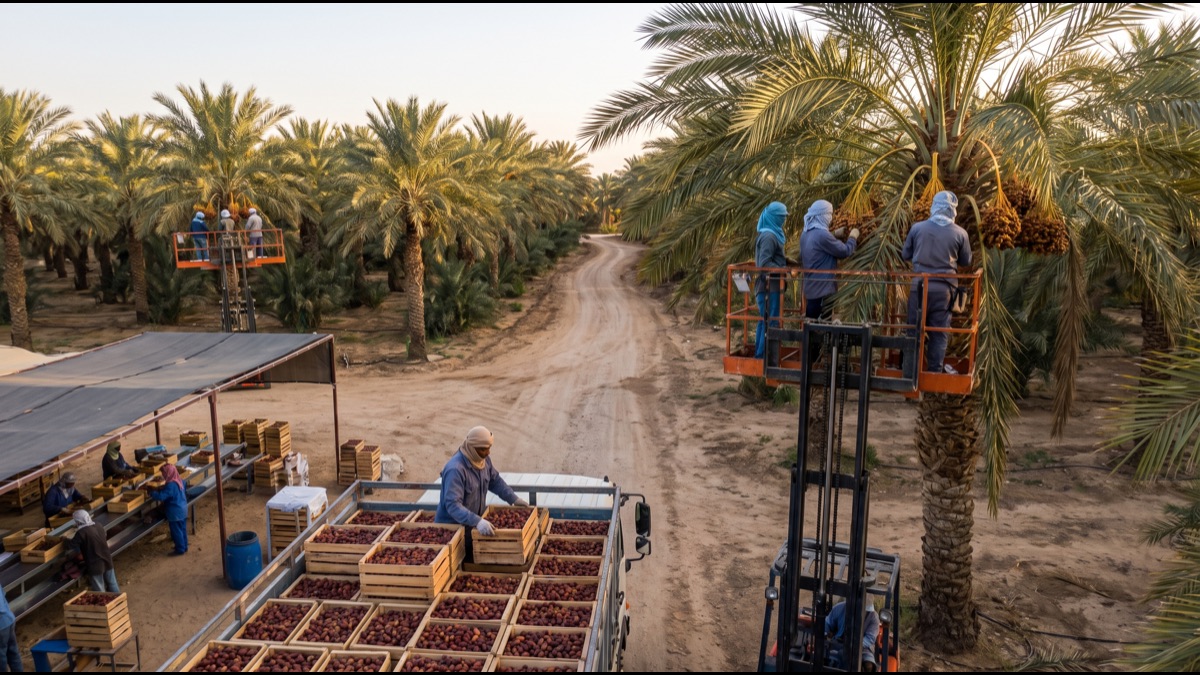
Long before oil was discovered beneath the Arabian Peninsula, the date palm was already the backbone of settled life across it. Today Saudi Arabia is among the largest date producers on the planet, harvesting from tens of millions of trees spread across oases and irrigated farms stretching from the central Al-Qassim region to the palm groves surrounding Madinah.
Understanding how this industry actually functions means looking past the romantic image of the desert oasis to the genuinely modern agricultural operation underneath it, one that blends centuries-old hand pollination techniques with drip irrigation systems, cold storage logistics, and export certification designed for supermarket shelves thousands of kilometers away.
Why the Date Palm Predates the Modern Saudi State
Archaeological evidence places date cultivation in the Arabian Peninsula among the oldest continuous agricultural traditions anywhere in the world, with palm groves sustaining settled communities in an environment where almost nothing else could reliably be farmed at scale before modern irrigation.
Dates provided calorie-dense, easily stored nutrition that could survive months of travel, making them essential to trade caravans and pilgrimage routes long before the kingdom's current borders existed, and the palm itself supplied timber, fiber, and shade that supported the rest of oasis agriculture growing in its protection.
This deep history is not simply decorative background; it explains why the date palm still carries symbolic weight in national identity and why supporting the sector is treated as a matter of heritage as much as agricultural policy.
How Big the Industry Actually Is Today
Saudi Arabia counts its date palms in the tens of millions, spread across hundreds of thousands of hectares of cultivated land, placing it consistently among the handful of largest date-producing countries alongside Egypt, Iran, and Algeria in most international agricultural statistics.
Hundreds of distinct date cultivars are grown across the kingdom, each with different flavor, texture, and ripening characteristics, ranging from soft, syrupy varieties eaten fresh to firmer types better suited to drying, pressing into date paste, or processing into syrup.
The sector supports a substantial share of agricultural employment in regions where date farming remains the dominant land use, and it functions as both an economic activity and a significant piece of national food security policy given how well the crop suits the domestic climate.
Official agricultural census figures have tracked steady growth in both planted area and total yield over recent decades, a trend attributed to a mix of expanded irrigated land, improved cultivar selection, and gradual professionalization of farm management practices among growers who previously relied almost entirely on inherited, informal techniques passed down within families.
Where Most Saudi Dates Are Grown
Al-Qassim, in the center of the country, is generally recognized as the kingdom's single largest date-producing region, benefiting from a combination of suitable soil, established irrigation infrastructure, and generations of accumulated farming expertise concentrated in its oasis towns.
Madinah is similarly significant, both for its production volume and for the religious and cultural prominence of dates grown there, while the Eastern Province, Riyadh region, and parts of the south also contribute meaningfully to total national output with their own locally favored cultivars.
Each growing region tends to specialize in particular varieties suited to its specific soil and microclimate, which is part of why date names and reputations in Saudi Arabia are often tied as closely to a specific place as wine regions are elsewhere in the world.
Why Palms Are Pollinated by Hand
Date palms are dioecious, meaning individual trees are either male or female, and unlike many fruit trees they are wind-pollinated rather than relying on insects, a natural process that is inefficient and unreliable enough that commercial growers do not depend on it alone.
Each spring, farm workers climb female palms and manually transfer pollen collected from male flowers, a labor-intensive process performed at exactly the right moment in the flowering cycle to maximize fruit set, timing that experienced growers judge largely through direct observation built up over years.
This hands-on pollination step remains one of the most labor-dependent parts of the entire production chain even as other stages have modernized considerably, and it is a significant reason date farming continues to support meaningful seasonal agricultural employment.
What Makes Ajwa Dates Distinctive
Ajwa, a soft, dark, wrinkled date variety grown primarily in and around Madinah, carries particular religious and cultural significance within Islamic tradition, a status that has made it consistently one of the most recognized and highest-priced Saudi date varieties both domestically and among international buyers.
That cultural prestige has created strong, relatively price-insensitive demand, particularly during Ramadan and the Hajj and Umrah seasons when pilgrims and visitors specifically seek it out, giving Ajwa growers a distinct market position compared to producers of more commodity-oriented varieties.
The variety's specific growing requirements and comparatively modest yields relative to some other cultivars also contribute to its premium pricing, reinforcing a long-standing pattern where certain named varieties command dramatically different prices than bulk commodity dates from the same general region.
Other well-known Saudi varieties occupy their own distinct positions in this same hierarchy, including Sukkari, prized for its exceptionally high sugar content and crisp texture when eaten fresh, and Khalas, a widely grown, moderately priced variety that functions as something closer to an everyday staple across much of the Gulf.
How the Harvest Season Actually Unfolds
The date harvest typically runs from mid-summer into early autumn, with timing varying by variety and region, and fruit is generally picked in successive passes rather than all at once, since dates on the same bunch ripen at slightly different rates.
Harvesting still frequently involves workers climbing palms or using specialized lifting equipment to reach the fruit bunches safely, and the physically demanding nature of the work during the hottest months of the year has made harvest labor a persistent operational challenge for the sector.
Immediately after picking, dates typically move quickly to sorting and grading facilities, since fruit quality can deteriorate rapidly in high summer temperatures without prompt handling, cooling, and, for some varieties, controlled drying.
How Water Scarcity Shapes Modern Date Farming
Date palms are considerably more drought-tolerant than most commercial crops, able to survive on less water and higher salinity than many alternatives, which is precisely why they became the historical backbone of oasis agriculture in a region with almost no reliable surface water.
Large-scale modern cultivation nonetheless draws heavily on groundwater reserves in a country with extremely limited renewable freshwater, and the pace of extraction from some aquifers has raised sustainability concerns among agricultural planners looking multiple decades ahead.
In response, drip irrigation and other water-efficient techniques have been increasingly promoted and subsidized as replacements for older flood irrigation methods, reflecting a broader national push to reduce agricultural water consumption without abandoning a crop deeply tied to national food security and heritage.
Soil salinity compounds the water question further, since repeated irrigation in a hot, dry climate gradually concentrates salts in the topsoil unless it is periodically flushed with additional water, creating a genuine trade-off between conserving scarce groundwater and maintaining the long-term productivity of the same fields being irrigated more sparingly.
How Government Programs Support Producers
Government agricultural authorities have run sustained programs supporting date growers, including distribution of improved seedlings, technical extension services, and financing support intended to raise yields and quality across a farming population that ranges from small family groves to large commercial operations.
National date festivals and dedicated marketing initiatives have also been used to promote both domestic consumption and export awareness, treating dates explicitly as a heritage product worth actively marketing rather than a purely commodity agricultural export.
These support programs sit within the broader national push to strengthen food security and agricultural self-sufficiency in strategically important crops, a priority reinforced by periodic global food-supply disruptions that have made import dependence for staple foods a recurring policy concern.
What Happens After Harvest
Fresh dates that will be sold immediately are sorted by size and quality, cleaned, and packaged relatively quickly, while dates intended for longer storage or export undergo additional processing including controlled drying to reduce moisture content and extend shelf life safely.
A meaningful share of the harvest is processed into secondary products rather than sold as whole fruit, including date paste used as a baking and confectionery ingredient, date syrup known locally as dibs, and date-based snack and confectionery products aimed at both domestic and export retail markets.
Modern processing and packaging facilities, many built with government support as part of broader agro-industrial development, have professionalized this stage considerably compared to older, more informal post-harvest handling, improving both food safety and the ability to meet international import standards.
How Dates Move From Farm to Export Market
Exporting requires meeting phytosanitary and food-safety standards set by importing countries, which has driven investment in certified packing houses, cold-chain logistics, and quality control processes specifically designed to satisfy destination-market regulators rather than only domestic buyers.
Saudi dates reach international markets across Asia, Europe, and North America, competing directly with major producers including Iran, Tunisia, and Algeria, with premium named varieties generally commanding stronger export prices than undifferentiated bulk product.
Export promotion efforts have specifically targeted diversifying destination markets and building recognizable branding for premium Saudi varieties, aiming to capture more value from marketing and packaging rather than competing purely on the price of raw, unbranded fruit.
Why Ramadan Drives Domestic Demand
Dates hold specific religious significance in the tradition of breaking the daily Ramadan fast, which produces a sharp, predictable annual surge in domestic demand concentrated in the weeks leading up to and during the holy month each year.
This seasonal demand pattern shapes farm and trader planning considerably, with growers and distributors timing storage, processing, and release of inventory specifically to meet the Ramadan peak, when both volume sold and average prices paid typically rise compared to the rest of the year.
The scale of this domestic seasonal market means Saudi Arabia consumes a substantial share of its own harvest internally, distinguishing its date sector from more purely export-oriented agricultural industries where the bulk of production leaves the country of origin.
How Small Farmers Coexist With Large Operations
The sector includes a genuine mix of scales, from small family-run groves passed down through generations and farmed largely for local sale and personal consumption, to large commercial operations with mechanized processing lines and dedicated export departments.
Cooperative structures and government purchasing or support programs have historically helped smaller producers access processing facilities, financing, and markets that would otherwise favor larger operators with more capital, though consolidation pressure toward larger, more capital-intensive operations remains a long-term structural trend.
This mixed structure means date farming continues to function as meaningful smallholder livelihood in many rural communities even as the most visible export volumes and branded products increasingly come from larger, more industrialized producers.
What Threats the Industry Faces
The red palm weevil, an invasive pest that bores into palm trunks and can kill trees if not detected and treated early, has posed a persistent and economically significant threat to date palm groves across the region, requiring ongoing monitoring and pest-management investment.
Water scarcity, discussed above, represents a longer-term structural constraint rather than an acute crisis, but it shapes strategic decisions about where cultivation can realistically expand and which irrigation technologies growers are required or incentivized to adopt.
Climate pressures including rising extreme heat during already-hot growing seasons, along with competition for agricultural labor from other sectors, add further operational challenges that the industry's modernization programs are explicitly designed to help growers manage.
Price volatility adds a further layer of risk for growers, since a strong harvest across the region can push wholesale prices down sharply in a single season, meaning cooperative storage and staggered release of inventory have become as important to farm income as the growing techniques used in the field itself.
Why Dates Remain a Cultural Symbol, Not Just a Crop
Dates appear throughout Saudi hospitality customs, religious practice, and daily life in ways that go well beyond their nutritional or commercial value, offered to guests as a matter of course and exchanged as gifts during religious occasions and family celebrations alike.
This cultural embeddedness is part of why government support for the sector draws broad public backing even when purely economic arguments for agricultural self-sufficiency in a water-scarce country could be debated on efficiency grounds alone.
Visitors to Saudi Arabia frequently encounter this cultural weight directly, whether through a small dish of dates and Arabic coffee offered on arrival at almost any home or majlis, or through the elaborate displays of named varieties sold in dedicated date shops in cities such as Riyadh, Madinah, and Al-Ahsa, where price and presentation signal the same kind of connoisseurship associated with fine wine or specialty coffee elsewhere in the world.
Understanding Saudi date farming ultimately means holding both realities simultaneously: a genuinely modernizing commercial agricultural sector investing in irrigation technology, pest management, and export logistics, layered directly on top of an agricultural tradition that predates the modern state and remains central to how the country understands its own identity.
Sources
- Wikipedia — overview of date palm cultivation and varieties
- Food and Agriculture Organization of the United Nations — global date production statistics
- Saudi Ministry of Environment, Water and Agriculture — national agricultural programs and date sector data
- Saudi Ministry of Commerce — export and trade regulation information
- Convention on Biological Diversity — background on agricultural biodiversity and traditional crop varieties
FAQ
Why is Saudi Arabia one of the largest date producers in the world?
Centuries of oasis agriculture, favorable desert growing conditions for date palms, and sustained modern government investment in irrigation and cultivar improvement have combined to make date farming a major agricultural sector.
How are Saudi date palms pollinated?
Most date palms are pollinated by hand, since male and female flowers grow on separate trees and rely on wind rather than insects, so farm workers manually transfer pollen from male flowers to female ones each spring.
What is Ajwa and why is it significant?
Ajwa is a soft, dark date variety grown primarily around Madinah that carries particular religious and cultural significance in Islamic tradition, making it one of the most sought-after and highest-priced varieties.
How does date farming affect groundwater in Saudi Arabia?
Date palms are relatively drought-tolerant compared to many crops, but large-scale cultivation still draws on limited groundwater reserves, prompting a shift toward drip irrigation and more water-efficient farming practices.
Are Saudi dates mainly exported or consumed domestically?
Saudi Arabia consumes a very large share of its own date harvest domestically, particularly around Ramadan, while also exporting a meaningful volume to markets across Asia, Europe, and North America.
About the Author
We reference Wikipedia, the Food and Agriculture Organization, the Saudi Ministry of Environment, Water and Agriculture, the Saudi Ministry of Commerce, and the Convention on Biological Diversity to explain the background and current understanding of this topic.
Loved This Article?
Share it on WhatsApp → Share it on WhatsApp
Get more guides in your inbox — Subscribe to our newsletter for weekly surprising stories from Egypt, Saudi Arabia, Dubai, and beyond.