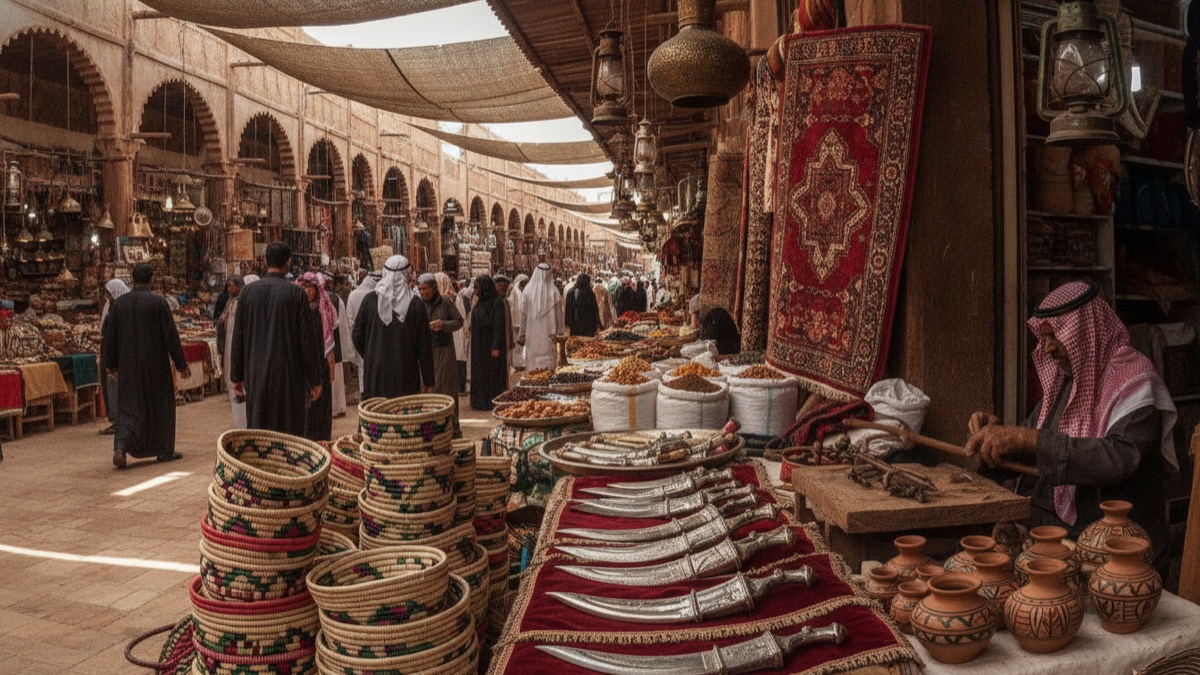
Saudi Crafts: A Living Heritage
Long before Saudi Arabia became known for its modern cities and ambitious megaprojects, its deserts, oases, and mountain valleys were home to craftspeople whose work shaped daily life. Weaving turned goat hair into tents that could withstand sandstorms. Potters shaped clay into water jars that kept liquids cool. Palm fronds were folded into baskets, fans, and mats. These objects were not decorative luxuries; they were survival tools refined into art forms.
Today, Saudi traditional crafts are experiencing a revival. Vision 2030 has placed cultural heritage at the center of national identity, and a new generation of artisans is returning to ancestral techniques. Government programs, craft festivals, and design incubators are helping weavers, potters, and metalworkers reach national and international markets. For travelers, this means an opportunity to buy objects that carry real stories rather than factory-made souvenirs.
This guide explores the most important crafts and souks in the Kingdom. You will learn how Sadu weaving is made, where to find Najdi pottery, how date markets work, and which cities offer the best authentic shopping. Whether you are visiting Riyadh, Jeddah, AlUla, or a small oasis town, you will know what to look for and how to buy with confidence.
Sadu Weaving: Geometry from the Desert
Sadu is a traditional form of weaving used by Bedouin communities across the Arabian Peninsula. It is instantly recognizable by its bold geometric patterns, often in black, white, brown, red, and cream. These patterns are not random; many represent tents, camels, dates, protection symbols, or the weaver's tribe. The technique uses wool and goat hair spun on a horizontal ground loom, producing durable fabric used for tent walls, cushions, bags, and camel saddles.
The weaving process is slow and communal. Women traditionally prepare the wool, dye it with natural pigments such as henna, indigo, and pomegranate, and then weave on a loom that is often set directly on the sand. A single large piece can take weeks or even months. Because of its cultural importance, Sadu weaving was inscribed on UNESCO's Representative List of the Intangible Cultural Heritage of Humanity in 2020, recognizing both the skill and the social knowledge it transmits.
Today, Sadu patterns appear on everything from luxury fashion to home décor. However, the most authentic pieces are still made by women in weaving cooperatives in Najd, Al-Qassim, and the Eastern Province. When buying, ask whether the item is handwoven on a traditional loom and whether the wool is natural. Machine-printed imitations are common in tourist markets, so provenance matters.
Pottery and Ceramics: Clay from the Wadis
Saudi pottery has deep roots in the Arabian Peninsula's agricultural settlements. In regions such as Najd, the Asir mountains, and Al-Ahsa, local clay deposits provided the raw material for water jars, cooking pots, storage vessels, and oil lamps. Traditional Najdi pottery is often unglazed or has a simple lead-free glaze, with forms designed for function: wide mouths for cooling, narrow necks for pouring, and thick walls for insulation.
One historically important center is Al-Uyaynah, north of Riyadh, where potters have worked for generations. The village has been restored as part of the Diriyah Gate development, and visitors can watch artisans shape clay on a wheel and fire it in wood-burning kilns. In the south, the Asir region has its own style, often decorated with bright mineral pigments and bold patterns that reflect the area's mountain culture.
Contemporary Saudi ceramists are blending these traditions with modern design. Riyadh's JAX District and Jeddah's Al-Balad host galleries and studios where young artists produce tableware, sculpture, and tiles inspired by traditional forms. Buying a piece from these studios supports individual makers and gives you an object that connects ancient craft with present-day Saudi creativity.
Palm-Frond Crafts: The Date Palm Economy
The date palm has been called the tree of life in Arabia, and almost every part of it has a use. The fronds, known locally as saaf, are dried and woven into baskets, mats, fans, hats, ropes, and decorative panels. The leaf bases can be used as kindling, and the trunks provide building material. For centuries, palm-frond crafts were a household skill across the Eastern Province, Al-Qassim, and the Hijaz.
Each region developed its own weaving style. In Al-Ahsa, large storage baskets called makhaba were woven to hold dates. In the Hijaz, smaller decorative fans and trays were common. The craft declined as plastic and imported goods became available, but it is now being revived through cultural heritage programs and eco-tourism projects that highlight sustainable, plant-based materials.
Visitors can find palm-frond products in heritage villages, date festivals, and museum shops. They make excellent lightweight souvenirs and are usually inexpensive. Look for tight, even weaving and natural color variations, which indicate handwork rather than factory production.
Date Markets: More Than a Sweet Snack
Saudi Arabia produces hundreds of varieties of dates, and the annual harvest is a major economic and cultural event. Al-Qassim and Al-Ahsa are the two largest date-producing regions, together supplying a significant share of the Kingdom's output. Markets overflow with varieties such as Sukkari, Ajwa, Khalas, Barhi, Safawi, and Sagai, each with distinct texture, sweetness, and shelf life.
Buying dates in a traditional market is an experience in itself. Vendors offer samples, explain the differences between soft, semi-dry, and dry dates, and sell dates stuffed with nuts or dipped in sesame. Prices vary by variety, grade, and packaging. During Ramadan and the Hajj season, demand peaks, and prices rise. The best time for a wide selection and competitive pricing is shortly after the harvest, from September to November.
High-quality dates should be plump, glossy, and free from crystallized sugar or mold. Ask for dates stored in cool conditions, and consider vacuum-packed boxes for travel. Ajwa dates from Medina are especially prized and are often sold in specialty shops with certificates of origin.
Traditional Souks: Old Marketplaces, New Energy
The souk is the historic commercial heart of Saudi cities. Unlike modern malls, souks are organized by trade: one street for spices, another for textiles, another for gold. The alleys are narrow, the bargaining is expected, and the atmosphere is social. Major traditional markets include Souq Al-Zal in Riyadh, Souq Al-Alawi in Jeddah's Al-Balad district, and the markets of Taif and Abha.
Souq Al-Zal, near Masmak Fortress, is one of Riyadh's oldest markets. It originally specialized in weapons, carpets, and traditional clothing. Today it is a good place to find prayer beads, brass coffee pots, daggers, and antique textiles. Souq Al-Alawi in Jeddah is part of the UNESCO-listed Al-Balad district and offers spices, oud, textiles, and household goods in a setting of coral-stone buildings and carved Roshan windows.
Bargaining in souks is normal, but it should be polite and good-humored. Start by offering 50 to 60 percent of the asking price and negotiate from there. If the seller does not meet your price, walking away is acceptable and sometimes produces a better offer. Shopping in a souk is as much about conversation as commerce, so take your time and enjoy the process.
Artisan Villages and Craft Workshops
Beyond the souks, a growing number of artisan villages and craft workshops offer deeper experiences. Al-Uyaynah near Diriyah hosts potters and weavers in a restored Najdi village. Al-Diriyah itself includes craft demonstrations as part of its heritage programming. In AlUla, the AlJadidah Arts District showcases contemporary artists working with traditional materials and motifs.
Seasonal festivals are another opportunity. The Janadriyah National Festival for Heritage and Culture, held near Riyadh, brings together craftspeople from every region for demonstrations, competitions, and sales. The Date Festival in Al-Qassim and the Rose Festival in Taif also include craft markets where visitors can meet makers directly.
Workshops are increasingly available to tourists. Some heritage hotels and cultural centers offer short classes in Sadu weaving, Arabic calligraphy, or pottery. These experiences last from an hour to a full day and provide a hands-on connection to Saudi culture that goes beyond sightseeing.
Where to Buy Authentic Crafts by City
Here is a practical guide to finding traditional crafts and souks in major Saudi destinations:
- Riyadh: Souq Al-Zal for antiques, textiles, and brass; Diriyah for pottery and heritage crafts; JAX District for contemporary ceramics and design.
- Jeddah: Al-Balad's Souq Al-Alawi for spices, oud, textiles, and Roshan-inspired woodwork; Red Sea Mall and Tahlia Street galleries for modern craft.
- AlUla: AlJadidah Arts District for art and design inspired by Nabataean and Dadanite heritage; winter festival markets for regional crafts.
- Abha and Asir: Qabil Street and local souks for mountain textiles, woven hats, and colorful pottery; Asir villages for traditional painted houses and crafts.
- Al-Qassim and Al-Ahsa: Date markets and date festivals for premium dates; palm-frond basket makers and heritage villages for saaf crafts.
- Taif: Souk Okaz area and rose distilleries for rose products, textiles, and mountain crafts.
Practical Tips for Buyers
Buying authentic crafts in Saudi Arabia is straightforward if you keep a few guidelines in mind. First, ask about origin and maker. Reputable sellers can tell you where an item was made and whether it is handmade. Second, inspect materials. Natural wool, clay, and palm fiber have subtle irregularities that machine-made goods lack. Third, compare prices across several shops before making a large purchase, especially for oud, gold, and antiques.
Fourth, respect photography rules. Some artisans and shopkeepers do not want their work photographed, so ask permission. Fifth, carry cash for small souk purchases, though cards are increasingly accepted. Finally, pack carefully. Pottery and large textiles need protection for the flight home, and date boxes can be heavy.
Sources
- Visit Saudi Official Tourism Portal — Official guide to Saudi heritage, crafts, and traditional markets.
- UNESCO Intangible Cultural Heritage — Sadu Weaving — UNESCO listing for Sadu weaving, its history, and cultural significance.
- Saudi Tourism Authority — Official updates on festivals, heritage sites, and cultural experiences.
- Arab News — Coverage of Saudi craft revival, artisan initiatives, and Vision 2030 cultural programs.
- Al Jazeera — Reporting on Saudi heritage, traditional markets, and cultural transformation.
- Lonely Planet — Saudi Arabia — Travel guide recommendations for souks, crafts, and regional shopping.
- Time Out Riyadh — Local listings for markets, craft fairs, and cultural events in Riyadh.
FAQ
What is Sadu weaving?
Sadu is a traditional Bedouin weaving technique using wool and goat hair on a ground loom. It produces geometric patterned textiles used for tents, cushions, bags, and camel saddles.
Where can I buy authentic Sadu textiles?
Look for weaving cooperatives in Najd, Al-Qassim, and the Eastern Province, heritage festivals such as Janadriyah, and reputable craft shops in Riyadh and Jeddah.
What crafts is Saudi Arabia known for?
Saudi Arabia is known for Sadu weaving, Najdi pottery, palm-frond basketry, Arabic calligraphy, brass coffee pots, traditional daggers, and oud and incense crafts.
What should I buy in a Saudi souk?
Popular buys include dates, oud, spices, brass dallahs, prayer beads, camel leather goods, handwoven textiles, and traditional clothing such as the shemagh or bisht.
Is bargaining expected in Saudi souks?
Yes, polite bargaining is normal in traditional souks. Start around 50 to 60 percent of the asking price and negotiate respectfully.
When is the best time to visit date markets?
The best selection and prices are usually from September to November, shortly after the date harvest. Demand and prices rise during Ramadan and Hajj.
Are there craft workshops for tourists?
Yes, heritage centers in Diriyah, AlUla, and some boutique hotels offer workshops in Sadu weaving, pottery, Arabic calligraphy, and other traditional crafts.
About the Author
The doyouknow.app Editorial Team covers travel, culture, and heritage across the Middle East. Our guides combine research, local insights, and practical advice to help travelers experience destinations with confidence.
Loved This Article?
Share it on WhatsApp → Share on WhatsApp
Get more Saudi Arabia travel tips in your inbox — Subscribe to our newsletter for weekly surprising stories from Dubai, Saudi Arabia, and beyond.