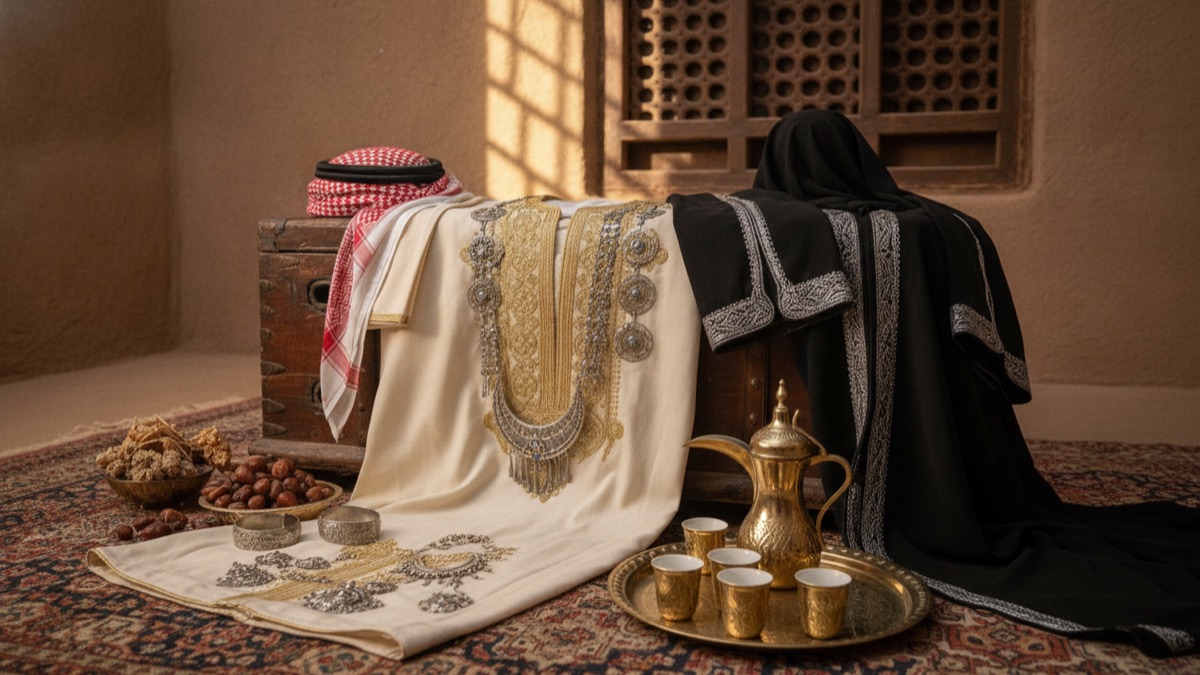
Saudi Traditional Dress and Culture
Saudi Arabia's traditional dress is far more than fabric and thread. It is a visual language that communicates region, status, occasion, and faith. From the flowing white thobe worn by men in Riyadh to the black abaya that has become a global symbol of Saudi womanhood, every garment carries centuries of history and social meaning. Understanding these clothes is essential for anyone who wants to truly understand the Kingdom.
This guide explores the major garments of Saudi traditional dress — the thobe, abaya, bisht, and shemagh — as well as the customs, regional variations, etiquette, and modern changes that shape how Saudis dress today. Whether you are planning a visit, researching the culture, or simply curious about one of the world's most distinctive national wardrobes, this article will give you a clear, respectful, and detailed introduction.
Traditional Saudi clothing has always been shaped by climate, religion, and social structure. The desert heat demanded loose, breathable garments. Islamic values encouraged modesty. And tribal identity found expression in small but significant differences in cut, color, and embroidery. Today, these traditions coexist with rapid social change, producing a fashion scene that is both deeply rooted and surprisingly contemporary.
The Thobe: Saudi Men's National Dress
The thobe (also spelled thawb) is the foundational garment of Saudi men's dress. It is a long, ankle-length robe with long sleeves, usually white for daily wear, though it can appear in cream, beige, light grey, or darker colors during winter months. The thobe is worn over an undershirt and a pair of loose trousers called sirwal, and it is almost always accompanied by a head covering.
In Saudi Arabia, the thobe is not considered formal or ceremonial dress; it is everyday clothing. Men wear it to work, to weddings, to the mosque, and to the supermarket. Its simplicity is its strength. The loose cut allows air to circulate, keeping the body cool under the harsh sun, while the white color reflects heat. In winter, Saudis may switch to heavier fabrics such as wool or cashmere blends in darker shades.
Although the basic shape is consistent, the details reveal a great deal. The collar may be stiff or soft, the cuffs may have buttons or hidden closures, and the side pockets may be positioned differently. Some thobes feature subtle embroidery along the neckline or placket, particularly for special occasions. In recent years, younger Saudis have embraced slim-fit cuts, colored linings, and designer labels, turning the thobe into a statement of personal style while preserving its traditional silhouette.
The thobe also reflects social context. A plain white cotton thobe is appropriate for daily life, while a more heavily embroidered or finely tailored thobe signals a special event. In some families, boys receive their first adult thobe at a coming-of-age celebration, marking their entry into adult responsibilities and dress codes.
The Abaya: Women's Outer Garment
The abaya is a loose, full-length outer robe worn by women in Saudi Arabia and much of the Gulf. Traditionally black, it is designed to be worn over regular clothing when a woman leaves the home. For decades, the abaya was a legal requirement for Saudi women in public, but in 2019 the government announced that women would no longer be required to wear it, although modest dress was still expected.
Despite the legal change, the abaya remains a significant part of Saudi women's lives. Many continue to wear it by choice, viewing it as a marker of faith, tradition, or personal comfort. Others have embraced colored, embroidered, or open-front abayas that function more like long coats than concealing robes. This evolution reflects a broader shift in Saudi society, where women are gaining more choices in how they present themselves while still navigating cultural expectations.
Traditionally, the abaya was paired with a headscarf called a shayla or tarha, and sometimes with a face veil known as a niqab. The combination of garments varied by region, family, and personal preference. In conservative areas such as Qassim and parts of the Najd, women were more likely to cover fully in black. In coastal cities like Jeddah, abayas have long featured more decorative elements, including embroidery, beads, crystals, and colored trim.
Under the abaya, Saudi women wear a wide range of clothing depending on the setting. At home or in women-only gatherings, they may wear elaborate dresses, designer outfits, or traditional garments such as the jalabiya. The abaya therefore functions as a flexible outer layer that allows women to move between public modesty and private expression.
The Bisht: Cloak of Prestige
The bisht is one of the most visually striking garments in Saudi dress. A long, loose cloak traditionally made from wool, camel hair, or fine synthetic fabric, it is worn over the thobe on important occasions. Its most distinctive feature is the ornate trim — usually gold, silver, or copper thread — that runs along the front opening, collar, and sleeves.
Bishts are most commonly black, brown, or cream, though modern designers have introduced navy, grey, and burgundy versions. The quality of the fabric and the intricacy of the trim determine the price, with high-end bishts costing thousands of riyals. A well-made bisht is often passed down through generations or given as a significant gift.
In Saudi culture, the bisht carries strong associations with honor, dignity, and celebration. It is worn at weddings, graduations, religious holidays such as Eid, and official receptions. Gulf leaders and dignitaries often wear bishts when receiving guests or attending state functions. Putting on a bisht is a ceremonial act; it signals that the wearer is entering a space of importance.
The bisht also appears in popular culture. Saudi athletes, musicians, and public figures sometimes wear bishts at award ceremonies or international events, using the garment as a symbol of national pride. In 2022, the bisht gained global attention when Lionel Messi wore one during the FIFA World Cup trophy presentation in Qatar, sparking widespread discussion about Gulf fashion and hospitality.
The Shemagh and Ghutra
No Saudi men's outfit is complete without a head covering. The two main types are the ghutra, a plain white square scarf, and the shemagh, a red-and-white checkered scarf. Both are folded into a triangle and worn on the head, then held in place by a black double cord called the igal.
The ghutra is the more common choice across the Gulf and is often associated with formal, clean, and modern style. The shemagh, with its distinctive red-and-white pattern, is strongly associated with Saudi Arabia and is especially popular in the central and northern regions. The way the headscarf is folded and positioned can also carry meaning. Some styles are practical, keeping the head cool and protected from sand; others are more decorative, with carefully arranged drapes and tails.
The igal itself has a practical origin. Historically, it was used to tether a camel's legs at night, and men would wear it on their heads during the day for easy access. Today, it is purely ornamental, though it remains an essential part of the Saudi look. Igal cords come in different weights and finishes, and some men own several to match different thobes or occasions.
In addition to the ghutra and shemagh, some Saudi men wear a tagiyah or koofiyah, a small white cap, underneath the headscarf. This cap helps keep the scarf in place and is also worn on its own in religious settings or at home. Together, these elements create the layered, textured appearance that makes Saudi men's dress instantly recognizable.
Regional Variations Across the Kingdom
Saudi Arabia is a vast country, and its traditional dress reflects the diversity of its regions. While the thobe and abaya are national garments, local styles reveal subtle but meaningful differences.
Najd (Riyadh and Central Region): Dress in the Najd tends to be conservative and understated. Men wear plain white thobes with red-and-white shemaghs, and women traditionally wore fully black abayas with minimal decoration. The aesthetic is simple, dignified, and closely tied to Bedouin traditions.
Hijaz (Jeddah, Mecca, Medina): As a historic trading crossroads, the Hijaz has a more cosmopolitan dress culture. Hijazi thobes often feature narrower cuts, different collar styles, and more embroidery. Women's abayas in Jeddah have historically been more decorative, with colored trim, beadwork, and lighter fabrics suited to the humid coastal climate.
Eastern Province (Dammam, Khobar, Al-Ahsa): Influenced by proximity to Bahrain, Qatar, and Kuwait, the Eastern Province has its own tailoring traditions. Men may wear slightly shorter thobes or different cuff styles, and the shemagh is extremely common. The region's oil wealth has also made it a center for luxury fashion and bespoke tailoring.
Asir and Southern Regions: The mountainous south has cooler weather and a distinct cultural identity. Traditional dress here includes thicker fabrics, layered garments, and more colorful elements. The futa or izar, a wrapped lower garment similar to a sarong, is sometimes worn by men in rural areas, while women's dress may include brightly embroidered traditional dresses for private and festive occasions.
These regional differences are becoming less rigid as Saudis move between cities and as national media and fashion brands promote a unified Saudi style. However, many families still maintain regional traditions, especially during weddings, national celebrations, and religious holidays.
Dress Etiquette and Customs
Dress in Saudi Arabia is governed by a combination of law, religion, custom, and context. Understanding the unwritten rules helps visitors and newcomers avoid offense and shows respect for local culture.
Modesty is the guiding principle. Both men and women are expected to cover their shoulders and knees in public. Tight, transparent, or revealing clothing is considered inappropriate. This applies regardless of nationality; while foreigners are generally given some leeway, dressing modestly is always appreciated.
Context matters. What is acceptable at a private compound, a five-star hotel, or an international business conference may not be appropriate in a traditional neighborhood, a government office, or a mosque. Visitors should observe the environment and adjust accordingly. In mosques, both men and women should dress conservatively, and women may be asked to cover their hair.
Special occasions call for special dress. Weddings, Eid gatherings, and graduations are opportunities for Saudis to wear their finest clothes. Men may wear bishts over embroidered thobes, while women may wear luxurious dresses under decorated abayas. Guests should dress more formally than usual for such events.
Religious settings. During Ramadan and Hajj, dress codes tend to become more conservative. Many Saudis wear white more frequently during these periods, and pilgrims performing Umrah or Hajj wear special white garments called ihram, which symbolize purity and equality before God.
Greetings and personal space. Dress etiquette is connected to broader social customs. In formal settings, Saudis may stand when greeting someone older or more senior. Handshakes between men are common, but men should wait for a woman to extend her hand first. These small gestures show awareness of the culture that clothing also represents.
Modern Changes and Contemporary Fashion
Saudi dress is not frozen in time. Over the past decade, the Kingdom has experienced profound social and economic changes, and fashion has been one of the most visible arenas of transformation.
The most significant legal change came in 2019, when Crown Prince Mohammed bin Salman announced that the abaya would no longer be mandatory for women. This decision opened space for women to express themselves more freely through clothing, though many still choose to wear the abaya for religious, cultural, or practical reasons. Since then, Saudi streets have become more diverse in style, with women wearing colored abayas, open abayas over jeans, or Western-style modest fashion.
For men, the thobe has also evolved. Tailors now offer slim fits, shorter lengths, and personalized details such as colored buttons, hidden pockets, and monogrammed cuffs. Young Saudis increasingly treat the thobe as a fashion item, pairing it with designer sneakers, luxury watches, and carefully chosen shemaghs. Social media influencers have played a major role in popularizing these trends.
The Saudi government has actively supported the fashion industry as part of Vision 2030. Riyadh Season and Jeddah Season include fashion shows, designer markets, and cultural exhibitions. The Saudi Fashion Commission, established in 2020, works to develop local talent, promote sustainable production, and position the Kingdom as a regional fashion hub. In 2024, Saudi Arabia hosted its first official fashion week in Riyadh, drawing international designers, buyers, and media.
At the same time, there is a strong movement to preserve traditional craftsmanship. Organizations such as the Living Heritage Institute and various cultural foundations support artisans who produce handwoven bishts, embroidered abayas, and traditional jewelry. The goal is not to choose between tradition and modernity but to weave them together.
This balance is reflected in everyday life. A young Saudi professional might wear a tailored thobe to work, switch to jeans and a hoodie at a cafe, and put on a family bisht for a cousin's wedding. Identity is expressed through these choices, not despite them.
Sources
- Visit Saudi Official Tourism Portal — Official information on Saudi culture, customs, and travel guidance
- Saudi Fashion Commission — Official source on the development of Saudi fashion, traditional dress, and industry initiatives
- Saudi Vision 2030 — Government platform documenting social and economic reforms, including cultural and fashion sectors
- Encyclopaedia Britannica — Saudi Arabia — Authoritative overview of Saudi history, regions, and culture
- Al Jazeera — Saudi Arabia — Reporting on social changes, women's rights, and modern fashion developments
- Arab News — Saudi-based English-language coverage of culture, fashion, and societal trends
- Smithsonian Magazine — Cultural and historical analysis of Middle Eastern dress and textile traditions
FAQ
What is a thobe?
A thobe is a long, ankle-length robe worn by men across the Arabian Peninsula. In Saudi Arabia, it is usually white for daily wear and can be made from cotton or lightweight wool, with regional variations in collar, cuff, and embroidery details.
What is the difference between a shemagh and a ghutra?
A ghutra is a square white headscarf, while a shemagh is a red-and-white checkered headscarf. Both are worn folded and held in place by an igal, a black cord. The shemagh is more common in central and northern Saudi Arabia, whereas the plain white ghutra is widely worn across the Gulf.
Do Saudi women still have to wear an abaya?
Since 2019, women in Saudi Arabia are no longer legally required to wear an abaya in public, although modest dress is still expected. Many Saudi women continue to wear the abaya by choice, and it remains common in conservative regions and formal settings.
What is a bisht and when is it worn?
A bisht is a traditional men's cloak, usually black, brown, or cream, trimmed with gold or silver braid. It is worn over the thobe at weddings, graduations, religious celebrations, and official ceremonies as a mark of prestige and respect.
Are there regional differences in Saudi dress?
Yes. Najdi dress tends to be simpler and more conservative, with white thobes and red-and-white shemaghs. Hijazi dress, influenced by Ottoman and Indian Ocean trade, often features more embroidery and darker bishts. Southern regions may use thicker fabrics and layered garments due to cooler mountain climates.
What should visitors wear in Saudi Arabia?
Visitors should dress modestly. Men should avoid shorts and sleeveless shirts in public. Women are no longer required to wear an abaya but should choose loose-fitting clothing that covers shoulders and knees. Swimwear is acceptable only at private beaches and pools.
How is Saudi fashion changing today?
Saudi fashion is blending tradition with global trends. Designers are reinterpreting the thobe and abaya with contemporary cuts, sustainable fabrics, and bold colors. Fashion weeks in Riyadh and Jeddah, along with government support for the creative economy, are accelerating this evolution while preserving cultural identity.
What is an igal?
An igal is a black double cord worn over the ghutra or shemagh to hold it in place on the head. Historically, it was used to tether camels, but today it is a decorative and essential part of traditional Saudi men's dress.
Can foreigners wear a thobe or abaya?
Yes, foreigners are generally welcome to wear a thobe or abaya as a sign of respect and appreciation for Saudi culture. Many visitors choose to wear an abaya when visiting mosques or conservative areas, and some men enjoy wearing a thobe during cultural events or festivals.
What colors are acceptable for Saudi traditional dress?
White is the standard color for men's daily thobes because it reflects heat. Women traditionally wear black abayas, though colored and decorated abayas are increasingly common. Bishts are typically black, brown, or cream. For special occasions, richer colors and finer fabrics are acceptable.
About the Author
doyouknow.app AI-assisted Editorial Workflow — This article was prepared with AI-assisted research and editing, using the sources listed on the page. It is not based on firsthand testing, on-the-ground reporting, or a claim of personal experience or professional credentials. Please check official sources for current details.
Loved This Article?
Share it on WhatsApp → Share on WhatsApp
Get more Saudi culture tips in your inbox — Subscribe to our newsletter for weekly surprising stories from Dubai, Saudi Arabia, and beyond.