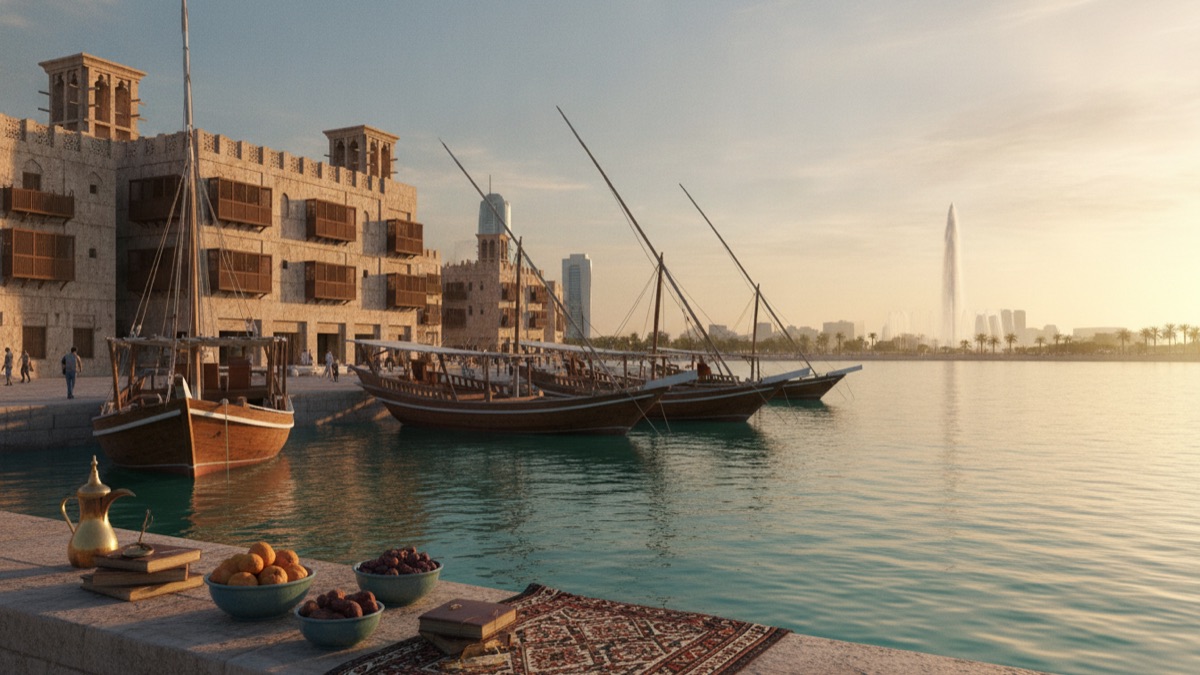
Jeddah: The Gateway to the Red Sea
Jeddah is not just Saudi Arabia's commercial capital — it is the country's most cosmopolitan city, a living museum where ancient coral-stone houses stand minutes from luxury resorts. For centuries, this Red Sea port served as the gateway for pilgrims traveling to Mecca. Today, it welcomes travelers seeking world-class diving, UNESCO-listed architecture, and some of the best seafood in the Arabian Peninsula.
This Jeddah travel guide covers everything you need to plan your trip: from wandering the alleyways of Al-Balad to watching the sunset at the Floating Mosque, from navigating King Abdulaziz International Airport to escaping the heat on a day trip to Taif. Whether you are visiting for a weekend or a week, here is how to experience Jeddah like a traveler, not a tourist.
Al-Balad: Jeddah's Historic Heart
Al-Balad, meaning "The Town," is the historic center of Jeddah and a UNESCO World Heritage Site. Founded in the 7th century, it was the main commercial district until the 1970s oil boom shifted growth northward. Today, it is being carefully restored, and the results are remarkable.
The most striking feature of Al-Balad is its Roshan — elaborately carved wooden latticework windows that extend from the coral-stone walls. These screens allowed cool sea breezes in while keeping prying eyes out, and they turned the facades into works of art. No two Roshan are identical. Walk down Souk Al-Alawi, the main thoroughfare, and you will see hundreds of variations, each telling a different story of the family that commissioned it.
Beyond the architecture, Al-Balad is home to some of Jeddah's best markets. The Souq Al-Alawi sells everything from frankincense and oud to gold and textiles. The Qabel Trail, a pedestrianized heritage path, connects several restored houses including Bayt Nassif and Bayt Matbouli, both now open as museums. For the best experience, visit on a Thursday or Friday evening when the area is illuminated and locals stroll after dinner.
Practical tip: Wear comfortable walking shoes. The streets are uneven, and you will want to look up constantly. Parking is limited; arrive by taxi or Uber and explore on foot.
The Jeddah Corniche
The Jeddah Corniche stretches for over 30 kilometers along the Red Sea coast, making it one of the longest waterfront promenades in the world. It is divided into sections, each offering a different experience.
The northern end near the Faisaliah district is the most developed, with landscaped gardens, cycling paths, and outdoor gyms. The Jeddah Waterfront (also called New Corniche) features a sandy beach, swimming areas, and food trucks. Families gather here on weekends for picnics and barbecues. The middle section around the Al-Hamra neighborhood is where you will find the city's best restaurants and cafes with sea views.
The southern Corniche is quieter and more residential, offering a glimpse of how locals actually live. At sunset, the entire promenade becomes a social space — joggers share paths with fishermen, children play on the grass, and couples watch the sun dip below the horizon. The Red Sea sunsets here are genuinely spectacular, painting the sky in shades of coral and gold.
Al-Rahma: The Floating Mosque
Officially named Al-Rahma Mosque but universally known as the Floating Mosque, this is one of the most photographed buildings in Saudi Arabia. Built on stilts over the Red Sea, it appears to hover above the water at high tide. The white marble structure gleams against the blue sea, and the effect is most dramatic during sunrise and sunset when the light turns the water golden.
The mosque is fully functional and open to visitors outside prayer times. Non-Muslims are welcome to admire the exterior and, during designated hours, the interior. The space is serene — the sound of waves beneath the floor creates a unique atmosphere for prayer and reflection. Located on the northern Corniche near the Al-Shati district, it is best visited by car or taxi.
Best time to visit: Arrive 45 minutes before sunset to see the mosque in daylight, at golden hour, and then illuminated at night. Parking is available but fills quickly on weekends.
Red Sea Adventures
Jeddah sits on the eastern shore of the Red Sea, and the underwater world here is extraordinary. The Red Sea is home to over 1,200 species of fish, many of which are found nowhere else on Earth. For divers, Jeddah offers some of the most accessible reef diving in the region.
The Abu Tair Reef, about 90 minutes north of the city, is a popular spot for both diving and snorkeling. The coral is healthy, and you are likely to see moray eels, turtles, and barracuda. Closer to the city, the Obhur Creek area has several dive centers that cater to beginners and offer PADI certification courses.
If diving is not your thing, the Red Sea beaches are excellent for swimming, paddleboarding, and jet skiing. Many of the luxury hotels have private beach clubs with day-pass options for non-guests. The water temperature rarely drops below 24°C, making it swimmable year-round.
Best diving season: March to May and September to November offer the clearest visibility and calmest seas.
King Fahd Fountain
The King Fahd Fountain is Jeddah's most famous landmark. At 312 meters, it is the tallest fountain in the world, and its water jet is visible from across the city. The fountain was gifted to the city by King Fahd and has been operating since 1985.
The best viewing spots are from the Corniche near the Jeddah Flagpole or from the sea-facing rooms at the InterContinental and Hilton hotels. At night, the fountain is illuminated by 500 spotlights, creating a spectacle that draws crowds every evening. The show runs continuously from sunset to midnight, though wind conditions occasionally cause temporary shutdowns.
Photography tip: The fountain is backlit at night, so the best photos are taken at blue hour (just after sunset) when the sky still has color and the lights are on. A tripod helps, but even smartphone shots look impressive here.
Jeddah Cuisine & Dining
Jeddah's food culture is distinct from the rest of Saudi Arabia. As a port city, it has been influenced by centuries of trade with Africa, India, and the Levant. The result is a cuisine that is lighter, more seafood-focused, and more diverse than what you will find in Riyadh.
Sayadieh is the city's signature dish — a spiced fish and rice platter topped with caramelized onions, pine nuts, and almonds. The fish is usually hammour or red snapper, cooked in a tomato-based broth that gives the rice its distinctive color. Another must-try is Kibda (beef liver), a popular breakfast dish flavored with cumin, garlic, and lemon.
For street food, try Mutabbaq, a stuffed savory pancake that originated in Yemen but was perfected in Jeddah. The Balila (spiced chickpeas) sold from carts in Al-Balad is a beloved snack. And do not leave without trying Qursan, a bread-based dish soaked in rich meat stew, traditionally served at Saudi family gatherings.
Sweets are equally important. Basbousa (semolina cake soaked in syrup) and Luqaimat (fried dough balls with date syrup) are widely available. For something uniquely Jeddawi, seek out Hijazi coffee, flavored with cardamom and saffron, traditionally served with dates and pastries.
Best Neighborhoods to Stay
Jeddah is spread out, and choosing the right neighborhood will shape your experience. Here are the best areas for different types of travelers:
Al-Hamra (Downtown): The most central area, close to the Corniche, major malls, and business districts. Best for first-time visitors and business travelers. Hotels range from mid-range to luxury, and you are never far from a good restaurant.
Al-Shati (Northern Corniche): The upscale coastal strip with the best beach access. Most of the city's luxury hotels are here, including the Ritz-Carlton and Park Hyatt. Best for families and travelers who want a resort experience within the city.
Al-Balad (Historic District): While there are no major hotels inside the heritage area itself, staying nearby in the Al-Kandarah or Al-Safa neighborhoods puts you within walking distance of the souks. This is best for culture-focused travelers.
Al-Andalus (East Jeddah): A quieter, more residential area with good value hotels and strong local character. Best for budget travelers and those who want to see how locals live.
Al-Thuwal (North of City): A developing area with new waterfront developments. Best for longer stays and those with a car who want to explore beyond the city center.
Top Hotels in Jeddah
Jeddah's hotel scene has improved dramatically in recent years. Whether you are looking for a historic palace converted into a boutique hotel or a beachfront resort, there are options for every budget.
Park Hyatt Jeddah — Marina, Club and Spa: The city's most iconic luxury hotel, set on the Red Sea with a private marina, spa, and exceptional seafood restaurant. The sea-facing rooms offer the best fountain views in the city.
Ritz-Carlton Jeddah: Located in the Al-Hamra district, this palace-style hotel features ornate interiors, a private art collection, and one of the best breakfast buffets in the city. The Corniche-facing suites are worth the upgrade.
Jeddah Hilton: A classic business hotel with a beachfront location, multiple pools, and direct Corniche access. Reliable, well-located, and often more affordable than the ultra-luxury options.
Assila, a Luxury Collection Hotel: A boutique option in the heart of Al-Balad's revival. The rooms are large, the design is contemporary-Saudi, and the rooftop restaurant offers views over the historic district.
Mid-range: The Elaf Jeddah Hotel and Al-Harthy Hotel offer clean, comfortable rooms in central locations at reasonable rates. Both are walking distance from the Corniche and major shopping areas.
Best Restaurants in Jeddah
Jeddah's dining scene is evolving rapidly. While traditional Saudi restaurants remain popular, a new wave of international and fusion spots has opened in recent years. Here are our top picks:
Al-Nakheel (Park Hyatt): The best seafood restaurant in the city, with a terrace that overlooks the Red Sea. The sayadieh is exceptional, and the grilled hammour is a must-order. Reservations are essential on weekends.
Toki: A contemporary Saudi restaurant in Al-Balad that reimagines traditional Hijazi dishes with modern techniques. The Qursan here is the best in the city, and the atmosphere — in a restored coral house — is unbeatable.
Twina: A local favorite for seafood, located on the Corniche. The fish is sold by weight and cooked to order. The fried shrimp and crab soup are standout dishes. Come early; it fills up fast.
Maedat Bait Al-Filfil: An Ethiopian restaurant that has become a Jeddah institution. The injera bread and spiced stews are authentic and delicious. It is a reminder of the city's deep African connections.
Cafe Bateel: For a lighter meal, this cafe chain serves excellent dates, Arabic coffee, and pastries. The Al-Andalus branch has a lovely outdoor terrace.
Street food: Do not miss the food stalls along Al-Balad's souks for Mutabbaq and fresh sugarcane juice, or the late-night Kibda carts that appear near the Corniche after 10 PM.
Transport from Jeddah Airport
King Abdulaziz International Airport (JED) is located about 19 kilometers north of the city center. It is the busiest airport in Saudi Arabia and has been significantly expanded in recent years, with a new terminal that opened in 2019.
Taxi / Uber / Careem: The easiest option. A ride to downtown Al-Hamra takes 20-30 minutes and costs approximately 50-70 SAR. Rideshare apps are reliable, and most drivers speak enough English for basic directions. The designated pickup area is on the ground floor outside arrivals.
Airport Bus: The Saptco bus service connects the airport to the city center for about 10 SAR. Buses run every 30-60 minutes, but the schedule can be irregular. This is the cheapest option but not the most convenient if you have luggage.
Car Rental: All major rental companies operate at the airport. Driving in Jeddah is straightforward, though traffic can be heavy during rush hours (7-9 AM and 5-8 PM). Parking is generally available at hotels and malls, but street parking in Al-Balad is limited.
Hotel Transfers: Luxury hotels offer airport transfers for 150-300 SAR. Book in advance for the best rate.
Domestic Connections: If you are flying onward to Riyadh, Dammam, or Abha, the domestic terminal is connected to the international terminal by a free shuttle bus.
Day Trips: Taif & Thuwal
Jeddah is an excellent base for exploring the surrounding region. Two destinations stand out for day trips:
Taif: Located 180 kilometers east of Jeddah in the Sarawat Mountains, Taif is known as the "City of Roses" for its flower farms and perfume distilleries. The mountain drive takes about 2 hours and offers spectacular views. At 1,879 meters above sea level, Taif is noticeably cooler than Jeddah — a welcome escape during the summer months.
Highlights include the Al-Rudaf Park, the Shubra Palace (a historic museum), and the Al-Hada Mountain with its cable car. The rose season is March to April, when the farms are in full bloom. Taif also has a historic souq and excellent fruit orchards.
Thuwal: About 80 kilometers north of Jeddah, Thuwal is a small coastal town that has become a gateway to the Red Sea's best diving. The King Abdullah University of Science and Technology (KAUST) is nearby, and the university's research divers have helped preserve the local reefs. The diving here is quieter and more pristine than closer to the city. Charter boats can be arranged from Jeddah's marina.
Other options: The Al-Wahbah Crater is a volcanic crater about 250 kilometers inland, best visited as an overnight trip. The Shoaiba Power Plant Beach south of the city is a popular local swimming spot with clearer water than the city beaches.
Practical Travel Tips
Best time to visit: November to March is ideal. Daytime temperatures are in the mid-20s Celsius, and evenings are cool enough for outdoor dining. Avoid June to September unless you enjoy 45°C heat.
Dress code: Jeddah is more liberal than Riyadh, but modest dress is still expected. Men should avoid shorts in traditional areas. Women are no longer required to wear an abaya, but loose-fitting clothing that covers shoulders and knees is respectful. Beachwear is acceptable at private hotel beaches.
Currency: The Saudi Riyal (SAR). Credit cards are widely accepted, but carry cash for souks and street food. ATMs are plentiful.
Language: Arabic is the official language, but English is widely spoken in hotels, restaurants, and tourist areas. Road signs are bilingual.
Visas: Most nationalities can obtain an e-visa online in minutes. The visa is valid for one year and allows multiple entries of up to 90 days each.
Friday closures: Most shops and restaurants open after the Jumu'ah prayer (around 1:30 PM). Plan accordingly.
Sources
- Visit Saudi Official Tourism Portal — Official travel information, visa policies, and destination guides
- UNESCO World Heritage Centre — Al-Balad UNESCO listing and heritage documentation
- Saudi Tourism Authority — Official statistics, destination development, and travel updates
- Lonely Planet — Jeddah — Travel guide content and neighborhood recommendations
- Kayak Travel Guide — Hotel and flight booking data, price ranges, and travel trends
- Rough Guides — Saudi Arabia — Practical travel advice and cultural context
- Fodor's Travel — Jeddah — Restaurant recommendations and insider tips
FAQ
Is Jeddah safe for tourists?
Yes, Jeddah is generally very safe for tourists. Saudi Arabia has low crime rates, and the city is welcoming to international visitors. Standard travel precautions apply, but violent crime is rare.
Do I need a visa to visit Jeddah?
Most nationalities can apply for a Saudi e-visa online. The visa is typically valid for one year, allows multiple entries, and permits stays of up to 90 days per visit. Citizens of GCC countries do not need a visa.
Can non-Muslims visit Mecca from Jeddah?
No. Mecca and Medina are closed to non-Muslims. This restriction is strictly enforced. Non-Muslim visitors should respect these boundaries and explore Jeddah's many other attractions instead.
What is the best area to stay in Jeddah?
Al-Hamra is best for first-time visitors due to its central location. Al-Shati is ideal for beach and resort access. Stay near Al-Balad if you want to be close to historic sites and traditional markets.
How much does a trip to Jeddah cost?
Mid-range travelers should budget around 400-600 SAR per day for accommodation, meals, and transport. Luxury travelers can expect to spend 1,500+ SAR daily. Budget options exist, especially in local restaurants and mid-range hotels.
What should I wear in Jeddah?
Modest dress is recommended. Women are no longer required to wear an abaya but should choose loose clothing covering shoulders and knees. Men should avoid shorts in traditional areas. Hotel beaches and private compounds are more relaxed.
Is alcohol available in Jeddah?
No. Alcohol is prohibited throughout Saudi Arabia, including in Jeddah. Hotels and restaurants do not serve alcohol. Many travelers enjoy the excellent fresh juices, Arabic coffee, and non-alcoholic mocktails instead.
How do I get around Jeddah?
Uber and Careem are widely available and affordable. Taxis are also common but agree on a fare beforehand if not using a meter. The Jeddah Metro is under construction; until it opens, buses and rental cars are the main public options.
What is the best time of year to visit Jeddah?
November through March offers the most pleasant weather, with daytime temperatures of 22-30°C. April and October are also manageable. June through September is extremely hot and humid, with temperatures exceeding 40°C regularly.
Can I swim in the Red Sea in Jeddah?
Yes, but choose your spot carefully. Public beaches vary in cleanliness. The best swimming is at hotel private beaches or the designated swimming areas at Jeddah Waterfront. The water is warm year-round and generally safe for swimming.
About the Author
doyouknow.app AI-assisted Editorial Workflow — This article was prepared with AI-assisted research and editing, using the sources listed on the page. It is not based on firsthand testing, on-the-ground reporting, or a claim of personal experience or professional credentials. Please check official sources for current details.
Loved This Article?
Share it on WhatsApp → Share on WhatsApp
Get more Saudi Arabia travel tips in your inbox — Subscribe to our newsletter for weekly surprising stories from Dubai, Saudi Arabia, and beyond.