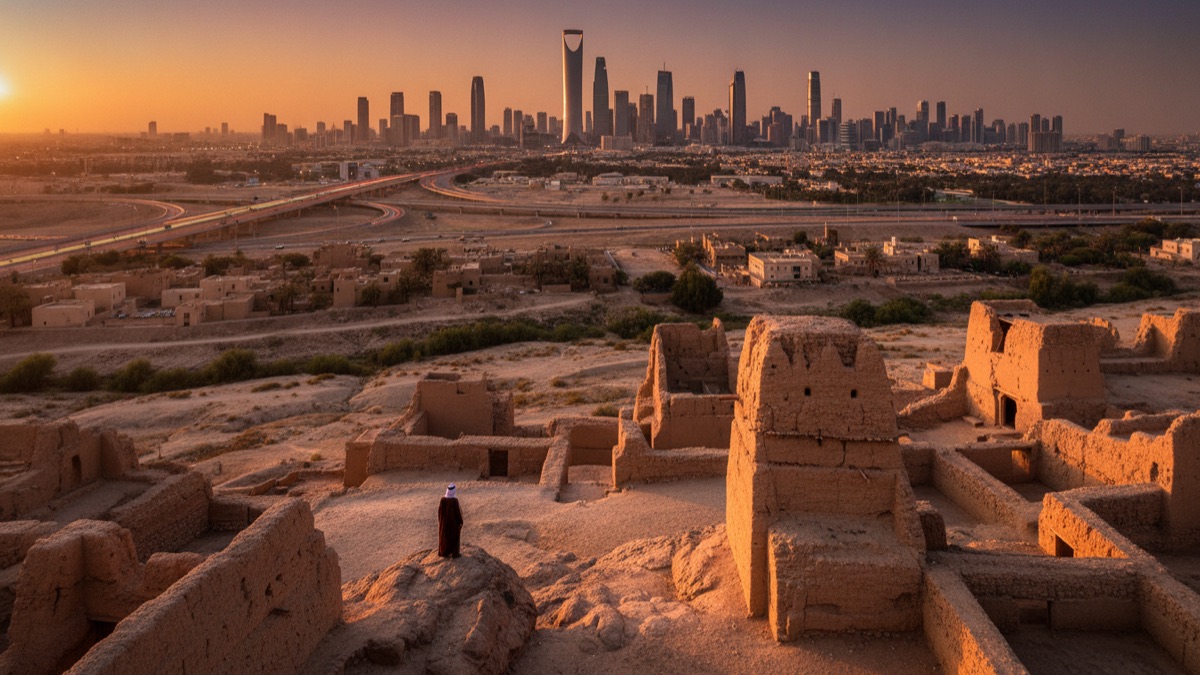
History of Saudi Arabia: From Diriyah to Today
In 1744, two men met in Diriyah: an emir and a religious scholar. Nobody there could have known that this alliance would help shape, two centuries later, a state stretching from the Red Sea to the Gulf. The history of Saudi Arabia is a story of alliances, wars, diplomacy, patience, and transformation.
The First Saudi State: 1744-1818
The modern Saudi story began in Diriyah, where Muhammad bin Saud allied with Muhammad bin Abd al-Wahhab. It was not only a military alliance; it connected political authority, religious reform, tribal networks, and territory.
The first Saudi state expanded quickly across Najd, Al Ahsa, the Hijaz, and toward Iraq and the Levant. But expansion brought enemies. The Ottoman Empire, acting through Egypt, sent a campaign led by Ibrahim Pasha. In 1818, Diriyah was destroyed and the first state ended.
The Second Saudi State: 1824-1891
Turki bin Abdullah Al Saud restored Saudi rule in Riyadh in 1824. The second Saudi state was smaller than the first and centered mainly on Najd, but it built more durable administrative habits.
Under Imam Faisal, the state developed systems for taxation, justice, and tribal relations. Riyadh grew, though it remained a modest town by modern standards. The second state ended in 1891 when Al Rashid defeated Al Saud at the Battle of Mulayda, forcing the family into exile in Kuwait.
Unification of the Kingdom: 1902-1932
On 15 January 1902, Abdulaziz bin Abdul Rahman Al Saud led a small force back to Riyadh and retook the city. That event became the starting point for the unification of much of the Arabian Peninsula.
Over the next three decades, Abdulaziz consolidated Najd, defeated Al Rashid, took the Hijaz, negotiated the Treaty of Jeddah with Britain, and in 1932 proclaimed the Kingdom of Saudi Arabia.
Abdulaziz was not only a warrior. He was also a diplomat and coalition builder, using negotiation, marriage alliances, taxation, trade, and political timing to build a modern state from pre-modern structures.
The Oil Era: 1938-1960s
In 1938, the California Arabian Standard Oil Company—later Aramco—began producing oil from Dammam Well No. 7. The well was only the beginning, but it changed the country’s future.
Production grew during and after the Second World War. The United States needed oil; Saudi Arabia had oil. A strategic relationship emerged and has shaped regional politics ever since.
By the 1950s, oil revenues were transforming the treasury. Roads, schools, state institutions, and new forms of administration became possible. King Abdulaziz died in 1953, before the full scale of the oil transformation became visible.
King Saud and then King Faisal inherited that transformation. Under Faisal, the oil state became more structured: development plans, modern budgets, universities, overseas scholarships, and a more assertive foreign policy all expanded.
Modern Saudi Arabia: 1975-2015
King Khalid’s reign saw rapid economic growth as oil prices rose. King Fahd’s reign included decisive events: the 1979 seizure of the Grand Mosque, the Iranian Revolution, the Gulf War, industrial-city development in Jubail and Yanbu, and a major expansion of education.
King Abdullah’s reign brought further change: the founding of King Abdullah University of Science and Technology, wider opportunities for women in education and work, and a more visible reform conversation. It also coincided with regional turmoil and security challenges.
King Salman’s Era: 2015 to Today
King Salman came to the throne in 2015. The period that followed was marked by rapid policy and social change. Mohammed bin Salman became defense minister in 2015, crown prince in 2017, and prime minister in 2022.
Vision 2030, announced in 2016, aims to diversify the economy, develop tourism and entertainment, empower women, build new cities and destinations such as NEOM, Qiddiya, and the Red Sea, and reduce dependence on oil.
Recent changes have been fast: women driving, cinemas reopening, Riyadh Season, tourism expansion, new megaprojects, and a far more visible public entertainment sector. These shifts make the current period one of the most consequential in Saudi history.
Saudi Arabia Today: Between Past and Future
Saudi Arabia today is one of the Middle East’s largest economies, a central energy producer, and the host of Islam’s two holiest cities. At the same time, it is trying to redefine itself: from oil dependence toward diversification, from a closed tourism model toward international visitors, and from older social limits toward a different public culture.
This transformation is not simple. There are questions about identity, balance, and sustainability. But Saudi history shows a repeated pattern: the country has changed before, and it is changing again.
Frequently Asked Questions
When was Saudi Arabia founded?
The Kingdom of Saudi Arabia was formally proclaimed on 23 September 1932. The unification process began with Abdulaziz’s recapture of Riyadh in 1902.
Who was the founding king?
The founding king was Abdulaziz bin Abdul Rahman Al Saud, who retook Riyadh, unified Najd and the Hijaz, and proclaimed the Kingdom in 1932.
What were the three Saudi states?
The first Saudi state was centered in Diriyah from 1744 to 1818. The second was centered in Riyadh from 1824 to 1891. The third began with Abdulaziz’s campaign from 1902 and became the modern Kingdom.
What is Vision 2030?
Vision 2030 is a national transformation plan announced in 2016 to diversify the economy, develop tourism and entertainment, empower women, and reduce dependence on oil.
Sources
- Saudi national archive — historical documents. Saudi National Archive
- Saudi Ministry of Culture — national history and heritage. Ministry of Culture
- King Saud University — modern Arabian history. KSU
- Vision 2030 official portal. Vision 2030
- Madawi Al-Rasheed. (2012). Saudi Arabia: History and Debate.
- Alexander Bligh. (1966). The Saudis: The Story of the House of Saud.
- Harry St John Philby. (1955). Saudi Arabia: Its History and People.