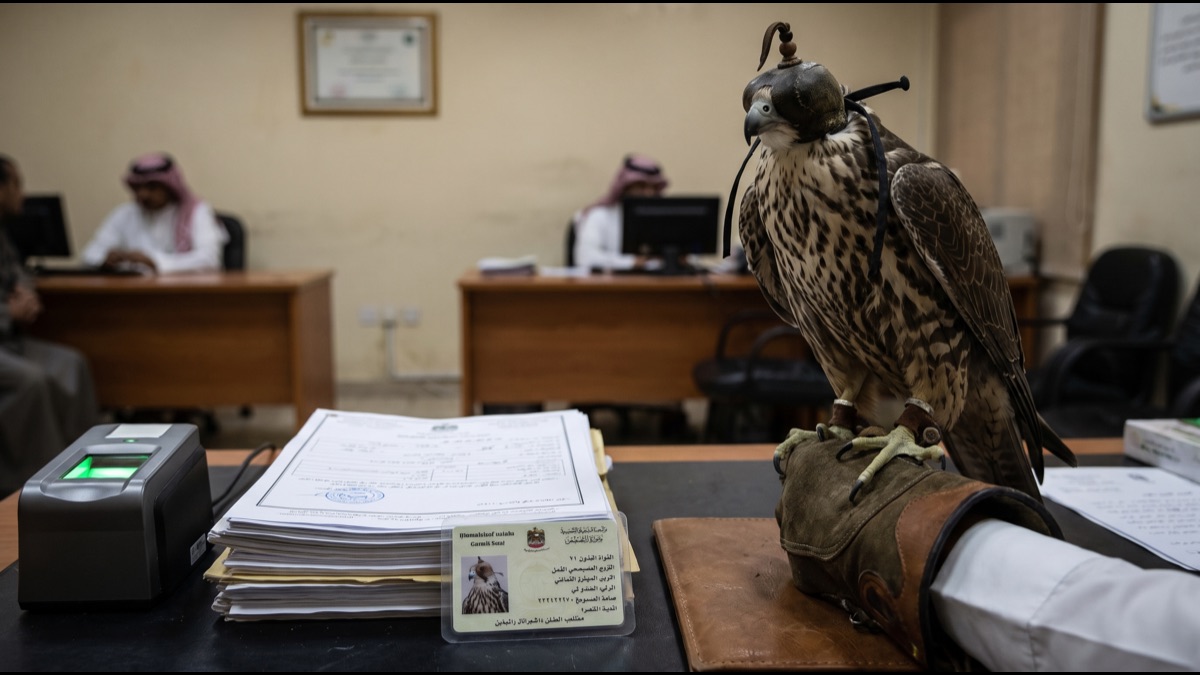
In Saudi Arabia, a bird of prey can travel internationally with its own passport, carry a government-issued microchip, and require its owner to hold a formal license before it is ever flown, all in service of a hunting tradition that predates the modern state itself. Falconry occupies a genuinely unusual position in the Kingdom, treated simultaneously as a living Bedouin heritage practice and as a tightly regulated wildlife activity subject to international conservation law.
Understanding how the licensing, documentation, and breeding systems actually function reveals a surprisingly modern bureaucratic apparatus built specifically to protect an ancient practice from the pressures that have driven wild raptor populations toward decline across much of the world.
Why Falconry Needs Government Regulation
Falcons used in traditional hunting are wild raptor species, several of which are protected under international conservation agreements due to historical population declines driven by habitat loss, pesticide exposure, and unregulated capture for the falconry trade itself.
Without formal oversight, the enormous demand for hunting and competition birds across the Gulf region could plausibly drive renewed pressure on wild populations, which is precisely the outcome regulation is designed to prevent while still allowing the cultural practice to continue.
Saudi Arabia's regulatory framework therefore serves two purposes simultaneously: protecting wild raptor populations from unsustainable extraction, and providing legitimate falconers with a legal, documented pathway to own and fly birds without running afoul of wildlife trafficking law.
What a Falcon Passport Actually Contains
A falcon passport is an official document recording the bird's species, its unique microchip identification number, its origin, whether captive-bred or legally wild-sourced, and its chain of ownership, functioning much like a livestock pedigree combined with a travel document.
These passports are required specifically for international travel, since falconers frequently transport birds across Gulf borders for hunting trips, competitions, and veterinary treatment, and authorities at each border need a reliable way to verify a bird's legal status without physically inspecting genetic or capture records.
The passport system also protects falconers themselves, since a bird lacking proper documentation can be seized at a border regardless of how it was actually acquired, making the paperwork as practically essential to a serious falconer as a passport is to its human owner.
How Microchipping Actually Works
Falcons subject to regulation are implanted with a small identifying microchip, typically inserted into the muscle tissue by a licensed veterinarian, that can be scanned by authorities to instantly retrieve the bird's registered identity and ownership records.
This system closes a critical enforcement gap that existed before its introduction, since a wild-caught bird could previously be presented as captive-bred with little practical way for an inspector to verify the claim without extensive investigation.
Microchip registries are cross-referenced against breeding facility records and import documentation, allowing authorities to flag inconsistencies, such as a chip number that does not match any legitimate breeder's registered output, as a strong indicator of illegal wild capture or trafficking.
What Owners Need to Legally Fly a Falcon
Beyond the bird's own documentation, falconers themselves must generally hold appropriate permits to legally possess and fly a bird of prey, with requirements varying somewhat depending on species and intended use, whether purely recreational hunting or formal competition.
Obtaining these permits typically involves demonstrating the applicant's competence in falconry practice and providing evidence of appropriate housing and care facilities, since authorities have a legitimate interest in ensuring regulated birds are kept in conditions meeting basic welfare standards.
Enforcement has tightened considerably in recent years as falconry has grown into a larger commercial and competitive industry, with authorities treating undocumented ownership as a genuine regulatory violation rather than the informal tolerance that characterized earlier decades of the practice.
How Wild Capture Is Actually Restricted
Trapping wild falcons remains legally possible in Saudi Arabia but only within specific licensed seasons, quotas, and locations, a framework designed to permit a limited, sustainable continuation of the traditional practice of trapping migratory falcons rather than banning capture outright.
Licensed trappers must generally report captured birds for registration and microchipping before they can be legally kept or sold, folding wild-caught birds into the same documentation system that governs captive-bred ones rather than creating a separate, less accountable category.
Enforcement against illegal, unlicensed trapping has become a genuine conservation priority, with penalties for violations designed to be severe enough to discourage the black-market capture that regulation is specifically intended to eliminate from the legitimate falconry economy.
Why Captive Breeding Became the Norm
The overwhelming majority of falcons used in modern Saudi falconry and competition are now captive-bred rather than wild-caught, a shift driven by both conservation pressure and the simple practical advantage of predictable, year-round supply that wild trapping seasons cannot offer.
Specialized breeding facilities, some operating at considerable commercial scale, produce birds specifically selected for the physical and temperamental traits valued in hunting and competition, applying deliberate selective breeding much as other prized animal traditions do.
This shift toward captive breeding has been actively encouraged by regulators precisely because it reduces pressure on wild populations while still supplying the growing demand from a falconry culture that shows no sign of declining in popularity across the region, a trend breeding facility operators consistently point to when discussing their own expansion plans.
How CITES Shapes Cross-Border Falcon Trade
Many falcon species used in traditional hunting are listed under the Convention on International Trade in Endangered Species, meaning their cross-border movement and trade is subject to international permit requirements regardless of domestic Saudi regulation.
Saudi Arabia's national licensing and passport system is specifically designed to align with these international obligations, ensuring that a bird legally documented domestically can also clear the additional layer of international wildlife trade compliance required when it travels abroad.
This dual-layer compliance, domestic licensing plus international CITES documentation, is precisely why the paperwork surrounding a single falcon can be considerably more extensive than that required for many other privately owned animals of comparable value.
Why Prize Falcons Cost So Much
Elite falcons, particularly hybrids combining gyrfalcon size and power with saker falcon endurance, have sold at auction for sums reaching hundreds of thousands of dollars, with the most exceptional individual birds reportedly commanding prices exceeding a million.
Value is driven by a combination of documented lineage, physical characteristics prized in competition, and demonstrated hunting or racing performance, creating a market where a bird's paperwork and competitive record matter as much to its price as its physical condition.
This valuation dynamic mirrors other elite animal markets, such as thoroughbred racehorses, where a relatively small population of top-tier competitors commands prices wildly disproportionate to the broader population of ordinary, non-elite animals of the same species.
What the King Abdulaziz Falconry Festival Actually Is
Saudi Arabia hosts a major annual falconry festival featuring competitive events that test speed, hunting skill, and physical presentation, drawing falconers and substantial prize money from across the Gulf region in a format that closely parallels other Saudi heritage competitions.
The festival serves a dual function similar to the camel festival held elsewhere in the Kingdom's calendar, celebrating traditional Bedouin practice while providing a formal, prestigious venue where serious falconers can demonstrate their birds' quality and compete for genuinely significant prize purses.
Government tourism bodies have increasingly promoted the festival to international visitors, treating falconry's genuine novelty to non-regional audiences as a distinctive cultural attraction that fits naturally alongside the Kingdom's broader heritage tourism strategy.
How Falcon Hospitals Actually Operate
Given the substantial financial and cultural value invested in individual birds, Saudi Arabia operates specialized veterinary facilities dedicated specifically to falcon health, staffed by veterinarians trained in the particular physiology and common ailments of birds of prey.
These facilities handle everything from routine health checks required for passport documentation to specialized treatment for injuries sustained during hunting or competition, functioning as a genuinely distinct veterinary specialty rather than a subset of general avian medicine.
The existence of dedicated falcon hospitals at this scale is itself a reflection of how seriously the practice is taken commercially and culturally, since few countries maintain veterinary infrastructure this specialized for a single category of privately owned animal.
Some of these facilities have also begun offering advanced diagnostic imaging and even surgical procedures once available only for high-value racehorses and companion animals, a level of investment that reflects both the genuine affection owners hold for individual birds and the straightforward financial logic of protecting an asset that can be worth more than the vehicle used to transport it to the clinic.
Why Falconry Is UNESCO Heritage
Falconry was inscribed on UNESCO's Representative List of the Intangible Cultural Heritage of Humanity through a multinational nomination that includes Saudi Arabia alongside numerous other countries where the practice has deep historical roots.
This recognition formally acknowledges falconry as a living cultural practice rather than merely a historical curiosity, a designation Saudi heritage authorities have referenced explicitly when justifying continued government investment in supporting and regulating the tradition.
The UNESCO listing has also provided a useful international framework for coordinating conservation and regulatory approaches across the many countries where falconry remains actively practiced, since shared heritage status encourages a degree of aligned policy thinking around sustainable practice.
How Falconry Culture Passes Between Generations
Traditional falconry knowledge, including handling technique, training methods, and the specific vocabulary used to describe a bird's condition and behavior, has historically been transmitted informally within families and tribal communities rather than through any formal curriculum.
Modern falconry clubs and associations have begun formalizing some of this knowledge transfer, offering structured training and mentorship specifically aimed at introducing younger Saudis to the practice as urbanization reduces the informal exposure earlier generations gained naturally through family life.
Government cultural programming has increasingly supported this generational transmission effort directly, treating the preservation of practical falconry skill, not merely the ceremonial or competitive aspects, as essential to keeping the heritage genuinely alive rather than reduced to festival spectacle alone.
How Technology Has Changed Modern Falconry
GPS tracking devices attached to hunting falcons have become standard equipment among serious practitioners, allowing an owner to locate a bird that has flown out of sight during a hunt, a genuine practical necessity given how far and fast a falcon can travel once it commits to a chase.
Specialized falconry equipment suppliers, including hood makers, glove manufacturers, and breeders of the traditional lure and jess equipment used in training, have developed into a dedicated commercial supply chain serving a hobbyist and professional base considerably larger than outsiders typically assume.
Social media has also reshaped how falconers showcase their birds, with dedicated accounts documenting training progress, hunting footage, and competition results building substantial followings among an audience that extends well beyond the traditional falconry community itself, feeding renewed public interest in a practice that might otherwise have remained largely invisible to younger, urban Saudis.
What Happens When a Falcon Is Retired From Competition
Falcons that age out of competitive condition or sustain injuries preventing further flying are rarely simply released, since a captive-bred bird lacks the survival skills a wild-raised falcon would have, and releasing a valuable documented bird would also undermine the traceability the licensing system depends on.
Many retired competition falcons instead enter breeding programs, where their proven genetic lineage becomes valuable for producing the next generation of hunting and competition birds, extending a successful bird's economic and cultural value well beyond its own flying career.
Owners with particularly beloved birds sometimes keep them purely as companions for the remainder of their natural lives, a practice that reflects the genuine emotional attachment many falconers develop toward individual birds after years of daily training and handling.
A small number of retired birds also find a second career in educational programs, appearing at schools and cultural events specifically to introduce children to falconry heritage in a controlled setting, extending a bird's usefulness to the tradition long after its competitive flying days have ended.
Saudi falconry regulation ultimately represents a deliberate attempt to reconcile two things that might otherwise pull in opposite directions: an ancient hunting tradition rooted in the free capture of wild birds, and a modern conservation and wildlife trade framework built specifically to prevent exactly that kind of unregulated extraction.
The passport, microchip, and licensing apparatus that has emerged from this reconciliation is genuinely unusual among heritage practices worldwide, and it offers a working example of how a government can support the continuation of a beloved cultural tradition without simply exempting it from the environmental protections that tradition's original form would otherwise threaten.
As demand for elite competition birds continues to grow across the Gulf, regulators face an ongoing balancing act between accommodating a genuinely thriving commercial and cultural industry and ensuring the documentation infrastructure keeps pace closely enough to prevent that same growth from creating new incentives for the illegal wild capture the entire system was built to eliminate in the first place, a tension likely to define how the regulation evolves over the coming decade.
Sources
- UNESCO Intangible Cultural Heritage — official listing and documentation for falconry as living heritage
- CITES Secretariat — international wildlife trade regulations covering falcon species
- Saudi Press Agency — coverage of Saudi falconry festivals and regulatory announcements
- Reuters — reporting on Gulf falcon markets, pricing, and conservation enforcement
FAQ
Do falcons in Saudi Arabia actually need passports?
Yes, falcons that travel internationally are issued official passport documents that record ownership, species, and microchip identification to comply with wildlife trade regulations.
Is it legal to trap wild falcons in Saudi Arabia?
Wild falcon capture is tightly regulated and permitted only within specific licensed seasons and quotas, with most competition and hunting birds now bred in captivity instead.
Why are falcons microchipped?
Microchipping allows authorities to verify a bird's legal origin and ownership history, preventing illegal wild capture or trafficking from being disguised as captive breeding.
How much can a prize falcon actually cost?
Elite competition falcons, particularly rare gyrfalcon-saker hybrids, have sold for hundreds of thousands of dollars at auction, with the very best birds reportedly exceeding a million.
Is falconry recognized as UNESCO heritage?
Yes, falconry was inscribed on UNESCO's Representative List of the Intangible Cultural Heritage of Humanity in a multinational nomination that includes Saudi Arabia.
About the Author
We reference UNESCO Intangible Cultural Heritage, the CITES Secretariat, the Saudi Press Agency, and Reuters to explain the background and current understanding of this topic.
Loved This Article?
Share it on WhatsApp → Share it on WhatsApp
Get more guides in your inbox — Subscribe to our newsletter for weekly surprising stories from Egypt, Saudi Arabia, Dubai, and beyond.