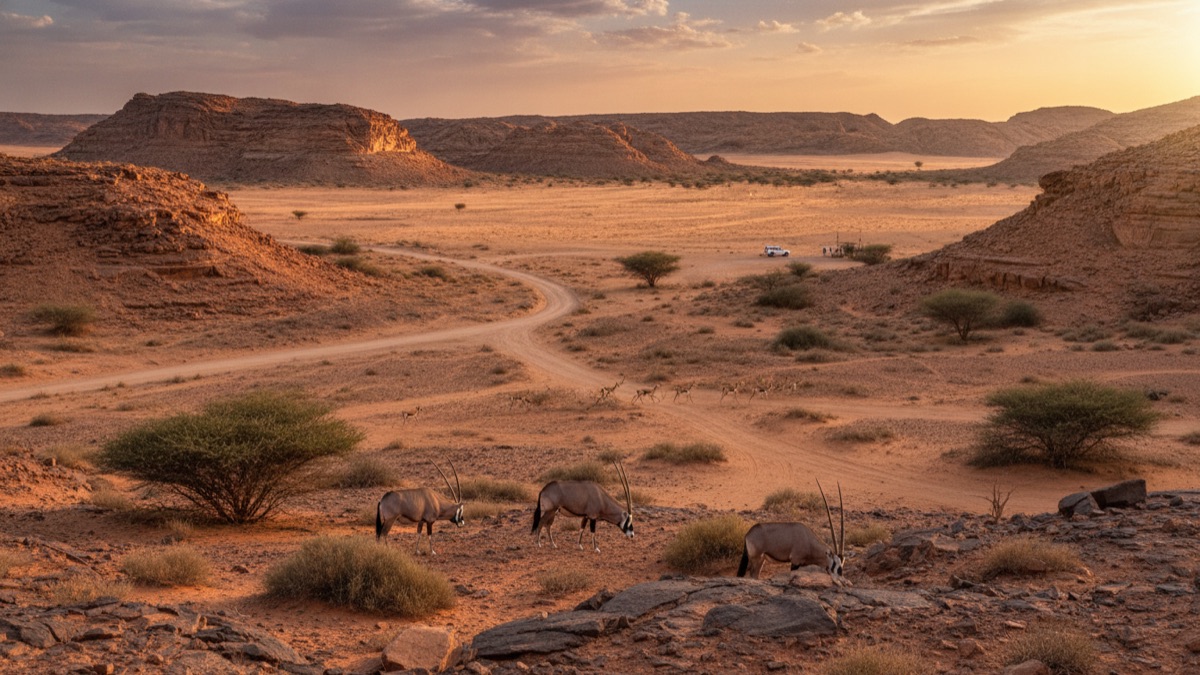
Saudi Arabia's Wild Side
Saudi Arabia is rewriting its global image. While pilgrims and business travelers have long known the Kingdom for its deserts and holy cities, a quieter transformation is taking place across its mountains, coasts, and wadis. Under Vision 2030, Saudi Arabia is investing heavily in conservation, protected areas, and wildlife tourism. The result is one of the most ambitious rewilding and nature-based tourism programs in the Middle East.
This guide explores Saudi wildlife and nature reserves in depth: the ecosystems that survive in one of the world's driest regions, the endemic species found nowhere else on Earth, the bird migration routes that cross the Peninsula, the remarkable recovery of the Arabian oryx, and the reserves now opening to visitors. Whether you are a wildlife photographer, a birdwatcher, an ecotourist, or simply curious about Saudi Arabia's natural side, this article will show you where to go and what to expect.
Saudi Arabia's Biodiversity: A Surprising Natural Heritage
The Arabian Peninsula is often stereotyped as an empty desert, but Saudi Arabia's biodiversity is far richer than most visitors expect. The Kingdom covers approximately 2.15 million square kilometers and spans several distinct biogeographic zones. In the west, the Sarawat Mountains rise above 3,000 meters and trap moisture from the Red Sea, creating misty highlands where juniper forests, wild olive trees, and terraced farms thrive. In the south, the Asir region receives the highest rainfall in the country and supports cloud forests, baboon troops, and rare orchids. Along the Red Sea and Arabian Gulf coasts, coral reefs, mangroves, and seagrass beds shelter marine life comparable to any in the Indian Ocean.
Even the interior deserts are not lifeless. The Nefud, Dahna, and Rub' al Khali sand seas contain specialized flora and fauna that have adapted to extreme heat, aridity, and salinity. Acacia trees, tamarisks, and saltbushes provide shade and food for gazelles, foxes, hares, lizards, and countless insects. After rare winter rains, dormant seeds burst into bloom, transforming gravel plains into carpets of color.
Protected Areas and National Reserves
Saudi Arabia has established more than 15 terrestrial protected areas and a growing network of marine protected zones. These reserves are managed by several agencies, including the National Center for Wildlife (NCW), the Ministry of Environment, Water and Agriculture, the Saudi Wildlife Authority, and regional development authorities such as the Royal Commission for AlUla and the Red Sea Global company.
The protected area network covers deserts, mountains, wetlands, coastal islands, and coral reefs. Many of these areas were originally created for conservation or hunting regulation but are now being developed for low-impact ecotourism under Vision 2030. This represents a major shift: instead of treating nature as a backdrop for resource extraction, Saudi policy increasingly recognizes biodiversity as a national asset.
The following table summarizes some of the most important protected areas in the Kingdom:
| Reserve | Region | Ecosystem | Highlights |
|---|---|---|---|
| Asir National Park | Asir | Mountain forest, cloud forest | Juniper forests, Arabian baboons, hiking trails |
| Saja Umm Ar Rimth | Riyadh | Desert plateau, acacia woodland | Arabian oryx, rewilding programs, stargazing |
| Al-Khunfah | Tabuk | Gravel desert, sabkha wetlands | Migratory birds, desert gazelles, archaeological sites |
| Harrat Al-Habrah | Makkah | Lava field, wadis | Volcanic geology, rare reptiles, seasonal pools |
| Farasan Islands | Jazan | Marine archipelago, coral reefs | Dolphins, dugongs, sea turtles, mangroves |
| Jubail Marine Wildlife Sanctuary | Eastern Province | Gulf coastline, seagrass beds | Migratory shorebirds, green sea turtles, dugongs |
| Uruq Bani Ma'arid | Najran/Rub' al Khali | Sand dunes, gravel plains | Arabian oryx, sand gazelles, houbara bustard |
| King Salman Park | Riyadh | Urban green corridor | Wadi Hanifah restoration, recreation, biodiversity |
These protected areas vary enormously in accessibility. Some, like Asir National Park, have paved roads, visitor centers, and marked trails. Others, like Uruq Bani Ma'arid, require four-wheel-drive vehicles, careful planning, and ideally a local guide. The key is to match your destination to your experience level and interests.
Endemic Species Found Only in Arabia
Endemic species — animals and plants found nowhere else on Earth — are the ultimate measure of a region's biological uniqueness. Saudi Arabia hosts dozens of endemic species, many of which are restricted to specific mountain ranges, islands, or desert systems.
On land, the Arabian oryx is the most famous endemic mammal. Once extinct in the wild, it has been reintroduced to several reserves and is now a symbol of Saudi conservation. The Arabian gazelle, sand gazelle, and mountain gazelle are smaller antelopes adapted to different habitats. The Arabian wolf, striped hyena, and Arabian red fox are predators that persist in remote areas despite historical persecution.
The Nubian ibex, with its magnificent curved horns, inhabits the rugged escarpments of the Hijaz and Asir mountains. The Arabian baboon, the only primate native to the Peninsula, lives in troops along the western mountains and is especially easy to see in Asir National Park. The rock hyrax, despite looking like a rodent, is actually a distant relative of elephants.
Reptiles and amphibians are particularly diverse. The Arabian horned viper, carpet viper, and various geckos and agamids are adapted to desert life. In the southwest, the Asir Mountains shelter endemic frogs, salamanders, and freshwater crabs in streams that flow year-round.
Bird endemism is also significant. The Arabian partridge, Arabian waxbill, Yemen thrush, and Asir magpie are found only in the southwestern highlands. The Asir magpie is one of the most threatened birds in the world, with a population estimated at fewer than 135 pairs. Conservation efforts focus on protecting its oak and juniper forest habitat from firewood collection, overgrazing, and development.
Plants are equally important. The Sarawat Mountains contain relict forests of African juniper, wild olive, and almond. The desert regions host endemic succulents, bulbs, and shrubs that flower after rain. The ghaf tree, a drought-resistant acacia, is the national tree of the UAE and also common in northern Saudi Arabia, providing shade, fodder, and cultural symbolism across the Peninsula.
Bird Migration: The Kingdom as a Flyway
Saudi Arabia lies at the heart of one of the world's great bird migration corridors. Every spring and autumn, millions of birds pass through the Peninsula on their way between breeding grounds in Eurasia and wintering grounds in Africa, the Horn of Africa, and South Asia. The Red Sea coast, the Tihamah coastal plain, and the mountain foothills are especially important.
Raptors are among the most visible migrants. Steppe eagles, lesser spotted eagles, honey buzzards, and Levant sparrowhawks move south in September and October, often forming spectacular kettles as they exploit thermals over mountains and coastlines. In spring, the same species return north, sometimes in even larger numbers.
Waterbirds follow different routes. The Red Sea and Arabian Gulf coasts provide critical stopover habitat for shorebirds such as bar-tailed godwits, red knots, sandpipers, and plovers. The Jubail Marine Wildlife Sanctuary on the Gulf coast is one of the best places in the Kingdom to see migrating waders, flamingos, and herons. Inland wetlands, although scarce, can become temporary hotspots after floods.
The Tabuk region and the northern Red Sea coast are notable for white storks, common cranes, and pelicans. The Farasan Islands host breeding colonies of bridled terns, white-cheeked terns, and sooty gulls. Offshore, the islands also support ospreys, which nest on cliffs and man-made structures.
For the best birdwatching, visit during the migration windows of March to May and September to November. Early morning is usually most productive. Bring a spotting scope if possible, as many shorebirds and raptors can be distant.
The Arabian Oryx: From Extinction to Recovery
No Saudi wildlife story is more powerful than that of the Arabian oryx. This white antelope with straight, spear-like horns once roamed across the Arabian Peninsula in large herds. By the 1970s, however, overhunting and habitat loss had driven it to extinction in the wild. The last wild individuals were killed or captured, and the species survived only in zoos and private collections.
The recovery began with captive breeding programs. The Phoenix Zoo in Arizona played a pioneering role, but Saudi Arabia and other Gulf states also built their own breeding herds. In 1990, the first reintroductions took place in the Mahazat as-Sayd Protected Area, a fenced reserve in western Saudi Arabia. Later reintroductions expanded to Uruq Bani Ma'arid and Saja Umm Ar Rimth.
Today, Saudi Arabia holds one of the largest captive and reintroduced populations of Arabian oryx in the world. The species has been downlisted from "Extinct in the Wild" to "Vulnerable" on the IUCN Red List, though it still depends heavily on protected areas and management. The oryx is also a cultural icon, appearing on coins, stamps, airline logos, and the jerseys of the Saudi national football team.
Seeing an Arabian oryx in the wild requires patience and luck. Your best chances are in Mahazat as-Sayd, Uruq Bani Ma'arid, or Saja Umm Ar Rimth. Visitors usually spot them at dawn or dusk, when they move to drink or graze. Their white coats reflect the desert light, making them visible from surprisingly far away.
Rewilding Under Vision 2030
Vision 2030, Saudi Arabia's long-term transformation plan, places nature and environmental protection at the center of economic diversification. The plan recognizes that the Kingdom's future cannot depend only on oil; it must also develop tourism, recreation, and sustainable land use. Several Vision 2030 projects are directly linked to wildlife and conservation.
The Saudi Green Initiative, launched in 2021, aims to plant 10 billion trees across the country and rehabilitate 40 million hectares of degraded land. If successful, it will be one of the largest landscape restoration programs in history. The initiative also targets net-zero emissions by 2060 and the protection of 30 percent of land and sea areas by 2030.
The National Center for Wildlife has released large numbers of Arabian oryx, sand gazelles, mountain gazelles, and Nubian ibex into protected areas. In 2023 and 2024, the Kingdom reported record numbers of wildlife reintroductions, including the release of endangered species into reserves that had not held them for generations. Monitoring is done using camera traps, satellite collars, and ranger patrols.
The Red Sea Project and AMAALA are developing coastal tourism while setting aside significant marine protected areas. The Red Sea Global company has committed to conserving coral reefs, mangroves, and seagrass beds across its development zone. These projects are designed to demonstrate that luxury tourism and conservation can coexist.
AlUla is another major example. The Royal Commission for AlUla is restoring the oasis ecosystem, protecting rock art sites, and reintroducing native species. The Arabian leopard, critically endangered and possibly extinct in the wild in Saudi Arabia, is the focus of a captive breeding and eventual reintroduction program. In 2024, the commission reported the birth of cubs in captivity, raising hopes for the species' future.
These programs are not without challenges. Water scarcity, climate change, invasive species, and the risk of overdevelopment all threaten progress. Nevertheless, the scale of investment and political commitment is unprecedented in the region.
Best Wildlife Reserves to Visit
Saudi Arabia offers a growing range of nature-based experiences, from accessible mountain parks to remote desert wilderness. Here are the best reserves and natural areas for wildlife travelers:
Asir National Park
Established in 1981, Asir National Park was the first national park in Saudi Arabia. It covers more than 1,600 square kilometers of mountains, forests, and villages in the southwest. The park is famous for its cool climate, misty peaks, and dense juniper forests. Visitors can see Arabian baboons, hamadryas baboons, foxes, eagles, and endemic birds such as the Asir magpie and Yemen linnet.
The park has well-developed facilities, including the Soudah Peak area, the highest point in Saudi Arabia at 3,015 meters. There are picnic areas, walking trails, cable cars, and viewpoints. The nearby village of Rijal Almaa offers cultural experiences in traditional stone towers. Asir is best visited from October to April, when temperatures are mild and the landscape is greenest.
Saja Umm Ar Rimth
Located about 200 kilometers northwest of Riyadh, Saja Umm Ar Rimth is a protected area that combines desert plateau, acacia woodland, and salt flats. It is one of the best places in central Saudi Arabia to see Arabian oryx, sand gazelles, and ostriches in a relatively natural setting. The area is also excellent for stargazing due to its dark skies.
Access requires a four-wheel-drive vehicle and advance planning. Some tour operators in Riyadh offer day trips and overnight camping experiences. The best time to visit is from November to March, when temperatures are tolerable and wildlife is more active.
Uruq Bani Ma'arid
Uruq Bani Ma'arid lies on the western edge of the Rub' al Khali, the Empty Quarter. It is one of the most pristine desert reserves in Arabia, protecting massive red sand dunes, gravel plains, and wadis. The reserve is a UNESCO Biosphere Reserve and a key site for the reintroduction of Arabian oryx and sand gazelles.
This is true wilderness. Visitors need specialized vehicles, navigation equipment, and experience in desert travel. Guided expeditions are strongly recommended. The landscape is extraordinary: towering dunes, ancient lakebeds, and some of the darkest skies on Earth. Wildlife sightings include oryx, gazelles, foxes, sand cats, and desert monitors.
Al-Khunfah
Al-Khunfah, in the Tabuk region near the Jordanian border, is a protected area of gravel desert, limestone hills, and seasonal salt flats known as sabkhas. It is one of the best birdwatching sites in northern Saudi Arabia, especially during spring and autumn migration. Species recorded here include houbara bustards, cream-colored coursers, larks, wheatears, and various raptors.
The area also contains archaeological remains, including ancient inscriptions and caravan routes. Camping is possible, but visitors should prepare for temperature extremes and bring all supplies. The nearest city is Tabuk, about 200 kilometers away.
Farasan Islands
The Farasan Islands, off the coast of Jazan in the southern Red Sea, are a marine protected area of extraordinary beauty. The archipelago includes more than 170 islands, many uninhabited, surrounded by coral reefs, mangroves, and seagrass beds. Marine life includes dolphins, dugongs, sea turtles, reef sharks, and hundreds of fish species.
Birdwatchers can see breeding seabirds, ospreys, and migratory shorebirds. The islands also have historical significance, with Ottoman forts, pearl merchant houses, and mangrove forests used by traditional fishers. Boat tours and snorkeling trips can be arranged from Jazan. The best time to visit is from October to May, when seas are calm and temperatures are moderate.
Jubail Marine Wildlife Sanctuary
On the Arabian Gulf coast, the Jubail Marine Wildlife Sanctuary protects one of the most important coastal ecosystems in the region. The sanctuary includes seagrass beds, salt marshes, mudflats, and sandy islands that support thousands of migratory birds. It is also an important nesting area for green sea turtles and a feeding ground for dugongs.
Access is more restricted than at other sites, but birdwatching tours can sometimes be arranged with permits. The nearby city of Jubail provides accommodation and services. Winter is the best season for bird numbers, while summer is when turtle nesting occurs.
Harrat Al-Habrah
Harrat Al-Habrah is a volcanic lava field west of Taif, part of the larger Harrat chain that stretches across western Arabia. The rugged black landscape contains lava tubes, craters, seasonal pools, and wadis that support unusual plant and animal communities. Reptiles, birds of prey, and desert-adapted mammals are found here.
The area is little visited and offers a sense of exploration. A guide is recommended because of the difficult terrain and lack of services. Harrat Al-Habrah is best combined with a trip to Taif or the nearby Shafa Mountains.
Practical Tips for Wildlife Travelers
Traveling for wildlife in Saudi Arabia requires preparation, but the rewards are exceptional. Here are practical tips to help you plan:
Best season: The wildlife viewing season runs from October to April. Summer temperatures routinely exceed 45°C in the interior and make most outdoor activity dangerous. Spring can bring brief wildflower blooms in the desert.
Permits and access: Some protected areas require permits or advance booking. Check with the National Center for Wildlife or local tourism offices before visiting remote reserves. Some sites are closed during hunting seasons or conservation activities.
Vehicle and equipment: Most reserves outside cities require a four-wheel-drive vehicle. Carry extra water, fuel, a satellite phone or emergency beacon, a GPS device, and a comprehensive first-aid kit. Desert travel can be unforgiving.
Guiding: Local guides add enormous value. They know where animals are likely to be, understand terrain and weather, and can assist with Arabic-language interactions. Several Riyadh and Jeddah-based operators now specialize in wildlife and desert tours.
Photography: A telephoto lens of at least 300mm is useful for mammals and birds. For landscapes, wide-angle lenses capture the scale of dunes and mountains. Dust is a constant risk, so protect your equipment.
Respect wildlife: Keep a safe distance from animals, especially baboons, which can become aggressive around food. Do not feed wildlife. Stay on marked trails where they exist. Avoid disturbing nesting birds or resting marine animals.
What to wear: Dress in loose, light-colored clothing, a wide-brimmed hat, and sturdy walking shoes. Desert mornings and mountain evenings can be cold, so bring layers. Sunscreen and sunglasses are essential.
Health and safety: Dehydration and heat-related illness are the main risks. Drink water constantly, even if you do not feel thirsty. Travel with others when possible and inform someone of your itinerary.
Sources
- Visit Saudi Official Tourism Portal — Official destination guides, reserve information, and travel updates.
- Saudi Vision 2030 — Official framework for conservation, tourism, and sustainability goals.
- National Center for Wildlife, Saudi Arabia — Wildlife conservation programs, protected area management, and species reintroductions.
- IUCN Red List of Threatened Species — Status and conservation assessment of the Arabian oryx.
- BirdLife International — Global bird conservation data, including Important Bird Areas in Saudi Arabia.
- Convention on Biological Diversity — Framework for national biodiversity strategies and protected area targets.
- UNESCO Man and the Biosphere Programme — Information on Uruq Bani Ma'arid Biosphere Reserve.
FAQ
What is the best time to visit Saudi Arabia for wildlife?
The best time is from October to April, when temperatures are mild and migratory birds are present. Spring can also bring desert wildflowers after rain.
Where can I see Arabian oryx in Saudi Arabia?
The best places are Mahazat as-Sayd Protected Area, Uruq Bani Ma'arid, and Saja Umm Ar Rimth. Access to some sites requires permits or guided tours.
Is Saudi Arabia good for birdwatching?
Yes. The Kingdom lies on major migration flyways and hosts important wetlands, mountains, and coastal sites. Asir, Jubail, Al-Khunfah, and the Farasan Islands are notable birding destinations.
What is the Saudi Green Initiative?
Launched in 2021, it aims to plant 10 billion trees, restore 40 million hectares of degraded land, and protect 30 percent of Saudi land and sea by 2030.
Can tourists visit protected areas in Saudi Arabia?
Many protected areas are opening to visitors under Vision 2030, but some require permits, guides, or four-wheel-drive vehicles. Check official sources before traveling.
What endemic animals live in Saudi Arabia?
Notable endemics include the Arabian oryx, Asir magpie, Arabian baboon, Nubian ibex, Arabian wolf, and several reptiles, amphibians, and plants restricted to the southwestern mountains.
Are there marine protected areas in Saudi Arabia?
Yes. The Farasan Islands and Jubail Marine Wildlife Sanctuary are two key marine protected areas with coral reefs, mangroves, dugongs, sea turtles, and seabirds.
About the Author
doyouknow.app AI-assisted Editorial Workflow — This article was prepared with AI-assisted research and editing, using the sources listed on the page. It is not based on firsthand testing, on-the-ground reporting, or a claim of personal experience or professional credentials. Please check official sources for current details.
Loved This Article?
Share it on WhatsApp → Share on WhatsApp
Get more Saudi Arabia travel tips in your inbox — Subscribe to our newsletter for weekly surprising stories from Saudi Arabia and beyond.