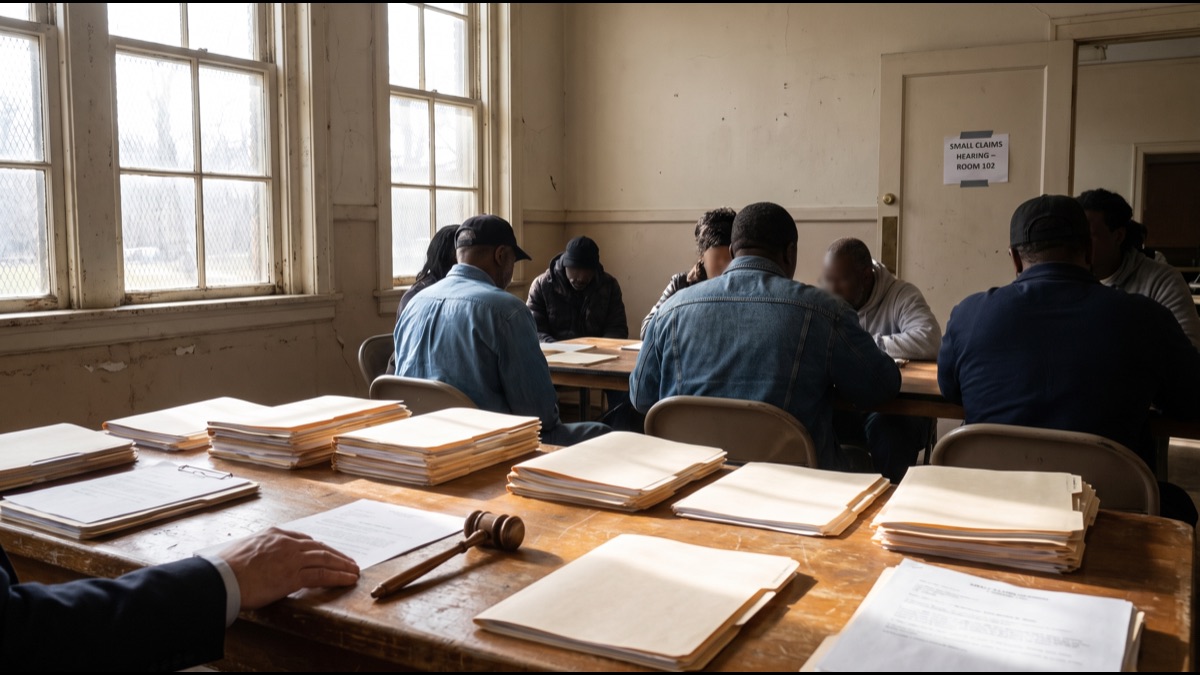
Small claims court exists specifically so an ordinary person with a genuine dispute, an unpaid deposit, a botched repair, an unrepaid loan, can get a legal resolution without hiring a lawyer or navigating the full complexity of the regular civil court system. Despite this deliberately simplified design, the process still runs on a specific set of procedural rules that most people only discover once they actually need to use them.
Understanding how a claim actually moves from filing to judgment, and what happens after a judgment is won, explains both why small claims court genuinely delivers on its promise of accessible justice for straightforward disputes and why the least understood part of the entire process is often not winning the case but actually collecting what is owed afterward.
What Small Claims Court Was Actually Designed For
Small claims court was created to address a specific gap in the justice system: disputes involving relatively modest amounts of money that were nonetheless too complicated or expensive to resolve informally, but for which hiring a lawyer and pursuing a full civil lawsuit would cost more than the amount actually in dispute.
The system deliberately strips away much of the procedural formality of regular civil litigation, simplified filing forms, informal hearing procedures, and rules of evidence considerably more relaxed than a standard trial, specifically so a person without any legal training can realistically represent themselves and receive a fair hearing on the merits of their dispute.
This design goal shapes essentially every other feature of the system, from the relatively low dollar caps that keep cases within the intended scope to the frequent restrictions on formal legal representation, all aimed at preserving the court's core purpose as an accessible venue for ordinary disputes rather than a scaled-down version of full civil litigation.
What Kinds of Cases Actually Qualify
Small claims courts generally hear disputes over unpaid debts, security deposit disputes between landlords and tenants, breach of contract claims for services not delivered as promised, property damage claims below the relevant dollar threshold, and disputes over defective goods or unrefunded payments for undelivered products or services.
Most jurisdictions explicitly exclude certain case types regardless of dollar amount, including family law matters like divorce or custody, cases seeking anything other than monetary damages such as an injunction or specific performance, and claims involving certain regulated categories like bankruptcy, which must proceed through the regular court system instead.
The underlying test courts generally apply is whether the dispute is genuinely straightforward enough to resolve without extensive legal argument or complex evidentiary proceedings, meaning even a dispute nominally within the dollar limit can sometimes be redirected to regular civil court if it involves unusually complicated legal questions.
The Dollar Limits That Actually Apply
Every small claims court operates under a maximum claim amount, commonly ranging from a few thousand to around ten or fifteen thousand dollars equivalent depending on jurisdiction, and a claimant seeking more than this cap must either voluntarily reduce the claim to fit within the limit or pursue the case through regular civil court instead.
These limits are periodically adjusted, generally upward, to account for inflation, though the adjustment schedule and resulting cap vary considerably even between neighboring jurisdictions within the same country, making it genuinely important to verify the current limit for the specific court where a claim will actually be filed rather than assuming a figure from general knowledge.
Claimants with a legitimate dispute exceeding the cap sometimes strategically waive the excess amount specifically to remain eligible for small claims court's faster, cheaper, lawyer-free process, a calculated trade-off weighing the value of the waived amount against the time and cost that pursuing the full sum through regular court would require.
Why Lawyers Are Often Restricted or Discouraged
A meaningful number of small claims court systems either prohibit formal legal representation entirely or actively discourage it through procedural design, reasoning that allowing one party to bring a lawyer while the other represents themselves would undermine the deliberately level playing field the entire system is built to preserve.
Where lawyers are permitted, courts often adjust procedure to compensate, allowing self-represented parties considerably more informal latitude in presenting their case and generally expecting less strict adherence to formal rules of evidence and procedure than would be tolerated when both sides are professionally represented.
This restriction reflects the court's founding purpose directly, since a system requiring legal representation to navigate effectively would recreate exactly the cost and complexity barrier small claims court was specifically designed to eliminate for ordinary people pursuing genuinely modest, straightforward disputes.
How to Actually File a Claim
Filing generally begins with completing a standardized claim form, available at the courthouse or increasingly online, requiring the claimant to identify the defendant, state the amount claimed, and briefly describe the factual basis of the dispute in plain, non-legal language rather than formal legal pleading style.
A filing fee, typically modest and scaled to the amount claimed, is required at submission, though many jurisdictions offer a fee waiver for claimants who can demonstrate financial hardship, ensuring the filing cost itself does not become a meaningful barrier to accessing the court for genuinely modest disputes.
Claimants must generally file in the correct venue, typically the court covering the area where the defendant lives or does business, or sometimes where the underlying dispute actually occurred, a jurisdictional requirement that can result in a case being dismissed or transferred if filed in an improper location regardless of the claim's underlying merit.
How the Other Party Actually Gets Notified
Once filed, the court requires formal service of process, official notification to the defendant that a claim has been filed against them, typically accomplished through certified mail, a process server, or in some jurisdictions the sheriff's office, rather than the claimant simply informing the other party informally.
This formal service requirement exists to ensure due process, guaranteeing the defendant genuinely received adequate notice and opportunity to respond before any judgment can be entered against them, and courts generally require documented proof of successful service before a hearing can proceed to judgment.
Difficulty completing service, particularly when a defendant is deliberately evasive or has moved without leaving a forwarding address, is a genuinely common practical obstacle at this stage, sometimes requiring additional attempts, alternative service methods, or in persistent cases a court order permitting notification by publication.
What Happens If the Defendant Does Not Respond
If a properly served defendant fails to respond or appear by the required deadline, the court can generally enter a default judgment in the claimant's favor, effectively accepting the claimant's version of events as uncontested since the defendant chose not to present any opposing evidence or argument.
Default judgments carry the same legal force as a judgment reached after a full contested hearing, meaning the claimant can proceed directly to collection efforts once the judgment is entered, though defendants generally retain a limited window to petition the court to set aside a default judgment if they can demonstrate a legitimate reason for their non-appearance.
Courts generally require a claimant seeking default judgment to still present at least minimal evidence supporting the claim's validity, since a default judgment is not simply automatic upon non-appearance but rather still requires the court to confirm the underlying claim has at least a basic factual foundation.
What Evidence Actually Matters in Court
Written contracts, receipts, invoices, photographs documenting property damage or defective goods, and relevant correspondence such as emails or text messages form the backbone of most successful small claims presentations, since a judge deciding a case in a single brief hearing relies heavily on documentary evidence rather than extended witness testimony.
Witnesses with direct, firsthand knowledge of relevant events can meaningfully strengthen a case, though small claims hearings rarely accommodate the extended witness examination typical of full civil trials, meaning witness testimony is generally most effective when concise and focused on specific, clearly relevant facts rather than broad character testimony.
Organizing evidence clearly before the hearing, generally chronologically with a simple written summary of the dispute's timeline, considerably improves a self-represented party's ability to present their case efficiently within the limited hearing time most small claims courts allocate to any single case.
How the Hearing Itself Actually Proceeds
Small claims hearings are considerably shorter and less formal than a standard civil trial, often lasting only ten to twenty minutes per case, with the judge typically asking direct questions of both parties rather than relying on the more formal examination and cross-examination procedure used in full civil litigation.
Both the claimant and defendant generally present their version of events directly to the judge, submit any physical evidence and documents, and respond to the judge's questions, with the informal, conversational structure of the hearing specifically designed to accommodate parties without legal training or courtroom experience.
Many jurisdictions require or strongly encourage mediation before or instead of a full hearing, offering both parties a chance to reach a mutually acceptable settlement with a neutral mediator's assistance, a route that resolves a substantial proportion of filed small claims cases without ever reaching a formal judicial decision.
How Judges Actually Reach a Decision
Judges in small claims court apply the same underlying legal principles as regular civil court, contract law, property law, and relevant consumer protection statutes, but generally exercise considerably more flexibility in how strictly they apply formal rules of evidence and procedure given the self-represented nature of most parties appearing before them.
Decisions are frequently issued immediately at the conclusion of the hearing, particularly for straightforward cases, though more complex disputes may result in the judge taking the matter under advisement and issuing a written decision within a specified period afterward rather than ruling from the bench on the spot.
Judges generally explain the reasoning behind their decision, at least briefly, which serves an important educational function for self-represented parties who may not fully understand why a particular piece of evidence or argument did or did not persuade the court in their specific case.
What Happens After You Win
Winning a small claims case produces a legal judgment establishing that the defendant owes the claimant a specific amount, but critically, the court does not automatically collect this amount on the claimant's behalf, placing the entire burden of actually obtaining payment squarely on the winning party.
Some jurisdictions require the losing party to voluntarily pay the judgment within a specified period, and a defendant who does pay promptly closes the matter cleanly, but a defendant who simply ignores the judgment leaves the claimant needing to pursue additional, more involved legal steps to actually collect the money owed.
This gap between winning a case and actually being paid surprises many first-time claimants who assume the court's role extends to enforcement, when in most jurisdictions the judgment itself functions more as a legal tool the winning party must then actively use to pursue collection through separate, subsequent processes.
Why Collecting a Judgment Is Often the Hardest Part
A defendant who genuinely lacks assets or income, sometimes described as judgment-proof, may leave even a fully valid, uncontested judgment practically uncollectible for years, since court judgments generally do not create money out of thin air, they simply establish a legal entitlement the winning party must find actual assets or income to collect against.
Common collection tools available to a judgment holder include wage garnishment, where a portion of the defendant's paycheck is legally redirected to satisfy the debt, and bank account levies, where funds are seized directly from an account, though both tools generally require the winning party to file additional paperwork and sometimes locate the defendant's specific employer or bank first.
Winning parties frequently underestimate how much additional effort and occasionally additional cost collection actually requires, which is why experienced small claims litigants generally research a defendant's apparent ability to pay before filing, since a judgment against a genuinely insolvent defendant, however legally sound, often delivers little practical value.
What Actually Improves Your Odds of Winning
Organizing clear, chronological documentary evidence before the hearing, arriving with concise, specific facts rather than an emotional narrative, and directly addressing the specific legal elements of the claim, such as demonstrating a contract existed and was actually breached, meaningfully improves a self-represented claimant's odds of a favorable outcome.
Verifying the defendant's ability to actually pay before filing, since a technically winnable case against a genuinely judgment-proof defendant delivers little practical value, and confirming the claim falls within the correct dollar limit and proper venue for the specific court are both essential preparatory steps too often skipped by first-time claimants.
Attending any offered mediation session in good faith before the formal hearing frequently produces a faster, more predictable outcome than proceeding straight to judgment, since a negotiated settlement both parties actively agree to is generally easier to enforce voluntarily than a judgment one side never accepted as fair in the first place.
Can a Judgment Be Appealed
Appeal rights in small claims court are generally more limited than in regular civil litigation, and in many jurisdictions only the losing defendant, not the claimant, retains a right to appeal, reflecting a deliberate policy choice to keep small claims decisions relatively final rather than inviting prolonged appellate litigation over comparatively modest sums.
Where an appeal is permitted, it frequently takes the form of a completely new hearing before a different judge, sometimes called a trial de novo, rather than a review limited to whether the original judge made a legal error, giving the appealing party a genuine second opportunity to present their case rather than merely challenging a narrow procedural point.
Appeal deadlines in small claims court are typically quite short, often just ten to thirty days from the judgment, making prompt action essential for a party who genuinely intends to challenge an unfavorable outcome rather than accepting it as final.
How Small Claims Court Differs Across Countries
While the small claims concept exists in some form across most common law jurisdictions, the specific dollar limits, filing procedures, and lawyer restrictions vary considerably from country to country and even between regions within the same country, making it essential to consult the specific rules of the actual court where a claim will be filed.
Some countries operate a more inquisitorial small claims model, where the judge takes a more active role in questioning parties and gathering facts rather than relying primarily on each side to present its own case, a structural difference that can make the hearing experience feel meaningfully different depending on the specific legal tradition involved.
Despite these procedural differences, the underlying purpose remains remarkably consistent internationally: providing an accessible, relatively fast, and comparatively inexpensive venue for resolving modest monetary disputes without requiring the full cost and complexity of formal legal representation.
Costs Beyond the Filing Fee
Beyond the initial filing fee, claimants should budget for the cost of formal service of process, which varies depending on the method used and can add a meaningful expense particularly if a first attempt fails and a second must be arranged through a professional process server rather than simple certified mail.
Additional court costs can arise if a case requires multiple hearing dates, if evidence must be formally certified, or if a winning party later needs to file separate paperwork to pursue wage garnishment or a bank levy, each of which can carry its own modest filing fee distinct from the original claim filing cost.
Claimants should weigh these cumulative costs against the amount actually in dispute before filing, since a claim for a very small sum can occasionally end up costing nearly as much to pursue through service, hearings, and eventual collection as the amount ultimately recovered, undermining the practical value of pursuing the smallest disputes through formal court process at all.
Sources
- Wikipedia — overview of small claims court systems and their history
- American Bar Association — guidance on small claims procedure and self-representation
- National Center for State Courts — research on small claims court structure and outcomes
- Consumer Financial Protection Bureau — consumer guidance on debt disputes and judgment collection
- Nolo — practical legal guidance on filing and collecting small claims judgments
FAQ
Do I need a lawyer for small claims court?
Generally no — many jurisdictions restrict or discourage formal legal representation specifically to keep the process accessible to self-represented parties.
What is the maximum amount I can sue for?
It varies by jurisdiction, typically a few thousand to around ten or fifteen thousand dollars equivalent; claims above the cap must be reduced or filed in regular civil court.
What happens if I win but the defendant won't pay?
The court does not automatically collect the judgment; you must pursue separate collection steps such as wage garnishment or bank account levies.
What if the defendant doesn't show up to the hearing?
The court can generally enter a default judgment in the claimant's favor, provided the claimant still presents at least minimal supporting evidence.
Is mediation required before a hearing?
Many jurisdictions require or strongly encourage mediation first, and a significant share of cases settle this way without reaching a formal judicial decision.
About the Author
We reference Wikipedia, American Bar Association, National Center for State Courts, Consumer Financial Protection Bureau, Nolo to explain the background and current understanding of this topic.
Loved This Article?
Share it on WhatsApp → Share it on WhatsApp
Get more guides in your inbox — Subscribe to our newsletter for weekly surprising stories from Egypt, Saudi Arabia, Dubai, and beyond.