Introduction
In 1885, the German psychologist Hermann Ebbinghaus memorized thousands of nonsense syllables and timed how quickly he forgot them, producing the first scientific map of memory decay. His central finding still anchors memory science: we lose most of what we learn within days unless we review it, and each well-timed review makes the memory last measurably longer.
Spaced repetition is the practical system built on that insight. Instead of cramming everything into one session, you review material at expanding intervals — after a day, then three days, then a week, then a month. It is now the engine behind study apps like Anki and SuperMemo, and major reviews of learning research rank it among the most reliable techniques students can use.
The Forgetting Curve
Ebbinghaus's forgetting curve shows retention collapsing steeply after learning: without any review, people can lose more than half of new material within days, and the sharpest drop happens in roughly the first 24 hours. The decay is exponential, meaning forgetting is fastest right after learning and then slows down for whatever survives.
The crucial discovery was that each review resets the curve and makes it flatter. A memory revisited just as it starts to fade becomes more durable than one revisited too early or too late. That is why the timing between reviews matters more than the raw number of repetitions — the goal is to catch the memory near the edge of forgetting, not to rehearse it constantly.
Why Spacing Beats Cramming
Cognitive scientists explain the effect through retrieval practice and what researcher Robert Bjork calls desirable difficulty. Pulling information out of memory strengthens it far more than passively rereading it, and when retrieval takes a little effort — because some time has passed — the brain treats the information as worth keeping and stores it more strongly.
Spacing also breaks the illusion of fluency. Rereading notes in one sitting feels smooth and familiar, which tricks learners into overestimating what they know; spaced retrieval exposes the gaps honestly. A 2006 meta-analysis by Cepeda and colleagues covering 254 experiments confirmed that spaced practice outperforms massed practice across ages, subjects, and retention intervals.
Designing a Spaced Schedule
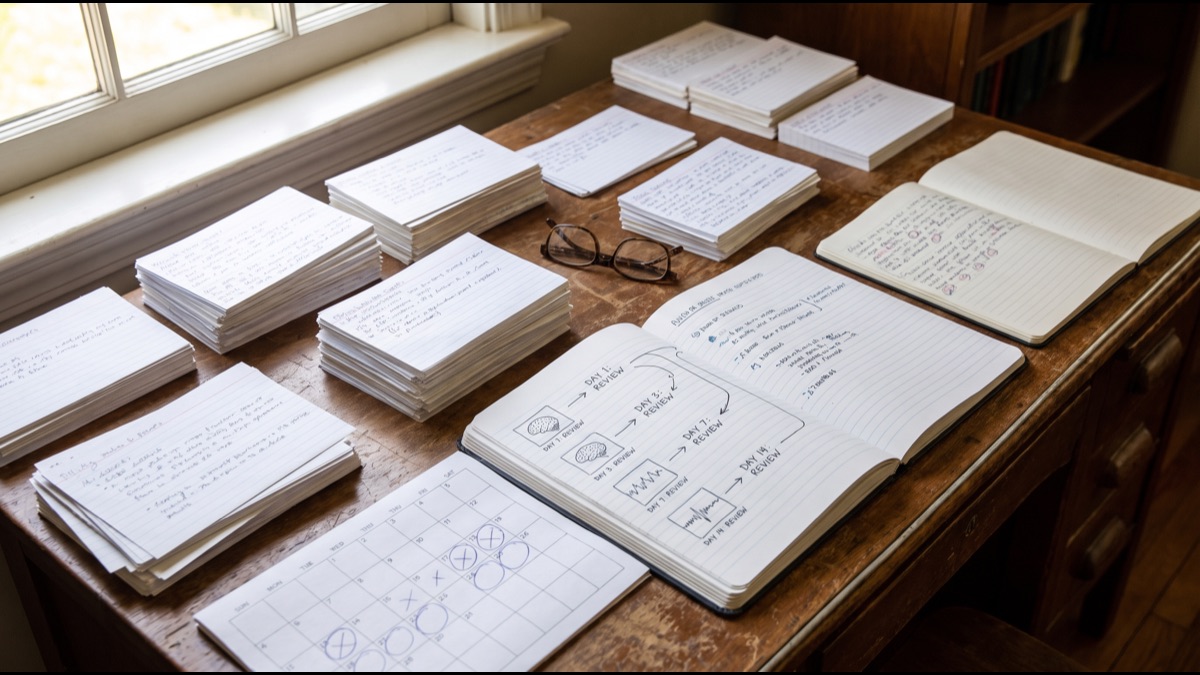
A practical starting pattern is to review new material after one day, then three days, then a week, two weeks, and a month. Whenever you fail to recall an item, it drops back to a shorter interval; whenever recall is easy, the interval stretches. The system self-adjusts so hard items appear often and easy items fade into the background.
Flashcard software automates this entirely. The SM-2 algorithm, developed by Piotr Woźniak for SuperMemo in 1987, assigns each card its next review date based on how easily you recalled it, and Anki's scheduler works on the same principle. For a subject with hundreds of facts — vocabulary, anatomy, formulas — the algorithm handles the calendar while you handle the remembering.
Where Spaced Repetition Helps Most
Spaced repetition delivers its biggest gains for large volumes of discrete material: language vocabulary, medical terminology, historical dates, chemical symbols, and exam facts. Medical students famously rely on it, with shared Anki decks containing tens of thousands of cards used across entire degree programs.
It is not a complete study method on its own. Durable learning still requires understanding the material first, and techniques like elaboration and interleaving complement spacing well. But for the specific problem of keeping knowledge available months or years after you learned it, no technique has stronger evidence behind it.
Sources
- Wikipedia — overview of the technique, its history, and scheduling algorithms
- Psychological Science in the Public Interest — Dunlosky et al.'s review of effective learning techniques, rating practice testing and distributed practice highest
- Wikipedia — Ebbinghaus's forgetting curve and the research on retention decay
FAQ
What is spaced repetition in simple terms?
Spaced repetition is a study method where you review the same material at increasing intervals — for example after one day, three days, a week, and a month — instead of studying it all at once. Each review is timed to happen just as you are about to forget, which makes the memory stronger each time.
How is spaced repetition different from cramming?
Cramming concentrates all study into one session, which produces quick but shallow learning that fades within days. Spaced repetition spreads the same total study time across weeks, and research consistently shows this produces far stronger long-term retention for equal or even less total effort.
How often should I review when using spaced repetition?
A common starting schedule is one day, three days, one week, two weeks, and one month after first learning something. If you forget an item at any point, return it to a shorter interval; if recall is easy, let the gap grow. Flashcard apps like Anki compute these intervals automatically.
Do spaced repetition apps actually work?
Yes. Apps such as Anki and SuperMemo implement scheduling algorithms based on memory research, and the underlying spacing effect is one of the most replicated findings in cognitive psychology, supported by meta-analyses covering hundreds of experiments. The app handles the timing; you still have to do the retrieval.
Can spaced repetition help me prepare for an exam?
Yes, and it is most effective when you start several weeks before the exam rather than days. Enter material into your review system as you learn it, and by exam time each fact will have been retrieved multiple times at growing intervals, which is exactly the pattern that produces durable recall under pressure.
About the Author
doyouknow.app Editorial Team — We reference cognitive psychology research, including the Dunlosky et al. (2013) review of learning techniques and the forgetting curve literature, to explain how spacing strengthens long-term memory.
Loved This Article?
Share it on WhatsApp → Share on WhatsApp
Get more guides in your inbox — Subscribe to our newsletter for weekly surprising stories from Egypt, Saudi Arabia, Dubai, and beyond.