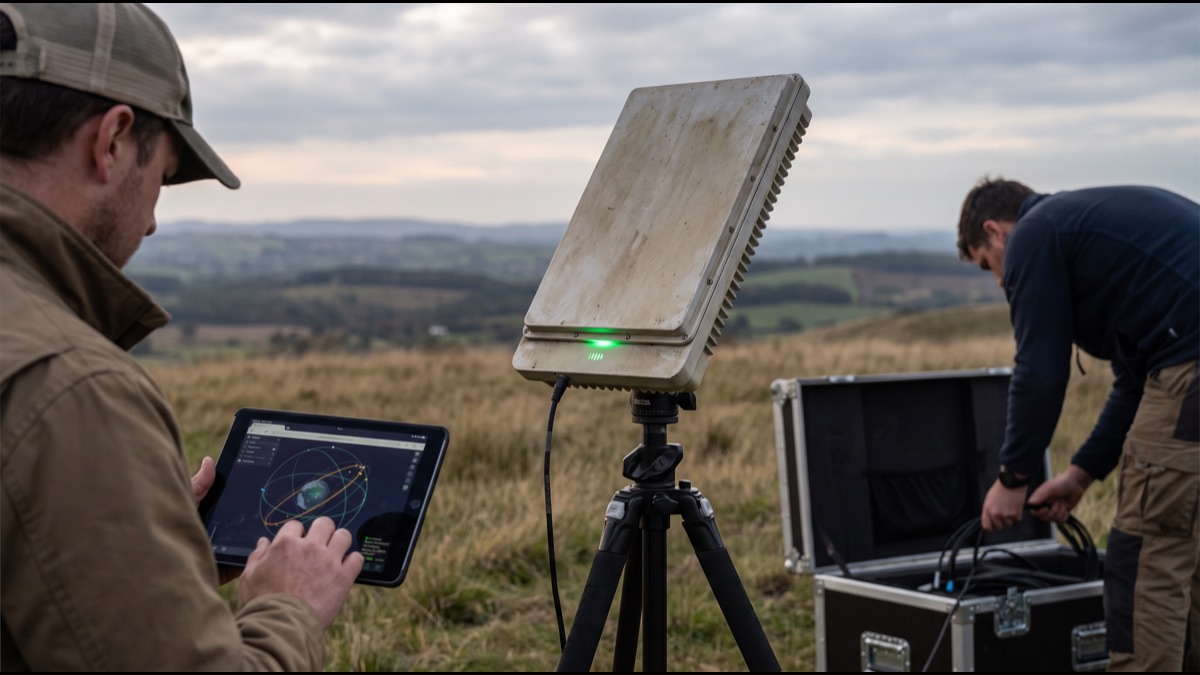
A Starlink dish sitting motionless on a rooftop is, at every moment, aiming an invisible beam at a satellite racing overhead at roughly 27,000 kilometres an hour. That satellite is only in useful view for a few minutes before it drops toward the horizon, at which point the dish has to find and lock onto a completely different satellite without ever missing a beat of the connection.
Most people assume a satellite dish has to physically swivel to follow something moving that fast, the way an old satellite TV dish creaks around on a motor. Starlink's user terminal does nothing of the sort, and the reason it does not needs to start with what is actually inside that flat white panel.
Understanding it means separating two very different problems that look identical from the outside: pointing a beam accurately at a fast-moving target, and knowing which target to point at from one second to the next as an entire fleet of satellites streams past overhead.
Why the Dish Has No Motors At All
Older satellite dishes, including traditional satellite TV dishes, physically move a curved reflector using small motors to keep it aimed at a single geostationary satellite that appears to hang motionless in the sky, because that satellite orbits at exactly the same rate the Earth rotates.
Starlink satellites orbit far lower and far faster, which rules out geostationary positioning entirely, and physically swinging a dish fast enough and precisely enough to track something crossing the sky in minutes would require motors, gears, and moving parts that wear out, break down in wind and dust, and add significant manufacturing cost and failure points to millions of terminals.
The terminal instead has no moving parts that matter for tracking at all: the entire flat panel stays bolted in one fixed physical orientation once installed, and everything involved in following a moving satellite happens electronically inside the panel rather than mechanically outside it.
What a Phased Array Actually Is
Inside the flat panel sits a phased array antenna, a grid containing well over a thousand individual small antenna elements arranged across the surface, each capable of transmitting or receiving a signal with a precisely controlled timing delay relative to its neighbors.
By adjusting the tiny timing offset applied to each element, the array can make the combined radio wavefront from all those elements constructively reinforce in one specific direction and cancel out in every other direction, which is functionally identical to steering a beam, without any part of the hardware physically turning to face that direction.
This technique, called electronic beam steering, is the same underlying principle used in modern military radar systems and some 5G cellular base stations, repurposed here for a consumer device that costs a small fraction of what those military systems cost.
How Fast the Beam Actually Has to Move
Because Starlink satellites orbit only a few hundred kilometres above the Earth rather than the tens of thousands of kilometres geostationary satellites sit at, they move across the visible sky remarkably quickly from the ground, typically staying above a useful elevation for only a handful of minutes per pass.
The phased array has to continuously recalculate the tiny timing adjustments across its entire grid of elements many times per second throughout that pass, silently sweeping the effective beam direction across the sky to track the satellite's arc without the visible panel ever appearing to move at all.
This recalculation is handled entirely by onboard processing chips built into the terminal, running the same kind of real-time signal processing mathematics found in radar systems, adjusted continuously based on precisely known orbital data for every satellite currently in view.
Handing Off From One Satellite to the Next
As a satellite currently serving a dish drops toward the horizon and its signal path grows longer and weaker, the terminal has to identify another satellite already rising into a better position and switch its beam to that new satellite before the connection to the old one degrades enough to be noticeable.
This handoff process happens automatically and, under normal conditions, invisibly to the user, similar in concept to how a moving phone hands off from one cellular tower to the next during a call, except that here the towers themselves are also moving at orbital speed rather than staying fixed to the ground.
Because SpaceX operates thousands of satellites in the constellation, there is almost always another satellite already positioned to take over, which is precisely why the network was designed around so many satellites rather than a smaller number of larger ones.
Why the Dish Needs to Know Exactly Where It Is Pointed
Electronic beam steering only works correctly if the terminal's software has an accurate reference for its own physical orientation, since steering a beam to a specific angle relative to the satellite requires first knowing which direction the flat panel itself is actually facing in the real world.
Every Starlink terminal includes built-in sensors, comparable to those in a smartphone, that measure its tilt and orientation once installed, and the terminal's setup process explicitly checks this orientation and will refuse to operate properly, warning the owner through the companion app, if the dish is mounted at an angle that leaves too much of the sky obstructed.
This is also why Starlink strongly recommends a completely clear view of the sky rather than a mostly clear one: a phased array cannot electronically steer its beam around a tree or a roofline the way a person could simply lean sideways to see past an obstacle.
The Ground Side of the Same Trick
The same phased array steering technique runs in both directions: the satellite itself also uses a similar electronically steered antenna system to aim its own downlink beam precisely at the ground terminal below, rather than broadcasting in every direction and wasting most of its transmission power.
This mutual steering, ground terminal to satellite and satellite to ground terminal, is what allows a relatively low-power radio link to carry meaningful broadband speeds across the hundreds of kilometres separating a rooftop terminal from a satellite moving overhead.
It also allows a single satellite to serve multiple distinct ground terminals within its coverage footprint simultaneously by steering separate beams toward each of them rather than broadcasting one shared signal to everyone below.
What Actually Limits How Many Satellites Can Be Tracked
A single terminal typically only needs to maintain a strong link with one satellite at a time for basic connectivity, though the underlying hardware is capable of briefly evaluating multiple candidate satellites near the horizon to choose the best one before committing the beam to a full handoff.
The practical limit on tracking performance comes less from the number of elements in the array and more from how much of the sky is actually visible to the terminal, since obstructions, low mounting height, and steep beam angles near the horizon all degrade signal quality even when the electronics themselves are working perfectly.
Terminals mounted higher up, with a clearer 100-degree-plus view of open sky, consistently perform better in real-world testing than identical terminals mounted lower with partial obstructions, precisely because more visible sky means more candidate satellites available at any given moment.
Why Weather Affects the Signal More Than People Expect
The specific radio frequencies Starlink terminals use, in the Ku and Ka bands, carry a lot of data efficiently but are also more readily absorbed and scattered by heavy rain and wet snow than the older, lower frequencies traditional satellite TV uses, a well-documented tradeoff called rain fade.
Because the electronic beam steering itself is unaffected by weather, any slowdown during a storm comes specifically from signal attenuation passing through the atmosphere rather than any difficulty tracking the correct satellite, and the terminal compensates as much as it can by favoring whichever currently visible satellite offers the clearest path.
Regions with intense but short-lived downpours, including much of the Gulf during summer storms, typically see brief speed dips during the heaviest rainfall rather than a full outage, since most storm cells pass over a fixed location relatively quickly.
How This Differs From Older Low-Earth-Orbit Satellite Phones
Earlier low-orbit satellite phone networks existed decades before Starlink and also had to solve the problem of fast-moving satellites, but they generally used much smaller, simpler antennas designed for low-bandwidth voice calls rather than broadband internet, and often relied on mechanically simpler, lower-gain antennas that could tolerate weaker, more intermittent signal quality.
Starlink's phased array approach exists specifically because broadband internet demands a much stronger, much more precisely aimed signal than a voice call does, and achieving that signal quality against a target moving at orbital speed was not practically solvable with consumer-affordable hardware until phased array manufacturing costs fell dramatically in the last decade.
That manufacturing cost drop, driven largely by advances originally developed for military radar and 5G infrastructure, is arguably as important to Starlink's existence as the satellites themselves, since a phased array terminal that once cost tens of thousands of dollars can now be manufactured at a scale suitable for millions of households.
What Happens During Extreme Heat or Cold
Phased array electronics generate a meaningful amount of heat during operation, and Starlink terminals include internal heating elements specifically so the dish can melt accumulated snow in cold climates, a feature that surprised many early users who assumed a flat electronic panel would have no reason to warm itself at all.
In extremely hot climates, including much of the Gulf during summer, terminals include thermal management systems that can reduce performance or temporarily pause operation if internal components approach unsafe operating temperatures, a protective measure aimed at preserving the electronics over the terminal's expected multi-year lifespan.
SpaceX has released successive hardware revisions specifically aimed at improving thermal tolerance and power efficiency, reflecting how much of the ongoing engineering effort on the ground terminal side is about heat management rather than the core beam-steering technology itself.
Why Precise Timing Data Underpins the Whole System
None of the electronic steering described above works without extremely precise, constantly updated knowledge of exactly where every relevant satellite is at any given moment, data that is calculated from orbital mechanics and continuously refined using ground station tracking and onboard satellite telemetry.
Terminals receive updated orbital predictions regularly so that their onboard processors can calculate, in advance, exactly which direction to steer the beam at any future moment rather than searching blindly, which is part of why a terminal typically needs periodic software and data updates to keep performing accurately over time.
This dependency on precise orbital data is also why a completely new terminal, freshly powered on for the first time, needs a brief initial period to download current satellite position data before it can establish a stable connection.
The Bigger Engineering Story Behind a Flat White Panel
What looks, from a rooftop, like an unremarkable flat panel with no visible moving parts is actually running continuous radar-grade signal processing, satellite handoff logic, orbital prediction, and thermal management simultaneously, all packed into a device designed to be self-installed by an ordinary customer with no technical training.
The apparent simplicity on the outside is deliberately achieved by hiding an enormous amount of engineering complexity on the inside, which is precisely the design philosophy that makes electronically steered phased arrays practical for a mass-market consumer product rather than a specialized piece of military or research equipment.
That combination, consumer-grade simplicity built on top of military-grade tracking technology, is what ultimately allows a household in a location with no cable or fibre infrastructure to get broadband speeds from a fixed panel bolted to a roof, quietly tracking an invisible parade of satellites overhead.
Why Ships, Planes, and RVs Rely on the Same Trick
Terminals built for ships, aircraft, and moving recreational vehicles have to track the same fast-moving satellites while the terminal itself is also constantly changing direction and speed, an extra challenge these units solve by adding motion sensors that measure the vehicle's own heading and speed moment to moment and feeding those readings directly into the electronic beam-steering calculations.
Conceptually this differs from a stationary home terminal only by one additional variable that has to be continuously compensated for, the movement of the terminal itself, which is why maritime and aviation terminals cost considerably more and typically include additional phased array elements to make up for the tracking precision otherwise lost to a moving, vibrating platform.
Airlines that have added this kind of connectivity to commercial flights over the Gulf and beyond specifically cite the same underlying phased array technology as what finally made reliable broadband possible above the clouds, a use case that earlier satellite systems built around slower mechanical tracking could never support at cruising speed.
Sources
- Wikipedia — overview of the Starlink satellite constellation and ground terminal design
- Wikipedia — technical background on phased array antennas and electronic beam steering
- IEEE Spectrum — engineering reporting on low-earth-orbit satellite internet and phased array hardware
- SpaceX — official technical background on Starlink terminals and network operation
FAQ
Does a Starlink dish physically move to track satellites?
No, the flat panel stays bolted in a fixed position; a phased array antenna inside steers the beam electronically by adjusting timing across more than a thousand individual antenna elements, with no motors involved.
Why does Starlink need such a clear view of the sky?
Because the beam is steered electronically rather than physically, it cannot bend around a tree or roofline the way a person could lean to see past an obstacle, so any blocked section of sky simply becomes unusable for tracking a satellite passing through it.
Does bad weather affect Starlink by disrupting the tracking?
No, heavy rain or wet snow absorbs and scatters the radio signal itself, called rain fade, rather than interfering with the electronic beam steering, so slowdowns during storms come from signal attenuation, not tracking failure.
How often does a Starlink dish switch to a new satellite?
Because low-orbit satellites cross the visible sky in only a few minutes, a terminal typically hands off to a new satellite every few minutes throughout the day, a process designed to be invisible to anyone using the connection.
Why do Starlink dishes have built-in heaters?
The heaters let the terminal melt accumulated snow in cold climates so the flat panel keeps a clear signal path, a feature many owners find surprising for an electronic device with no other moving parts.
Is Starlink’s tracking technology related to military radar?
Yes, the underlying phased array beam-steering principle was developed and refined for military radar and later 5G infrastructure, and falling manufacturing costs for that technology are a major reason Starlink terminals became affordable for households.
How is a ship or aircraft terminal different from a home dish?
It uses the same electronic beam-steering principle but adds motion sensors that track the vehicle’s own heading and speed, feeding that data into the steering calculations so the beam stays locked on a satellite even while the platform itself is moving.
About the Author
We reference Wikipedia and other authoritative sources to explain the background and current understanding of this topic.
Loved This Article?
Share it on WhatsApp → Share it on WhatsApp
Get more guides in your inbox — Subscribe to our newsletter for weekly surprising stories from Egypt, Saudi Arabia, Dubai, and beyond.