Every trading day, a handful of computer systems quietly decide who buys and who sells millions of shares, at exactly what price, in microseconds. When someone places an order to buy or sell a stock, it does not simply find a matching counterparty by luck. It enters a highly structured, rule-governed system built specifically to answer one question as fast and fairly as possible: given everyone currently willing to buy and everyone currently willing to sell, who trades with whom, and at what price?
Understanding that system explains far more than it might seem to at first. It explains why a stock's quoted price can jump unexpectedly, why some trades execute instantly while others sit unfilled, why large institutional trades sometimes happen invisibly, and why exchanges themselves are, underneath the branding, essentially software companies running one of the most heavily tested pieces of infrastructure in modern finance.
What a Stock Exchange Actually Is Today
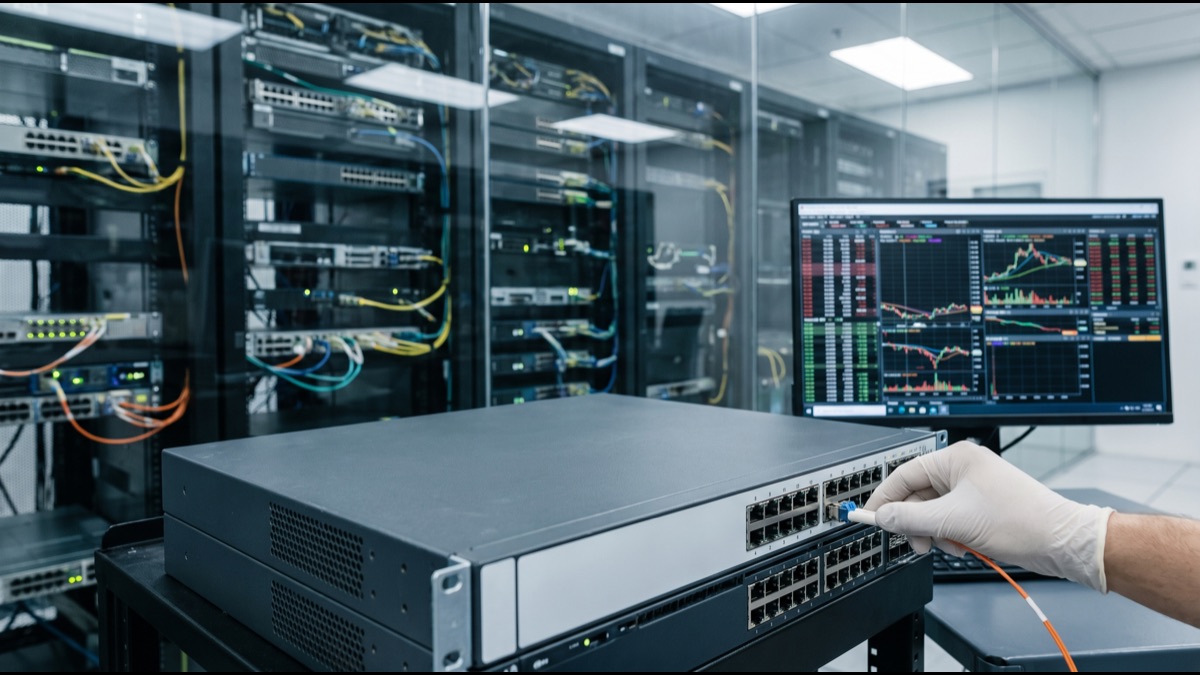
A modern stock exchange is not a physical trading floor with people shouting prices, although that image persists from decades past. Exchanges such as the New York Stock Exchange, Nasdaq, the London Stock Exchange, and the Dubai Financial Market are today primarily data centers running specialized software called matching engines, connected to member firms through extremely low-latency network links.
The exchange itself does not own the shares being traded and does not decide prices in any discretionary sense. Its role is closer to that of a neutral referee and record-keeper: it receives orders from brokers acting on behalf of clients, applies a fixed, publicly documented set of rules to determine which orders can be matched against each other, and publishes the resulting trade and the updated best available prices to everyone simultaneously.
This neutrality is not incidental — it is legally mandated in most jurisdictions. Exchanges are required to treat every incoming order according to the same published rulebook regardless of which firm sent it, and regulators audit matching-engine behavior specifically to confirm that no order type or participant receives preferential treatment outside what the rulebook explicitly allows.
The Order Book: The Real Heart of the Market
At the center of every exchange sits a data structure called the order book, essentially a continuously updated ledger of every currently active buy and sell order for a given stock, organized by price level. Buy orders are called bids, sell orders are called offers or asks, and the book is typically displayed with the highest bid and lowest offer at the top, since those are the prices closest to actually trading.
Each price level in the book aggregates every order currently willing to trade at that specific price, and within a price level, the exchange also tracks the order in which those orders arrived. This structure is what actually gets manipulated, published, and referenced every time you see a stock's live "depth of market" or "level 2" quote on a trading app.
An order book is never static. Thousands of new orders can arrive, get modified, or get cancelled every second for an actively traded stock, and the matching engine must process each event in the exact sequence it arrived, since even microsecond-level ordering differences can determine which of two otherwise identical orders gets filled first.
Limit Orders Versus Market Orders
The two most fundamental order types work in almost opposite ways. A limit order specifies a maximum price you are willing to pay to buy, or a minimum price you are willing to accept to sell, and it rests in the order book unfilled until a matching counterparty arrives, which might happen instantly, slowly, or never at all if the price never gets reached.
A market order, by contrast, specifies no price at all. It instructs the exchange to fill the order immediately against whatever orders are currently sitting in the book, starting from the best available price and, if the order is large enough, working through successive price levels until it is completely filled. This guarantees execution but not a specific price, and for a large enough order in a thin market, the effective average price paid can be noticeably worse than the price quoted the instant before the order arrived.
Most retail brokers default new users toward limit orders for exactly this reason, since a market order in an illiquid or fast-moving stock can execute at a materially different price than what the trader last saw on their screen, a phenomenon commonly called slippage.
Price-Time Priority: Who Gets Filled First
When multiple orders sit at the same price level, the exchange needs a fair, deterministic way to decide which one trades first when a matching order finally arrives. The dominant rule used by most major equity exchanges is called price-time priority: orders offering the best price are matched first, and among orders at an identical price, the order that arrived earliest is matched first.
This is precisely why professional trading firms invest enormous sums in reducing network latency between their own servers and an exchange's matching engine — even a few microseconds of advantage in reaching the exchange first can determine which firm's order sits ahead in the queue at a given price level, which can matter considerably when trading at high volume.
Some exchanges and some order types use variations on strict time priority, including size-based priority or pro-rata allocation in certain derivatives markets, but for the vast majority of ordinary listed-stock trading, price-time priority remains the governing rule, and it is published explicitly in each exchange's rulebook rather than left as a trade secret.
How a Match Actually Happens, Step by Step
When a new order arrives at the matching engine, the system first checks whether it can be matched immediately against the opposite side of the book. A buy order matches against the lowest-priced available sell order if the buyer's limit price is at or above that sell price; a sell order matches against the highest-priced available buy order under the mirror-image condition.
If a match is found, the engine executes a trade at the resting order's price, not the incoming order's price, which is why a buy limit order set well above the current best offer still executes at that lower offer price rather than the buyer's stated maximum — the exchange never charges more than necessary to complete the trade.
If the incoming order is larger than the best available opposite order, the engine fills what it can at that price level, then moves to the next price level and repeats the process, continuing until the incoming order is either fully filled or, for a limit order, until no further match is available at an acceptable price, at which point any unfilled remainder is added to the book as a new resting order.
Why the Bid-Ask Spread Exists
The gap between the highest current bid and the lowest current offer is called the bid-ask spread, and it exists because someone has to be willing to trade immediately with whoever shows up next, absorbing the risk that the market moves against them before they can offload the position. That willingness is not free, and the spread is effectively the price charged for providing it.
Highly liquid, heavily traded stocks such as large index constituents typically carry extremely narrow spreads, sometimes a single cent, because enormous competing interest on both sides keeps the gap tight. Thinly traded stocks can carry spreads amounting to a meaningful percentage of the share price, because fewer participants are willing to bear the risk of holding an illiquid position.
The spread is also one of the clearest real-time signals of a market's health for a given stock: a spread that suddenly widens sharply, without an obvious matching news event, often indicates that liquidity providers have pulled back, anticipating volatility they are not currently willing to price.
What Market Makers Actually Do
Market makers are firms that continuously post both a bid and an offer for a stock, profiting from the spread between them across a large volume of trades rather than from taking a directional view on where the price is heading. Their presence is what keeps an order book populated even during quiet periods when few ordinary investors happen to be actively trading.
Many exchanges formally register certain firms as designated market makers for specific securities, granting them particular obligations, such as maintaining a two-sided quote within a defined width during most trading hours, in exchange for certain benefits like reduced fees or priority in specific matching scenarios, a trade-off intended to guarantee baseline liquidity even in less popular stocks.
Without market makers willingly absorbing the other side of trades when natural buyers and sellers are not perfectly matched in real time, order books for all but the most actively traded stocks would be considerably wider and thinner, making it noticeably harder for ordinary investors to trade at a reasonable price on demand.
How High-Frequency Trading Fits In
High-frequency trading refers to strategies executed by computer algorithms at extremely high speed, often holding positions for fractions of a second, and it accounts for a substantial share of total trading volume on major exchanges today. Much of this activity is a modernized, automated version of traditional market making and arbitrage rather than anything fundamentally new in kind.
A significant portion of high-frequency activity involves detecting tiny, fleeting price discrepancies between related instruments, such as a stock and a derivative tracking it, or the same stock listed on two different exchanges, and trading rapidly to profit from the gap before it closes, a process that in aggregate tends to keep prices for related instruments closely aligned with each other.
The speed involved is genuinely extreme by ordinary standards, with some firms co-locating their servers physically inside an exchange's own data center specifically to shave fractions of a millisecond off the transmission time, reflecting how much competitive value exists in reaching the matching engine microseconds before a rival.
Dark Pools and Off-Exchange Trading
Not all trading happens on a public exchange with a visible order book. Dark pools are private trading venues, often operated by large banks or independent firms, where participants can submit orders that are matched without publishing bid and offer prices to the wider market beforehand, only reporting the resulting trade after it has occurred.
Institutional investors use dark pools primarily to trade very large blocks of shares without signaling their intentions to the broader market, since a visible order to buy or sell a huge quantity on a public exchange can itself move the price against the investor before the full order is even completed, a phenomenon called market impact.
Regulators permit dark pools but impose specific disclosure and fair-access requirements on them, and a meaningful share of total equity trading volume in major markets now occurs off traditional public exchanges, a trend that has itself become a recurring subject of regulatory review regarding its effect on public price discovery.
The Opening and Closing Auctions
Rather than starting the trading day with the same continuous matching used during regular hours, most major exchanges open and close each session with a batch auction. Orders accumulate for a period without being matched, and at a specific moment, the exchange calculates a single price that maximizes the total number of shares that can be matched, then executes every eligible order at that single clearing price simultaneously.
This auction mechanism exists specifically because continuous matching works poorly when a market has been closed overnight and a large volume of orders, reflecting new overnight news, arrives all at once. A single clearing auction absorbs that surge fairly, without the artificial volatility that could result from processing a flood of orders one at a time in arrival order.
The closing auction in particular carries outsized importance for index funds and other large institutional strategies, since many benchmarks and fund valuations are explicitly based on official closing prices, meaning a substantial share of daily trading volume in many stocks concentrates specifically in the final minutes before the close.
What Happens During Extreme Volatility
Exchanges have automated mechanisms designed to pause trading temporarily when prices move unusually far, unusually fast. These circuit breakers and limit-up/limit-down bands exist because extremely rapid price moves are sometimes driven by genuine information but are sometimes the result of technical malfunctions, erroneous orders, or a cascade of automated selling triggering further automated selling.
A short trading halt gives the market a brief window to absorb news, allows erroneous orders to be identified and cancelled by the firms that placed them, and lets liquidity providers reassess their pricing before resuming continuous matching, rather than allowing a technical glitch to compound into a much larger, harder-to-unwind dislocation.
These mechanisms were substantially expanded and refined following specific historical incidents, including sudden, severe intraday crashes that regulators later traced partly to automated trading feedback loops, and they continue to be adjusted as market structure and trading speed evolve.
How Exchanges Actually Make Money
Exchanges generate revenue primarily from three sources: fees charged per trade or per order to member firms, fees charged to companies for the right to be listed and remain listed on the exchange, and fees charged for access to real-time market data feeds, which are separately monetized and can represent a substantial share of an exchange's total revenue.
Many exchanges also operate under a maker-taker fee model, paying a small rebate to firms whose resting orders provide liquidity that gets matched against, while charging a slightly larger fee to firms whose incoming orders take that liquidity, an incentive structure specifically designed to encourage more orders sitting in the book at any given moment.
Because exchanges are themselves frequently publicly traded companies, their own profitability depends directly on total trading volume and data-feed demand, creating a commercial incentive to continuously invest in matching-engine speed and reliability, since outages or perceived unfairness can rapidly push volume toward a competing venue.
What Regulators Watch For
Securities regulators monitor exchange matching-engine behavior closely, requiring detailed, timestamped records of every order and every match so that unusual patterns can be reconstructed and investigated after the fact. Specific manipulative tactics, such as placing large orders with no intention of executing them purely to influence other participants before cancelling, are illegal regardless of how quickly they are executed.
Regulators also periodically review broader market-structure questions, including how much trading volume should be permitted to occur away from public exchanges, whether maker-taker fee structures create conflicts of interest for brokers routing client orders, and whether the speed advantages available to the fastest firms create an unfair two-tier market.
The overall system, imperfect as any large piece of financial infrastructure inevitably is, remains built around a genuinely simple underlying goal: matching willing buyers with willing sellers as fairly, transparently, and efficiently as current technology allows, according to rules published in advance rather than decided case by case. Every quoted price, every instant fill, and every unfilled order sitting quietly in the book is the visible output of that same rule-governed machine running continuously throughout the trading day.
The next time a stock's price seems to move for no obvious reason between two consecutive trades, the explanation is almost never mysterious. It is simply the order book doing exactly what it was built to do: finding the next available match at the next available price, one order at a time, according to rules anyone can read in advance.
Sources
- Wikipedia — overview of order matching systems and price-time priority
- U.S. Securities and Exchange Commission — regulatory guidance on market structure, dark pools, and circuit breakers
- Nasdaq — exchange documentation on matching engine rules and fee schedules
- Financial Industry Regulatory Authority — data and rules on off-exchange trading volume
- Dubai Financial Market — regional exchange trading rules and market structure
FAQ
Does a human ever decide who my trade matches with?
No — for the overwhelming majority of listed-stock trades, the entire process from order arrival to execution is handled by an automated matching engine with no human in the loop.
What is the difference between a limit order and a market order?
A limit order specifies the worst price you'll accept and may not fill immediately; a market order accepts whatever price is currently available and fills right away.
Why does a stock's price sometimes jump between trades with no obvious news?
Thin order books mean the next best price a few levels deep can be meaningfully higher or lower, so a moderately sized order can walk through several price levels at once.
What is a dark pool?
A dark pool is a private trading venue where orders are matched without publishing bids and offers beforehand, used mainly by large institutions to trade size without moving the visible market.
Is high-frequency trading the same as market manipulation?
No — most high-frequency trading is ordinary market-making and arbitrage conducted at high speed; regulators separately prosecute specific manipulative tactics like spoofing regardless of the speed used.
About the Author
We reference Wikipedia, the U.S. Securities and Exchange Commission, Nasdaq, the Financial Industry Regulatory Authority, and the Dubai Financial Market to explain the background and current understanding of this topic.
Loved This Article?
Share it on WhatsApp → Share it on WhatsApp
Get more guides in your inbox — Subscribe to our newsletter for weekly surprising stories from Egypt, Saudi Arabia, Dubai, and beyond.