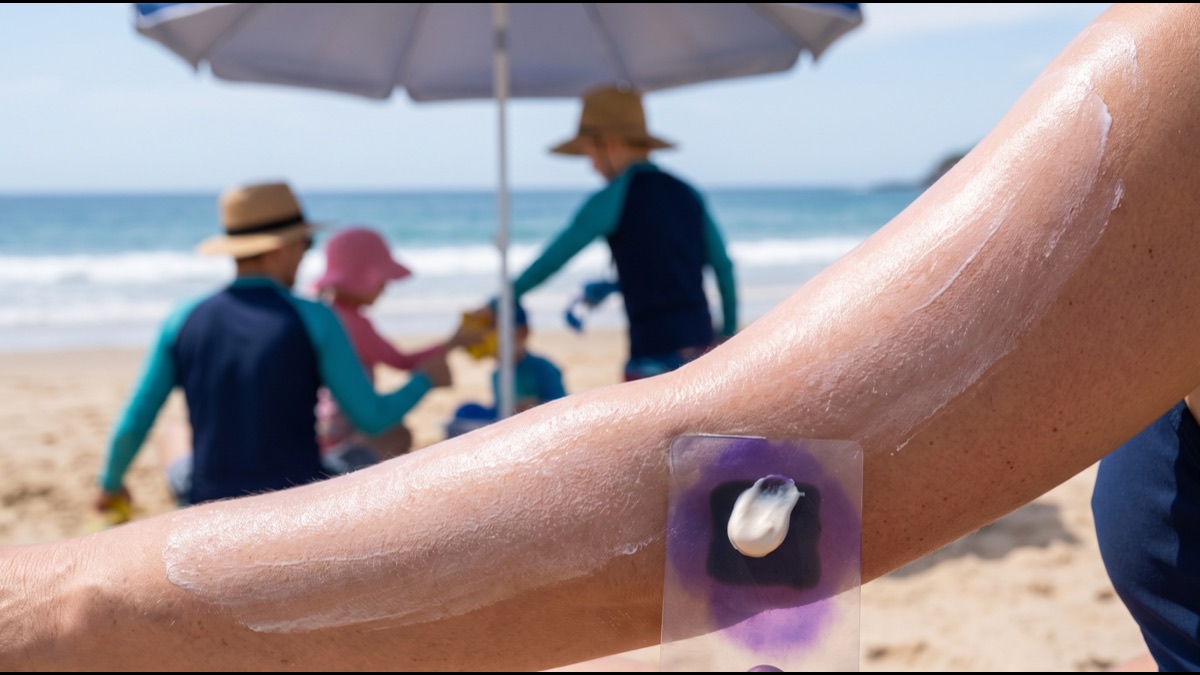
Almost nobody applies enough sunscreen to get the protection printed on the bottle, because the rating is measured using a quantity considerably larger than people naturally use. Applying a quarter of the tested amount does not give a quarter of the protection but substantially less than that.
The number is also widely misunderstood as a measure of how long protection lasts, which it is not, and it describes only one of the two types of radiation that damage skin. Understanding what the rating actually measures, how the two classes of ingredient differ, and why reapplication matters more than the number explains most of what goes wrong in ordinary use.
What Ultraviolet Radiation Actually Does
Sunlight contains ultraviolet radiation in wavelengths shorter than visible light, carrying enough energy to damage molecules within skin cells directly.
The most consequential damage is to DNA, where absorbed energy causes adjacent bases to bond incorrectly, producing errors that can lead to cancer if not repaired.
Cells repair most of this damage continuously, and the risk arises from accumulated unrepaired errors rather than from any single exposure, which is why lifetime dose matters.
Why Two Types of Ultraviolet Matter
The radiation reaching the surface divides into two relevant bands, one shorter and more energetic and the other longer and considerably more abundant.
The shorter band causes most sunburn and directly damages DNA, while the longer band penetrates deeper and generates reactive molecules that damage cells indirectly.
Both contribute to skin cancer and ageing, which is why protecting against only one leaves a substantial portion of the damage unaddressed.
What SPF Actually Measures
The sun protection factor measures only how much longer it takes skin to redden under laboratory conditions, and reddening is caused almost entirely by the shorter band.
This means the number describes protection against sunburn specifically and says nothing about the longer wavelengths responsible for much of the ageing and deeper damage.
A high number therefore does not indicate comprehensive protection, which is why separate labelling exists for the longer band and why it should be checked independently.
Why SPF Is Not a Time Multiplier
A common belief holds that a given factor multiplies safe exposure time proportionally, so a higher number allows correspondingly longer in the sun.
This is wrong because protection degrades through rubbing, sweating, and chemical breakdown well before any theoretical limit is reached.
Ultraviolet intensity also varies enormously by time of day, season and location, which means any time-based calculation depends on conditions the number does not capture.
What the Numbers Actually Translate To
A factor of thirty blocks around ninety-seven percent of the relevant radiation, while fifty blocks around ninety-eight percent, which is a small absolute difference.
Because the scale is not linear, doubling the number does not double protection, and the improvement above a certain point becomes marginal.
The practical significance of higher numbers is that they provide a buffer against under-application, since real-world coverage falls well short of tested conditions.
Why Application Quantity Matters So Much
Ratings are measured using a specific quantity per area of skin, which amounts to considerably more product than people apply when using sunscreen normally.
Studies consistently find typical application at a quarter to half of the tested amount, which reduces effective protection to a fraction of the labelled figure.
The relationship is not proportional, so applying half the amount yields substantially less than half the protection, which is the single largest source of real-world failure.
How Much Is Actually Needed
Covering an adult body adequately requires roughly a shot glass of product, which is far more than most people would estimate or willingly use.
For the face and neck alone, guidance typically suggests around a teaspoon, or two finger-lengths of product squeezed onto the index and middle fingers.
These quantities feel excessive because the resulting layer is visible and takes time to absorb, which is precisely why people instinctively use less.
What Mineral Filters Do
Mineral sunscreens use zinc oxide or titanium dioxide, which sit on the skin surface and both scatter and absorb ultraviolet radiation.
The common description of them as purely physical blockers is an oversimplification, since absorption accounts for a substantial share of their effect rather than reflection alone.
Zinc oxide provides good coverage across both relevant bands, which makes it one of the few single ingredients offering genuinely broad protection.
Why Mineral Formulas Leave a Cast
Because mineral particles scatter visible light as well as ultraviolet, they leave a whitish appearance that is considerably more noticeable on darker skin.
Reducing particle size lessens the visible cast, though it also alters how the particles interact with light and has raised questions about absorption through skin.
Research has generally found that these particles remain in the outer skin layers rather than entering the body, though this remains an active area of investigation.
How Chemical Filters Work
Organic filters absorb ultraviolet energy and release it as heat, which requires the molecule to be present in the skin surface rather than sitting entirely on top.
Different filters absorb different wavelength ranges, so products combine several to achieve coverage across the full relevant spectrum.
They are generally more cosmetically acceptable, spreading transparently and feeling lighter, which is why they dominate everyday products despite mineral alternatives existing.
Why Some Filters Degrade in Sunlight
Certain organic filters break down under the very radiation they are absorbing, which reduces protection over the course of an exposure.
Formulators address this with stabilising ingredients and by combining filters that protect each other, which has substantially improved photostability.
This degradation is a genuine reason for reapplication independent of sweating or rubbing, since the product becomes less effective simply through use.
Why Regulatory Approval Differs by Country
Several filters widely used elsewhere are unavailable in some markets because they are regulated as drugs requiring extensive approval rather than as cosmetic ingredients.
This has left certain markets relying on older filters while newer ones offering better coverage and stability have been in routine use abroad for years.
The difference is regulatory rather than scientific, and it is a substantial reason sunscreens from different regions perform noticeably differently.
What Broad Spectrum Actually Certifies
Labelling for broad spectrum indicates the product provides protection across both relevant bands in a defined proportion rather than only against sunburn.
Testing measures how protection is distributed across wavelengths, which prevents a product from claiming broad coverage while protecting mostly at one end.
Different regions use different systems, with some using a star rating or a separate factor, which means labels are not directly comparable between markets.
Why Water Resistance Is Time-Limited
No sunscreen is waterproof, and products may only claim resistance for a defined period verified by testing during immersion.
After that period protection is assumed to have declined substantially, which is why reapplication after swimming is advised regardless of the claim.
Towelling removes product mechanically and is frequently more damaging to coverage than the water itself, which makes drying off a specific reason to reapply.
How Reapplication Actually Works
Guidance recommends reapplying roughly every two hours during exposure, which reflects degradation and removal rather than any fixed lifespan of the chemistry.
Reapplication also compensates for under-application, since a second layer over a first brings total coverage closer to what testing assumed.
The first reapplication is arguably the most important, because it corrects the initial shortfall rather than merely maintaining an existing level.
What Sunscreen Does Not Prevent
Sunscreen reduces damage but does not eliminate it, and using it to extend time in intense sun can result in greater total exposure than avoiding the sun would.
Evidence for reduced skin cancer incidence with regular use is strong, but the effect depends on adequate application rather than merely on owning the product.
This is why guidance consistently treats sunscreen as one measure among several rather than as a substitute for shade, timing and clothing.
Why Clothing Outperforms Sunscreen
Fabric provides protection that does not degrade, wash off, or depend on application technique, which makes it considerably more reliable in practice.
Tightly woven and darker fabrics block substantially more radiation, and garments rated for ultraviolet protection make the level explicit.
This is why clothing, hats and shade are recommended first, with sunscreen applied to areas that cannot practically be covered.
How Shade and Timing Compare
Ultraviolet intensity peaks around the middle of the day and falls sharply either side, which means timing outdoor activity is one of the most effective available measures.
Shade reduces exposure substantially but not completely, since radiation scatters through the atmosphere and reflects off surfaces including sand, water and snow.
Reflection is why exposure can be high in shade near water or snow, and why burns occur in situations where direct sun seemed to have been avoided.
Why Cloud Cover Is Misleading
A substantial proportion of ultraviolet radiation passes through cloud, which means overcast conditions provide far less protection than the reduction in brightness suggests.
Because heat and glare are reduced, the usual warning signs of overexposure are absent, and people remain outdoors longer than they otherwise would.
This makes cloudy days a common circumstance for unexpected burns, particularly at altitude or on water where intensity is already elevated.
What Altitude and Latitude Change
Ultraviolet intensity increases with altitude because there is less atmosphere to absorb it, rising meaningfully for every several hundred metres of elevation.
Intensity is also higher nearer the equator, where sunlight passes through the atmosphere at a steeper angle and travels a shorter path.
These factors mean identical behaviour produces very different exposure in different places, which is why local ultraviolet index forecasts are more useful than general guidance.
Why the UV Index Is Useful
The index expresses expected ultraviolet intensity on a simple scale, incorporating sun angle, cloud, altitude and ozone into a single figure.
It is more actionable than temperature, which correlates poorly with ultraviolet intensity, and explains why burns occur readily on cold clear days at altitude.
Guidance thresholds are tied to the index rather than to season, which reflects that risk depends on measurable conditions rather than on the calendar.
What About Vitamin D
Skin produces vitamin D on exposure to the shorter ultraviolet band, which creates an apparent conflict with advice to minimise exposure.
Studies have generally found that typical sunscreen use does not produce deficiency, largely because real-world application is insufficient to block production entirely.
Where deficiency is a concern, supplementation is the recommended solution, since it provides the vitamin without the accompanying DNA damage.
Why Environmental Concerns Emerged
Certain organic filters have been associated with harm to coral in laboratory studies, which prompted several jurisdictions to restrict their sale.
The evidence linking sunscreen specifically to reef decline at realistic concentrations is contested, with warming and pollution regarded as considerably larger drivers.
The restrictions have nonetheless shifted product formulation toward mineral filters in affected markets, which has changed what is available regardless of the underlying evidence.
How to Choose and Use It Properly
A product labelled for broad spectrum protection at a reasonably high factor is adequate, and differences above that point matter far less than how much is applied.
Cosmetic acceptability genuinely matters, since a product that feels unpleasant will be applied thinly and infrequently regardless of its rating.
Applying generously before going out, reapplying after roughly two hours or after swimming, and combining it with shade and clothing captures nearly all the available benefit.
Why Sunburn Is a Delayed Signal
Redness does not appear during exposure but develops over several hours, peaking well after the damage that caused it has already occurred.
This delay removes the feedback that would otherwise stop people, since there is no sensation at the moment the harmful dose is being received.
It is the main reason burns happen despite people believing they were monitoring their skin, and it is why exposure must be limited by time rather than by how the skin feels.
What Tanning Actually Is
A tan is the skin producing pigment in response to DNA damage, which makes it a record of injury rather than an indicator of health.
The pigment does provide some subsequent protection, though the level is low and considerably less than even modest sunscreen use provides.
Because the tan only develops after damage has occurred, building one as preparation for a holiday provides minimal benefit at real cost.
Why Sunbeds Are Treated Differently
Tanning devices emit concentrated ultraviolet radiation and have been classified as carcinogenic to humans by international cancer authorities.
Risk rises sharply with use before early adulthood, which is why several countries prohibit access entirely for people under a certain age.
The claim that a controlled dose is safer than sun exposure does not hold, since the emitted wavelengths penetrate deeply and the doses involved are substantial.
How Skin Type Changes the Calculation
People with more melanin experience less immediate burning, which reflects genuinely greater baseline protection against the shorter ultraviolet band.
This does not eliminate risk, since damage from the longer wavelengths still accumulates and skin cancer still occurs across all skin tones.
Diagnosis is frequently later and outcomes worse in darker skin, partly because lower perceived risk reduces both screening and clinical suspicion.
Why Some Medications Increase Sensitivity
A number of common drugs make skin substantially more reactive to ultraviolet, producing burns at exposures that would normally be harmless.
The effect can be immediate or develop as an allergic-type reaction over subsequent days, and it is frequently not connected to the medication by the person affected.
This is why photosensitivity warnings appear on many prescriptions, and why an unexpected burn is worth checking against anything recently started.
What Sunscreen in Cosmetics Delivers
Moisturisers and foundations frequently carry a protection factor, but the quantity applied for cosmetic purposes is far below what testing assumes.
The resulting protection is a fraction of the stated figure, which means these products supplement rather than replace dedicated application.
They are genuinely useful for incidental daily exposure, but relying on them during extended time outdoors produces considerably less protection than the label suggests.
The most consequential thing about sunscreen is not which one you buy. Ratings are measured using considerably more product than people naturally apply — typically two to four times as much — and the relationship is not proportional, so using half the tested amount delivers substantially less than half the protection. Adequate coverage for an adult body is roughly a shot glass, which feels excessive precisely because the visible layer is what proper application looks like. The number is also misunderstood in two ways. It is not a time multiplier, since protection degrades through rubbing, sweat and chemical breakdown well before any theoretical limit. And it measures only sunburn, which is caused almost entirely by the shorter ultraviolet band — saying nothing about the longer wavelengths that penetrate deeper and drive much of the ageing and damage. That is what separate broad-spectrum labelling exists for. Beyond that, the differences narrow quickly. Factor thirty blocks about ninety-seven percent and factor fifty about ninety-eight, so the main value of a higher number is buffering against under-application. Clothing and shade outperform sunscreen because they do not degrade or depend on technique, and cloud is deceptive — much ultraviolet passes through while the heat and glare that normally warn you do not.
Sources
- Wikipedia — filter chemistry, SPF testing, and regulatory differences
- World Health Organization — ultraviolet index and sun protection guidance
- US Food and Drug Administration — sunscreen labelling rules and filter approval status
- Cancer Research UK — evidence on sun exposure, sunscreen use and skin cancer risk
- National Institutes of Health — research on ultraviolet DNA damage and vitamin D synthesis
FAQ
Does SPF 50 last longer than SPF 30?
No. SPF is not a time multiplier. It measures how much radiation is blocked — about 98 percent versus 97 percent — and protection degrades through rubbing and sweat regardless.
How much sunscreen should I actually use?
Roughly a shot glass for an adult body, and about a teaspoon for face and neck. Most people apply a quarter to half of the amount used in testing.
Is mineral sunscreen better than chemical?
Neither is inherently better. Zinc oxide offers genuinely broad coverage, while organic filters spread more transparently — and a product that feels pleasant gets applied properly.
Do I need sunscreen on cloudy days?
Often yes. A substantial proportion of ultraviolet passes through cloud, and because heat and glare are reduced, the usual warning signs of overexposure are missing.
Will sunscreen cause vitamin D deficiency?
Studies have generally not found this, largely because real-world application is too thin to block production entirely. Where deficiency is a concern, supplements are the recommended fix.
About the Author
We reference Wikipedia, World Health Organization, US Food and Drug Administration, Cancer Research UK, and National Institutes of Health to explain the background and current understanding of this topic.
Loved This Article?
Share it on WhatsApp → Share it on WhatsApp
Get more guides in your inbox — Subscribe to our newsletter for weekly surprising stories from Egypt, Saudi Arabia, Dubai, and beyond.