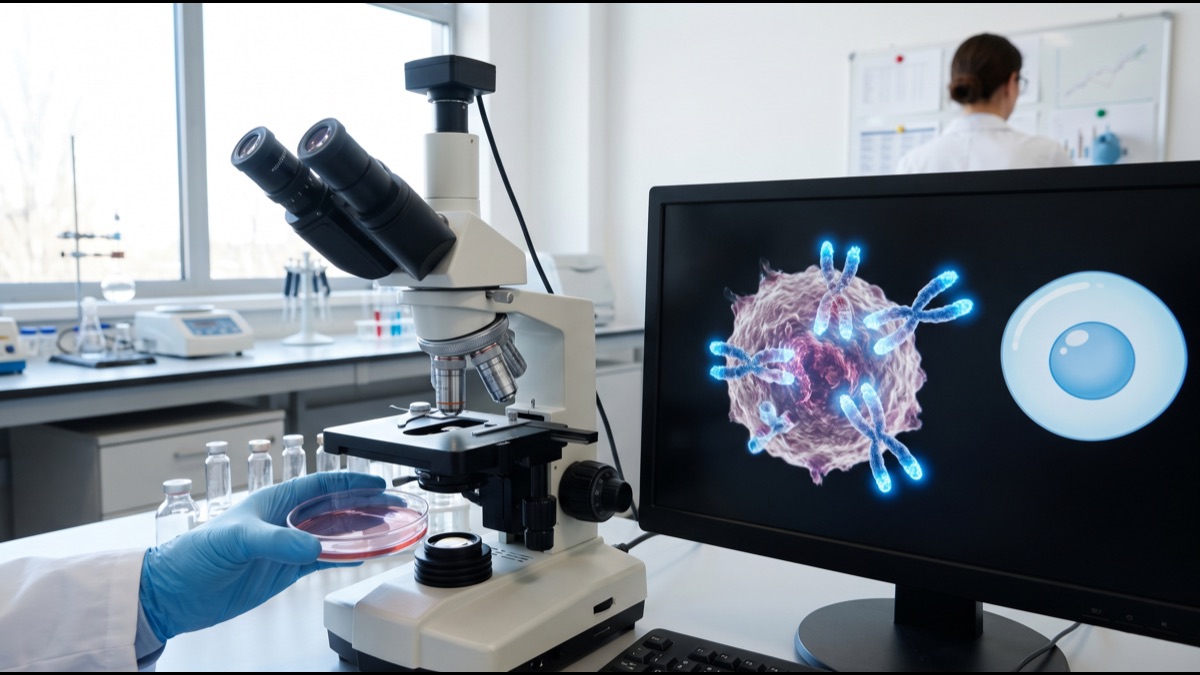
Every time one of your cells divides, something small and largely invisible happens at the very tips of its chromosomes. A short repeating stretch of DNA at each chromosome's end gets slightly shorter, and that stretch is called a telomere. Its slow, steady erosion is one of the clearest molecular clocks biologists have found for cellular aging, and understanding how it works explains a surprising amount about why bodies age, why some tissues wear out faster than others, and why "telomere-boosting" products almost never do what they claim.
What a Telomere Actually Is
A telomere is a repetitive sequence of DNA, in humans the six-letter sequence TTAGGG repeated thousands of times, sitting at the very end of each of the 46 chromosomes packed into the nucleus of nearly every human cell. It is bound by a set of proteins collectively called shelterin, which fold the telomere into a protective loop structure that hides the raw end of the DNA from the cell's own repair machinery.
This structure matters because a chromosome's end genuinely resembles damaged DNA at the molecular level, an open, unprotected strand break of exactly the kind cells are built to detect and urgently repair. Without a telomere disguising that end as something other than damage, a cell's repair systems would treat the natural end of a chromosome as an emergency, potentially fusing chromosomes together or triggering cell-cycle arrest in response to a perfectly normal structure.
Why Chromosomes Need Protective Caps at All
Linear chromosomes, the kind found in humans and nearly all complex organisms, have a structural problem that circular bacterial chromosomes do not: two exposed ends per chromosome that are chemically indistinguishable from the broken ends produced by DNA damage. Without some mechanism to mark these ends as intentional rather than accidental, cells would constantly misidentify their own chromosome tips as damage requiring repair.
The telomere solves this by acting as a disposable buffer and an identification tag simultaneously. Because it contains no genes, its own gradual shortening does not immediately destroy genetic information the way erosion into an actual gene-coding region would, giving the cell a built-in margin before shortening becomes genuinely dangerous.
The End-Replication Problem
The reason telomeres shorten at all traces back to a specific limitation in how DNA polymerase, the enzyme that copies DNA, physically works. DNA polymerase can only add new bases by extending an existing strand in one direction, and it requires a short RNA primer to get started on each new stretch it synthesizes.
On one of the two strands being copied during replication, this mechanism works cleanly all the way to the chromosome's end. On the other strand, however, the very last RNA primer used near the chromosome tip cannot be replaced with DNA the way primers elsewhere on the strand are, because there is no further strand behind it to extend from. When that final primer is eventually removed, it leaves a short gap of unreplicated DNA at the extreme end of the new chromosome copy.
This limitation, discovered independently by several molecular biologists in the 1970s and known as the end-replication problem, means that every single round of chromosome copying loses a small amount of DNA specifically at the telomeric end, regardless of how accurately the rest of the genome is copied.
How Telomeres Actually Shorten With Each Division
In most human cells, each cell division shortens telomeres by roughly 50 to 200 base pairs, a genuinely tiny fraction of the several thousand base pairs a typical telomere starts with at birth, but one that accumulates steadily and irreversibly across the many divisions a cell lineage undergoes over a lifetime.
Newborn telomeres typically measure around 10,000 to 15,000 base pairs, and by the time a person reaches old age, telomeres in easily-sampled tissues like blood cells have often shortened to somewhere in the range of 5,000 to 8,000 base pairs, though the rate and starting length both vary considerably between individuals and between different tissue types in the same person.
Because the shortening is cumulative and essentially one-directional under normal conditions, telomere length functions as a rough, imperfect record of how many times a particular cell lineage has divided, which is part of why it attracted such intense scientific interest as a potential biomarker of aging.
The Hayflick Limit
In 1961, biologist Leonard Hayflick observed that normal human cells grown in laboratory culture would divide a finite number of times, typically somewhere between 40 and 60 divisions depending on cell type and donor, before entering a permanent state in which they stopped dividing altogether despite remaining alive and metabolically active.
At the time Hayflick made this observation, the underlying mechanism was completely unknown, and the finding itself was controversial, contradicting the then-prevailing assumption that cells grown outside the body could divide indefinitely if simply given adequate nutrients. It took several more decades of research to connect this observed division limit to telomere shortening specifically.
The connection was established once researchers could measure telomere length directly and observed that cells approaching their division limit consistently had the shortest telomeres, while experimentally lengthening telomeres in cultured cells could extend how many times those cells would divide before stopping, providing strong evidence that telomere length was a genuine causal driver of the limit Hayflick had described, not merely a correlated side effect.
What Cellular Senescence Actually Looks Like
When a cell's telomeres shorten to a critical threshold length, the exposed, unprotected chromosome end can no longer be reliably hidden by the shelterin complex, and the cell's DNA-damage-detection machinery genuinely registers this as unrepaired damage, triggering a response called cellular senescence.
A senescent cell stops dividing permanently but does not die; it remains metabolically active, often for years, while secreting a distinctive mixture of inflammatory signaling molecules collectively called the senescence-associated secretory phenotype, which can affect neighboring tissue and has been linked to several age-related inflammatory conditions.
Senescence is now understood as a genuinely double-edged mechanism: it very likely evolved as a tumor-suppression safeguard, since a cell that cannot divide cannot become the growing mass of a tumor, but the accumulation of senescent cells throughout the body over a lifetime is increasingly implicated as a direct contributor to tissue dysfunction and age-related disease, motivating an active area of research into drugs called senolytics that selectively clear senescent cells.
How Telomerase Rebuilds Telomeres
Some cells can counteract telomere shortening using an enzyme called telomerase, which carries its own internal RNA template and can extend the very end of a chromosome by adding new telomeric repeats directly, bypassing the end-replication problem entirely rather than solving it through normal DNA polymerase activity.
Telomerase was discovered in the early 1980s by Elizabeth Blackburn and Carol Greider studying the single-celled organism Tetrahymena, work that later earned both scientists, along with Jack Szostak, the 2009 Nobel Prize in Physiology or Medicine for identifying how chromosomes are protected by telomeres and the enzyme telomerase.
In cells where telomerase is highly active, telomere length can be maintained or even extended across repeated divisions, effectively removing the division-count ceiling that the Hayflick limit imposes on ordinary cells, which is precisely why telomerase activity is so tightly restricted in the human body outside of a small number of specific cell types.
Why Most Adult Cells Don't Use Telomerase
In adult humans, telomerase is highly active in a limited set of cell types that genuinely need to divide extensively, including certain stem cells, cells of the immune system during an active response, and the cells lining the reproductive tract responsible for producing sperm and egg cells across a lifetime.
The overwhelming majority of ordinary adult cells, including most skin cells, liver cells, and connective tissue cells, keep telomerase switched off almost entirely, which means these cells experience the full effect of progressive telomere shortening across their working lifetime and are the cells in which the Hayflick limit and eventual senescence are most directly relevant.
This selective restriction is not an oversight; it appears to be an evolved tradeoff. An organism that allowed every cell type unrestricted telomerase activity would gain cells capable of dividing indefinitely, but it would also remove one of the body's principal internal safeguards against uncontrolled cell growth.
The Cancer Connection
Roughly 85 to 90 percent of human cancers reactivate telomerase, allowing tumor cells to rebuild their telomeres after each division and bypass the length-based limit that would otherwise cause a rapidly dividing abnormal cell lineage to senesce before it could grow into a clinically significant tumor.
A smaller fraction of cancers achieve the same effect through an entirely different mechanism called alternative lengthening of telomeres, which uses a DNA-recombination-based process rather than the telomerase enzyme itself, demonstrating that cancer cells face strong evolutionary pressure to solve the telomere-shortening problem by whatever mechanism is available to them.
This connection is precisely why efforts to develop telomerase-activating therapies for anti-aging purposes have proceeded with considerable caution in legitimate research settings: an intervention that successfully reactivates telomerase throughout the body could plausibly extend healthy cell division while also removing a meaningful natural barrier against tumor formation.
What Actually Correlates With Telomere Length
Population studies consistently find that average telomere length in easily sampled tissue, typically white blood cells, declines with chronological age, which is what originally made telomere length attractive as a potential biological aging biomarker distinct from simple calendar years.
However, the correlation is genuinely loose at the individual level. Two people of identical age can have telomere lengths differing substantially due to genetics, since telomere length at birth itself varies between individuals and is partly heritable, plus a range of subsequent lifestyle and environmental exposures.
Multiple studies have linked shorter telomeres to chronic psychological stress, smoking, obesity, and low socioeconomic status, though the effect sizes reported are generally modest, and untangling genuine causation from confounding factors that independently affect both stress exposure and health outcomes remains an active methodological challenge in this research area.
Why Telomere Length Tests Are Not Reliable Age Predictors
Several commercial services now offer to measure a customer's telomere length from a blood or saliva sample and report back a supposed "biological age," but the scientific basis for treating this as a meaningful individual prediction remains weak, despite the genuine population-level correlation between telomere length and age.
Telomere length varies considerably between different cell types within the same individual at the same moment, measurement techniques themselves carry meaningful technical variability between labs, and the wide natural range of telomere lengths at any given age means a single measurement provides limited information about an individual's actual health trajectory or remaining lifespan.
Mainstream scientific and medical organizations have generally cautioned against using commercial telomere testing as a basis for personal health or lifestyle decisions, noting that the same underlying population data that supports telomere length as a research tool does not translate into a reliable predictive test for any specific person.
What Lifestyle Factors Genuinely Affect Telomere Shortening
Chronic oxidative stress, an imbalance in which reactive molecules damage cellular components faster than the body's antioxidant defenses can neutralize them, appears to accelerate telomere shortening, since telomeric DNA is particularly vulnerable to this specific type of damage due to its repetitive guanine-rich sequence.
Regular physical activity has been associated with longer telomeres in several observational studies, plausibly through reduced oxidative stress and inflammation, though as with most telomere research, establishing a clean causal relationship separate from the many other health differences between physically active and sedentary populations remains genuinely difficult.
Chronic sleep deprivation, prolonged psychological stress, and smoking have each been independently associated with accelerated telomere shortening in multiple studies, giving telomere biology at least a plausible mechanistic link to some of the same lifestyle factors already known to affect health and longevity through other, better-established pathways.
Why Telomerase-Activating Supplements Are Not a Solution
A range of commercial supplements marketed as telomerase activators, most commonly containing an extract of the plant Astragalus membranaceus, have gained popularity based on limited laboratory studies showing modest telomerase activation in isolated cells, a result that has not translated into robust evidence of safe, meaningful telomere lengthening in living humans.
Given the well-established connection between reactivated telomerase and cancer risk, any intervention that genuinely and substantially increased telomerase activity throughout the body would need extremely rigorous safety evaluation before it could be considered appropriate for healthy people seeking to slow aging, a bar that no currently marketed supplement has come close to meeting.
The gap between "activates telomerase in a petri dish" and "safely and usefully extends healthy human lifespan" is enormous, and no regulatory body has approved any product specifically for telomere lengthening in humans, which is itself a meaningful signal about the current state of the evidence regardless of individual product marketing claims.
Telomeres sit at an unusually clean intersection of basic molecular biology and one of the oldest human preoccupations, the desire to understand and perhaps slow the process of aging. The actual science is genuinely elegant: a structural solution to a real problem in how linear chromosomes get copied, an enzyme that can reverse that problem in specific cells that need it, and a tight evolutionary tradeoff between allowing unlimited cell division and preventing cancer.
What the science does not currently support is any reliable individual test of biological age based on telomere length, or any supplement capable of safely reversing telomere shortening in a normal adult body. The honest state of the field is that telomere biology explains a great deal about why cells age the way they do, while offering considerably less certainty about what any individual person can actually do about it.
Sources
- Wikipedia — overview of telomere structure, function, and the end-replication problem
- The Nobel Prize — 2009 Physiology or Medicine prize summary for the discovery of telomerase
- National Institute on Aging — research background on cellular senescence and biomarkers of aging
- PubMed Central — peer-reviewed research on telomere length, lifestyle factors, and cancer
- National Cancer Institute — information on telomerase reactivation in cancer
FAQ
Do longer telomeres mean a longer life?
Not reliably — telomere length correlates loosely with age at a population level, but individual variation is large, and no clinical test of telomere length can currently predict an individual's remaining lifespan.
Can telomerase supplements actually reverse aging?
No approved supplement has been shown to safely lengthen telomeres in humans, and activating telomerase carries real cancer risk since it is the same mechanism many tumors exploit to divide indefinitely.
Why don't cancer cells run out of telomeres?
Roughly 85-90% of cancers reactivate telomerase, letting tumor cells rebuild their telomeres after every division and bypass the length-based limit that stops normal cells from dividing indefinitely.
Does stress actually shorten telomeres faster?
Multiple studies link chronic psychological stress to shorter telomeres in blood cells, though the effect size is modest and the causal mechanism, likely involving oxidative stress and cortisol, is still being worked out.
Why do skin and gut cells need working telomeres more than nerve cells?
Skin and gut lining cells divide constantly to replace worn-out tissue, so their telomeres shorten fast and become a real limiting factor, while mature nerve cells rarely divide at all and are barely affected by telomere length.
About the Author
We reference Wikipedia, The Nobel Prize, National Institute on Aging, PubMed Central, and National Cancer Institute to explain the background and current understanding of this topic.
Loved This Article?
Share it on WhatsApp → Share it on WhatsApp
Get more guides in your inbox — Subscribe to our newsletter for weekly surprising stories from Egypt, Saudi Arabia, Dubai, and beyond.