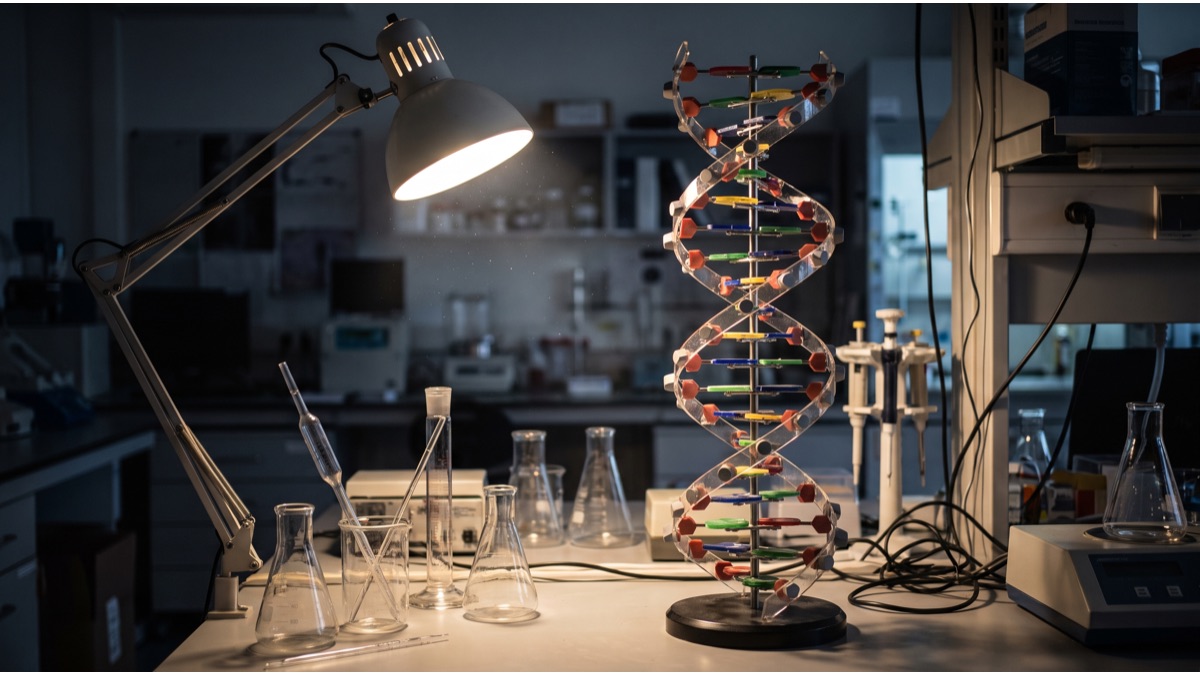
A tool that bacteria evolved billions of years ago to fight off viruses is now precise enough to correct a single misspelled letter among the three billion letters of human DNA. That tool is CRISPR, and its journey from an obscure bacterial defense mechanism to an approved human therapy happened remarkably fast by the standards of biomedical science.
Understanding how CRISPR actually works, from recognizing a DNA sequence to cutting it and letting the cell's own repair machinery finish the job, explains both why the technology is genuinely revolutionary and why it still carries real risks that keep its most controversial applications tightly restricted.
What CRISPR Actually Stands For and Where It Came From
CRISPR stands for clustered regularly interspaced short palindromic repeats, an unwieldy technical name describing a distinctive repeating pattern of DNA sequences that scientists first noticed in bacterial genomes decades before anyone understood what that pattern actually did.
Researchers eventually realized these repeated sequences were interspersed with fragments of DNA taken from viruses that had previously attacked the bacteria, essentially a genetic mugshot library the bacterium kept to recognize the same invader if it ever returned.
How Bacteria Originally Used CRISPR as an Immune System
When a virus infects a bacterium, the bacterium can capture a small snippet of the invading virus's genetic material and insert it into its own CRISPR sequence, creating a permanent genetic record of that specific threat.
If the same virus attacks again, the bacterium transcribes that stored snippet into a guide molecule, uses it to recognize the matching sequence in the invading virus, and deploys a cutting protein to destroy the virus's genetic material before it can cause an infection.
How the Guide RNA Actually Finds the Right DNA Sequence
Scientists adapted this natural bacterial defense system by designing a synthetic guide RNA molecule programmed to match essentially any DNA sequence of interest, allowing researchers to direct the editing system to a specific location anywhere within an organism's entire genome.
This guide RNA works through simple base-pairing chemistry, the same fundamental pairing rule that holds the two strands of DNA together, which is what allows scientists to redirect the system to a completely new target simply by changing the guide's sequence rather than redesigning the entire tool.
How the Cas9 Protein Actually Cuts DNA
Once the guide RNA locates and binds to its matching DNA sequence, it recruits a protein called Cas9, which acts as a pair of molecular scissors, physically severing both strands of the DNA double helix at that exact location.
This double-strand break is precisely what makes editing possible, since a cell's DNA repair systems only activate their more error-prone or more easily redirected pathways in response to this kind of clean, complete break rather than the smaller everyday damage cells repair constantly without any editing consequence.
How Cells Actually Repair a Double-Strand Break
Cells possess two main pathways for repairing a double-strand break: a fast but imprecise pathway that simply rejoins the cut ends, often introducing small insertion or deletion errors in the process, and a slower, more accurate pathway that uses a matching DNA template to repair the break with genuine precision.
Which repair pathway the cell defaults to, and which one scientists can deliberately encourage by supplying their own template DNA, is the central mechanism that determines whether an edit disables a gene entirely or precisely rewrites it into a new desired sequence.
How Scientists Use Repair Errors to Deliberately Disable a Gene
When researchers want to simply knock out a gene's function entirely, they let the cell's fast but imprecise repair pathway do the work, since the small insertion or deletion errors it commonly introduces frequently shift the gene's reading frame enough to render the resulting protein completely nonfunctional.
This approach is genuinely useful for studying what a specific gene actually does in an organism, since disabling it and observing the resulting change in the organism's biology is one of the most direct ways scientists can determine a gene's real function.
How Scientists Actually Insert New DNA at the Cut Site
To make a precise correction rather than simply disabling a gene, scientists supply the cell with a custom DNA template containing the desired sequence, which the cell's more accurate repair pathway can then use as a blueprint to rewrite the region surrounding the cut.
This template-guided repair is what allows scientists to correct a specific harmful mutation directly, converting a disease-causing DNA sequence back into the healthy version found in most of the population, rather than simply disabling the gene as the cruder repair pathway would.
Why Off-Target Cuts Remain the Technology's Biggest Risk
Because a guide RNA sometimes tolerates small mismatches with sequences elsewhere in the genome that closely resemble its intended target, Cas9 can occasionally cut at unintended locations, a phenomenon called off-target editing that represents the technology's most serious safety concern.
Researchers have developed increasingly refined guide RNA designs and modified Cas9 variants specifically engineered to tolerate far less mismatch, substantially reducing but not yet completely eliminating the risk of unintended edits occurring somewhere else in a treated cell's genome.
How Newer Base Editing Avoids Cutting DNA Entirely
Base editing, a more recent refinement of the technology, chemically converts one DNA letter directly into another without ever creating a double-strand break at all, sidestepping much of the off-target risk and unpredictable repair-error risk associated with traditional cutting-based editing.
This approach is particularly well suited to correcting the many genetic diseases caused by a single incorrect DNA letter, since it can directly reverse that specific error with considerably less risk than the cut-and-repair approach traditional CRISPR editing relies upon.
How Prime Editing Goes Even Further Than Base Editing
Prime editing extends the underlying concept further still, functioning essentially as a molecular word processor capable of searching for a specific short DNA sequence and directly replacing it with a new one, without relying on a double-strand break or being limited to changing just a single genetic letter at a time.
This added flexibility makes prime editing potentially applicable to a much broader range of genetic mutations than base editing alone can address, though the technique remains technically more complex to deliver efficiently into living cells at present.
How CRISPR Is Actually Delivered Into Living Cells
Getting the CRISPR editing components physically into the correct cells inside a living body is a genuinely difficult engineering problem in its own right, commonly solved using modified harmless viruses, lipid nanoparticles, or by editing cells outside the body before returning them to the patient.
The choice of delivery method significantly shapes what diseases a given CRISPR therapy can realistically treat, since some methods work well for reaching blood cells removed from the body but poorly for reaching cells deep inside solid organs like the brain or liver.
Why Editing Blood Cells Is Considerably Easier Than Editing Organs
Blood-forming stem cells can be extracted from a patient's body, edited under carefully controlled laboratory conditions, verified for correct editing, and then reinfused back into the patient, sidestepping the difficult problem of delivering editing machinery accurately throughout an entire living organ.
This is precisely why the first CRISPR therapies to reach approval targeted blood disorders rather than diseases affecting solid organs, since the ex vivo editing approach available for blood cells is currently far more reliable and controllable than delivering CRISPR directly inside a living body.
How the First Approved CRISPR Therapy Actually Works
The first approved CRISPR-based therapy treats sickle cell disease and beta thalassemia by editing a patient's own blood stem cells outside the body to reactivate a fetal form of hemoglobin that is normally switched off after birth, compensating for the patient's defective adult hemoglobin.
This approach does not correct the original disease-causing mutation directly but instead cleverly works around it, demonstrating that a genuinely effective CRISPR therapy does not necessarily need to fix the root genetic error as long as it can restore adequate function through an alternative genetic pathway.
Why Germline Editing Remains Ethically and Legally Restricted
Editing sperm, eggs, or early embryos would make genetic changes heritable, permanently passed down to all future descendants rather than affecting only the treated individual, which raises fundamentally different ethical questions than editing an adult patient's own cells for their own personal treatment.
Most countries currently prohibit human germline editing for reproductive purposes, reflecting broad scientific and ethical consensus that the technology's long-term consequences across future generations, combined with genuinely unresolved safety questions, are not yet adequately understood or contained.
How CRISPR Is Used Outside Human Medicine Entirely
Agricultural researchers use CRISPR to develop crop varieties with improved disease resistance, drought tolerance, or nutritional content, often achieving in a few years changes that traditional selective breeding techniques would have required many decades to accomplish through comparatively slow trial and error.
The technology is similarly used extensively in basic biological research, allowing scientists to study gene function across countless organisms, and in biotechnology applications ranging from engineering bacteria to more efficiently produce useful industrial and pharmaceutical compounds.
How Scientists Actually Test a New CRISPR Therapy for Safety
Before any CRISPR therapy reaches human patients, researchers extensively sequence edited cells in the laboratory to comprehensively check for unintended off-target edits, evaluate whether the intended edit actually produces the desired biological effect, and confirm the edited cells continue behaving normally over an extended observation period.
Clinical trials then proceed through carefully staged phases specifically designed to evaluate safety in a small number of patients first before gradually expanding to larger groups, the same rigorous staged framework long used for evaluating conventional new drugs before approval.
Why CRISPR Therapies Are Currently So Extraordinarily Expensive
Current CRISPR treatments can cost well over a million dollars per patient, a price driven by the genuinely complex, highly individualized manufacturing process required, extensive safety testing, and the relatively small number of patients over which the enormous development cost can currently be spread.
Costs are widely expected to decline over time as manufacturing processes become more standardized and efficient and as more companies enter the field with competing therapies, following a cost trajectory broadly similar to other genuinely novel biotechnology treatments after their initial approval.
How Patent Disputes Genuinely Shaped the Early CRISPR Industry
Multiple research institutions filed competing and overlapping patent claims over foundational CRISPR technology, leading to years of expensive legal disputes over exactly who deserved credit and licensing rights for different specific aspects of the underlying technology.
These patent disputes meaningfully influenced which companies could commercialize which specific CRISPR applications, and licensing complexity from that era continues to shape business arrangements across the gene-editing industry even now, years after the core scientific breakthroughs themselves were first published.
How CRISPR Genuinely Differs From Older Gene Therapy Techniques
Older gene therapy approaches typically added a functional copy of a gene into a cell without removing or correcting the original faulty version, whereas CRISPR can directly edit the existing DNA sequence itself, correcting the underlying problem rather than simply adding a workaround alongside it.
This distinction matters considerably for diseases where simply adding an extra gene copy is not sufficient, or where the faulty gene actively produces a harmful protein that must be eliminated or corrected rather than just supplemented with a working copy.
What Actually Happens Inside an Edited Cell When It Divides
Once a cell's DNA has been successfully edited, that specific edit is faithfully copied into both resulting daughter cells every time the edited cell subsequently divides, meaning a single successful editing event in a stem cell can eventually propagate the correction throughout an entire tissue over time.
This self-propagating property is precisely what makes editing long-lived stem cells so much more valuable and durable than editing short-lived mature cells, since stem cells continuously regenerate the tissue they belong to, carrying the genetic correction forward indefinitely rather than it fading out.
How Regulators Actually Decide Whether to Approve a CRISPR Treatment
Regulatory agencies evaluate CRISPR therapies using largely the same fundamental safety and efficacy framework applied to conventional drugs, while paying particularly close attention to the unique long-term risks specific to permanently modifying a patient's own genetic material.
Because these are such genuinely novel treatments, regulators frequently require considerably longer follow-up monitoring periods after treatment than are typical for conventional drugs, specifically to catch any genuinely delayed adverse effects that might only become apparent years after the original treatment.
Why Some Genetic Diseases Are Considerably Better Suited to CRISPR Than Others
Diseases caused by a single well-understood mutation in a single gene, particularly ones affecting easily accessible cell types like blood cells, are currently the most tractable genuinely realistic targets for CRISPR therapy given today's delivery and editing technology.
Diseases involving many different genes interacting in complex ways, or requiring editing of cells deep inside organs that are genuinely difficult to reach reliably, remain considerably harder targets, representing the frontier that current gene-editing research is actively working to make treatable.
How CRISPR Screening Is Used to Discover What Genes Actually Do
Beyond therapy, researchers use CRISPR to systematically disable one gene at a time across thousands of cells simultaneously in a single coordinated experiment, then observe which specific disabled genes cause a meaningful change in the cells' behavior under study.
This large-scale screening approach has dramatically accelerated the pace of discovering which specific genes are genuinely involved in diseases like cancer, providing researchers with promising new drug targets that would have taken vastly longer to identify using older, much slower one-gene-at-a-time research methods.
What the Next Generation of Gene-Editing Tools Actually Looks Like
Researchers are actively developing smaller and more efficient Cas protein variants that are considerably easier to package into delivery vehicles, along with entirely new editing systems discovered in other organisms beyond the bacteria where CRISPR itself was originally found.
Parallel efforts are focused on improving delivery methods to reach a much wider range of tissues reliably, since the fundamental editing chemistry itself has already advanced considerably faster than the practical ability to deliver it precisely everywhere in the human body it might genuinely be needed.
Sources
- Wikipedia — overview of CRISPR biology, mechanism, and applications
- National Institutes of Health — research and clinical data on CRISPR-based gene therapies
- U.S. Food and Drug Administration — regulatory information on approved gene-editing therapies
- Nature — peer-reviewed research on CRISPR mechanisms and clinical applications
- World Health Organization — international guidance on human genome editing ethics and governance
FAQ
Is CRISPR the same as traditional gene therapy?
No, older gene therapy typically adds a working gene copy without removing the faulty one, while CRISPR can directly edit the existing DNA sequence itself to correct the underlying problem.
Why is editing blood cells easier than editing organs?
Blood stem cells can be removed from the body, edited under controlled lab conditions, verified, and reinfused, avoiding the much harder problem of delivering editing tools accurately throughout a living organ.
Is editing human embryos or sperm and eggs legal?
Most countries currently prohibit heritable human germline editing for reproductive purposes, reflecting broad ethical concern about permanently altering future generations before the technology's long-term safety is fully understood.
What is an off-target edit and why does it matter?
It is an unintended cut at a DNA location resembling the actual target, a safety risk researchers have substantially reduced through more precise guide RNA and Cas9 designs but not yet fully eliminated.
Why are CRISPR therapies so expensive right now?
Costs reflect complex individualized manufacturing, extensive safety testing, and a currently small patient base over which enormous development costs must be spread, a price expected to fall as the field matures.
About the Author
We reference Wikipedia, National Institutes of Health, U.S. Food and Drug Administration, Nature, and World Health Organization to explain the background and current understanding of this topic.
Loved This Article?
Share it on WhatsApp → Share it on WhatsApp
Get more guides in your inbox — Subscribe to our newsletter for weekly surprising stories from Egypt, Saudi Arabia, Dubai, and beyond.