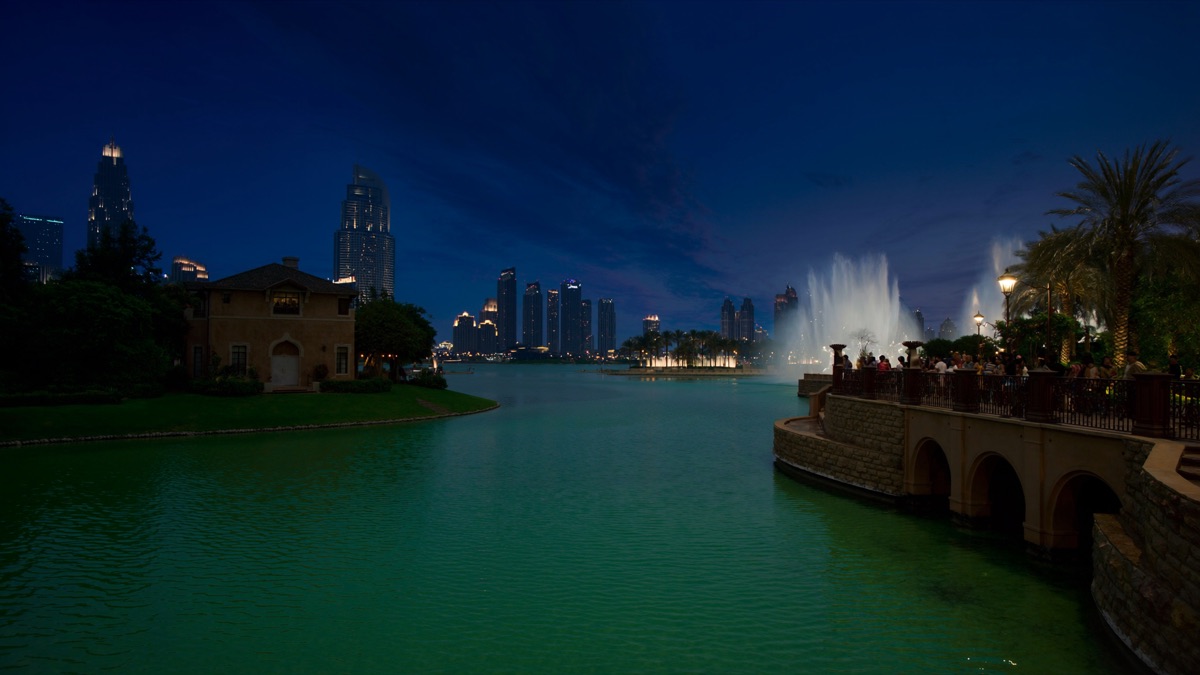
The Dubai Fountain's water does not react to music in real time the way it might appear; every single jet, light, and spray pattern is pre-programmed in advance against a specific music track, frame by frame, using specialized choreography software originally developed for large-scale theatrical and theme-park productions. What looks like a live, responsive performance is actually a precisely synchronized playback of a pre-built sequence, timed to the exact millisecond against the chosen song.
Understanding that pre-programmed nature explains both the fountain's technical scale, over 6,600 lights and more than 25 colored projectors working in the water itself, and why each show follows an identical, repeatable pattern every single time that specific song plays rather than varying performance to performance.
Choreography Software Built for the Stage, Not Just Water
The fountain's water and light sequences are designed using specialized choreography and show-control software originally developed for large theatrical productions and theme park attractions, adapted specifically to control water jets, lighting, and projection elements instead of stage machinery or ride vehicles.
This software lets designers build a show visually on a computer timeline first, mapping exactly which jets fire, how high, in what color, at which precise moment in the music, before any of it is tested on the actual physical fountain installation.
Why the Water Is Not Actually Reacting to Sound
Unlike a simple sound-reactive fountain that might crudely respond to volume or bass levels in real time, the Dubai Fountain's shows are built around a specific, unchanging music track with every water and light cue mapped to a precise timestamp in that exact recording.
This distinction matters technically: real-time audio reactivity would produce a rougher, less precisely choreographed result, while pre-programmed timestamp-based control allows the kind of exact, repeatable synchronization the fountain is specifically known for.
The Water Jets Themselves: Types and Specific Roles
The installation uses several distinct jet types, including extreme jets capable of shooting water over 150 meters into the air, oscillating jets that sweep in programmed arcs, and shooter jets that fire rapid, percussive bursts timed to musical beats, each type serving a different visual and choreographic function.
Combining these different jet types within a single sequence lets designers create dramatically varied visual movement, from slow, sweeping arcs during a musical build-up to rapid, punchy bursts precisely timed to a song's strongest beats.
How the Lighting System Layers Onto the Water
Thousands of individually controllable lights are embedded within and around the water jets, programmed to change color and intensity in exact synchronization with both the music and the specific water pattern occurring at that same moment.
This lighting layer is programmed as its own separate but tightly coordinated timeline within the same choreography software, ensuring color changes land precisely on specific musical beats or lyrical moments rather than shifting independently of the water's own timing.
Why Shows Are Built and Tested Before Public Performance
Because the choreography is built entirely in advance rather than improvised, each new show sequence goes through an extensive design and physical testing phase, where engineers verify that programmed jet timings, heights, and lighting cues actually translate correctly onto the real installation's physical water pressure and mechanical response characteristics.
This testing phase exists because a sequence that looks correct purely in software simulation can behave slightly differently once translated to real water pressure, actual jet mechanical response time, and genuine environmental conditions like wind, all of which engineers must account for before a show is considered ready for public performance.
The Underlying Mechanical and Pump Infrastructure
Behind the visible fountain, a substantial underwater mechanical infrastructure of pumps, valves, and jet mechanisms physically executes the choreographed sequence, requiring the water pressure and flow delivered to each individual jet to be precisely controllable and repeatable show after show.
This mechanical precision requirement is exactly why the fountain uses purpose-built, individually addressable jet and pump systems rather than a single shared water-pressure system, since coordinating hundreds of independently timed jets requires that level of individual mechanical control.
Why Multiple Songs Rotate Through the Schedule
The fountain maintains a rotating repertoire of several distinct choreographed shows, each built around a different song, meaning visitors on different days or at different showtimes can genuinely see a different specific performance rather than the exact same sequence repeating indefinitely.
Building and maintaining multiple full choreographed sequences requires the underlying show-control software to store and reliably recall each show's specific timing data on demand, switching between complete pre-built sequences rather than generating new choreography live.
How Precision Timing Actually Gets Verified in Software
Choreography software timestamps every single cue, down to fractions of a second, against a master timeline synchronized to the exact audio track, meaning a jet cue programmed to fire at a specific second in the song will trigger at that same precise moment every single time the show plays.
This frame-accurate timing infrastructure is directly borrowed from theatrical lighting and pyrotechnic show control systems, where similarly exact synchronization between multiple physical effects and a fixed audio track is an equally critical technical requirement.
The Scale That Makes This Genuinely Complex
Coordinating thousands of lights and hundreds of individually controlled jets across a lake spanning a significant length, all synchronized to the same music track with millisecond-level precision, represents a genuinely large-scale control engineering challenge distinct from smaller decorative fountains.
This scale is precisely why the Dubai Fountain is frequently cited in engineering and entertainment-technology contexts as a benchmark example of large-scale synchronized water, light, and music choreography rather than treated as a simple decorative water feature.
Why This Model Has Influenced Other Major Attractions
The specific combination of pre-programmed choreography software, large-scale mechanical water control, and precise music synchronization pioneered and refined at installations like this has influenced the design approach for numerous other major fountain and water-show attractions built subsequently around the world.
This influence reflects a broader shift in large-scale entertainment engineering toward pre-programmed, software-driven precision choreography across many different physical mediums, water, light, fire, and projection, rather than relying on simpler, less precisely synchronized live-reactive systems.
The Mechanical Systems Behind Every Water Jet
Each individual water jet, or emitter, is driven by its own dedicated pump and nozzle assembly capable of independently controlling water height, angle, and spray pattern, meaning the fountain's choreography software is not simply turning a single shared water supply on and off but individually commanding hundreds of separately controllable mechanical units in precise coordination.
Oscillator jets, capable of rapidly sweeping side to side while firing, and shooter jets, capable of launching a concentrated water column dramatically higher than the surrounding standard jets, exist as genuinely distinct mechanical hardware categories within the installation, each requiring different pump pressure and nozzle engineering, which is why choreography sequences deliberately vary which jet types are active to create visually distinct movement patterns rather than simply varying the height of one uniform jet type throughout a show.
The underlying pump infrastructure draws from a dedicated lake reservoir built specifically to supply the installation, with a filtration and water-quality management system running continuously behind the scenes to keep the water clear enough for the lighting effects layered on top to read clearly rather than scattering through cloudy or debris-laden water.
How Lighting Design Layers on Top of the Water Choreography
Thousands of individually addressable lights, mounted both within the water jets themselves and around the surrounding lake structure, are programmed on their own synchronized timeline that runs alongside, rather than as an afterthought to, the water movement choreography, since color, brightness, and lighting pattern changes need to land on the same musical beats the water choreography is already synchronized to.
Underwater lighting fixtures specifically illuminate the water columns from within as they rise, creating the glowing, colored water-column effect visible in nighttime shows, an effect that requires the light fixtures themselves to be fully submerged and waterproofed while still allowing precise, individually addressable color and intensity control from the same central choreography system driving the water jets above them.
Coordinating water and light as two separate but perfectly synchronized systems, rather than treating lighting as simple decorative illumination, is part of why the overall visual effect reads as a single unified performance rather than two separate technical systems running in loose parallel.
Maintenance and Why the Fountain Sometimes Pauses
Regular maintenance shutdowns, during which individual jets, pumps, or lighting fixtures are inspected, repaired, or replaced, are scheduled specifically to prevent the kind of visible malfunction, a jet firing at the wrong height or a light failing to change color on cue, that would be immediately noticeable to an audience watching hundreds of precisely synchronized elements move together.
Strong wind conditions trigger an automatic show suspension protocol, since wind can meaningfully distort a tall water column's trajectory and spray pattern away from its programmed choreography, creating both a visual inconsistency with the intended effect and a genuine safety concern for nearby pedestrians if spray drifts unpredictably beyond the fountain's designed boundary.
This wind-triggered suspension reflects a broader engineering principle applied throughout the installation: the choreography software's precision is calibrated for specific, controlled conditions, and rather than attempting to compensate computationally for unpredictable environmental interference in real time, the system is designed to pause entirely until conditions return to a range the choreography can reliably execute as intended.
How a New Show Sequence Actually Gets Choreographed
Designing a new choreographed sequence begins with detailed musical analysis, breaking a chosen track down beat by beat and identifying specific musical cues, a rising crescendo, a percussive hit, a sudden quiet passage, that the water and light programming will be built to match precisely rather than approximately.
Choreographers then work with specialized software that lets them assign specific jet groups, heights, and lighting cues to exact timestamps in the musical track, effectively building a mechanical performance score that functions similarly to how a human dance choreographer might map movement to music, except executed by hundreds of independently controlled mechanical and lighting elements rather than human performers.
Extensive live testing follows the initial programming phase, since a sequence that looks correct in simulation software can still reveal timing discrepancies once actual water physics, jet response lag, and lighting fixture response times are involved, meaning final refinement genuinely requires running the actual physical hardware repeatedly rather than trusting simulation alone.
Water Conservation in a Desert Climate
Operating a large-scale recirculating water feature in a desert climate raises legitimate water conservation questions, and the installation addresses this primarily through a closed-loop recirculation system, where the same water continuously cycles through the fountain's jets and back into the lake reservoir rather than being freshly drawn and discharged with each show.
Evaporation, an unavoidable loss in any exposed water feature operating in a hot desert climate, is offset through periodic water replenishment, and the installation's water-quality treatment systems are specifically designed to manage mineral concentration that naturally increases over time as water evaporates while dissolved minerals remain behind in the recirculating supply.
This closed-loop design reflects a broader pattern common to major fountain installations in water-scarce climates worldwide, where the operational choice to recirculate rather than continuously draw fresh water is less a symbolic sustainability gesture and more a practical engineering necessity given genuine regional water costs and availability constraints.
Why Music Licensing Shapes Which Songs Get a Show
Not every popular song becomes a fountain show, since securing the rights to synchronize a specific recording with a large-scale, repeatedly performed public choreography is a genuinely separate and often more complex licensing negotiation than simply playing a song over public speakers, requiring specific synchronization rights that not every rights holder is willing or able to grant for this kind of large-scale, long-running public use.
This licensing reality is part of why the installation's show rotation tends to favor a mix of well-known classical and orchestral pieces, which often carry simpler public-domain or more easily negotiated licensing, alongside a smaller, carefully selected set of contemporary popular tracks whose rights holders specifically agreed to this kind of large-scale, long-term public choreography use.
Because licensing agreements for a specific track are often time-limited, the fountain's programmed repertoire genuinely rotates over the years as older licensing agreements expire and new ones are negotiated, meaning the specific shows an audience sees today are not necessarily the same fixed permanent playlist that debuted when the installation first opened, even though the underlying choreography engineering approach itself remains fundamentally unchanged, an ongoing legal and creative negotiation process that continues quietly behind the scenes long after any single show first debuts and keeps the overall program feeling current rather than fixed in place indefinitely, sustaining novelty for return visitors year after year.
Sources
- Wikipedia — overview of the Dubai Fountain's design, scale, and technical specifications
- Emaar Properties — official information on the Dubai Fountain attraction
- WET Design — engineering background on large-scale choreographed water feature design
FAQ
Does the Dubai Fountain react to music live?
No; every jet, light, and spray pattern is pre-programmed in advance against a specific music track using choreography software, then played back with precise, repeatable timing.
Why is pre-programmed timing used instead of real-time sound reactivity?
Timestamp-based programming allows exact, repeatable synchronization between water, light, and music, producing a more precisely choreographed result than crude real-time audio reactivity could achieve.
Are all the water jets in the show identical?
No; the installation uses several distinct jet types, including extreme jets shooting very high, oscillating jets sweeping in arcs, and shooter jets firing rapid bursts, each serving a different choreographic role.
Does the fountain always play the same song and sequence?
No; it maintains a rotating repertoire of several distinct choreographed shows, each built around a different song, so different showtimes can feature genuinely different performances.
Why does building a new show sequence take extensive testing?
A sequence that looks correct in software simulation can behave differently once translated to real water pressure, jet mechanical response time, and conditions like wind, requiring physical verification before public performance.
What kind of software controls the fountain's choreography?
Specialized choreography and show-control software originally developed for large theatrical productions and theme parks, adapted to control water jets, lighting, and projection elements.
About the Author
We reference Wikipedia and other authoritative sources to explain the background and current understanding of this topic.
Loved This Article?
Share it on WhatsApp → Share it on WhatsApp
Get more guides in your inbox — Subscribe to our newsletter for weekly surprising stories from Egypt, Saudi Arabia, Dubai, and beyond.