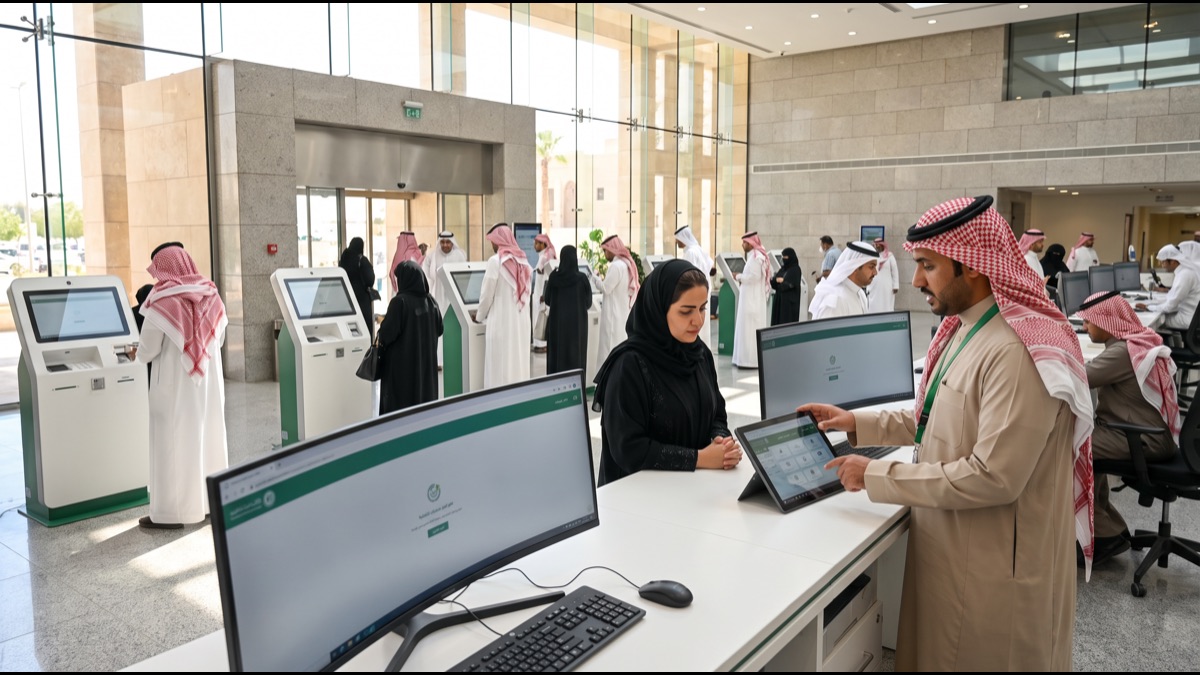
Anyone who has used a Saudi government digital service in recent years, whether renewing a vehicle registration, checking a legal case status, or verifying a professional certificate, has likely interacted with technology built by Elm, even if the branding on screen said something else entirely. Elm is a Saudi public-private technology company that builds and operates much of the underlying digital infrastructure behind government and quasi-government services, working alongside but distinct from Absher, the Ministry of Interior's own citizen portal. Confusing Elm with Absher is common, since both sit in the same broad category of Saudi digital government services and residents rarely need to know which specific company built the platform they are using. Understanding the difference matters because it explains why some services require an Absher login, others use a separate Elm-branded system, and why Saudi Arabia's approach to digital government services differs structurally from countries that run everything through a single centralized portal.
What Elm Actually Is
Elm is a Saudi joint-stock technology company with government-linked ownership, meaning it operates with commercial structure and accountability while being closely tied to national digital transformation goals rather than functioning as a purely private startup.
Rather than being a single consumer-facing app, Elm functions more like an infrastructure and systems-integration partner, building the back-end platforms that various government bodies then present to the public under their own branding.
This structure lets individual ministries and agencies focus on their specific regulatory functions while relying on a specialized technology partner to handle the platform engineering, security, and identity-verification layers underneath.
How This Differs From Absher
Absher is specifically the Ministry of Interior's own digital portal, covering services like ID documents, traffic violations, and residency permits, and it is the platform most residents interact with most frequently.
Elm, by contrast, builds and operates a broader range of platforms across multiple sectors, including judicial services, professional licensing, vehicle-related services, and business registration systems that sit outside the Ministry of Interior's direct remit.
In practice, a resident might log into an Absher-branded service for one task and an Elm-branded or Elm-built service for another, without necessarily realizing the two sit under different institutional ownership even though both feel like part of the same government digital ecosystem.
Why Saudi Arabia Uses Multiple Platforms Rather Than One
Splitting digital services across multiple specialized platforms rather than one single portal reflects how different government functions have different legal owners, data sensitivity levels, and regulatory requirements that make full consolidation impractical.
Judicial case data, for example, involves different confidentiality and access-control requirements than vehicle registration data, so building separate systems with tailored security models is often more practical than forcing everything into one undifferentiated database.
This approach does create some fragmentation from a user's perspective, which is why Saudi Arabia has also invested in unified national identity verification that lets these separate platforms authenticate the same user consistently, even if the platforms themselves remain distinct.
The Identity Verification Layer Underneath
A key piece of what makes these platforms function smoothly is a shared national digital identity system that lets a resident authenticate once and have that identity trusted across multiple otherwise-separate government platforms.
This shared identity layer is what allows a resident to move between an Absher-branded service and an Elm-built platform without re-entering the same identity documents at every single interaction, since the underlying verification has already confirmed who they are.
Building and maintaining this identity infrastructure securely, so that it cannot be spoofed or exploited to access services under a false identity, is one of the more technically demanding parts of the entire digital government ecosystem.
Judicial Services as a Major Elm-Linked Function
One of the more significant service areas linked to Elm involves digitizing aspects of the judicial system, including case tracking, notification systems, and electronic submission of certain filings that previously required in-person visits to a court.
Digitizing judicial processes carries particular sensitivity because case data often involves personal and sometimes commercially confidential information, so access controls and audit trails for who viewed what information become especially important in this part of the system.
The push to digitize judicial services fits into a broader Saudi goal of improving the ease and speed of doing business, since faster and more transparent case processing is often cited by international business-environment assessments as a meaningful factor in a country's investment climate.
Vehicle and Traffic-Adjacent Services
A range of vehicle-related digital services, including certain inspection, registration, and violation-adjacent functions, run through platforms connected to this broader public-private technology ecosystem, working alongside the traffic services more directly branded under Absher.
The practical reason for this division is that vehicle inspection and certification often involves private-sector garages and certified inspection centers, so the technology platform needs to interface cleanly with private businesses in a way that a purely internal ministry system would not need to.
This is a recurring pattern across the ecosystem: wherever a government function intersects meaningfully with private-sector actors, a platform built with that interface in mind tends to sit outside the core interior-ministry portal.
Professional Licensing and Certification Verification
Many professional licensing and certification checks, from verifying a contractor's registration to confirming a healthcare professional's credentials, run through digital verification systems that let employers, clients, or regulators check credentials without relying on paper documents that can be forged or outdated.
This kind of verification system matters especially for regulated professions where an unqualified or improperly licensed individual could cause real harm, so the integrity of the underlying data and the speed of verification are treated as core requirements rather than convenience features.
For businesses hiring in regulated sectors, or for residents needing to confirm a service provider's legitimate credentials, this verification layer functions as a meaningful trust mechanism that reduces reliance on documents alone.
How Business Registration Services Fit In
Business registration and certain commercial licensing functions also run through platforms in this ecosystem, letting entrepreneurs complete registration steps digitally rather than through purely in-person bureaucratic processes that used to take considerably longer.
Because business registration intersects with tax authorities, commercial courts, and sector-specific regulators, the underlying platform has to interface with multiple government data systems simultaneously, which is exactly the kind of systems-integration work this ecosystem specializes in.
Faster, more reliable business registration is frequently cited as one of the more tangible improvements Saudi residents and entrepreneurs have experienced from this broader digital transformation push, since it directly shortens the time needed to formally start operating a business.
Why a Public-Private Structure Was Chosen
Structuring this kind of entity as a public-private company rather than a purely internal government department gives it more flexibility to hire specialized technology talent, adopt modern engineering practices, and move at a pace that traditional civil-service hiring and procurement processes often struggle to match.
At the same time, government-linked ownership ensures the entity remains accountable to national policy priorities and data-sovereignty requirements rather than operating purely on commercial incentives that might not align with public-service goals.
This hybrid structure is increasingly common internationally for digital government transformation efforts, since it attempts to combine the operational agility of a private company with the accountability and mission alignment of a public institution.
Data Security and Sovereignty Considerations
Given how much sensitive personal, legal, and financial data flows through these platforms, data security and sovereignty, meaning where and how data is stored and who can access it, are treated as foundational requirements rather than optional add-ons.
Saudi digital government infrastructure is generally built with data residency requirements that keep sensitive government data within domestic infrastructure rather than relying on foreign-hosted cloud services for the most sensitive functions.
This requirement shapes technology vendor selection and system architecture decisions throughout the ecosystem, since any technology partner has to be able to meet these residency and access-control requirements before being brought into a government-linked project.
What Happens When a User Encounters a Problem
Because these platforms are built and operated by a technology company working on behalf of various government bodies, support pathways for a stuck user typically route through the specific government agency responsible for that service rather than through Elm directly.
This division of support responsibility can be confusing for users who assume a single point of contact should be able to resolve any digital government service issue, when in practice the responsible agency and the underlying technology provider are functionally separate.
Understanding this separation helps residents direct support requests to the right place more quickly, rather than repeatedly contacting a general help channel that may not have visibility into the specific service in question.
How This Fits Into Saudi Arabia's Broader Digital Ambitions
This digital-services ecosystem is one piece of a much larger Saudi push to rank among the more digitally advanced governments globally, a goal explicitly tied to Vision 2030's broader economic diversification and ease-of-doing-business objectives.
International rankings and assessments of government digital service quality increasingly factor into how investors and multinational companies evaluate the practical ease of operating in a given country, which gives this kind of infrastructure investment a economic rationale well beyond simple citizen convenience.
As more services move onto these platforms, the practical measure of success becomes less about the number of digitized services and more about whether residents and businesses experience measurably faster, more reliable interactions with government functions they used to handle in person.
What Residents Should Know Practically
For most residents, the practical takeaway is less about which specific company built a given platform and more about knowing that Saudi Arabia's digital government services are split across a small number of trusted platforms rather than a single unified app.
When a service does not appear on Absher, checking whether it is handled through a separate Elm-linked platform, often reachable through links from official government portals, is generally the right next step rather than assuming the service simply is not available digitally.
Keeping national identity and mobile-verification details up to date across these systems remains important, since the shared identity-verification layer underneath all of them depends on this information being current and accurate.
How These Platforms Handle Peak Demand
Government digital services often see sharp usage spikes around specific dates, such as license renewal deadlines or academic enrollment periods, and platforms in this ecosystem have to be engineered to handle these predictable surges without slowing down or becoming unavailable.
This kind of load engineering is a less visible but genuinely important part of what makes a government digital service trustworthy, since a service that becomes unreliable exactly when the most people need it defeats much of the purpose of digitizing it in the first place.
Planning for these predictable peaks, rather than treating them as unexpected surprises, is one of the operational disciplines that separates a mature digital government platform from an early-stage one still working out its reliability.
Mobile Access and the Shift Away From Desktop Portals
A large share of interaction with these platforms now happens through mobile apps and mobile browsers rather than desktop computers, reflecting broader regional smartphone adoption patterns rather than a Saudi-specific choice.
This shift has pushed platform design toward simplified mobile-first interfaces and stronger reliance on mobile-based identity verification, such as one-time codes sent to a registered phone number, rather than desktop-oriented authentication methods.
Keeping a registered mobile number current is therefore not a minor detail but a functional requirement, since much of the verification infrastructure underlying these services assumes the phone number on file is both accurate and actively in the user's possession.
How Private Companies Interact With This Ecosystem
Beyond individual residents, private companies frequently need to interact with these platforms for regulatory compliance, employee verification, and business licensing renewal, which means the systems have to support both individual and organizational accounts with different permission structures.
Larger companies in particular often need bulk verification capabilities, such as checking the licensing status of many employees at once, which places different technical demands on the platform than a single individual checking their own single credential.
This dual requirement, serving both individual residents and organizational users at scale, is part of why the underlying technology has to be built with genuine enterprise-grade reliability rather than simpler consumer-app engineering standards.
Why International Comparisons Matter for This Model
Saudi Arabia is not alone in splitting government digital services across multiple specialized platforms with a shared identity layer; several other countries with advanced digital government systems use broadly similar architectures rather than one monolithic portal.
Comparing this model with countries that use a single unified portal shows a real tradeoff: unified portals can feel simpler for users but are harder to adapt when different government functions have very different technical and regulatory needs.
Saudi Arabia's approach reflects a judgment that specialized platforms with shared identity infrastructure offer more flexibility for rapid expansion of new digital services than trying to force every function into one system from the start.
What This Means for Long-Term Digital Government Planning
As more services move online, the practical challenge shifts away from simply digitizing individual functions and toward keeping the overall ecosystem coherent, so that residents do not feel lost trying to figure out which platform handles which task.
This is why continued investment in the shared identity and discovery layer, meaning the systems that help a user find the right service and authenticate once across platforms, matters just as much as building new services themselves.
The long-term measure of success for this model will likely be whether it can keep expanding the number of digitized services without proportionally increasing the confusion or friction a typical resident experiences navigating between them.
How Trust Is Built Into the System Over Time
Trust in a government digital platform is not established simply by launching it; it accumulates gradually as residents experience repeated, reliable interactions where the system does what it promises without unexpected failures or confusing dead ends.
Early missteps in any digital government rollout, such as a service outage during a high-demand period or an authentication failure that locks a user out of an urgent transaction, tend to leave a lasting impression that outweighs many smaller successes.
This is part of why platform operators in this ecosystem tend to prioritize reliability and clear error messaging over adding flashy new features, since a service residents genuinely trust with sensitive tasks is more valuable long-term than one with more functions but less consistency.
The Practical Difference Between a Ministry Website and a Platform Like This
A traditional ministry website is typically informational, publishing forms, regulations, and contact details, whereas a transactional platform like the ones built by Elm actually processes an action, verifies identity, updates a legal record, or issues a valid credential.
This distinction matters because the security, auditing, and legal-validity requirements for a transactional platform are considerably higher than for an informational website, since a mistake or vulnerability in a transactional system can directly cause real financial or legal harm.
Recognizing which type of digital touchpoint a resident is dealing with, informational versus transactional, helps explain why some government web pages feel simple and static while others require the more rigorous identity verification described earlier in this article.
Elm's role in Saudi Arabia's digital government ecosystem illustrates a broader design choice: rather than building one all-purpose government app, the kingdom has developed a small number of specialized, interoperable platforms, each tailored to the specific legal and operational needs of the functions it serves. Absher remains the most visible and frequently used of these platforms for most residents, but a meaningful share of judicial, professional, business, and vehicle-related digital services run through infrastructure built by Elm and similar public-private technology partners. The shared identity-verification layer underneath these separate platforms is what keeps the experience relatively coherent for users, even though the platforms themselves sit under different institutional ownership and serve different regulatory functions. As Saudi Arabia continues expanding this digital ecosystem, understanding which platform handles which function, and knowing that Elm sits alongside rather than inside Absher, makes it considerably easier to find the right service quickly rather than assuming every government function should live in a single familiar app.
Sources
- Wikipedia: E-government — General background on digital government service models and public-private technology partnerships
- Saudi Vision 2030 official site — Official framework tying digital transformation to broader economic diversification goals
- World Bank: Digital Development — Comparative context on government digital transformation and ease-of-doing-business rankings
- Wikipedia: Absher — Background on the Ministry of Interior's separate citizen portal
FAQ
Is Elm the same thing as Absher?
No. Absher is the Ministry of Interior's own citizen portal, while Elm is a separate public-private technology company that builds platforms for judicial, professional licensing, vehicle, and business services. They are related parts of the same broader digital government ecosystem but are institutionally distinct.
Why does Saudi Arabia use multiple platforms instead of one unified government app?
Different government functions have different legal owners, data sensitivity levels, and regulatory requirements, which makes tailored, specialized platforms more practical than forcing everything into one undifferentiated system.
How does authentication work across these separate platforms?
A shared national digital identity verification layer lets a resident authenticate once and have that identity trusted across multiple otherwise-separate platforms, avoiding repeated document verification at every service.
What kind of services does Elm typically handle?
Judicial case digitization, professional licensing and credential verification, vehicle-related services intersecting with private inspection centers, and business registration functions that involve multiple government data systems.
Who should a resident contact if they have a problem with an Elm-built platform?
Support generally routes through the specific government agency responsible for that service rather than through Elm directly, since Elm builds the underlying technology on the agency's behalf.
About the Author
We reference Wikipedia: E-government, Saudi Vision 2030 official site, World Bank: Digital Development, and Wikipedia: Absher to explain the background and current understanding of this topic.
Loved This Article?
Share it on WhatsApp → Share it on WhatsApp
Get more guides in your inbox — Subscribe to our newsletter for weekly surprising stories from Egypt, Saudi Arabia, Dubai, and beyond.