Introduction
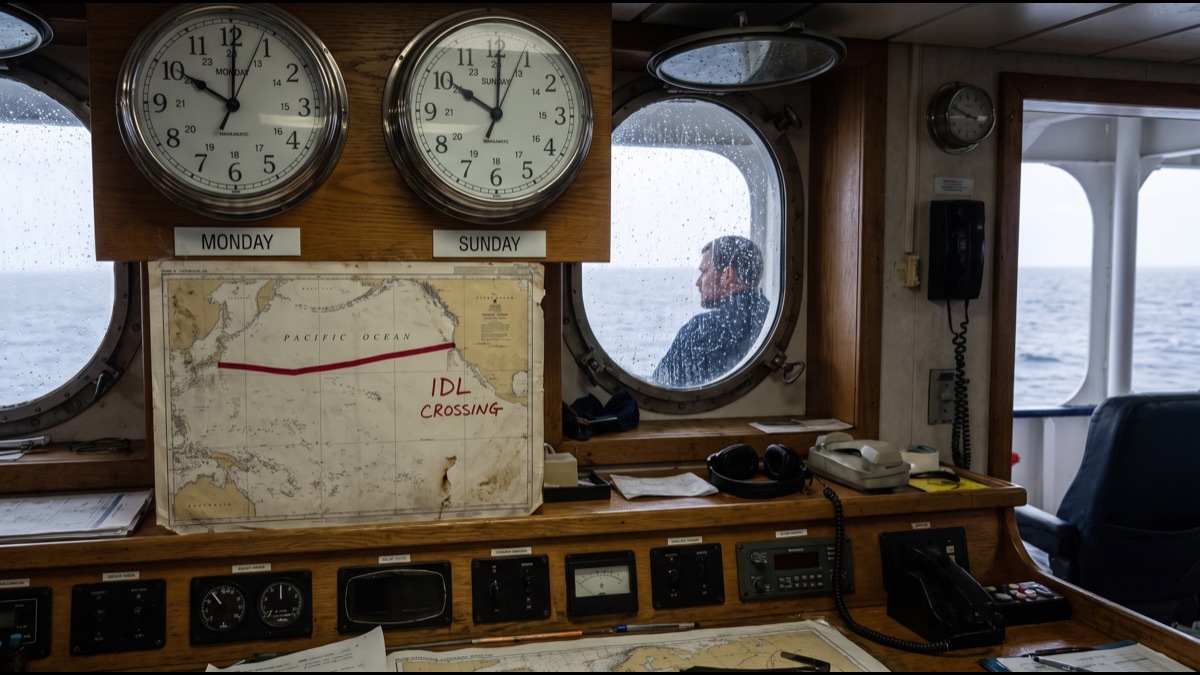
Fly from Fiji to Hawaii and you can land the day before you left, even though the flight takes hours, not a day in reverse. The trick is the International Date Line, an imaginary line running roughly along the 180th meridian in the Pacific Ocean where the calendar date changes by exactly one day.
There is no single treaty that created the line, and no country is legally bound by its exact path. It exists because the world needed a single place where Monday could become Sunday again, closing the loop created by 24 separate time zones.
Why a Line Is Needed
Time zones exist because Earth rotates, and each 15 degrees of longitude shifts local noon by about an hour. Starting from a reference point and moving time zones forward as you travel east eventually adds up to a full 24 hours — a whole extra day compared to someone who stayed in place.
Without a fixed line where the date resets, two people standing near each other could disagree on the day of the week depending on which direction they had traveled to get there. The date line is simply the seam where that 24-hour gap is stitched shut.
Why the Line Zigzags
If the date line followed the 180th meridian exactly, it would slice through Russia's Chukotka region, several Pacific island nations, and the Aleutian Islands, splitting single countries and communities into two different calendar days. To avoid that chaos, the line bends around national borders.
The most dramatic bend swings east around Kiribati, whose easternmost islands moved their side of the line in 1995 so the entire country could share the same date — and, as a side effect, become among the first places on Earth to greet each new year.
What Happens When You Cross It
Traveling west across the line, you skip a calendar day: Tuesday becomes Wednesday. Traveling east, you repeat one: Wednesday becomes Tuesday again. Ships and long-haul flights across the Pacific are the most common places this actually happens to real travelers.
The date line has no connection to time zones themselves; it only affects the date label, not the local clock. A place just west of the line and a place just east of it can show nearly the same clock time while being a full calendar day apart.
Sources
- Encyclopaedia Britannica — definition and history of the International Date Line
- Wikipedia — the geography of the 180th meridian and the date line's path
- timeanddate.com — practical explanation of crossing the date line while traveling
FAQ
What is the International Date Line?
The International Date Line is an imaginary line running through the Pacific Ocean, roughly along the 180th meridian, where the calendar date changes by one full day. It has no legal or treaty status and exists purely by international convention.
Why does the date line zigzag instead of following a straight meridian?
The line bends around national borders and island territories, such as Russia's far east and Pacific nations like Kiribati, so that no single country is split into two different calendar dates.
What happens when you cross the International Date Line?
Traveling west across the line advances the calendar by one day, while traveling east repeats a day. This only changes the date, not the local clock time, which is set separately by time zones.
Is the date line the same thing as a time zone?
No. Time zones control what time it is on the clock, while the date line controls what calendar day it is. A location can share nearly the same clock time as a neighboring one across the line while being an entire day apart on the calendar.
About the Author
We reference Britannica, Wikipedia, and timeanddate.com resources on longitude and the history of the date line to explain how it functions.
Loved This Article?
Share it on WhatsApp → Share on WhatsApp
Get more guides in your inbox — Subscribe to our newsletter for weekly surprising stories from Egypt, Saudi Arabia, Dubai, and beyond.