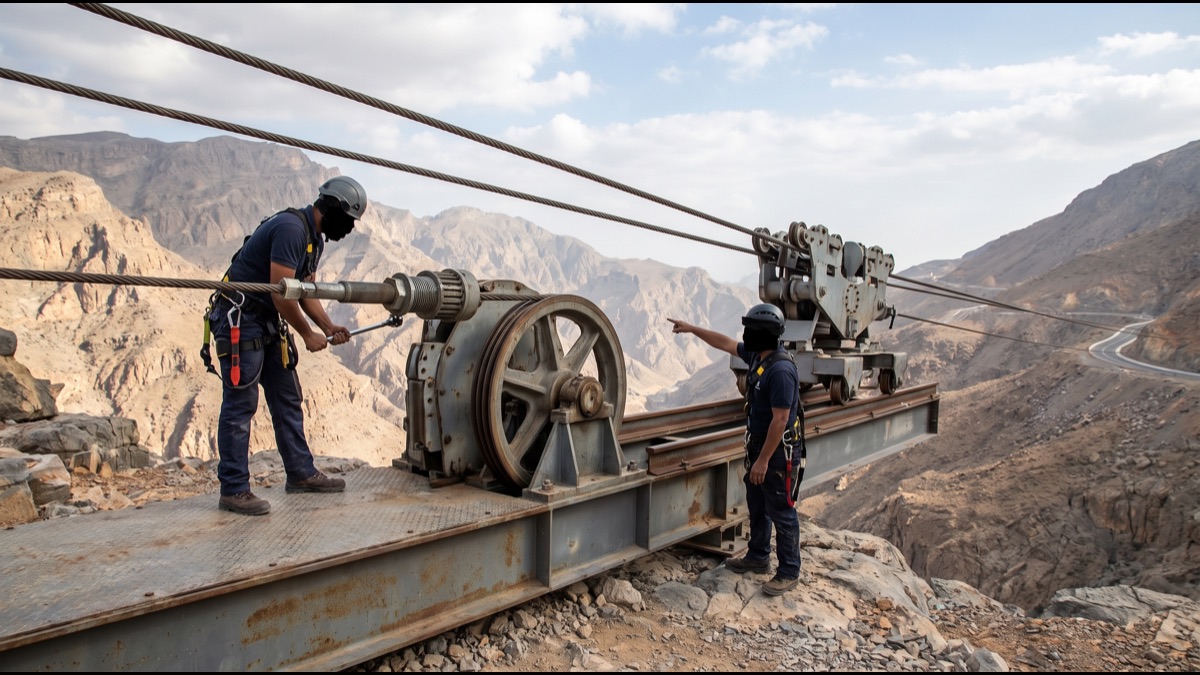
Riders strapped into a harness at the top of Jebel Jais, the highest mountain in the UAE, briefly reach speeds comparable to a car on a highway before a carefully engineered braking system brings them to a controlled stop more than two kilometers later. The zipline holding the title of the world's longest is not simply a long cable stretched between two points; it is a precisely calculated piece of mechanical engineering built to convert gravity into a safe, repeatable, high-speed ride thousands of times a day.
Understanding how the system actually works, from the specific cable engineering involved to how operators manage the very real risk posed by desert mountain winds, explains why building the world's longest zipline required considerably more than simply finding the longest available stretch of mountain terrain and stringing a cable across it.
It also reveals why Ras Al Khaimah specifically pursued this record as part of a deliberate tourism diversification strategy, turning a stretch of rugged, previously little-visited mountain terrain into a globally recognized adventure tourism landmark.
A Mountain Built for a World Record
Jebel Jais, rising to just under two thousand meters, is the tallest mountain in the UAE, and its dramatic elevation change and rugged canyon terrain made it a natural candidate for a long-distance zipline attraction capable of genuinely competing for a world distance record rather than simply offering a short, scenic ride.
The specific route chosen threads across a natural canyon gap in the mountain, a topographical feature that let engineers achieve the necessary distance and elevation drop within a single continuous run rather than needing to break the ride into an artificially extended series of shorter, less dramatic segments.
What Actually Makes a Zipline a Zipline
At its core, a zipline is a straightforward application of gravity: a rider suspended from a pulley-equipped trolley rolls along a tensioned cable strung between a higher starting point and a lower ending point, with height difference converting directly into rolling speed as the trolley descends the cable's slope.
What separates a genuinely world-class zipline installation from a simpler backyard or adventure-park version is the engineering required to safely manage that speed and distance at scale, since the same basic physics that makes a short zipline fun becomes a serious engineering challenge once the cable stretches for kilometers and riders are expected to reach highway-comparable speeds.
Why Jebel Jais Was Chosen for This Specific Record
Beyond simply being the UAE's tallest peak, Jebel Jais offered a specific combination of accessible road infrastructure already built for the mountain's broader tourism development, a canyon gap of sufficient length and elevation drop, and government backing eager to establish Ras Al Khaimah as a genuine adventure tourism destination distinct from the luxury and shopping tourism associated with nearby Dubai.
This combination of natural terrain and deliberate government tourism strategy is why the specific record-breaking zipline installation happened at Jebel Jais rather than at another mountain location in the region that might have offered comparable raw elevation but lacked the same combination of accessibility and strategic tourism investment.
How the Cable System Is Actually Engineered
The steel cable itself is engineered to extremely precise tension and load specifications, calculated to safely support the combined weight of a rider and equipment moving at high speed while accounting for cable sag, thermal expansion in extreme desert heat, and the repeated cyclical stress of thousands of rider passes without measurable degradation over the installation's operational lifespan.
Cable tensioning is not a one-time setup step but an ongoing operational parameter engineers monitor and adjust, since even small changes in tension can meaningfully affect rider speed, cable sag at the midpoint of the run, and the wear pattern the trolley system experiences over repeated use.
What the Trolley and Harness Actually Do
The trolley, the wheeled mechanism that actually rolls along the cable, is engineered specifically to minimize rolling friction at high speed while maintaining a secure, redundant connection to the rider's harness, since any single point of failure in this connection would be catastrophic given the speeds and heights involved.
Modern high-speed zipline harness systems typically include multiple independent attachment points and backup safety mechanisms specifically so that no single component failure alone could result in a rider becoming detached from the cable system, a redundancy philosophy standard across serious commercial adventure attractions rather than something unique to this particular installation.
How Riders Actually Reach Highway Speeds
The specific speed a rider reaches depends on the cable's elevation drop, its length, the rider's weight, and current wind conditions, with the Jebel Jais installation engineered so that a typical rider reaches speeds reported in the range of well over a hundred kilometers per hour during the fastest section of the descent.
This speed is achieved almost entirely through gravity acting on the elevation drop rather than through any powered assistance, meaning the entire ride's speed profile is a direct, calculable function of the cable's specific engineered geometry rather than something that could be easily adjusted after the fact without physically altering the installation.
The Braking System That Prevents a High-Speed Collision
Bringing a rider traveling at highway speed to a safe, controlled stop requires a braking system engineered well beyond a simple mechanical stop at the end of the line, typically combining a gradual magnetic or friction-based braking zone that begins decelerating the rider well before the final stopping point with a secondary mechanical backstop as a final safety measure.
This layered braking approach exists specifically because a single braking mechanism failing at these speeds would pose an unacceptable safety risk, so redundant, independently functioning braking systems are standard engineering practice for any zipline attraction operating at genuinely high speeds rather than a leisurely, low-speed ride.
Why Wind Is the Operator's Biggest Daily Concern
Because the ride operates on an exposed mountain ridge with no surrounding structures to break wind, operators monitor wind speed and direction continuously and will delay or suspend operations entirely when conditions exceed safety thresholds, since strong crosswinds can meaningfully affect a rider's trajectory and speed in ways the engineered braking system was not specifically designed to compensate for.
This wind sensitivity is a genuinely common operational constraint across high-altitude zipline installations worldwide, not a specific weakness of this particular attraction, and it is part of why visitors are generally advised to check operational status before traveling to the mountain during unusually windy periods of the year.
How Often the Cable Is Actually Inspected
Commercial zipline cables of this scale undergo scheduled inspection routines that check for wire strand damage, corrosion, and changes in tension well beyond what a casual visual check could catch, typically following manufacturer and regulatory maintenance schedules that specify exact inspection intervals based on total rider volume and elapsed operational time rather than a fixed calendar schedule alone.
These inspection regimes are a standard, non-negotiable part of operating any high-capacity commercial zipline, since a cable carrying thousands of paying riders annually at high speed cannot rely on infrequent or informal checks the way a much lower-traffic recreational installation conceivably might.
What Happens If a Rider Gets Stuck Mid-Line
Well-engineered zipline systems account for the possibility of a rider stopping short of the end platform, whether due to unusually light rider weight, unexpected headwind, or a technical issue, with trained staff equipped to perform a rope-based rescue retrieval along the cable itself rather than the installation simply having no contingency plan for this scenario.
Operators typically brief riders on this possibility before departure specifically to manage expectations, since a mid-line stop, while rare on a well-tensioned, well-maintained system, is treated as a planned-for operational contingency rather than an emergency failure of the underlying engineering.
Why the Ride Is Split Into Multiple Stages
The full zipline experience at Jebel Jais is typically structured across multiple connected zipline stages rather than a single unbroken run, a design choice that allows operators to manage rider throughput more efficiently, perform staged safety checks at each platform, and offer visitors a structured, multi-part adventure experience rather than a single brief descent.
This staged structure also provides natural points where operators can pause operations for weather or maintenance reasons without needing to halt the entire mountain-wide system, adding operational flexibility that a single unbroken multi-kilometer cable run would not offer nearly as easily.
How Weight and Body Position Actually Affect Speed
Heavier riders generally descend somewhat faster than lighter riders on the same cable under identical wind conditions, a straightforward consequence of gravity acting on mass, though the engineered braking system is calibrated to safely handle the full expected range of rider weights rather than being tuned for a single average weight alone.
Body position during the ride, generally instructed by operators before departure, also has a measurable effect on aerodynamic drag and therefore final speed, which is part of why riders receive specific positioning guidance rather than being left to adopt whatever posture feels most comfortable during the descent.
What Guinness World Records Actually Verifies
Achieving formal recognition as the world's longest zipline required independent verification of the specific measured distance according to Guinness World Records' documented methodology, a process considerably more rigorous than simply advertising an impressive-sounding length, requiring precise surveyed measurement of the actual cable route rather than an approximate straight-line distance between start and end points.
This formal verification process is part of why record claims in adventure tourism are generally taken seriously by industry observers, since the certification requires documented evidence meeting a specific, internationally recognized measurement standard rather than resting purely on a destination's own marketing claims.
Why Adventure Tourism Became a UAE Diversification Bet
The broader UAE tourism strategy has increasingly emphasized diversifying beyond luxury shopping, dining, and beach tourism concentrated in Dubai and Abu Dhabi toward a wider range of experiences, including desert and mountain adventure tourism, specifically to capture visitor segments and repeat-visit motivations that traditional luxury tourism marketing does not fully address on its own.
Ras Al Khaimah's specific bet on mountain adventure tourism, anchored by the Jebel Jais zipline record, reflects this wider strategic shift, positioning the emirate as a genuinely distinct complementary destination within the broader UAE tourism ecosystem rather than attempting to directly compete with Dubai's established luxury tourism positioning.
How the Attraction Fits Into Ras Al Khaimah's Tourism Strategy
Beyond the zipline itself, Ras Al Khaimah has invested in surrounding mountain infrastructure, including additional adventure activities, dining, and accommodation options built specifically around Jebel Jais, treating the record-holding zipline as an anchor attraction intended to draw visitors toward a broader, multi-day mountain tourism experience rather than a single standalone day trip.
This anchor-attraction strategy, using one globally recognized, easily marketable record-holding experience to draw visitors toward a wider destination offering, is a common pattern in tourism development, and the zipline's world-record status has provided exactly the kind of internationally shareable, easily marketed hook such a strategy generally requires to succeed.
What Regular Maintenance Actually Costs an Attraction Like This
Operating a high-capacity, high-speed commercial zipline at this scale involves ongoing costs well beyond the initial construction investment, including scheduled cable and equipment inspection, trained safety staff, weather monitoring infrastructure, and periodic component replacement as parts reach their rated operational lifespan, costs that must be sustained indefinitely for the attraction to remain safely operational.
These ongoing operational costs are a genuine consideration in the broader economics of adventure tourism attractions, since a headline-grabbing world record generates valuable marketing exposure but does not, on its own, cover the continuous maintenance investment required to keep a high-speed mechanical system safely running for paying visitors year after year.
Why Record Attractions Rarely Stay Records Forever
World record attractions in adventure tourism generally exist within a competitive landscape where other destinations have genuine incentive to eventually build something longer, faster, or more dramatic, meaning record status, while valuable for marketing in the near term, is rarely treated by destination operators as a permanent competitive advantage.
This dynamic pushes destinations holding a current record to invest in the broader visitor experience surrounding the record attraction itself, since a destination whose appeal rests purely on a title that could eventually be surpassed by a competing location needs additional genuine value to retain visitor interest over the long term.
How Safety Briefings Actually Prepare First-Time Riders
Before being cleared to ride, every guest goes through a mandatory safety briefing covering harness fitting, body positioning, hand placement, and exactly what to expect during acceleration and braking, a session designed specifically to reduce first-timer anxiety and prevent the kind of panicked mid-ride movement that could genuinely affect trajectory or braking behavior.
Staff conducting these briefings are trained to recognize visibly anxious riders and adjust their guidance accordingly, sometimes offering additional reassurance or a brief practice positioning check before departure, since a calm, correctly positioned rider is measurably easier for the engineered system to bring to a safe, predictable stop than one who is tense or incorrectly positioned in the harness.
Why the View From the Platform Is Part of the Design
Beyond the pure mechanics of the ride itself, the launch platforms and connecting walkways were deliberately positioned to maximize the dramatic canyon and mountain views riders and waiting guests experience, a design choice that treats the anticipation and photography opportunity before departure as part of the overall visitor experience rather than a purely functional loading area.
This attention to the surrounding visual experience reflects a broader adventure-tourism design principle: a record-breaking ride draws initial visitor interest, but the surrounding sensory experience, the view, the anticipation, the sense of scale looking down into the canyon, is what actually makes visitors describe the experience memorably afterward and recommend it to others.
What the Experience Actually Teaches About Engineering
Beneath the marketing headline of a world-record zipline sits a genuinely substantial body of applied mechanical and civil engineering, cable tensioning calculations, redundant braking system design, wind-monitoring protocols, and rigorous inspection regimes, all working together invisibly so that a rider experiences the descent as a straightforward, exhilarating few minutes rather than as the outcome of a carefully engineered safety system.
That gap between the visible thrill and the invisible engineering supporting it is, in many ways, the same pattern found across most well-designed adventure attractions: the more genuinely safe and reliable the underlying system, the less a visitor actually notices it, right up until the moment they are strapped in at the top of the mountain looking down at the canyon below.
Sources
- Wikipedia — overview of the Jebel Jais zipline and its world record status
- Guinness World Records — official verification methodology for world record zipline distance claims
- Ras Al Khaimah Tourism Development Authority — regional tourism strategy and Jebel Jais destination development
- UAE tourism resources — background on UAE adventure and mountain tourism diversification
FAQ
How fast do riders actually go on the Jebel Jais zipline?
Riders reach speeds reported well over a hundred kilometers per hour during the fastest section of the descent, achieved almost entirely through gravity acting on the cable’s engineered elevation drop rather than any powered assistance.
What stops a rider from crashing into the end platform at high speed?
A layered braking system typically combines a gradual magnetic or friction-based deceleration zone with a secondary mechanical backstop, ensuring redundant safety measures rather than relying on a single braking mechanism at these speeds.
Why does the zipline sometimes close due to wind?
The ride operates on an exposed mountain ridge with no surrounding structures to break wind, and strong crosswinds can meaningfully affect rider trajectory and speed, so operators suspend operations when conditions exceed safety thresholds.
What happens if a rider stops before reaching the end?
Well-engineered systems account for this possibility, and trained staff are equipped to perform a rope-based rescue retrieval along the cable, treating a mid-line stop as a planned operational contingency rather than an emergency failure.
Why did Ras Al Khaimah build the world’s longest zipline specifically?
It reflects a deliberate tourism diversification strategy aimed at positioning the emirate as a distinct adventure tourism destination, using the globally marketable world-record status as an anchor attraction to draw visitors toward a broader mountain tourism offering.
About the Author
We reference Wikipedia and other authoritative sources to explain the background and current understanding of this topic.
Loved This Article?
Share it on WhatsApp → Share it on WhatsApp
Get more guides in your inbox — Subscribe to our newsletter for weekly surprising stories from Egypt, Saudi Arabia, Dubai, and beyond.