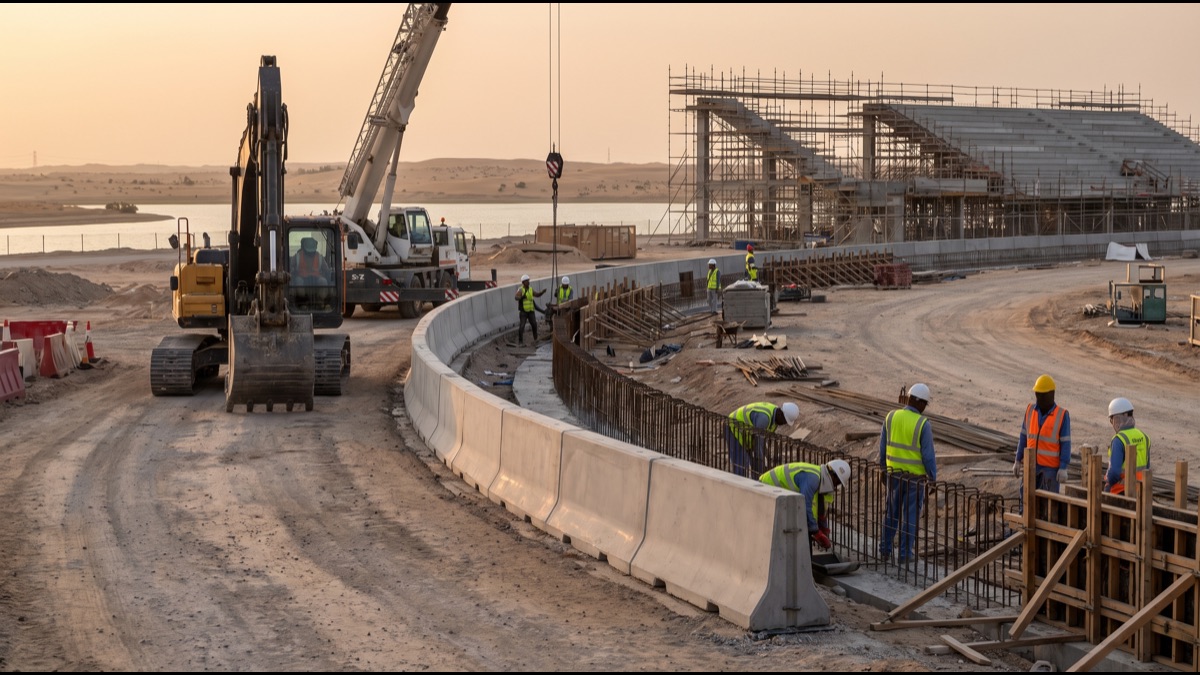
Formula 1 cars now reach speeds exceeding 250 kilometers per hour along a seaside boulevard in Jeddah that, only months earlier, was an ordinary corniche road used for evening strolls and family picnics. The Jeddah Corniche Circuit stands as one of the most ambitious rapid-construction projects in modern motorsport, transforming public streets into the fastest street circuit on the entire Formula 1 calendar in a design and build timeline that stunned engineers accustomed to years-long venue development.
Understanding how the track was actually designed, built, and subsequently modified reveals both the genuine engineering achievement involved and the safety trade-offs that came with prioritizing speed above almost every other consideration in the circuit's original layout.
Why Saudi Arabia Wanted an F1 Race Fast
Saudi Arabia's decision to secure a Formula 1 race slot came as part of a broader national push to establish the Kingdom as a major international sporting destination, running in parallel with investments across golf, boxing, esports, and football under the country's wider Vision 2030 sports strategy.
Unlike countries that spend years constructing a permanent purpose-built facility before hosting a first race, Saudi organizers opted for a street circuit specifically because it could be delivered on a dramatically compressed timeline, allowing the Kingdom to join the F1 calendar considerably sooner than a ground-up permanent venue would have permitted.
This urgency reflected genuine competitive pressure within the region, since neighboring Gulf states had already established themselves as Formula 1 hosts, and securing a race slot quickly carried real strategic value in the broader contest for regional sporting prestige and international visibility among nations pursuing remarkably similar tourism and soft-power ambitions.
Why the Corniche Was Chosen as the Site
The Jeddah Corniche, a long waterfront boulevard already built to a high standard for ordinary traffic, offered planners a genuine head start unavailable on undeveloped desert land, since much of the base roadway infrastructure the circuit ultimately used already existed before design work began.
The seafront setting also carried significant marketing value, allowing broadcast footage to showcase Red Sea views alongside high-speed racing action, a visual pairing organizers considered a meaningful asset in positioning the race internationally compared with a circuit built in a less photogenic inland location.
Using an existing public corridor did impose real constraints on the design process, since the track had to work within the corniche's actual geography and available width rather than being freely shaped the way a purpose-built permanent circuit typically is.
How Tilke's Firm Designed the Layout
The circuit was designed by the firm led by Hermann Tilke, the engineer and architect responsible for designing or redesigning the overwhelming majority of circuits added to the Formula 1 calendar over the past two decades, giving Saudi organizers access to genuinely proven street-circuit design expertise.
Tilke's team worked within the corniche's existing road network to plot a layout featuring an unusually high number of corners packed into a relatively compact lap, connected by long, sweeping high-speed sections that became the track's defining characteristic.
Designing a street circuit differs substantially from designing a permanent facility, since the layout must account for existing utility infrastructure, building foundations close to the road edge, and the practical need to fully restore the corridor to ordinary public use once the race weekend concludes.
What Makes It the Fastest Street Circuit
The Jeddah circuit's defining characteristic is its combination of very high average speed with the confined, wall-lined character typical of street circuits, a combination that does not occur together at any other track on the calendar in quite the same proportion.
Most street circuits, including the historic Monaco layout, are constrained by tight, low-speed sections that naturally cap average lap speed regardless of a car's outright pace, whereas Jeddah's design features comparatively few such slow corners relative to its long flowing sections.
This design choice produces genuinely exceptional lap speeds for a street circuit, but it also means drivers are traveling at speeds closer to those seen on permanent high-speed circuits while still racing within walls positioned much closer to the track surface than a permanent venue would typically allow.
How the Track Surface Was Actually Laid
Constructing a Formula 1-grade racing surface on top of an existing public road required extensive resurfacing work, since ordinary road asphalt does not meet the grip, durability, and consistency standards Formula 1 machinery demands at racing speeds.
Construction crews worked through an intensive schedule to lay specialized racing asphalt across the full length of the circuit, a process considerably more demanding under compressed time pressure than the multi-season construction schedule typical of a permanent facility.
Beyond the asphalt itself, teams had to install temporary infrastructure including pit garages, paddock facilities, and race control systems, all of which needed to be functional to Formula 1 operational standards despite existing for only a fraction of the year at this single location.
How Barriers and Run-Off Areas Were Installed
Street circuits rely heavily on temporary concrete barriers and debris fencing rather than the extensive gravel run-off areas found at many permanent circuits, since the available space alongside an existing public road is typically far more limited than at a purpose-built venue.
Engineers positioned barriers to follow the natural geometry of the corniche's existing road edges as closely as possible, a constraint that inherently limits how much safety margin can be built into any individual corner compared with a circuit designed from scratch around driver safety alone.
This barrier-heavy, low-margin safety configuration is a structural feature of nearly all street circuits, not something unique to Jeddah, but the track's exceptionally high average speeds meant any given safety trade-off carried more severe potential consequences than the same layout would at a slower circuit.
Why the Compressed Timeline Was So Unusual
Permanent Formula 1 venues typically take several years from initial planning to first race, encompassing environmental review, land acquisition, and a multi-season construction program well before a single car turns a competitive lap on the finished surface.
Jeddah compressed this entire process into a period widely reported as under a year, an extraordinarily aggressive schedule made possible specifically because the project relied on existing roads rather than requiring construction of an entirely new facility from open ground.
Engineers and F1 team personnel involved in the early events publicly described the construction pace as unprecedented for a Grand Prix venue, with some circuit elements reportedly still receiving final touches in the days immediately preceding the first race weekend.
What Went Wrong in the Circuit's Early Races
The circuit's combination of high speed and close barriers produced several serious, high-profile crashes during its first seasons on the calendar, incidents that drew considerable attention from drivers, teams, and the sport's governing body regarding the track's overall safety margin.
Several drivers publicly voiced concerns about specific sections of the layout following these incidents, describing the combination of speed and barrier proximity as more demanding than they were accustomed to at other circuits on the calendar.
These early safety concerns prompted the sport's governing body and circuit organizers to undertake a formal review process rather than dismissing driver feedback, a response that ultimately led to concrete modifications ahead of subsequent race weekends.
How Safety Reviews Changed the Track
Following the early safety incidents, organizers implemented specific layout adjustments at the sections identified as highest risk, including barrier repositioning and, in some cases, modest changes to corner geometry intended to increase available run-off margin.
These modifications reflect a broader pattern common across newer Formula 1 venues, where a circuit's initial layout is treated as a working starting point subject to revision based on real racing data rather than a fixed final design locked in before the first competitive lap.
The governing body's willingness to mandate changes at a high-profile new venue demonstrated that commercial and promotional considerations, however significant, did not override the sport's formal safety review process when genuine risk concerns were identified by drivers and technical delegates.
How the Circuit Reverts to a Public Road
Unlike a permanent circuit that remains a dedicated racing facility year-round, the Jeddah Corniche returns to ordinary public road use for the overwhelming majority of the calendar year, with racing infrastructure installed shortly before the event and removed again once it concludes.
This reversion process involves removing temporary barriers, pit structures, and race control installations, restoring normal traffic flow, signage, and public access to a stretch of waterfront that functions as an active commuter and recreational corridor for the rest of the year.
The logistics of this repeated install-and-remove cycle represent a genuine ongoing operational cost of hosting a street race, one permanent circuits do not face, since a fixed facility never needs to be dismantled and rebuilt around its host city's ordinary daily life.
What the Race Means for Saudi Sports Strategy
The Saudi Arabian Grand Prix functions as a visible flagship within the Kingdom's broader strategy of hosting major international sporting events, a strategy officials have explicitly linked to tourism diversification goals under Vision 2030's wider economic transformation agenda.
Hosting Formula 1 specifically carries outsized global media value relative to many other sports, given the championship's international broadcast reach and the sport's association with technology, luxury, and national prestige in the eyes of many host governments pursuing similar strategies elsewhere.
Government tourism and investment bodies have consistently referenced the race weekend's broadcast exposure when discussing the Kingdom's broader sports-hosting strategy, treating the annual event as recurring proof of concept for the country's capacity to deliver major international sporting spectacles.
How the Race Weekend Logistics Actually Work
Hosting a night race, as the Jeddah Grand Prix is run, requires an extensive temporary floodlighting installation capable of meeting the exacting broadcast lighting standards Formula 1 demands, a substantial engineering undertaking layered on top of the track construction itself.
Traffic management for a race weekend held on a functioning urban corridor presents challenges distinct from those at a purpose-built circuit located away from a dense city center, requiring extensive coordination with local authorities to manage road closures and public transport diversions around the event.
Security and crowd management similarly must account for the circuit's urban setting, with organizers developing protocols specifically adapted to a street-circuit environment where spectator areas, city infrastructure, and the racing surface itself sit in much closer proximity than at a typical purpose-built venue.
How Teams Adapt Their Cars for the Circuit
Formula 1 teams approach Jeddah with setup philosophies distinct from those used at slower, tighter street circuits, since the track's unusual blend of high average speed and street-circuit walls rewards a different balance of downforce and straight-line efficiency than a conventional low-speed street venue demands.
Engineers typically configure cars with a setup closer to what would be used at a high-speed permanent circuit than at a traditional street track, prioritizing aerodynamic efficiency through the long flowing sections over the low-speed cornering grip that would matter more at a circuit like Monaco.
This setup compromise creates genuine strategic tension for engineers, since a car optimized purely for outright speed through the fast sections can become noticeably harder to place precisely near the barriers in the circuit's tighter corners, exactly the sections where a small error carries the most severe consequences.
How the Circuit Compares to Other Modern Street Tracks
Newer street circuits added to the Formula 1 calendar in recent years, including layouts in other rapidly developing host cities, have generally followed a broadly similar model of using existing urban infrastructure to accelerate delivery timelines, though none have matched Jeddah's combination of speed and construction pace simultaneously.
Comparisons with Singapore's long-established street circuit are instructive precisely because they highlight how differently two street tracks can race despite sharing the basic constraint of being built on public roads, with Singapore's tighter, slower layout producing a fundamentally different driving and strategic challenge than Jeddah's high-speed configuration.
Circuit designers studying Jeddah's case have generally drawn a specific lesson from its early safety history: that a street circuit's walls can be positioned close to a slow corner with acceptable risk, but doing the same near a genuinely high-speed section multiplies the potential consequences of even a routine racing incident, a distinction now treated as a baseline design principle rather than a controversial afterthought.
The Jeddah Corniche Circuit represents a genuine engineering accomplishment built under a timeline few permanent racing venues have ever attempted, but its early safety record also illustrates the real trade-offs involved in prioritizing speed of delivery and outright lap speed within the inherent physical constraints of an urban street layout.
Its continued evolution through safety-driven modifications reflects how Formula 1 venues generally develop over time, treating an opening layout as a first draft refined through real racing experience rather than a fixed and final design, a pattern likely to continue shaping the circuit for years to come, and one that future rapid-build street circuits elsewhere will almost certainly study before finalizing their own barrier placements.
Sources
- FIA — official Formula 1 governing body technical and safety documentation
- Formula 1 — official circuit information and race weekend coverage
- Reuters — reporting on circuit construction, safety incidents, and reviews
- BBC — coverage of the Saudi Arabian Grand Prix and driver safety concerns
FAQ
Why is the Jeddah circuit called the fastest street circuit in F1?
Its long, sweeping corniche-front straights combined with minimal low-speed corners allow cars to maintain exceptionally high average lap speeds compared to other street tracks.
How long did it take to build the Jeddah circuit?
The track was designed and constructed in under a year, an unusually compressed timeline compared to the typical multi-year process for a new permanent Formula 1 venue.
Is the Jeddah track a permanent racetrack?
No, it is a temporary street circuit built using the corniche's existing public roads, with barriers, run-off areas, and pit facilities installed and removed around the race weekend.
Why was the circuit considered dangerous in its early years?
Its combination of very high speeds and walls close to the track surface, typical of street circuits generally, produced several high-profile crashes that prompted safety reviews and barrier adjustments.
Who designed the Jeddah circuit layout?
The track was designed by Hermann Tilke's firm, the circuit designer responsible for numerous other modern Formula 1 venues built over the past two decades.
About the Author
We reference the FIA, Formula 1, Reuters, and the BBC to explain the background and current understanding of this topic.
Loved This Article?
Share it on WhatsApp → Share it on WhatsApp
Get more guides in your inbox — Subscribe to our newsletter for weekly surprising stories from Egypt, Saudi Arabia, Dubai, and beyond.