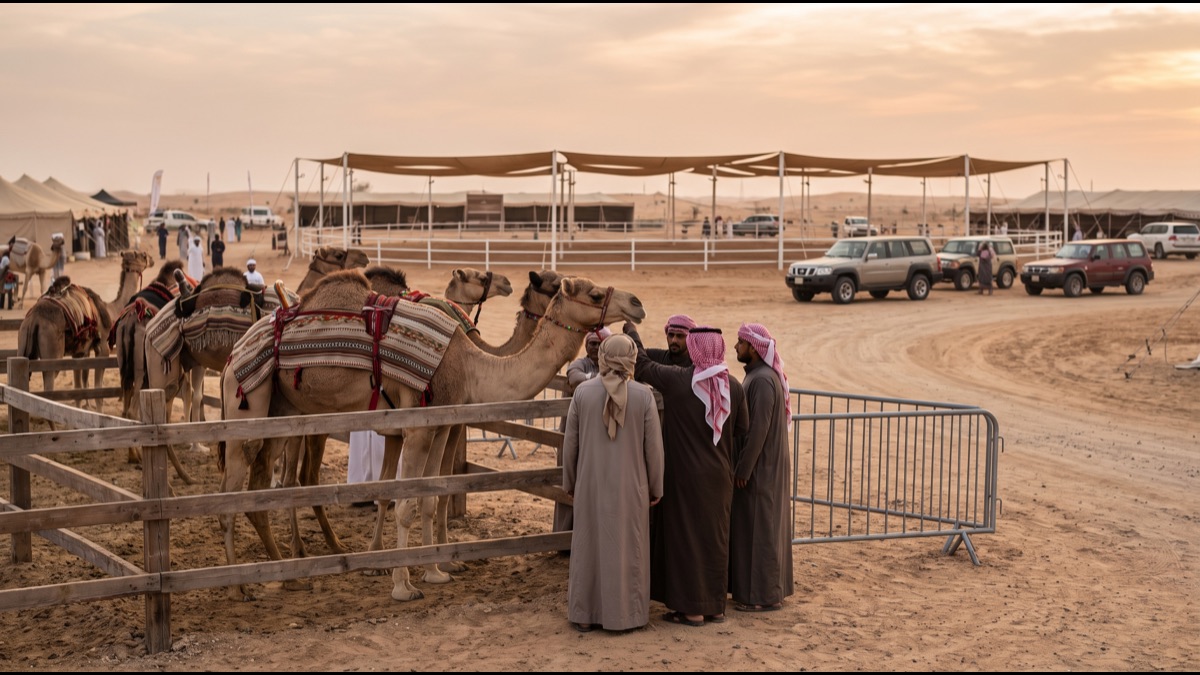
Every winter, thousands of camels line up in the Saudi desert to be judged not on speed or milk yield but on the elegant curve of a lip and the proud lift of a neck, competing for prize money that can exceed the value of a luxury apartment. This is the King Abdulaziz Camel Festival, held annually near Riyadh, and it has grown from a regional Bedouin gathering into one of the richest livestock competitions on earth, complete with genuine scandals, veterinary forensics, and a prize structure that rivals major international sporting events.
Understanding how the festival's judging, prize money, and enforcement actually work reveals a surprisingly sophisticated institution sitting underneath what outsiders often dismiss as a novelty, one that has become central to how Saudi Arabia preserves and monetizes a cultural tradition stretching back centuries while packaging it for a rapidly growing tourism sector.
What the Festival Actually Is
The King Abdulaziz Camel Festival is an annual event held in a purpose-built site outside Riyadh, combining beauty pageant competitions, camel racing, an extensive trading market, and cultural programming into a single multi-week gathering that draws breeders and spectators from across the Gulf and beyond.
Named after the Kingdom's founding monarch, the festival was established specifically to formalize and celebrate camel culture at a moment when rapid urbanization threatened to erode traditional Bedouin knowledge and practice, giving breeders a structured, prestigious venue to showcase animals that had previously been judged only informally within tribal and family circles.
What distinguishes this event from a typical agricultural fair is scale: the festival routinely attracts tens of thousands of competing camels across dozens of breed and color categories, supported by an organizing body responsible for judging standards, veterinary oversight, and the enormous logistics of housing and displaying that many animals over several weeks.
How It Grew Into a Global Spectacle
Camel beauty competitions existed informally across Bedouin communities for generations before the festival's modern formalization, typically as smaller gatherings where tribal elders and experienced breeders would informally rank animals during trading seasons rather than through any codified scoring system.
The transformation into a major national event tracked closely with Saudi Arabia's broader tourism and heritage strategy, as organizers recognized that camel culture offered a genuinely distinctive, non-replicable attraction that could not simply be copied by a competing destination the way a theme park or a shopping mall could be.
International media coverage, particularly following high-profile disqualification scandals, dramatically expanded global awareness of the event, turning what had been a primarily regional gathering into a subject of curiosity and reporting for audiences with no prior exposure to Gulf camel culture whatsoever.
What Judges Actually Look For
Camel beauty judging assesses a specific set of physical characteristics that differ meaningfully from what a casual observer might expect, focusing heavily on the shape and droop of the lips, the elegance of the neck's curve, the position and symmetry of the hump, and the overall proportion between head, neck, and body.
Different categories exist for different breeds and coat colors, since a black Majaheem camel and a cream-colored Sofor camel are judged against entirely separate aesthetic standards specific to their type, meaning a camel is never simply ranked against the entire field but rather within its own defined category.
Judges, typically experienced breeders themselves with decades of hands-on camel-rearing experience, are trained to detect the subtle physical markers that separate a merely healthy animal from one considered exceptionally beautiful by the specific aesthetic vocabulary that has developed around this tradition over generations.
How the Judging Process Actually Works
Competing camels are led before a judging panel in their designated category, where assessors evaluate the animal both standing and in motion, since posture and gait contribute meaningfully to the overall impression alongside static physical features.
Scoring generally proceeds through a points-based system covering the individually weighted physical criteria, with judges required to reach consensus or submit independent scores that are subsequently averaged, a structure designed to reduce the influence of any single judge's personal preference on the final result.
Finalists in each category typically progress through multiple judging rounds spread across the festival's duration, narrowing a very large initial field down to the handful of animals that ultimately compete for the top prizes in their specific breed and color division.
Why Camel Botox Became a Scandal
In a widely reported episode, festival organizers disqualified dozens of camels after veterinary inspection revealed that breeders had used cosmetic injections, popularly described as camel Botox, along with other physical alterations to manipulate lip shape, facial contour, and other judged features in an attempt to gain an artificial scoring advantage.
The scandal genuinely embarrassed the festival's organizing committee, since it undermined the fundamental premise of a competition meant to celebrate natural, selectively bred beauty rather than cosmetically engineered appearance, and it prompted a serious tightening of veterinary screening procedures in subsequent years.
Beyond reputational damage, the episode highlighted just how much money was genuinely at stake in the competition, since breeders would not have risked exposure and permanent disqualification through such an obvious manipulation unless the financial incentive to win had grown substantial enough to justify the gamble.
The disqualified owners came from across the competing Gulf states, suggesting the practice was not isolated to any single national breeding community but had instead spread as a genuinely shared response to the same escalating financial pressure facing serious competitors throughout the region's camel-breeding circuit.
How Cheating Detection Works Now
Following the cosmetic manipulation scandal, organizers introduced mandatory veterinary screening for all competing animals, specifically designed to detect injected fillers, surgical alteration, and other artificial modifications before an animal is permitted to compete in any judged category.
Veterinary teams now examine facial tissue for the telltale signs of injection, including specific patterns of swelling and tissue texture that differ meaningfully from a camel's natural anatomy, a screening process that has become a standard, publicly acknowledged part of the festival's official procedure rather than a discreet backstage check.
Disqualification for detected manipulation now carries serious consequences beyond losing that year's competition, including potential multi-year bans from future festivals, a deterrent structure organizers introduced specifically to protect the long-term credibility of the competition after the scandal's considerable reputational cost.
What the Prize Money Actually Looks Like
Total prize money distributed across the festival's beauty and racing competitions has grown into the tens of millions of dollars, a figure that places it among the richest livestock competitions anywhere in the world, comparable in scale to major purses in international thoroughbred horse racing.
Top individual beauty categories alone can offer prizes running into seven figures for a single winning animal, a sum that explains both the intensity of competition among serious breeders and, historically, the temptation that led some to attempt the cosmetic manipulation the scandal exposed.
Beyond direct prize money, victory carries substantial secondary financial value through breeding rights and resale value, since a camel with a documented championship pedigree commands dramatically higher prices in subsequent private sales than an otherwise comparable but unrecognized animal.
How Breeders Prepare Camels for Competition
Serious competitive breeding operations invest years of selective pairing to develop camels with the specific physical traits judges reward, applying essentially the same principle of deliberate selective breeding used in competitive dog or horse breeding, but calibrated to the particular aesthetic standards this tradition has developed.
In the weeks before competition, animals undergo intensive grooming and conditioning regimens, including specific dietary adjustments intended to achieve the coat condition and physical presentation judges favor, a legitimate preparation process that exists alongside, and is now clearly distinguished from, the illegitimate cosmetic manipulation the scandal exposed.
Handlers also train camels specifically for the presentation ring, since an animal's comfort and composure while being led and displayed before judges and a large crowd genuinely affects how favorably its physical features are perceived during the brief window of actual evaluation.
Why Camels Matter Culturally Beyond the Pageant
Camels occupy a uniquely central place in traditional Bedouin culture, having historically provided transportation, milk, meat, wool, and a critical means of surviving and navigating the desert environment long before the festival existed to celebrate them competitively.
The festival deliberately incorporates this broader cultural context, including poetry recitals, traditional dress displays, and heritage exhibitions alongside the competitive events, positioning the pageant as one visible expression of a much deeper cultural relationship rather than a standalone novelty spectacle.
For many Saudi families with generational ties to camel herding, the festival functions as a genuine reunion and knowledge-transmission event, where younger family members learn breeding and handling practices directly from elders in a context the wider public rarely witnesses firsthand.
How the Festival Fits Saudi Tourism Strategy
The festival has become a deliberate component of Saudi Arabia's broader tourism diversification strategy, offered as an authentic cultural experience distinct from the megaproject-driven attractions more commonly associated with the Kingdom's tourism push under Vision 2030.
Organizers have progressively added visitor-facing infrastructure, including expanded public viewing areas, food and retail zones, and clearer event programming aimed at international tourists rather than exclusively at the breeding and trading community that originally sustained the event.
Tourism officials have specifically cited the festival's global media attention, however controversial some of that coverage has been, as evidence that heritage-based events can generate international interest without requiring the enormous capital investment associated with the Kingdom's larger giga-projects.
What Other Events Happen During the Festival
Alongside the beauty pageant, the festival hosts extensive camel racing competitions with their own separate prize structures, drawing a distinct but overlapping community of owners and spectators more focused on speed and endurance than aesthetic judging.
A large commercial trading market runs concurrently, where camels change hands in transactions that can range from modest working animals to championship-pedigree specimens commanding prices that attract genuine international financial media attention alongside the cultural coverage.
Cultural programming rounds out the event, including traditional music, poetry competitions, and craft exhibitions specifically curated to showcase Bedouin heritage practices to a visitor base that increasingly includes people with no prior connection to camel culture whatsoever.
How International Attention Changed the Event
Global media coverage, particularly of the Botox scandal, introduced the festival to audiences who had never previously encountered the concept of a competitive camel beauty pageant, generating a mixture of genuine fascination and occasional mockery in international coverage.
Organizers have generally responded to this attention by leaning into transparency around the anti-cheating measures introduced after the scandal, treating the enforcement story itself as evidence of the competition's integrity rather than attempting to minimize or avoid the topic in official communications.
The festival's international profile has also attracted interest from breeders and cultural observers in other camel-rearing regions, including parts of North Africa and Central Asia, feeding a modest but genuine cross-border exchange of breeding knowledge and competitive interest that did not previously exist at this scale.
How the Festival Handles Its Logistics at Scale
Housing and displaying tens of thousands of camels over several weeks requires infrastructure most agricultural events never need to consider, including purpose-built holding pens organized by category, dedicated veterinary facilities capable of examining large numbers of animals daily, and a water and feed supply chain sized for a temporary population the size of a small city.
Traffic and crowd management have become increasingly significant logistical challenges as public attendance has grown alongside the trading and breeding community the festival originally served, requiring organizers to develop parking, shuttle, and viewing-area infrastructure that did not exist in the event's earlier, smaller iterations.
Security and animal welfare monitoring run in parallel throughout the event, since an operation involving this many valuable animals in close proximity to large public crowds carries genuine risk that organizers have had to professionalize considerably as both the festival's scale and its prize values have grown, with dedicated response teams now on standby for the entire duration rather than the informal arrangements the earliest editions relied upon.
The King Abdulaziz Camel Festival ultimately functions as far more than the viral pageant headlines suggest, operating as a serious economic institution with real veterinary science, meaningful enforcement infrastructure, and prize money substantial enough to shape breeding decisions made years in advance of any given competition.
Its evolution from an informal tribal practice into a globally reported, professionally judged institution mirrors a broader pattern across Saudi heritage tourism, where deeply traditional cultural practices are being formalized, monetized, and presented to international audiences without entirely losing the community relationships that originally sustained them.
Whether the festival can continue expanding its international visitor base while preserving the trust and participation of the multigenerational breeding families who built its reputation in the first place remains an open question, one that will likely shape how the event is run, judged, and marketed for years to come, and one that organizers appear acutely aware of every time they announce a new round of visitor-facing changes.
Sources
- Saudi Press Agency — official coverage of the King Abdulaziz Camel Festival and its results
- Reuters — international reporting on the camel Botox disqualification scandal
- BBC — coverage of camel beauty pageant culture and Gulf breeding traditions
- Visit Saudi — official tourism information on the festival and its programming
FAQ
What is the King Abdulaziz Camel Festival?
It is an annual Saudi festival near Riyadh centered on a camel beauty pageant and racing competitions, drawing breeders from across the Gulf and offering enormous prize purses.
What do judges actually look for in a beautiful camel?
Judges assess head shape, lip curve, neck posture, hump position, and overall proportion, with different criteria applied to different camel breeds and color categories.
Why were camels disqualified for Botox?
Dozens of camels were disqualified after organizers found breeders had used Botox and other cosmetic injections to alter lip and facial shape to win higher scores.
How much prize money is actually available?
Total prize money across the festival has run into the tens of millions of dollars, with top individual beauty categories alone offering seven-figure purses.
Can foreigners attend the festival?
Yes, the festival is open to the public and has increasingly promoted itself as a tourist attraction alongside its role as a serious breeding and trading event.
About the Author
We reference the Saudi Press Agency, Reuters, BBC, and Visit Saudi to explain the background and current understanding of this topic.
Loved This Article?
Share it on WhatsApp → Share it on WhatsApp
Get more guides in your inbox — Subscribe to our newsletter for weekly surprising stories from Egypt, Saudi Arabia, Dubai, and beyond.