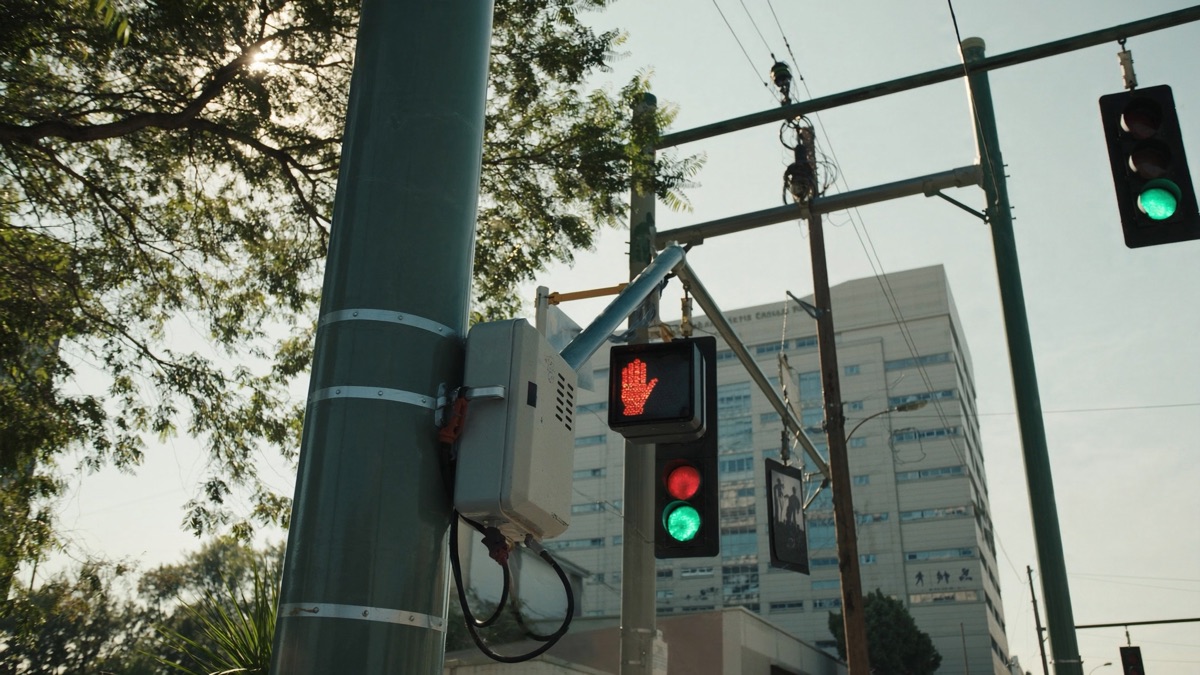
A red light that feels random or unfairly long is often not running on a simple fixed timer at all; a large share of modern traffic signals actively adjust their timing in real time based on sensors detecting exactly how much traffic is actually present in each direction. Understanding the layered system behind that decision, from buried road sensors to city-wide coordination software, explains both why wait times vary so much by time of day and why two seemingly identical intersections can behave completely differently.
Traffic engineers broadly divide signal control into two categories: fixed-time systems that follow a pre-programmed schedule regardless of actual traffic, and actuated or adaptive systems that respond dynamically to real-time conditions, and most busy urban intersections today use some version of the second approach.
Inductive Loop Sensors Buried in the Road
Many intersections have inductive loop sensors, coils of wire embedded just beneath the pavement surface, that detect a vehicle's presence through the metal in its body disrupting the loop's electromagnetic field, essentially the same underlying principle used in a metal detector.
These loops are strategically placed to detect not just whether any car is waiting, but often how many, allowing the signal controller to extend a green light for a lane with a long queue rather than switching on a fixed schedule regardless of how many vehicles are actually waiting.
Camera-Based Detection Is Increasingly Replacing Buried Loops
Newer intersections increasingly use overhead cameras with computer-vision software instead of buried loops, since cameras can be installed and adjusted without tearing up pavement and can additionally detect cyclists and pedestrians, not just vehicles with sufficient metal mass to trigger a loop.
This camera-based approach also allows a single intersection to be reconfigured for new lane patterns or turning restrictions purely through software changes, something a buried physical loop sensor cannot easily accommodate once installed.
How the Controller Actually Makes a Timing Decision
At the core of an actuated intersection sits a traffic signal controller, a specialized computer that continuously receives sensor input and applies a programmed logic set, deciding in real time whether to extend a current green phase, cut it short, or hold on the next scheduled change.
This logic typically includes minimum and maximum green-time limits for every direction specifically to guarantee fairness, preventing a heavy-traffic direction from monopolizing green time indefinitely while a cross-street direction sits at red far longer than acceptable.
Why Pedestrian Crossing Buttons Sometimes Do Nothing Visible
At many intersections, particularly during busy periods, a pedestrian signal is already programmed to activate automatically within the normal cycle regardless of whether the button is pressed, which is why pressing an already-active button often produces no noticeable change, despite the button genuinely working correctly.
During off-peak periods at the same intersection, however, that same button can be the only mechanism triggering a pedestrian phase at all, meaning its actual functional importance varies significantly by time of day even though its physical behavior looks identical to a pedestrian pressing it.
Signal Coordination Along a Corridor
On busy arterial roads, neighboring traffic lights are frequently coordinated through a "green wave" timing pattern, deliberately offsetting when each light turns green so a vehicle traveling at the road's target speed can pass through several consecutive intersections without stopping.
This coordination requires accurate timing calculations based on the specific distance between intersections and the intended travel speed, and it is precisely why driving noticeably faster or slower than a corridor's designed speed can cause a driver to hit every single red light instead of the intended green wave.
City-Wide Adaptive Traffic Management Systems
Larger cities increasingly deploy centralized adaptive traffic management systems that monitor an entire network of intersections simultaneously, using aggregated sensor data to adjust timing across multiple signals in response to citywide congestion patterns, accidents, or major events rather than optimizing each intersection in isolation.
This network-level optimization can meaningfully reduce overall city travel time even when it occasionally means a single specific intersection holds a slightly longer red light than it would under purely local, isolated control, because the system is deliberately balancing total network throughput rather than any one intersection's individual performance.
Emergency Vehicle Preemption
Many intersections include emergency vehicle preemption systems that detect an approaching ambulance or fire truck, typically through a signal emitted from the emergency vehicle itself, and automatically switch the relevant approach to green well ahead of the vehicle's actual arrival.
This preemption logic overrides normal actuated or fixed timing entirely for the duration of the emergency vehicle's passage, then returns the intersection to its regular operating logic immediately afterward, a genuinely different control mode layered on top of everyday signal timing.
Why All-Red Clearance Intervals Exist
Between one direction's green ending and the crossing direction's green beginning, most signals include a brief all-red interval during which every approach shows red simultaneously, specifically to let vehicles that entered the intersection legally during a yellow light clear it before conflicting traffic gets a green.
This short but genuinely critical safety buffer is calculated based on intersection size and typical vehicle speed, and it is one of the primary reasons intersection accidents caused by red-light running are less common than they would be without it.
Fixed-Time Signals Still Exist and Serve a Purpose
Despite the trend toward adaptive systems, fixed-time signals remain common in areas with consistently predictable, evenly balanced traffic patterns, since the added cost and complexity of sensors and adaptive logic offers little genuine benefit when traffic volume does not meaningfully fluctuate throughout the day.
Traffic engineers generally reserve adaptive investment for locations with genuinely variable demand, since a fixed-time signal is simpler to maintain and, in a genuinely low-variability location, performs nearly as well as a more expensive adaptive system would.
What Actually Determines a "Fair" Wait Time
Traffic engineers use metrics like average vehicle delay and total intersection throughput, rather than any single driver's individual wait time, to judge whether a given timing plan is performing well, meaning an individual driver's frustratingly long red light can still reflect a mathematically optimal overall timing plan for the intersection as a whole.
This distinction between individual experience and aggregate system performance is a genuine and recurring source of public frustration with traffic signal timing, since a plan optimized for total citywide efficiency will inevitably produce some individually long waits even while reducing average delay across all drivers combined.
How Signal Timing Data Feeds Back Into Urban Planning
Modern traffic controllers don't just execute a timing plan, they log every detection event, phase change, and pedestrian call, generating a continuous stream of intersection-level data that city traffic engineering departments feed into longer-range planning decisions well beyond the signal itself, from where to add a dedicated turn lane to which corridor most urgently needs a protected bike lane redesign.
This logged data is what actually justifies (or rules out) capital projects, since a proposal to rebuild an intersection or retime an entire corridor needs defensible before-and-after volume and delay numbers, not just anecdotal complaints about a bad light, and a properly instrumented signal quietly accumulates exactly that evidence every single day it operates.
Aggregated anonymized volume data from signal controllers, and increasingly from connected-vehicle and smartphone probe data blended alongside it, is also what feeds regional travel-demand models, the same models transportation authorities use to forecast whether a proposed new development or highway interchange will overload the surrounding street grid, making an individual traffic light one small sensor in a much larger regional planning instrument.
Some cities now publish this intersection performance data publicly through open-data portals, letting researchers, journalists, and residents independently analyze whether a given signal retiming project actually reduced delay as promised, a level of transparency that was effectively impossible before digital controllers replaced purely mechanical and electromechanical signal timers.
Why Countries Use Different Signal Sequences and Countdown Conventions
The familiar red-yellow-green sequence is close to universal, but the transition conventions around it vary meaningfully by country: many European countries briefly show red and yellow together immediately before green, a signal to drivers to prepare to move that most North American and Gulf-region signals simply omit, going straight from red to green with no warning phase at all.
Pedestrian countdown timers, now standard at most signalized crossings in the UAE, Saudi Arabia, and much of the developed world, were a genuinely significant safety and usability improvement over a plain static walk or don't-walk symbol, since they let a pedestrian already partway across make an informed decision about whether to continue or wait, rather than guessing how much time remains before the signal is about to change against them.
Some jurisdictions add an audible signal alongside the visual countdown specifically for pedestrians with visual impairments, a feature mandated by accessibility regulations in many countries and increasingly common at major urban intersections in the Gulf as new signal installations are specified to meet current accessibility standards rather than decades-old minimums.
Flashing-signal conventions differ too: a flashing yellow generally means proceed with caution in most countries that use it, while a flashing red is typically treated as equivalent to a stop sign, but the specific meaning and even the color pairing used for these intermediate states is set by national traffic codes rather than any single global standard, which is part of why the signal-reading habits a driver builds in one country don't always transfer cleanly when driving abroad.
The History Behind the Modern Traffic Signal
The first traffic signal installed anywhere predates the automobile-dominated street it's now associated with by decades, a gas-lit semaphore device installed outside the British Parliament in the 1860s specifically to help pedestrians and horse-drawn carriages cross safely, a device that was withdrawn from use after an explosion involving its gas illumination injured its operator, a genuinely inauspicious start for what would become one of the most ubiquitous pieces of urban infrastructure in the world.
The electric traffic signal as recognizably understood today emerged in early twentieth-century American cities grappling with a rapid and largely unregulated surge in automobile traffic, with several American cities independently claiming credit for early electric signal installations within a few years of one another, a pattern of parallel independent invention common to many transportation technologies of that era.
The three-color system specifically, red for stop, green for go, and yellow as a transitional warning, drew directly on railroad signaling conventions that predated road traffic signals by decades, since railroads had already standardized on red and green to mean stop and proceed well before automobiles existed in meaningful numbers, making the traffic light's color scheme less an original invention and more an adaptation of an already-proven signaling language to a new transportation context.
Early traffic signals were controlled manually by a police officer stationed in a signal tower or booth at the intersection, physically switching the lights based on direct visual observation of traffic buildup, a labor-intensive approach that automated timer-based controllers gradually replaced through the mid-twentieth century, setting the stage for the computerized, sensor-driven systems that now manage the overwhelming majority of signalized intersections in modern cities including across the Gulf region.
What Happens When the Power Goes Out at an Intersection
Most signalized intersections in the Gulf and elsewhere rely on grid power, and a genuine outage, whether from a storm, a construction accident severing a cable, or a broader grid failure, leaves the signal dark unless a backup system is in place, at which point the intersection effectively reverts to the same right-of-way rules that govern an unsignalized crossing, first-come priority with the understanding that drivers must actively negotiate the crossing rather than defer to an automated instruction.
Many high-volume or safety-critical intersections, particularly near hospitals, major highway interchanges, or airports, are fitted with battery backup systems specifically to keep the signal operating through short outages, and some jurisdictions additionally deploy portable generator-powered signal units or station traffic officers to direct traffic manually at especially critical intersections during longer outages.
A blacked-out signal legally defaults to all-way stop rules in most jurisdictions that address the scenario explicitly, meaning every approach must treat the intersection as though stop signs were posted in all directions, though in practice this default is inconsistently understood by drivers, which is a genuine part of why extended signal outages at busy intersections are treated as a priority repair dispatch rather than a routine maintenance ticket.
Some navigation app providers now surface live alerts for known malfunctioning signalized intersections directly within their apps, drawing on aggregated user reports and data feeds from local transport authorities, giving drivers advance warning before actually reaching a dead signal rather than discovering the problem abruptly at the stop line itself.
Sources
- Federal Highway Administration — traffic signal timing and adaptive traffic control system guidance
- Wikipedia — overview of signal timing, actuated control, and coordination systems
- Institute of Transportation Engineers — traffic engineering standards for signal timing and intersection design
FAQ
Are all traffic lights on a fixed timer?
No; a large share of modern signals use sensors, either buried loops or overhead cameras, to actively adjust timing in real time based on actual traffic present in each direction.
Why does pressing a pedestrian crossing button sometimes seem to do nothing?
During busy periods, the pedestrian phase is often already programmed into the normal cycle regardless of the button, so pressing it produces no visible change even though it is working correctly.
What is a "green wave" and why does driving at a certain speed matter?
It is a coordinated timing pattern where consecutive lights turn green in sequence for vehicles traveling at the road's intended speed; driving faster or slower than that speed can cause a driver to hit red lights instead.
How do emergency vehicles get traffic lights to turn green?
Preemption systems detect a signal emitted from an approaching ambulance or fire truck and automatically switch the relevant approach to green ahead of its arrival, overriding normal timing temporarily.
Why is there sometimes a moment where every direction shows red?
An all-red clearance interval lets vehicles that legally entered on yellow clear the intersection before conflicting traffic gets a green, reducing red-light-running collisions.
Why does my specific intersection still feel unfairly slow?
Traffic engineers optimize for citywide average delay and total throughput rather than any single driver's wait, so an individually long wait can still reflect a mathematically well-optimized overall timing plan.
About the Author
We reference Wikipedia and other authoritative sources to explain the background and current understanding of this topic.
Loved This Article?
Share it on WhatsApp → Share it on WhatsApp
Get more guides in your inbox — Subscribe to our newsletter for weekly surprising stories from Egypt, Saudi Arabia, Dubai, and beyond.