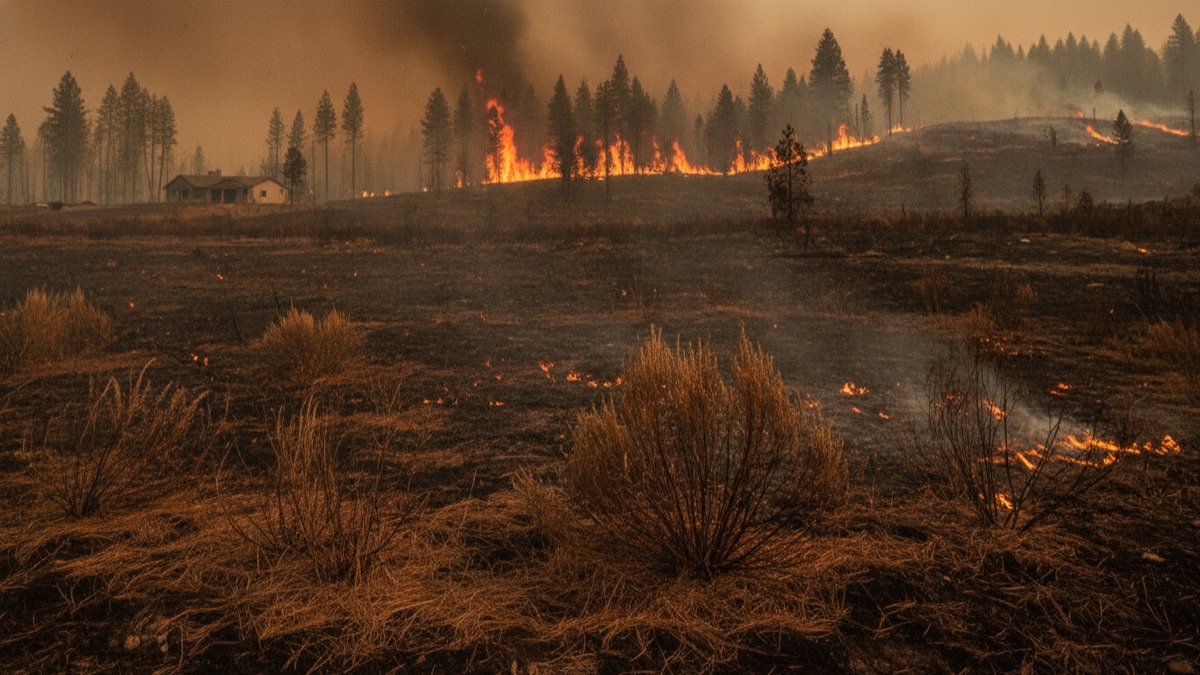
Wood does not actually burn. Heat drives volatile gases out of the solid material, and it is those gases that ignite. Everything about fire behaviour follows from this, including why moisture matters more than fuel quantity and why fires accelerate uphill.
The other counterintuitive findings are that a century of suppressing fires made them worse rather than rarer, and that most houses lost in wildfires are ignited by embers landing in gutters and vents rather than by an advancing wall of flame. Understanding the actual mechanism explains both why fires behave as they do and why the practical responses look nothing like extinguishing them faster.
What Actually Burns in a Wildfire
Wood does not burn directly, since heat first drives off volatile gases from the solid material and it is those gases that ignite and produce flame.
This is why fuel moisture matters so much, as water must be evaporated before the material reaches the temperature at which gases are released.
Fine material such as grass, needles and small twigs releases gas quickly and carries fire fastest, while large logs contribute heat and duration rather than spread.
Why Fuel Moisture Governs Everything
Fire behaviour depends more on how dry the vegetation is than on how much of it exists, since damp fuel absorbs energy rather than contributing it.
Fine fuels respond to humidity within hours, which is why fire danger can change dramatically over the course of a single afternoon.
Larger material responds over weeks or months, which means a long drought raises risk in a way that a few dry days cannot.
How Fire Spreads Through Radiation and Contact
A flame heats the fuel ahead of it by radiation and by direct contact with hot gases, raising it to ignition temperature before the flame arrives.
This preheating is why fire moves as a continuous front rather than igniting each piece of fuel independently when flames reach it.
Anything that increases contact between flame and unburnt fuel accelerates spread, which is the underlying reason slope and wind matter as much as they do.
Why Slope Accelerates Fire So Dramatically
Flames lean toward rising ground because hot gases move upward, which brings them into contact with fuel further ahead than on flat terrain.
This preheats uphill fuel far more effectively, and rates of spread roughly double for each significant increase in slope angle.
It is the reason fires run uphill far faster than people can, and why being above a fire on a slope is among the most dangerous positions possible.
What Wind Does to a Fire
Wind tilts the flame forward, increasing radiant heating of unburnt fuel, and simultaneously supplies oxygen that raises combustion intensity.
It also carries burning material ahead of the main front, starting new fires that then grow and merge, which is how fires cross barriers.
A change in wind direction converts a narrow flank into a wide head, which can multiply the active fire front within minutes and is the most common cause of entrapment.
Why Spotting Makes Containment So Hard
Burning embers lifted by convection can travel considerable distances before landing, and a single ember reaching receptive fuel starts a new fire.
This is why firebreaks, roads and even rivers frequently fail to stop a running fire, since the fire does not need to cross them on the ground.
Long-distance spotting is a defining feature of extreme fire behaviour, and it makes prediction far harder because ignition points become effectively random.
How Fire Creates Its Own Weather
Large fires generate enormous convection columns, drawing air inward at the surface and producing winds independent of the prevailing weather.
When the column rises high enough, moisture within it condenses into a cloud that can develop into a thunderstorm above the fire.
These storms produce erratic downdrafts and lightning, which can start fires far ahead of the front and make behaviour effectively unpredictable.
Why Some Ecosystems Require Fire
Many vegetation types evolved with regular fire and depend on it, with some species holding seed in cones that open only when heated.
Frequent low-intensity fire historically consumed accumulated material, keeping fuel loads low and preventing the intense fires that kill mature trees.
Excluding fire from these systems does not remove fire but postpones it, allowing fuel to accumulate until the eventual fire is far more severe.
What Fire Suppression Actually Changed
A century of extinguishing fires as quickly as possible produced landscapes carrying far more fuel than they historically did.
This changed the character of fire rather than its frequency, converting regular manageable burns into infrequent extreme events.
The pattern is now widely recognised, and the debate concerns how to reintroduce fire safely rather than whether suppression alone can work.
How Prescribed Burning Works
Deliberate burning under chosen conditions consumes fuel when weather makes fire controllable, reducing what is available when conditions are dangerous.
Windows for safe burning are narrow, requiring specific combinations of moisture, wind and temperature, and they are shrinking as climate changes.
Smoke and escape risk make it politically difficult, since a prescribed burn that escapes attracts far more attention than the far larger fire it might have prevented.
Why Indigenous Fire Practice Is Being Revisited
Many indigenous cultures used frequent small-scale burning to manage landscapes, maintaining conditions that suppressed large fires for millennia.
This practice was interrupted by colonisation and by fire exclusion policies, and the resulting fuel accumulation is now recognised as a contributing factor.
Several jurisdictions have begun formally incorporating traditional burning, which involves different timing and objectives from conventional prescribed burning.
What Climate Change Is Doing
Higher temperatures increase evaporation from vegetation, meaning fuel dries faster and reaches dangerous moisture levels earlier and more often.
Fire seasons have lengthened measurably in many regions, and the number of days with extreme fire weather has risen substantially.
The effect operates through fuel dryness rather than ignition, since most fires are started by people and the change is in how readily they spread.
Why Most Fires Are Started by People
Lightning causes a minority of ignitions in most regions, with the majority resulting from equipment, vehicles, power lines, escaped burns and arson.
Human ignitions occur near where people are, which places them close to property and extends the season beyond periods of lightning activity.
This means ignition prevention is genuinely effective, and several jurisdictions now shut off power lines during extreme conditions specifically to remove that source.
How Fires Destroy Houses
Most homes lost in wildfires are not consumed by a passing flame front but ignited by embers that land in gutters, vents and accumulated debris.
This means survival depends heavily on details of construction and maintenance rather than on the intensity of the fire itself.
Screening vents, clearing gutters, and removing combustible material near walls address the actual mechanism far more effectively than distance from vegetation alone.
Why Defensible Space Works
Clearing vegetation immediately around a structure reduces radiant heat and removes the fuel that would carry flame to the walls.
The zone closest to the building matters most, since material within a few metres determines whether an ember becomes a house fire.
Beyond that, the objective is reducing intensity rather than eliminating fuel, which means thinning and separation rather than complete clearance.
What Firefighters Actually Do
Direct attack on flames is possible only at low intensity, so most work involves building containment lines where fuel is removed ahead of the fire.
Aircraft dropping water and retardant slow a fire rather than extinguish it, buying time for ground crews who do the work that actually contains it.
Retardant works by coating fuel so it will not ignite, which means it is applied ahead of the fire rather than onto flames.
Why Fires Are Fought at Night
Overnight humidity rises and temperature falls, which raises fuel moisture and reduces fire intensity, frequently making direct attack possible.
This diurnal cycle is why containment progress is typically made overnight and why afternoon conditions produce the largest advances by the fire.
Warming nights are eroding this advantage in many regions, with fires increasingly remaining active through darkness rather than settling.
How Evacuation Decisions Are Made
Authorities weigh fire behaviour, road capacity and available time, since evacuating late can be considerably more dangerous than remaining in a prepared structure.
Most wildfire deaths occur during late evacuation, when people are caught in vehicles on roads with fire on both sides.
This is why warnings are issued early and why leaving before conditions deteriorate is emphasised over deciding when the fire becomes visible.
Why Smoke Is a Health Emergency
Wildfire smoke contains fine particles that penetrate deep into the lungs and enter the bloodstream, and it can affect populations hundreds of kilometres away.
Health effects extend well beyond respiratory irritation, with documented increases in cardiac events and hospital admissions during smoke episodes.
This means the population affected by a fire is far larger than the population near it, which is increasingly recognised in public health planning.
What Happens After a Fire
Removing vegetation and altering soil structure leaves slopes vulnerable, and heavy rain on a burnt catchment produces debris flows that can be more destructive than the fire.
These risks persist for years until vegetation re-establishes, which is why post-fire hazard assessment is now a routine part of recovery.
Water supplies are also affected, since ash and sediment entering reservoirs can compromise treatment for extended periods.
How Fires Are Predicted
Models combine weather forecasts, fuel type and moisture, terrain and current fire position to project spread over coming hours.
Accuracy is limited by the same factors that make fire dangerous, particularly spotting and wind changes, which introduce genuine randomness.
Satellite detection has improved enormously, allowing new ignitions to be identified within hours anywhere on the planet, which is most valuable in remote areas.
Why Fire Weather Indices Matter
Composite indices combining temperature, humidity, wind and fuel dryness give a single figure summarising how a fire would behave if started.
These drive operational decisions including pre-positioning crews, restricting activity and issuing warnings, since they anticipate rather than react.
They are more useful than any single measurement because fire behaviour depends on the combination, and dangerous conditions can arise from several different combinations.
What Building Codes Now Require
Regions with high fire risk increasingly mandate ember-resistant vents, non-combustible cladding, and restrictions on materials near structures.
Evidence from post-fire surveys shows these measures substantially raise survival rates, frequently determining why one house stands among many that did not.
The difficulty is existing housing, since codes apply to new construction while most homes at risk were built before any such requirement existed.
What the Problem Actually Is
Wildfire is not an anomaly but a process that most affected landscapes require, and the difficulty arises from where people have built rather than from fire itself.
The area where housing meets vegetation has expanded enormously, which places more property in the path of a process that will continue regardless.
This makes the practical question one of coexistence through building standards, land management and planning, rather than of prevention.
Why Crown Fires Are the Dangerous Kind
Fire moving through surface litter is generally controllable, but if flames reach the tree canopy the fire becomes far more intense and spreads through the treetops.
Ladder fuels, meaning shrubs and low branches that connect the ground to the canopy, are what allow this transition to happen.
Removing ladder fuels is therefore one of the most effective treatments available, since it keeps fire on the ground where crews can work against it.
How Fire Behaves in Grassland
Grass fires spread extremely quickly because fine fuel ignites almost instantly, with rates of advance that can exceed what a person can outrun.
They also burn out quickly and produce less residual heat, which means they are dangerous through speed rather than through intensity or duration.
This is why grassland fires kill people who underestimate them, since the modest flame height gives a misleading impression of how fast the front is moving.
Why Firefighter Shelters Are a Last Resort
Crews carry reflective shelters designed to reflect radiant heat and trap breathable air, deployed only when escape has become impossible.
They protect against radiant heat but not against direct flame contact or superheated gases, which limits survival to specific conditions.
Their existence reflects that entrapment remains possible despite planning, which is why escape routes and safety zones are identified before work begins rather than during it.
What Backburning Achieves
Crews deliberately ignite fuel ahead of an approaching fire so that it burns back toward the front, removing what the main fire would otherwise consume.
When the two meet there is nothing left to burn, which stops advance without requiring the fire to be extinguished directly.
It is effective but risky, since a backburn that escapes creates a second fire, which is why it is used when other options have already failed.
How Fire Affects Soil and Water
Intense heat can make soil temporarily water-repellent, so rain runs off rather than soaking in, which sharply increases flooding and erosion risk.
Vegetation loss removes both the roots holding slopes together and the canopy that intercepts rainfall before it strikes the ground.
This combination is why the most destructive consequence of a fire frequently arrives months later with the first heavy rainfall.
Why Fire Seasons Now Overlap Hemispheres
Aerial firefighting fleets and specialist crews have historically moved between northern and southern hemispheres, working opposite seasons in each.
Lengthening seasons at both ends have begun eroding the gap, which reduces the availability of shared resources exactly when demand is rising.
This is a practical consequence of climate trends that receives little attention, since it constrains response capacity rather than fire behaviour itself.
What Makes a Fire Uncontrollable
Beyond a certain intensity, measured as heat released per metre of fire front, direct attack becomes impossible and even machinery cannot work safely nearby.
Above that threshold containment depends entirely on weather changing or the fire reaching a break in fuel, which means suppression effort has little effect.
Recognising this early matters, because committing resources to an uncontrollable fire wastes capacity that could protect assets elsewhere.
How Fire Bans Actually Work
Restrictions on outdoor burning, machinery use and vehicle access are triggered by fire danger indices rather than by season, since risk depends on conditions.
They target the ignition sources most common in each jurisdiction, which is why the specific activities restricted differ considerably between regions.
Compliance is a genuine factor in outcomes, since a substantial proportion of destructive fires begin with activity that was already prohibited at the time.
Fire behaviour follows from one fact: solids do not burn, gases do. Heat drives volatile gases out of wood, and those gases ignite. This is why fuel moisture governs everything — water must evaporate before the material gets hot enough to release anything — and why fine material like grass and needles carries fire fastest while logs mainly add duration. It also explains the geometry. Flames lean toward rising ground, preheating uphill fuel far more effectively, which roughly doubles spread rate for each significant increase in slope. Wind does the same thing horizontally while adding oxygen and throwing embers ahead of the front, which is how fires cross rivers and roads that should have stopped them. Large fires generate convection columns strong enough to produce their own thunderstorms, at which point behaviour becomes effectively unpredictable. Two findings run against intuition. A century of extinguishing every fire did not reduce fire; it let fuel accumulate until regular manageable burns became rare extreme ones. And most houses are lost to embers landing in gutters and vents, not to a passing flame front — which means survival depends more on screened vents and cleared gutters than on distance from the trees.
Sources
- Wikipedia — fire behaviour, ecology and suppression history
- US Forest Service — fire behaviour research, fuel management and prescribed burning
- National Institute of Standards and Technology — post-fire structure survival studies and ember ignition research
- World Health Organization — health effects of wildfire smoke exposure
- Nature — research on fire weather trends and climate attribution
FAQ
Why do fires spread faster uphill?
Hot gases rise, so flames lean toward higher ground and preheat fuel further ahead than on flat terrain. Spread rate roughly doubles for each significant increase in slope.
Why don't rivers and roads stop wildfires?
Burning embers lifted by convection travel ahead of the front and start new fires on the far side, so the fire never needs to cross the barrier on the ground.
Did fire suppression make wildfires worse?
It changed their character. Extinguishing every fire let fuel accumulate, converting frequent low-intensity burns into infrequent extreme ones that kill mature trees.
How are most houses actually destroyed?
By embers landing in gutters, vents and debris rather than by the flame front. Screening vents and clearing gutters addresses the real mechanism.
Are wildfires caused by climate change?
Ignition is mostly human. Climate change acts through fuel dryness — higher temperatures dry vegetation faster, lengthening fire seasons and increasing extreme fire weather days.
About the Author
We reference Wikipedia, US Forest Service, National Institute of Standards and Technology, World Health Organization, and Nature to explain the background and current understanding of this topic.
Loved This Article?
Share it on WhatsApp → Share it on WhatsApp
Get more guides in your inbox — Subscribe to our newsletter for weekly surprising stories from Egypt, Saudi Arabia, Dubai, and beyond.