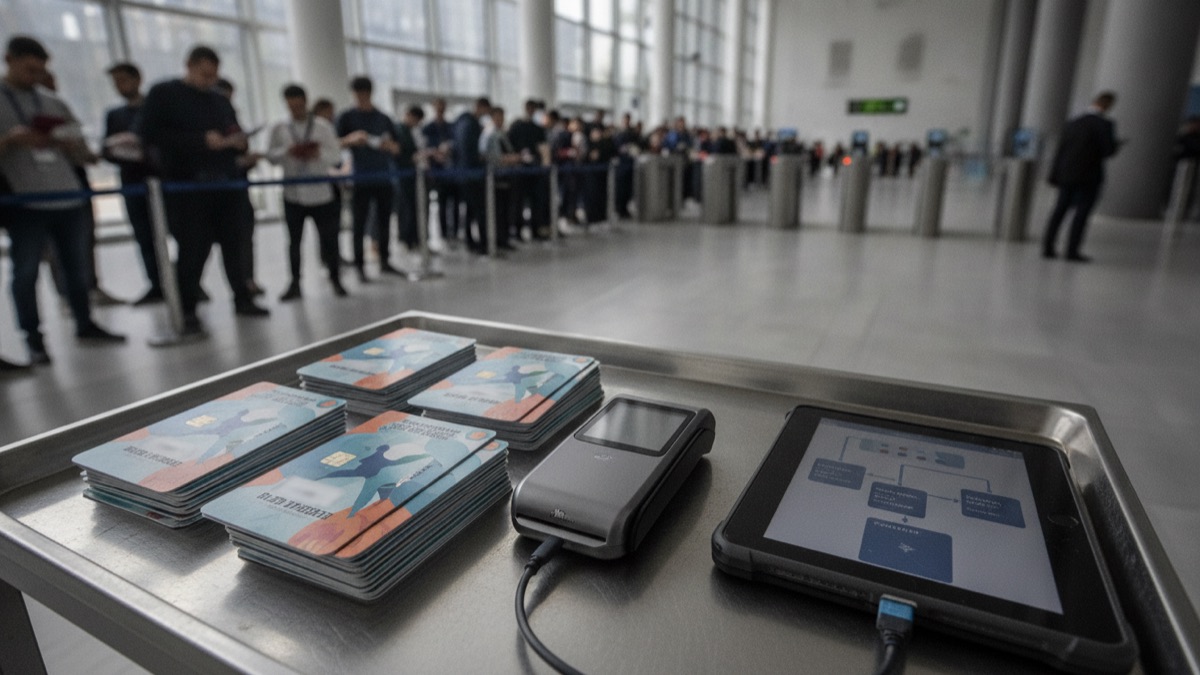
At a growing number of major football tournaments, a valid ticket alone will not get you through the gate. Fans must also complete a separate identity-verification process, commonly branded Fan ID, register personal details, submit to a background screening, and carry a physical or digital credential that stadium staff check independently of the ticket itself.
The system exists to solve a problem tickets alone cannot: a ticket proves someone paid for a seat, but it says nothing about who that person actually is, whether they have a history of stadium violence, or whether they pose a documented security risk. Understanding how Fan ID actually works means separating the registration process, the screening behind it, and the entry technology it ultimately plugs into.
Why a Ticket Alone Is No Longer Enough
Football hooliganism and organised stadium violence have a long, well-documented history, and tournament organisers and host governments have spent decades building tools specifically to keep known troublemakers out of stadiums regardless of whether they can obtain a ticket. A resold or gifted ticket historically made this nearly impossible to enforce, since the person walking through the gate was rarely the person who originally purchased it.
Fan ID closes that gap by tying stadium access to a verified individual identity rather than to a transferable piece of paper or a barcode alone. Even if a ticket changes hands informally, the underlying Fan ID credential is registered to a specific, screened person, which makes it considerably harder for someone on an exclusion list to simply borrow or buy their way past a ticket check.
The comparison to airport security is instructive: a boarding pass alone was never treated as sufficient proof of who is entitled to fly, which is why passport checks exist alongside it. Fan ID applies broadly the same logic to a stadium, treating the ticket as proof of payment and the identity credential as proof of who is actually walking through the gate, two separate questions that a barcode scan alone cannot answer.
What a Fan ID Application Actually Asks For
A typical application requires standard identity documentation, usually a passport, along with a recent photograph, a permanent address, and in many implementations a linked ticket purchase confirmation showing the applicant genuinely holds or intends to hold a ticket for the tournament. Some systems also request additional biometric data such as a facial scan captured during the application process itself.
Processing times vary considerably by host country and by how far in advance of the tournament the application is submitted, and organisers typically warn fans to apply well ahead of matchday, since a rejected or delayed application submitted at the last minute can leave a ticket holder unable to actually attend the match they paid for.
Family and group applications add another layer of complexity, since organisers must decide whether a parent can register a minor under a linked or simplified process, or whether every attendee, regardless of age, must independently complete the full application. Host countries have handled this differently, and the answer meaningfully affects how straightforward it is for a family to attend together.
How Background Screening Actually Works
Once submitted, an application is checked against domestic databases of individuals subject to existing stadium banning orders, and in some tournament editions against international information-sharing arrangements between participating countries' law enforcement and sporting bodies. The specific scope of these checks, and how transparent the process is to applicants, varies significantly by host nation.
This screening step is the part of the system most directly justified on security grounds, since it is intended to catch individuals with a documented history of serious public-order offences connected to football before they ever reach the stadium gate, rather than relying on staff to recognise a known troublemaker in a crowd of tens of thousands.
Screening databases also raise a false-positive problem that host countries handle with varying degrees of transparency: a common name, an outdated record, or a case of mistaken identity can in principle flag an entirely innocent applicant, and the quality of the appeals mechanism available in that scenario is one of the more meaningful practical differences between how well or poorly a given tournament's Fan ID system is regarded by supporter groups afterward.
Why Governments, Not Just FIFA, Are Involved
Fan ID is not simply a FIFA ticketing feature; it is typically implemented jointly with the host country's own government, since it functions as a genuine identity and security instrument that touches immigration, law enforcement, and data-protection authority all at once. This is part of why the exact design and legal basis of a Fan ID scheme differs meaningfully depending on which country is hosting.
In some tournament editions, Fan ID has also doubled as a de facto visa or entry facilitation tool for international visitors, with the credential itself, once approved, easing certain border formalities for ticket holders travelling specifically to attend matches, which further explains why host governments treat it as significantly more than a stadium turnstile convenience.
How Fan ID Ties Into Stadium Entry Technology
On matchday, the Fan ID credential, whether a physical card or a digital pass on a phone, is checked at dedicated turnstiles or scanning points, often alongside or integrated with the ticket scan itself. Some implementations use contactless card readers, others rely on QR-code scanning paired with a facial-verification check against the photograph submitted during registration.
This layered check, ticket plus identity credential plus, in some systems, live facial matching, is considerably more resistant to the kind of ticket fraud and unauthorised resale that a barcode-only system struggles to prevent, though it also requires meaningfully more infrastructure and staffing at every stadium entrance than a conventional ticket check alone.
Staffing a Fan ID-integrated entry point is also a materially larger operation than a conventional ticket gate, since it typically requires additional trained personnel to handle credential verification, resolve edge cases such as a damaged card or a facial-match failure, and manage the queue impact of a multi-step check compared with a single barcode scan, all of which host organisers must budget and plan for well before the tournament opens.
What Happens if an Application Is Rejected
Rejections can occur for security reasons, documentation problems, or mismatches between the application and the associated ticket purchase, and the specific appeals process available to a rejected applicant again depends heavily on the host country's system design. In several past tournament editions, rejected or delayed applications became a genuine point of public controversy, particularly for fans who had already booked travel and accommodation around a match they were ultimately unable to attend.
Because the credential is generally mandatory rather than optional wherever it is deployed rather than an optional convenience layered on top of the ticket itself, a rejected Fan ID application functionally voids the associated ticket for entry purposes even though the ticket itself was validly purchased, which is a meaningfully different consumer experience from a conventional ticketing system where payment alone guarantees entry.
Appeal timelines matter enormously here, since a rejection communicated with weeks to spare leaves genuine room to resolve a documentation error or mistaken-identity flag, while the same rejection delivered days before a match effectively forecloses any practical remedy regardless of how straightforward the underlying issue might have been to fix with more notice.
Why Fan ID Also Functions as a Travel Perk
Beyond security, host organisers have in several tournaments used the Fan ID credential as a mechanism to extend benefits to visiting supporters, most commonly free or discounted access to local public transport on matchdays, as an incentive to register and as a practical way to help move large numbers of visiting fans around a host city without additional ticketing friction.
This dual purpose, part security instrument and part visitor-services credential, is one reason organisers frame Fan ID publicly as much around fan convenience as around risk management, even though the underlying registration and screening process is the same regardless of which framing is emphasised.
The transport-benefit angle also has a genuine logistics purpose beyond goodwill: encouraging Fan ID holders onto free public transit reduces private-vehicle traffic and parking demand around a stadium precinct on matchday, which is a real operational concern for host cities managing tens of thousands of arrivals and departures within a narrow window before and after kickoff.
How Fan ID Fights Ticket Touting
Unauthorised resale of match tickets at inflated prices, commonly called touting or scalping, is a persistent problem for major tournaments, and tying stadium entry to a registered, screened individual identity makes it considerably harder to profitably resell a ticket to an anonymous buyer, since the buyer would also need to successfully register and pass screening under their own identity.
This does not eliminate secondary ticket markets entirely, since official resale platforms integrated with the Fan ID system can still allow legitimate transfers, but it does close off the informal, undocumented resale channel that has historically been hardest for organisers to police.
Official resale platforms integrated with a Fan ID system typically require the outgoing and incoming holder to both complete identity verification before a transfer is finalised, which adds friction compared with an anonymous paper-ticket handoff but is precisely the friction organisers intend, since it keeps every credential traceable to a screened individual at the moment of stadium entry.
What the Privacy Criticism Actually Argues
Civil liberties organisations and some football supporter groups have consistently raised concerns about Fan ID systems, focused primarily on how much personal and biometric data is collected, how long it is retained after the tournament ends, which government or private entities can access it, and how much discretion authorities have to deny entry without a fully transparent appeals process.
A separate strand of criticism argues that a system originally justified purely as an anti-hooliganism measure can, depending on host-country law, be used more broadly to screen or exclude visitors on grounds unrelated to football violence, a concern that has been raised in the context of several past tournaments and remains a live debate around any new Fan ID deployment.
The same tension appears in debates over facial-recognition-based gate matching specifically, since it introduces a biometric layer that critics argue is meaningfully more invasive than checking a photo ID by eye, even when organisers frame it purely as a faster, more reliable way to confirm a Fan ID holder's identity than manual document inspection at scale.
How Fan ID Differs Between Tournaments and Host Countries
There is no single global Fan ID standard; each hosting nation has generally designed its own implementation within the framework agreed with FIFA, meaning application requirements, screening criteria, appeals processes, and even whether facial recognition is used at the gate can differ meaningfully between one tournament and the next.
This variation makes generic advice about the process difficult to give reliably, and organisers typically direct fans to the official tournament ticketing and Fan ID information for the specific host country rather than relying on experience from a previous tournament, since assumptions carried over from one edition can be genuinely incorrect for the next.
Language and accessibility support for the application process itself is another variable that differs by host country, since a system available only in the host nation's official language, or requiring document uploads in a specific format, can meaningfully disadvantage international travellers less familiar with the local bureaucratic process, an operational detail rarely covered by the security-focused framing organisers typically emphasise.
What Happens to the Data After the Tournament Ends
Data retention policy is one of the least consistently publicised aspects of Fan ID systems, and stated retention periods have varied across past tournaments from a matter of months after the final whistle to considerably longer, depending on host-country data-protection law and the stated law-enforcement justification for keeping records.
Fans concerned about this are generally advised to review the specific privacy policy published for the tournament they are applying to attend, since blanket assumptions about data handling based on a different country's previous implementation are not a reliable guide to how a new host nation will actually manage the information it collects.
Fan ID exists because a paper or digital ticket alone cannot answer the one question stadium security actually cares about: who is this specific person standing at the gate. By tying entry to a verified, screened identity rather than a transferable barcode, host nations gain a genuine tool against both hooliganism and informal ticket touting, while also picking up a convenient mechanism for extending travel perks to legitimate visiting fans.
That capability comes with real trade-offs. Every Fan ID system collects a meaningful amount of personal and sometimes biometric data, gives host authorities discretion over who is allowed to attend, and varies enough between tournaments that fans cannot simply assume the last host country's process will apply to the next one. Understanding both halves of that trade-off, security benefit and privacy cost, is the honest picture of how these systems actually work.
Sources
- Wikipedia — background on football hooliganism and stadium security measures
- FIFA — official tournament ticketing and accreditation policy
- Amnesty International — human rights and privacy analysis of major sporting-event identity systems
- INTERPOL — international cooperation on football-related security information sharing
- European Data Protection Supervisor — guidance on biometric data collection and retention at large public events
FAQ
Is a Fan ID the same thing as a match ticket?
No. A ticket grants the right to attend a specific match, while a Fan ID is a separate identity credential that verifies who is holding that ticket and is often required for entry regardless of ticket ownership.
Does applying for a Fan ID require a background check?
Applicants are typically screened against domestic and sometimes international exclusion lists related to prior stadium banning orders or serious public-order offences, though the exact scope varies by host country and tournament.
Can a Fan ID application be rejected?
Yes, applications can be denied on security or documentation grounds, and in some tournament editions this has been a genuine source of controversy and appeals.
Why do host countries want Fan ID systems instead of just checking tickets?
Fan ID lets organisers verify identity ahead of matchday rather than at the gate, screen for known risks in advance, and in some cases offer holders benefits like free local transport, all of which are harder to manage with ticket checks alone.
Are Fan ID systems controversial?
Yes, particularly around data privacy, how long personal information is retained, and the discretion host authorities have to deny entry, which critics argue can be used more broadly than pure hooliganism prevention.
About the Author
We reference Wikipedia, FIFA, Amnesty International, INTERPOL, and the European Data Protection Supervisor to explain the background and current understanding of this topic.
Loved This Article?
Share it on WhatsApp → Share it on WhatsApp
Get more guides in your inbox — Subscribe to our newsletter for weekly surprising stories from Egypt, Saudi Arabia, Dubai, and beyond.