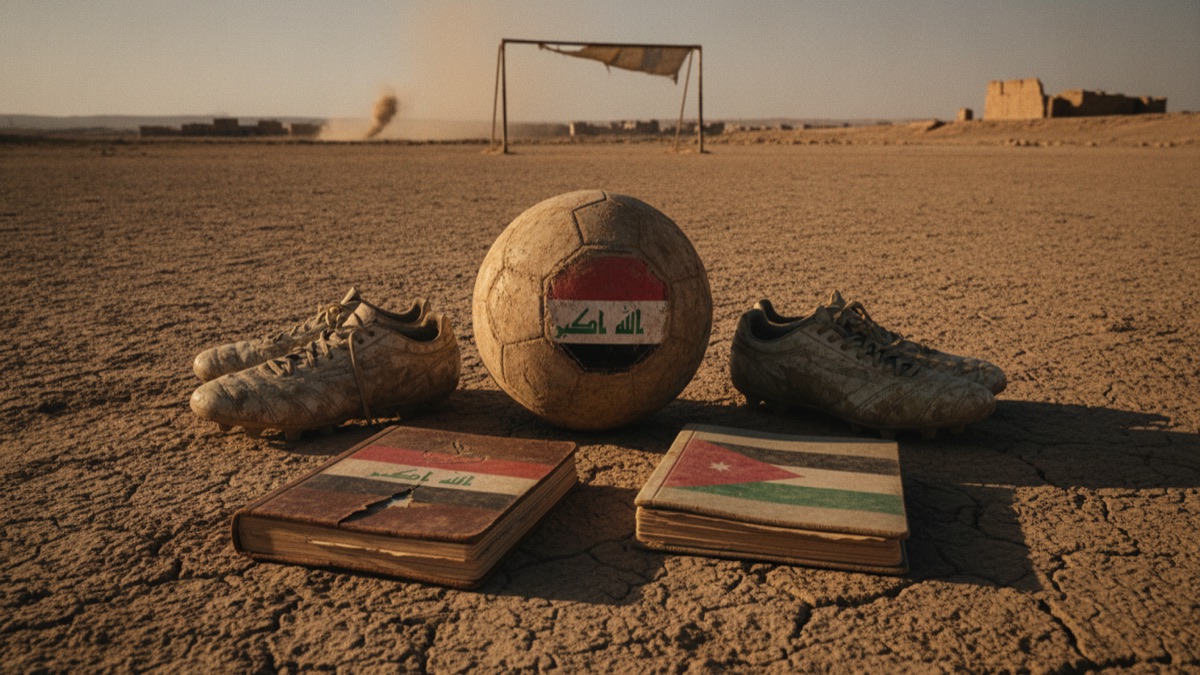
Not every World Cup story is built on star power. Some are built on discipline. For emerging Arab teams like Iraq and Jordan, tournament credibility often starts with shape, effort, and the willingness to make matches difficult rather than dramatic.
That may sound modest, but it is actually one of the clearest routes to respect and results on the biggest stage.
Key Takeaways
- Tournament discipline is a competitive advantage for emerging Arab teams.
- Iraq and Jordan can gain ground through structure and emotional control.
- These teams do not need constant possession to be effective.
- Compactness and selective aggression travel well in World Cup settings.
- Credibility grows when identity stays clear under pressure.
Context and Overview of Emerging-Team Strategy
Emerging teams often face stronger opponents, larger expectations, and thinner margins. The smartest response is not imitation. It is clarity. Iraq and Jordan can become dangerous by reducing chaos, protecting central spaces, and making every attacking moment count.
In tournaments, discipline is not defensive fear. It is competitive intelligence.
Breakdown of What Discipline Gives You
Better Defensive Protection
Good spacing reduces the number of emergencies. Both Iraq and Jordan have shown in recent AFC competitions that well-organized defensive blocks can frustrate more technically gifted opponents. When the distances between midfield and defensive lines are tight, there are fewer gaps for attackers to exploit.
Emotional Stability
Teams that do not panic stay alive longer. The World Cup environment can overwhelm inexperienced teams, leading to rash decisions and tactical disorganization. Iraq and Jordan's emphasis on structure provides a buffer against this emotional volatility.
Clear Attacking Triggers
Selective aggression often produces cleaner chances than constant ambition. Rather than trying to dominate matches, both teams look for specific moments: turnovers in dangerous areas, set pieces, and transitions when opponents are disorganized.
Respect From Opponents
Structured teams force favorites to work harder and think more carefully. Iraq and Jordan may not intimidate opponents on paper, but their defensive organization means that no match is easy.
Tactical Analysis
Understanding the tactical systems that Iraq and Jordan employ helps explain how discipline translates into results.
Iraq's Approach
Iraq typically set up in a compact 4-2-3-1, with the double pivot in midfield providing defensive cover and a platform for quick transitions. The full-backs are usually conservative, staying home to protect the defensive line rather than pushing high. The wide forwards are responsible for stretching the opponent in attack while tracking back to form a midfield bank of five when defending.
Jordan's Approach
Jordan favor a disciplined 4-4-2 or 4-1-4-1, with the central midfielder acting as a screen in front of the back four. Their approach is even more direct than Iraq's, looking to win the ball in midfield and release their forwards quickly. Jordan's success in the 2023 AFC Asian Cup, where they reached the final, was built on this kind of organized, no-frills football.
Common Tactical Themes
Both teams prioritize central compactness, aggressive pressing in the middle third, and quick vertical transitions. They do not try to dominate possession against stronger opponents. Instead, they accept a lower share of the ball and focus on making the most of their moments.
Strengths and Weaknesses
Their strength is defensive organization and collective effort. Their weakness is a lack of individual game-breakers who can create something from nothing. When these teams fall behind, they can struggle to generate sustained pressure because their systems are designed for controlled equilibrium rather than chasing the game.
Historical Context
The past provides important context for what Iraq and Jordan might achieve in 2026.
Iraq's 2007 Asian Cup Triumph
Iraq's 2007 AFC Asian Cup victory remains one of the most remarkable stories in football history. A team drawn from a nation in conflict defeated Saudi Arabia, South Korea, and Australia to lift the trophy. That campaign was built on discipline, unity, and defensive resilience: the same qualities that could serve them well at a World Cup.
Jordan's Steady Rise
Jordan have never qualified for the World Cup before 2026, but their progress in recent years has been clear. Their run to the 2023 AFC Asian Cup final demonstrated that they can compete with the continent's best teams. That tournament was a validation of their patient, methodical approach to development.
Lessons for 2026
Both teams have shown that Arab football can succeed without massive resources. What they need is clarity, commitment, and the ability to perform under pressure. The World Cup is a different level, but the principles are the same.
Pros & Cons of This Model
Pros
- Realistic for emerging teams
- Effective in short tournaments
- Helps reduce damaging mistakes
- Can produce surprise points or wins
Cons
- Requires concentration for long stretches
- Less room for attacking freedom
- Falling behind can disrupt the whole plan
- Public perception may undervalue disciplined football
How To Spot Good Tournament Discipline
Watch Distances Between Players
Connected units usually signal a clear plan.
Notice the Reaction to Pressure
Calm behavior is a major positive indicator.
Observe Attack Selection
Disciplined teams choose moments rather than forcing them.
Judge Endurance
Can the structure survive late stress?
FAQs
Why is discipline so important for Iraq and Jordan?
Because it helps close the gap against deeper or more talented opponents.
Does discipline mean defensive football only?
No. It means controlled football with purposeful risk.
Can disciplined teams still create big moments?
Absolutely. In fact, they often create cleaner moments through patience.
What does success look like for emerging teams?
Competitive performances, tactical clarity, and results that confirm progress.
What tactical systems suit Iraq and Jordan best?
Iraq often use a compact 4-2-3-1, while Jordan favor a disciplined 4-4-2 or 4-1-4-1, both emphasizing defensive shape and quick transitions.
What is the historical context for these teams?
Iraq's 2007 Asian Cup triumph showed their potential, while Jordan's steady rise in regional competitions reflects growing tactical maturity.
Related Resources
- Iraq at World Cup 2026 overview
- Jordan's underdog path at the tournament
- Why compact teams can thrive in group stages
Conclusion
For Iraq and Jordan, World Cup 2026 is not only about talent comparison. It is about whether tournament discipline can become a real weapon. If these teams remain organized, patient, and brave in the right moments, they can prove that structure is one of Arab football's most valuable growth tools.
Sources
This article was reviewed against current tournament context and official competition resources.