What Is Laylat al-Qadr?
Laylat al-Qadr, the Night of Decree (also translated as the Night of Power or Night of Destiny), is the most blessed night of the year in Islam. It is the night on which the Qur'an began to be revealed to the Prophet Muhammad (peace be upon him), delivered in its entirety to the lowest heaven before being revealed to him gradually over the following 23 years.
Allah describes it in the Qur'an as "better than a thousand months" — roughly 83 years. Worship performed on this single night is described as carrying more reward than a lifetime of ordinary devotion, which is why it occupies such a central place in the last third of Ramadan for Muslims worldwide.
The name itself carries layered meaning. Qadr can mean "decree" or "measure," pointing to the belief that the year's decreed affairs are apportioned on this night; it can also mean "honor" or "value," reflecting the night's elevated status; and some scholars connect it to the idea of constriction, noting traditions that describe the earth as crowded with descending angels.
The Night in the Qur'an: Surah Al-Qadr
The night is named directly after a short Meccan chapter, Surah Al-Qadr (Chapter 97), one of the shortest chapters in the Qur'an yet one of the most frequently recited during the last ten nights of Ramadan. It opens by stating that the Qur'an was sent down on this night, then poses a rhetorical question about its significance before answering that it is better than a thousand months.
The chapter goes on to describe the angels and the Spirit (understood by most commentators to refer to the angel Jibril/Gabriel) descending by their Lord's permission with every decree, and concludes by describing the night as peace until the break of dawn. Classical commentators such as Ibn Kathir and al-Tabari read this closing verse as describing a night largely free of harm, in which the customary order of the world is, in a sense, suspended in favor of mercy and safety.
Many Muslims make a point of reciting Surah Al-Qadr repeatedly during the last ten nights, both for its content and because of the virtue traditionally associated with its recitation.
When Does Laylat al-Qadr Occur?
The exact date is not known with certainty, and this uncertainty is itself considered part of the night's wisdom. It falls on one of the odd-numbered nights during the last ten nights of Ramadan: the 21st, 23rd, 25th, 27th, or 29th night, counting from sunset since the Islamic day begins at Maghrib.
Many scholars, drawing on several hadith reports, consider the 27th night of Ramadan the most likely candidate, and it is the night most commonly marked with special congregational programs in mosques across the Muslim world. However, there is genuine scholarly disagreement on this point — some traditions point to the 21st or 23rd, others suggest it could fall on any night in the final third of the month, and a minority of scholars have even argued it may not fall on a fixed night every year. The Prophet (peace be upon him) is reported to have encouraged his companions to seek it throughout all of the last ten nights rather than gamble on a single date, so that no one would miss it by narrowing their search too much.
Because the Islamic calendar is lunar and the start of Ramadan itself depends on moon sighting or astronomical calculation depending on the country, the last ten nights — and therefore the candidate dates for Laylat al-Qadr — can occasionally differ by a day between regions.
Why the Exact Date Is Kept Hidden
Scholars have offered several explanations for why Allah did not reveal the precise date of Laylat al-Qadr, even to the Prophet himself according to some narrations that describe him being reminded of it and then made to forget the exact night. The most commonly cited reason is that the uncertainty encourages sustained devotion rather than a single night of performative worship — a Muslim who wants to be confident of catching Laylat al-Qadr must dedicate the whole of the last ten nights to prayer, reflection, and good deeds.
This mirrors a broader pattern in Islamic practice, where the exact timing of certain blessed moments — the hour of acceptance on Friday, the identity of the most virtuous deed, the specific name among Allah's Beautiful Names that guarantees a prayer's acceptance — is deliberately left unspecified to encourage broad, consistent effort rather than narrow point-seeking.
Some scholars also connect the hidden timing to fairness across different circumstances and time zones. Since Muslims live across the globe and the night falls at different local times depending on longitude, no single fixed clock time could be equally accessible to everyone; framing the reward around a window of nights rather than a single universal moment allows every Muslim, wherever they live, a genuine opportunity to seek it fully within their own last ten nights of Ramadan.
Signs of Laylat al-Qadr
The Prophet described several signs associated with the night, transmitted in authenticated hadith collections. The night is calm and pleasant, neither too hot nor too cold, with a stillness in the air. The sun rises the next morning without its usual strong rays, appearing pale or like a disk one can look at directly, which some scholars explain by the large numbers of angels ascending at dawn after their descent the night before.
Some worshippers describe a subjective sense of tranquility, unusual concentration in prayer, or being moved to tears during supplication on a particular night, and many take this as a personal indication that they may have caught Laylat al-Qadr. Scholars are careful to note that these are personal spiritual experiences rather than definitive proofs, and that a Muslim's focus should remain on sincere worship throughout the last ten nights rather than on trying to positively identify the exact night after the fact.
What Muslims Do on Laylat al-Qadr
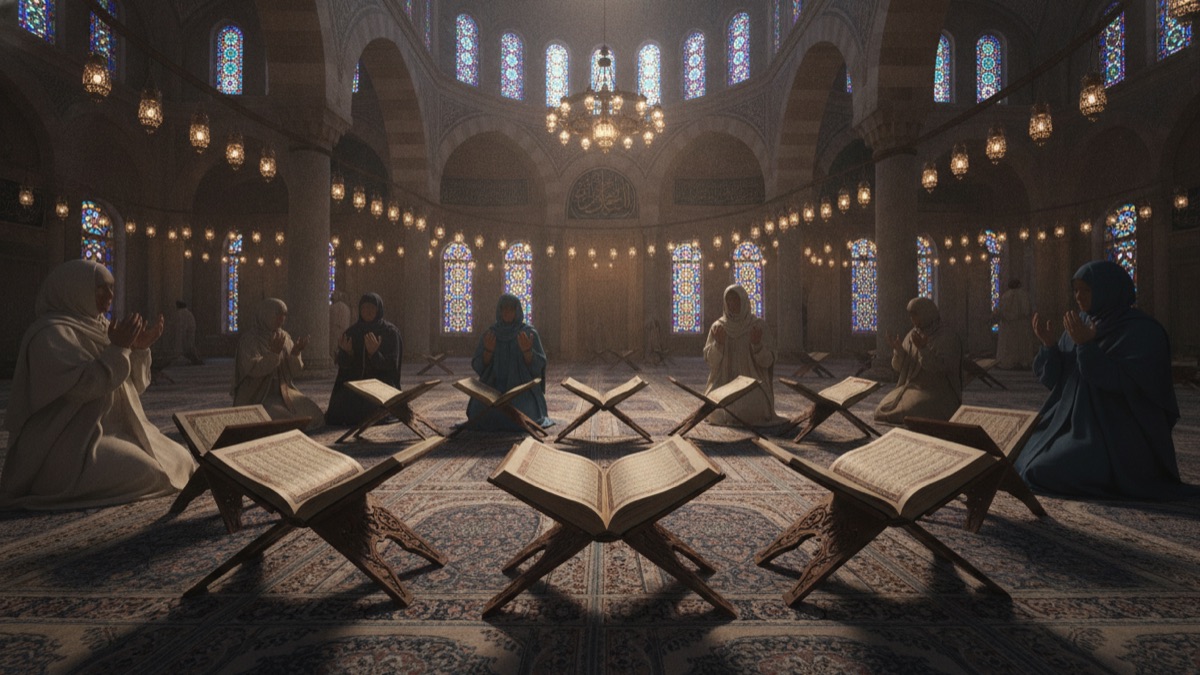
Muslims spend the night, and often much of the last ten nights, in voluntary night prayer (qiyam al-layl), extended Qur'an recitation, dhikr (remembrance of Allah), and dua (supplication). A widely reported hadith records Aisha, the Prophet's wife, asking him what she should say if she realized she was in Laylat al-Qadr; he instructed her to say a specific supplication asking Allah, who is Forgiving and loves forgiveness, to forgive her — a dua many Muslims repeat frequently throughout these nights.
Charity given on this night is especially encouraged, continuing the broader Ramadan emphasis on generosity. Many mosques hold special congregational night prayers (often combined with the regular Tarawih prayers) and extend them significantly on the odd nights, particularly the 27th. Families may stay awake together for much of the night, share the pre-dawn meal (suhoor) as a community, and prepare lists of sincere personal supplications in advance so that no request is forgotten in the moment. Some also use the night to review personal goals for the coming year, reconcile with family members, or settle disputes, treating the decree-focused nature of the night as a natural prompt for reflection and renewal, not only ritual worship.
I'tikaf and the Last Ten Nights
Many Muslims intensify their pursuit of Laylat al-Qadr through i'tikaf, a spiritual retreat in which a person secludes themselves in a mosque for the final ten days and nights of Ramadan, leaving only for essential needs. The practice is modeled directly on the example of the Prophet Muhammad (peace be upon him), who is reported to have observed i'tikaf every Ramadan during his years in Medina.
During i'tikaf, a person's time is devoted almost entirely to prayer, Qur'an recitation, dhikr, and reflection, deliberately withdrawing from worldly distractions to maximize the chance of experiencing Laylat al-Qadr with full presence and sincerity. Because a full ten-day retreat is not practical for everyone, especially those with work or family obligations, many mosques and scholars encourage shorter, partial forms of increased devotion during these nights — extra prayer, reduced screen time, and deliberate reflection — as a scaled-down version of the same spirit.
Laylat al-Qadr Around the Muslim World
Across the UAE, Saudi Arabia, and the wider Gulf, the 27th night of Ramadan in particular draws large congregations. The Grand Mosque in Mecca and the Prophet's Mosque in Medina extend their night prayers considerably, often continuing well past midnight, and these nights are among the most heavily attended of the entire year, with worshippers travelling specifically to perform Umrah and witness the night's prayers in the two holiest sites in Islam.
In the UAE, mosques typically hold extended Tarawih and Qiyam prayers on the anticipated nights, and many community initiatives increase food distribution and charitable giving to coincide with the last ten nights. Public and private sector working hours are also often shortened during this period under UAE Ramadan regulations, giving residents more time for worship in the evenings. Practices vary in detail from country to country and even mosque to mosque, but the underlying focus — increased prayer, charity, and Qur'an recitation concentrated in the last ten nights — is consistent throughout the Muslim world.
In South and Southeast Asia, the night is often called Shab-e-Qadr, and it is common for mosques to host all-night programs combining recitation, lectures, and collective dua. In many West African and North African communities, communal iftars are organized specifically for the odd nights, with proceeds or food often directed toward those in need as a way of combining the night's emphasis on charity with its emphasis on communal worship. Across the diaspora, including in the UK, North America, and Australia, mosques frequently coordinate childcare or family-friendly programming during the last ten nights specifically so that parents are able to attend extended night prayers.
Why the Night Is So Rewarding
On Laylat al-Qadr, according to the Qur'an, the affairs of the coming year are decreed and Allah showers mercy on His servants. The angels descend with the permission of their Lord, and the chapter describing the night concludes that it is peace until the break of dawn.
Because its exact identity is hidden, the mercy associated with the night is available to anyone who sincerely seeks it across the last ten nights, rather than being reserved for those with privileged knowledge of the precise date. This hidden nature is often described by scholars as a built-in lesson in humility, patience, and persistent effort — qualities Ramadan is designed to cultivate more broadly.
Common Misconceptions
Laylat al-Qadr is not a festival with fixed rituals in the way Eid is celebrated; it does not require a specific prayer format, a special sermon, or communal celebration to be valid. It is fundamentally a night of personal devotion, and its value comes from a sincere, private connection with Allah rather than from any particular outward ceremony.
It is also not limited to a specific country, mosque, or scholarly authority declaring it "found." Muslims can seek it at home, in the mosque, while travelling, or wherever they are able to worship — the emphasis in the Prophet's guidance was always on personal effort across the last ten nights, not on locating a single authoritative source that confirms the night has arrived. Another common misconception is that only intense, uninterrupted worship counts; scholars note that even modest, sincere acts — a few extra prayers, a chapter of Qur'an, a moment of honest dua — are valued, particularly for those with real constraints such as work, illness, or caregiving responsibilities.
Practical Ways to Prepare
Many Muslims begin preparing for the last ten nights before Ramadan even reaches its final third — clearing work commitments where possible, planning shorter or lighter meals to preserve energy for night prayer, and setting aside a specific list of duas to recite rather than trying to compose them spontaneously in the moment. Reducing screen time and other everyday distractions in the days leading up to the last ten nights is also commonly recommended, since sustaining focus across several consecutive nights of extra worship is often harder than a single night of enthusiasm.
For those balancing work, school, or caregiving duties, scholars generally advise realistic, sustainable effort over attempting an unsustainable schedule that leads to exhaustion. Praying the extra night prayers for even part of the night, reciting a portion of the Qur'an daily, and keeping a short, sincere list of personal duas are considered valuable even for those who cannot dedicate the entire night or the full ten days to worship.
Frequently Asked Questions
What does Laylat al-Qadr mean?
It means the Night of Decree or Night of Power, referring to the night the Qur'an began to be revealed and the night on which the year's affairs are believed to be decreed.
Which night is Laylat al-Qadr?
The exact night is not certain. It falls on one of the odd nights in the last ten nights of Ramadan, most commonly associated with the 27th, though scholars differ and the Prophet encouraged seeking it throughout all ten nights.
What should I do on Laylat al-Qadr?
Pray extra voluntary prayers, recite Qur'an, make dhikr and dua, give charity, and ask Allah for forgiveness and guidance — ideally sustained across the last ten nights rather than a single night.
Is Laylat al-Qadr only for adults?
No. People of all ages can seek its blessings through age-appropriate worship, and many families involve children in modest ways, such as extra prayers or charitable giving, during these nights.
Can women seek Laylat al-Qadr while menstruating?
Women who are menstruating do not pray the ritual prayer or fast, but they can still make dhikr, dua, give charity, listen to or reflect on the Qur'an, and engage in other permissible forms of worship throughout the night.
What is i'tikaf and do I have to do it to catch Laylat al-Qadr?
I'tikaf is a mosque retreat during the last ten nights modeled on the Prophet's practice, but it is not required to benefit from Laylat al-Qadr — sincere worship at home or wherever one is able also counts.
Is it true the sky or moon looks different on Laylat al-Qadr?
Reported signs relate mainly to a calm night and a pale, weak-rayed sunrise the following morning, rather than any dramatic visible change during the night itself; these signs are also not something to actively search for instead of focusing on worship.
Can Laylat al-Qadr fall on a different night in different countries?
Because Ramadan's start can vary slightly between countries depending on moon sighting or calculation methods, the specific calendar date some communities associate with the 27th night (or other candidate nights) can differ by a day, though the underlying last-ten-nights window is the same.
Related Reading
- What Is Zakat and How to Calculate It
- Hajj: A Complete Guide for Pilgrims
- Umrah: A Step-by-Step Guide
- Fasting in Ramadan: A Health Guide from Medical Sources
- Islamic Finance: A Beginner's Guide
Sources
- Quran.com — Surah Al-Qadr
- Sunnah.com — Hadiths on Laylat al-Qadr
- Islamic Relief — Laylat al-Qadr guide
- Encyclopaedia Britannica — Laylat al-Qadr
- Al-Islam.org — The Night of Decree
About the author: The doyouknow.app editorial team writes clear guides that make complex topics easy. Have a topic idea? Get in touch.
📱 Tell a friend: Share on WhatsApp