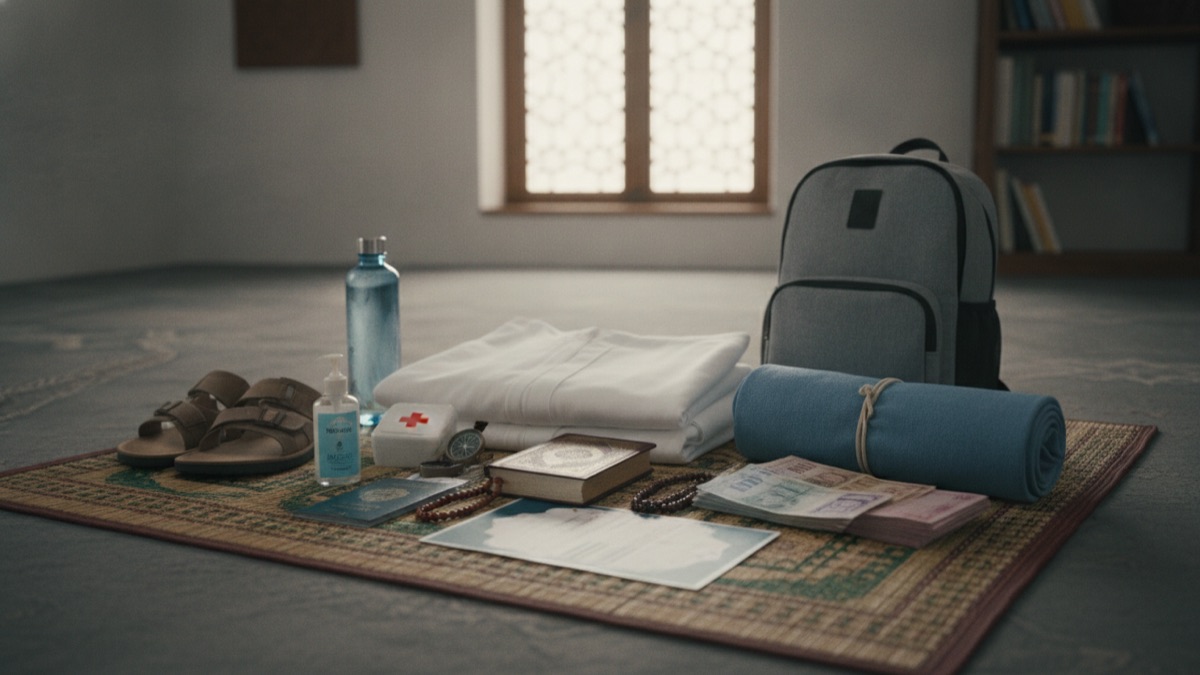
Umrah: A Step-by-Step Guide — Everything You Need to Know Before You Travel
Editorial note: This guide was checked against sources from the Saudi Ministry of Hajj and Umrah and the Nusuk platform on 2026-07-08. Always verify current visa, package, and vaccination conditions through haj.gov.sa and nusuk.sa before travelling.
In 2024, Saudi Arabia received about 16.9 million foreign Umrah pilgrims (Ministry of Hajj and Umrah / Guests of Rahman programme), in addition to more than 1.6 million Hajj pilgrims. This makes Umrah one of the most common spiritual journeys in the world. But how many pilgrims arrive in Makkah knowing the steps of Umrah fully? How many understand the difference between Tawaf and Sa'i, or know when shaving is required and when shortening is permitted? If you are planning Umrah for the first time, or even if you have performed Umrah before and want a comprehensive review, this Umrah guide is for you.
Umrah for beginners may seem complicated. There are new terms: Ihram, Miqat, Talbiyah, and shortening. There are timings: when to start, when to finish, how long each rite takes. And there are rules: what is permitted and what is prohibited in Ihram. But in essence, Umrah is much simpler than Hajj. It is a short journey that can be completed in a few hours, or extended over several days. This flexibility is what makes it attractive to so many people.
In this article we explain how to perform Umrah step by step. We discuss Umrah registration through digital platforms, detail the rites of Umrah clearly, and offer practical tips for every pilgrim — from young people to older adults, from tourists to residents. Umrah in Saudi Arabia today is different from what it was years ago. Registration is digital, transport is smooth, and options have multiplied. But the basics do not change: Ihram, Tawaf, Sa'i, and shaving or shortening the hair. Let us begin.
What Is Umrah?
Umrah is a voluntary journey to Makkah al-Mukarramah. It does not require standing at Arafat, stoning the Jamarat, or spending the night in Mina. It is a visit to the Sacred House to perform specific rites: Ihram, Tawaf, Sa'i, and shaving or shortening the hair. Once these acts are completed, Umrah ends and the pilgrim is released from Ihram. Umrah can be performed at any time of year, except the days of Hajj (8–13 Dhul-Hijjah), when it is preferred that the rites be for Hajj only.
How to Register for Umrah
Umrah registration in Saudi Arabia today is done through the Nusuk platform. The process is easy:
- Create an account on the Nusuk platform or app.
- Enter your personal details and passport information.
- Choose your Umrah date and length of stay.
- Book accommodation and transport (optional through the platform).
- Pay any fees and receive your Umrah permit.
- If you are outside Saudi Arabia, check the electronic visa requirements.
In the past, the pilgrim needed a Hajj agent (wakil). Today you can book everything yourself. But if it is your first time, an agent may be useful for coordinating accommodation and transport. Choose an agent approved by the Ministry of Hajj.
Umrah Steps: From Ihram to Release
Step 1: Ihram
Ihram is the intention and the clothing. The male pilgrim wears two white unstitched cloths; the female pilgrim wears her ordinary modest clothing. The intention: the pilgrim intends Umrah in the heart and says: "Labbayk 'Umrah." It is not necessary to say it loudly. From this point, the restrictions of Ihram begin: cutting hair or nails, using perfume, hunting, and marital relations are not permitted. Eating, drinking, sleeping, and ordinary business dealings are permitted.
The Miqat is the designated place for entering Ihram. It differs according to the direction from which you are coming. From the north (Jordan, Syria): Dhat 'Irq. From the south (Yemen): Yalamlam. From the east (UAE, Oman): Qarn al-Manazil. From the west (Egypt, Sudan): al-Juhfah. If you reach Makkah by air, your Ihram begins at Jeddah or Ta'if airport, but you must make the intention before passing Makkah.
Step 2: Tawaf
Tawaf is circumambulation of the Kaaba seven times. It begins at the Black Stone and the circuits are made anti-clockwise. Each circuit passes the Black Stone, the Yemeni Corner (Rukn al-Yamani), and the Maqam (Maqam Ibrahim). In the first two circuits, men perform al-Raml (brisk walking). The remaining circuits are walked at normal pace. Al-Raml is not required for women, older adults, or the sick.
After each circuit, it is recommended for a man to kiss the Black Stone if he can do so without harm. If crowding is severe, he points towards it and says "Allahu akbar." This is the Sunnah of the Prophet (peace and blessings be upon him). Women do not kiss the stone; they point to it from a distance.
After completing seven circuits, two rak'ahs are prayed behind Maqam Ibrahim if possible. If the place is crowded, they may be prayed anywhere in the Haram. Then the pilgrim drinks Zamzam water and supplicates to Allah.
Step 3: Sa'i
Sa'i is walking seven times between Safa and Marwah. It begins at Safa. In each round, the pilgrim walks from Safa to Marwah, then from Marwah to Safa — these count as two circuits. This is repeated until seven circuits are completed. Sa'i must be performed in the designated path (inside the Makkan Haram or in the areas designated for women).
Between the two green markers (on the wall), men are recommended to run. This is a reminder of what Hajar did when she searched for water for her son Isma'il. Women walk at normal pace.
After completing seven circuits, Sa'i is complete. The pilgrim now goes to complete the final rite of Umrah.
Step 4: Shaving or Shortening
Men shave their heads completely or shorten their hair (shortening from all sides). Shaving is better, but shortening is permissible. Women cut a small portion of their hair (2–3 centimetres). With this, the pilgrim is released from Ihram, and everything that was prohibited becomes permissible. Umrah is now complete.
Umrah Costs: What to Save
The cost of Umrah varies greatly depending on your country, travel date, length of stay, and hotel level. Here is a general estimate:
- Airfare: USD 300–1,500 (depending on distance and season).
- Visa: USD 0–200 (some nationalities are exempt).
- Accommodation: USD 50–300 per day (depending on distance from the Haram).
- Transport: USD 20–100 per day.
- Food: USD 20–50 per day.
- Personal expenses: USD 100–500.
Umrah in Ramadan is much more expensive. Umrah in the low season (Sha'ban, or after Ramadan) is cheaper. Umrah can be completed in 24–48 hours, but many pilgrims stay 5–7 days to visit Madinah al-Munawwarah and pray in the Prophet's Mosque.
Tips for the First-Time Pilgrim
- Book early: accommodation near the Haram sells out quickly. Book 3–6 months in advance if you plan to travel in Ramadan or summer.
- Learn some Arabic: dealing with locals, shopkeepers, and staff requires a shared language. Learn basic Arabic words: "Where is the Haram?", "How do I get to...?", "Thank you", "Assalamu alaykum."
- Carry extra Ihram clothing: Ihram clothing can get dirty or tear. Carry a spare set.
- Carry an ID card: your name, nationality, hotel, and guide's phone number if applicable.
- Avoid crowds at peak times: Tawaf after Fajr prayer is less crowded. Sa'i in the early morning is better.
- Keep Zamzam water with you: fill a Zamzam bottle and drink from it regularly. Zamzam water is available throughout the Haram.
- Do not forget Madinah: if you have time, visit the Prophet's Mosque in Madinah al-Munawwarah. Prayer there is equivalent to 1,000 prayers in the Grand Mosque (except for al-Aqsa Mosque).
Umrah for Women: Special Tips
- Women enter Ihram in their ordinary modest clothing. There is no special Umrah garment for women, but clothing must be loose, not brightly coloured, and not perfumed.
- A woman may not cover her face during Ihram. The face must be uncovered, but it may be covered in front of non-mahram men during times of crowding.
- A woman should not pray behind Maqam Ibrahim in the designated place. She prays in a separate women's area or wherever she finds space.
- If a woman menstruates during Tawaf or Sa'i: Tawaf and Sa'i continue. Menstruation does not invalidate Umrah, but the woman must be in a state of purity when entering Ihram. If she menstruates after Ihram, Tawaf and Sa'i are valid.
- Mahram: according to the frequently asked questions on the Saudi Ministry of Hajj and Umrah website, a woman may perform Umrah without a mahram. Always check the visa and package conditions in your country through the Nusuk platform.
Frequently Asked Questions
1. How long does Umrah take?
Umrah itself (the rites) can be completed in 3–5 hours. However, many pilgrims stay 3–7 days to visit Makkah and Madinah. Umrah in Ramadan may require a longer stay due to crowding.
2. Can I perform Umrah more than once a year?
Yes, Umrah is voluntary and can be performed at any time and any number of times. But you must be financially and physically able.
3. Do I have to shave my head after Umrah?
Shaving is better for men, but shortening (cutting part of the hair) is permissible. Women cut a small portion of their hair. Once shaving or shortening is done, Umrah ends and Ihram is released.
4. Can I travel to Makkah directly without Ihram?
No. If you are travelling by air, you must enter Ihram before reaching Makkah. On the plane, the crew announce the Miqat and distribute Ihram clothing. If you forget, make the intention for Ihram in your heart immediately.
5. What is the best time for Umrah?
Ramadan is the best spiritually but the most crowded. Sha'ban and the spring (after Ramadan) are less crowded and cheaper. Avoid Hajj (8–13 Dhul-Hijjah) if you want only Umrah.
Related Reading
- Hajj: A Complete Guide for Pilgrims
- Islamic Finance: A Beginner's Guide
- What Is Zakat and How Do You Calculate It?
- Fasting in Ramadan: A Health Guide from Medical Sources
Sources
- Saudi Ministry of Hajj — official website for registration and Umrah rules.
- Nusuk platform — the official digital platform for Hajj and Umrah.
- Absher platform — registration and appointment services for residents.
- Al-Azhar al-Sharif website — Al-Azhar fatwas on Umrah.
- Saudi Tourism Authority — travel and tourism information for pilgrims.
About the author: The doyouknow.app editorial team writes clear guides that make complex topics easy. Have a topic idea? Get in touch.
📱 Tell a friend: Share on WhatsApp
📬 Get more facts. Subscribe to our newsletter for surprising stories from Saudi Arabia and beyond.