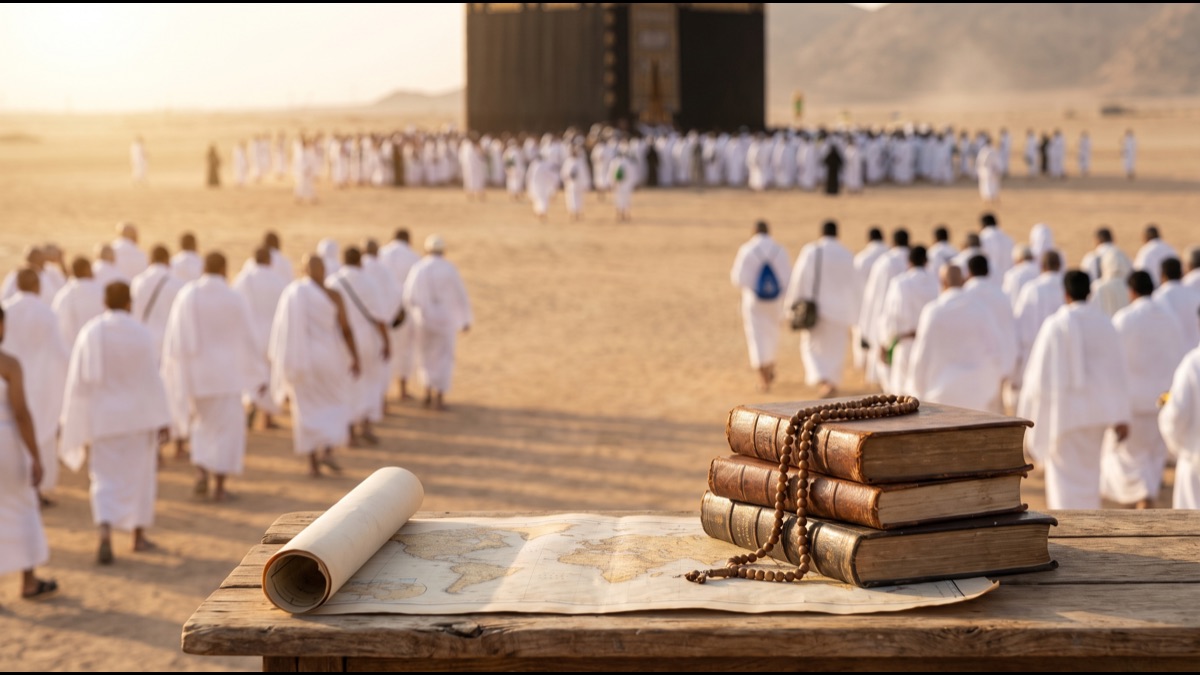
Hajj: A Complete Guide for Pilgrims — From Registration to Return
Editorial note: This guide was checked against sources from the Saudi Ministry of Hajj and Umrah, the Nusuk platform, and the Saudi Ministry of Health on 2026-07-07. Always verify current conditions and vaccination requirements through haj.gov.sa and nusuk.sa before travelling.
In recent seasons, the number of pilgrims has exceeded 1.6 million (Saudi General Authority for Statistics, 2025), making Hajj the largest annual human gathering in the world. Yet many pilgrims arrive without adequate planning and encounter health and logistical problems that could have been avoided. If you are considering Hajj this year or in the future, this Hajj guide is the ideal starting point.
How do I perform Hajj? The question sounds simple, but the answer branches into many details: registration, physical preparation, packages, accommodation, insurance, vaccinations, and studying the rites. Not every pilgrim needs the same level of preparation, but every pilgrim needs a sound foundation. In this article we explain the rites of Hajj and the steps of Hajj in a practical way, especially for first-time pilgrims.
The Kingdom of Saudi Arabia has developed a digital infrastructure for Hajj that makes Hajj registration much easier than before. The Nusuk platform and Absher allow pilgrims to register, pay fees, choose packages, and schedule vaccinations — all from home. But this digital convenience does not mean Hajj has become easy. Mental and physical preparation remain essential.
Who Must Perform Hajj?
Hajj is obligatory once in a lifetime for every Muslim who is adult, sane, and financially and physically able. "Able" here means having enough to cover the costs of travel and stay without causing financial harm to oneself or one's dependents. If you are in debt or struggling to provide basic needs for your family, you are currently exempt; Hajj remains obligatory on you once ability is attained.
Registration: How to Start
Hajj registration is done through official channels in each country. In Saudi Arabia, registration is through the Nusuk platform or Absher. In Egypt, it is through the Ministry of Interior or Tourism. In Pakistan, through the Hajj Bank. In Malaysia, through Tabung Haji. Every country has its own system, but the principle is the same: register early, be accurate with documents, and do not use unapproved intermediaries.
In Saudi Arabia, Hajj is registered electronically through the Nusuk platform. Approved Hajj packages are classified by service level and price into three main categories: economy, standard, and premium (Ministry of Hajj and Umrah). In terms of rites, there are also three Shar'i types: Hajj al-Tamattu' (Umrah then Hajj), Hajj al-Qiran (Umrah and Hajj together), and Hajj al-Ifrad (Hajj only). Choose what suits your situation after consulting a qualified scholar or guide.
Pre-Hajj Preparations
Physical Preparation
The steps of Hajj involve a great deal of walking. Between Mina, Muzdalifah, Arafat, and the Grand Mosque, you may walk 10–15 kilometres per day. If you currently walk fewer than 1,000 steps a day, starting a walking programme three months before Hajj is essential. Consult your doctor if you have heart disease, diabetes, or joint problems. Vaccinations: Saudi Arabia requires the quadrivalent meningococcal (ACYW) vaccine for all pilgrims. The seasonal influenza vaccine and COVID-19 vaccine for high-risk groups are also recommended (Saudi Ministry of Health, 2026). The polio, yellow fever, or cholera vaccines may be required for travellers from affected countries. Check your country's requirements before departure.
Financial Preparation
Hajj costs vary widely. In some countries, Hajj packages start from USD 5,000 and reach USD 20,000 or more. This cost includes airfare, accommodation, visa, transport, insurance, and food. Prepare a detailed budget and save an additional amount (at least 20%) for emergencies. Do not rely on friends or family to fund Hajj if you do not have the financial ability.
Mental and Spiritual Preparation
Read reliable books about the rites of Hajj before travelling. Hajj and Umrah of the Prophet by Ibn Baz and Manasik al-Hajj by al-Albani are reliable sources. Watch documentary videos by experienced pilgrims. Ask Allah to make Hajj easy for you and to accept it from you. Spiritual preparation is no less important than logistical preparation.
Hajj Steps: Day by Day
Day One: 8 Dhul-Hijjah (Yawm al-Tarwiyah)
- Ihram: If you are already in Ihram from Makkah, your Ihram continues. If you are coming from outside Makkah, you must enter Ihram at the Miqat designated for your region. The pilgrim wears two white unstitched cloths, intends Hajj, and recites the Talbiyah: "Labbayka Allahumma labbayk."
- Going to Mina: After Dhuhr prayer, pilgrims travel to Mina. There they stay and pray Dhuhr, Asr, Maghrib, and Isha shortened and combined. They spend the night in Mina to prepare for the Day of Arafat.
Day Two: 9 Dhul-Hijjah (Day of Arafat)
- Standing at Arafat: This is the greatest pillar (rukn) of Hajj. Pilgrims stand in Arafat from noon until sunset, spending the time in supplication, remembrance, and seeking forgiveness. The Khutbah of Arafat is delivered at Masjid Namirah. You must be in Arafat (or at least part of it) for the Hajj to be valid.
- Going to Muzdalifah: After sunset, pilgrims travel to Muzdalifah. They pray Maghrib and Isha combined and shortened. They spend the night in Muzdalifah and collect pebbles (49–70 small stones) for the stoning of the Jamarat.
Day Three: 10 Dhul-Hijjah (Yawm al-Nahr)
- Stoning Jamrat al-Aqaba: Pilgrims throw seven pebbles at the largest pillar, Jamrat al-Aqaba. This is a symbol of rejecting Satan.
- Shaving or shortening the hair: Men shave their heads or shorten their hair. Women cut a small portion of their hair. With this, the pilgrim is released from the first state of Ihram (al-tahallul al-awwal), and everything becomes permissible except intimacy with one's spouse.
- Sacrifice: The pilgrim sacrifices (or arranges for the sacrifice of) a sacrificial animal. It is a day of celebration, and pilgrims eat from the meat of the sacrifice.
- Returning to Mina: Pilgrims return to Mina to spend the night.
The Following Three Days: 11–12–13 Dhul-Hijjah (Ayyam al-Tashreeq)
- Stoning the Jamarat: On each day, pilgrims throw seven pebbles at each of the three Jamarat: the small, the middle, and the large (al-Aqaba). Begin with the small, then the middle, then the large.
- Remembrance and supplication: These are days of remembrance and gratitude. Pilgrims spend their time in supplication and takbir.
- Final release from Ihram: After stoning on the twelfth day (or the thirteenth if one delays), the pilgrim is finally released from Ihram (al-tahallul al-thani). Everything becomes permissible, including intimacy with one's spouse.
Tawaf and Sa'i
After release from Ihram, the pilgrim performs Tawaf (circumambulation of the Kaaba) seven times. Then he or she performs Sa'i (walking between Safa and Marwah) seven times. If Tawaf al-Qudum (the arrival Tawaf) was performed before standing at Arafat, then this Tawaf is Tawaf al-Ifadah. If Tawaf al-Qudum was not performed, then this Tawaf includes both al-Ifadah and al-Qudum.
Practical Tips for First-Time Pilgrims
- Protect your health: Drink water constantly and avoid excess sweets. Heat and crowding can lead to dehydration and heat exhaustion.
- Do not rush: Hajj is a spiritual journey, not a race. Take your time with every rite and do not let peer pressure make you hurry.
- Know your group: If you are in a group, know the phone numbers of guides and organisers. If you get lost, know your hotel name and bus number.
- Carry a copy of your passport: Leave the original at the hotel. Carry an ID card with your information and hotel name.
- Avoid crowds at peak times: If possible, perform Tawaf and Sa'i at less crowded times (midnight or after Fajr).
- Be patient: Crowding is part of Hajj. Forbearance and patience are part of the worship.
- Do not buy from street vendors: Goods may be of poor quality and prices inflated. Buy from trusted stores.
Frequently Asked Questions
1. What is the difference between Hajj and Umrah?
Hajj is an obligatory once-in-a-lifetime duty performed at specific times (Dhul-Hijjah). Umrah is voluntary and can be performed at any time of year. The rites of Umrah are fewer: Ihram, Tawaf, Sa'i, and shaving or shortening the hair. The rites of Hajj include standing at Arafat, stoning the Jamarat, and spending the night in Mina and Muzdalifah.
2. How can I be sure my Hajj is accepted?
Acceptance is in the hands of Allah. However, scholars mention conditions: a correct intention, performing the rites properly, not harming others, avoiding the prohibited acts of Ihram, and exercising patience and forbearance. Ask Allah to accept Hajj from you.
3. Can a woman perform Hajj alone?
According to the Saudi Ministry of Hajj and Umrah website, a mahram is not mandatory for all Hajj packages; a woman may register as part of a women's group. Always check the package and visa conditions in your country through the Nusuk platform.
4. What is the best Hajj package for first-time pilgrims?
Packages that include: a hotel near the Haram, varied food, a qualified guide, and comfortable transport. Avoid very cheap packages that place you in distant tents or without a guide.
5. How much should I save before considering Hajj?
The cost of Hajj differs by country. In many countries it ranges between USD 5,000 and USD 15,000. Save an additional 20% at least for emergencies. Do not put yourself or your family in debt because of Hajj.
Related Reading
- Umrah: A Step-by-Step Guide
- Islamic Finance: A Beginner's Guide
- What Is Zakat and How Do You Calculate It?
- Fasting in Ramadan: A Health Guide from Medical Sources
Sources
- Saudi Ministry of Hajj — official website for registration, Hajj rules, and packages.
- Nusuk platform — the official digital platform for Hajj and Umrah.
- Absher platform — registration and appointment services for pilgrims residing in Saudi Arabia.
- Al-Azhar al-Sharif website — Al-Azhar fatwas on Hajj and Umrah.
- Islamic Relief — Hajj Guide — practical Hajj guide in Arabic and English.
About the author: The doyouknow.app editorial team writes clear guides that make complex topics easy. Have a topic idea? Get in touch.
📱 Tell a friend: Share on WhatsApp
📬 Get more facts. Subscribe to our newsletter for surprising stories from Saudi Arabia and beyond.