Editorial note: This guide was checked against official Saudi government sources and service portals on 2026-07-10. Fees, procedures, and eligibility rules can change, so confirm details through the official channels linked below before acting.
Why Customs Rules Matter for Saudi Residents
Saudi Arabia sits at the crossroads of major trade routes and receives millions of residents, visitors, and shipments every year. Whether you are returning from a holiday, receiving a courier package, or relocating with your household goods, you will interact with Saudi customs. The rules are clear, but they are also strict. A small mistake—such as carrying an undeclared high-value item or a restricted product—can lead to confiscation, fines, or legal action.
For expatriates, customs rules are especially important because your residency status is tied to compliance with local laws. A customs violation can affect your record, your employment, and your ability to renew your iqama or leave and re-enter the Kingdom. This guide explains the rules that matter most for residents: personal baggage allowances, restricted and banned goods, declaration procedures, courier shipments, returning residents' household effects, and the penalties for getting it wrong.
If you are still planning your move or your first trip, our complete Saudi travel guide covers visas, airports, and arrival procedures, while our Saudi e-visa guide explains the main entry option for tourists and short-term visitors.
What Counts as a Personal Shipment
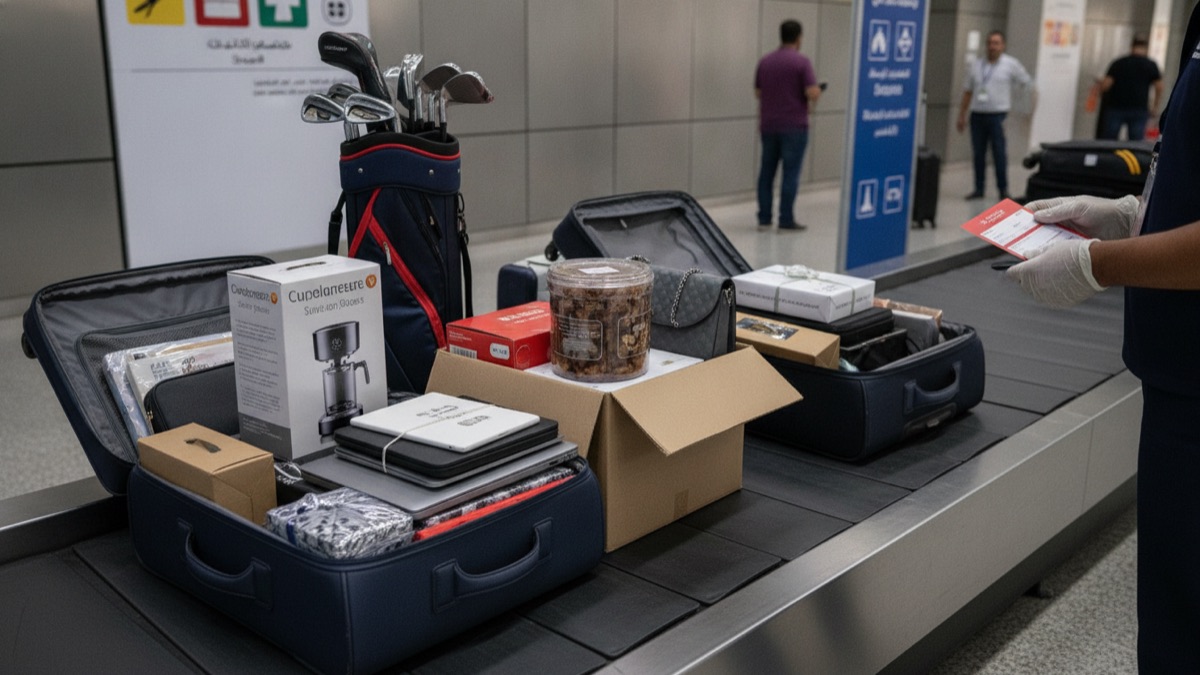
Not every item you carry is treated the same way. Saudi customs distinguishes between personal effects and commercial goods. Personal effects are items you own and use, or gifts intended for personal use by family and friends. They travel with you as baggage, arrive as a small courier package, or are shipped as part of a household move. Commercial goods, by contrast, are brought in for resale, business use, or repeated import in large quantities.
The key test is quantity and intent. A single new laptop for your own use is a personal effect. Five identical smartphones in original boxes look like commercial stock. A few jars of honey as a gift are personal. A crate of food supplements for distribution is commercial. When customs officers suspect a commercial intent, they may apply import duties, value-added tax, excise tax, and additional inspection fees. In serious cases, they may seize the goods and open an investigation.
For residents arriving by air, your checked luggage and carry-on bags are personal shipments. For residents ordering online, each delivery is treated as a personal import until the volume or value suggests otherwise. Keep invoices, receipts, and payment records. These documents prove the value and purpose of the items if customs asks questions.
Duty-Free Allowances for Residents and Travelers
Saudi Arabia grants a duty-free allowance for personal goods and gifts carried by travelers. According to ZATCA, the current threshold is SAR 3,000 per passenger for items that are clearly for personal use. Goods below this value, and not on a restricted list, generally enter without customs duty or value-added tax. Amounts above the threshold must be declared and taxed.
Tobacco and related products have their own limits. Travelers aged 18 and over may bring up to 200 cigarettes, or 500 grams of other tobacco products, duty-free. Larger quantities for personal use may still be allowed, but they attract duties and excise taxes. The maximum personal import of tobacco products is generally limited to 2 kilograms per person over a three-month period. E-cigarettes and vaping liquids are permitted only for personal use; commercial quantities are prohibited.
Perfume and eau de cologne may be imported in reasonable quantities for personal use. There is no published milliliter cap, but customs officers will look at whether the amount is consistent with personal consumption rather than resale. When in doubt, keep the original packaging and receipt.
Duty-free allowances are per person and cannot be combined across family members. A couple cannot pool their SAR 3,000 allowances into a single bag of goods worth SAR 6,000. Each traveler should carry their own items, and each must declare any amount above their individual limit.
When and How to Declare Goods
Declaration is the process of telling customs what you are bringing into the country. Saudi Arabia uses a two-channel system at airports: the green channel for travelers with nothing to declare, and the red channel for travelers with declarable goods. Choosing the wrong channel is itself a violation if you are carrying items that should have been declared.
You must declare goods when their total value exceeds the duty-free allowance, when they are restricted but you have a valid permit, or when they fall under special rules such as excise tax. You must also declare currency, bearer negotiable instruments, precious metals, gemstones, and fine jewelry when their combined value reaches SAR 60,000 or more. This rule applies whether you are entering or leaving the country.
ZATCA offers an electronic declaration system that lets travelers submit declarations before arriving at the port. This can speed up processing for goods above the duty-free limit and for some restricted items. However, for cash and valuables above SAR 60,000, you must still visit the customs declaration office in person at the port even if you submitted an online declaration. Paper declaration forms are also available at customs desks.
When declaring, provide accurate descriptions, values, and supporting documents such as invoices or receipts. Under-declaring the value of goods to avoid duty is considered smuggling. If the value is uncertain, customs may assess the goods themselves and charge duty based on their valuation.
Banned and Restricted Items
Some items are completely banned from entering Saudi Arabia. There are no permits or exceptions that make them legal for personal import. These include alcoholic beverages of any kind, pork and pork-derived products, narcotic drugs and psychotropic substances, drug paraphernalia, pornographic or morally offensive material, and gambling equipment. Weapons, explosives, and firearms are also prohibited unless you hold specific government authorization.
Other items are restricted, meaning they may enter only under certain conditions or with advance approval. Controlled medications require pre-authorization from the Saudi Food and Drug Authority and a valid prescription. Commercial quantities of food products, especially meat and poultry, require halal certification and health certificates. Live animals, plants, seeds, and agricultural products are subject to quarantine and may need permits from the Ministry of Environment, Water and Agriculture.
Electronic devices are generally allowed, but customs officers may inspect phones, laptops, tablets, and cameras for prohibited content. Content that is pornographic, politically sensitive, or offensive to public morality can lead to confiscation of the device and legal consequences. Before traveling, remove any content that could be interpreted as prohibited.
Counterfeit goods, fake currency, and items that infringe intellectual property rights are also banned. Even a single fake designer bag or pirated software copy can be seized. Used clothing in commercial quantities and retreaded tires are prohibited for commercial import, though personal used clothing for your own wardrobe is normally acceptable.
Courier Shipments and Online Purchases
Ordering from international websites has become common for Saudi residents, but every delivery crossing the border passes through customs. Courier companies such as DHL, Saudi Post, and Aramex act as intermediaries, but they do not control customs decisions. They collect duties and taxes on behalf of ZATCA before delivering the package.
The same duty-free allowance concept applies, but in practice most courier shipments above the de minimis threshold attract duty and VAT. The threshold can change, so check the latest rules on the ZATCA or Fasah websites. If your shipment is held, the courier will contact you for payment or additional documents such as a copy of your iqama, passport, or invoice.
To avoid delays, use your full legal name and a valid Saudi mobile number on the shipping label. Keep the purchase invoice and tracking number. Be cautious with restricted categories such as cosmetics, supplements, electronics, and food. These are more likely to be inspected or rejected. If the item is prohibited, it will be confiscated and you may not receive a refund.
Some residents use mail forwarding services or personal shopping services. These can be convenient, but they do not remove your liability. You are still the importer, and you must ensure the shipment complies with Saudi customs law. Repeated imports of similar items in large quantities may be classified as commercial activity.
Returning Residents and Household Goods
Residents who are returning to Saudi Arabia after time abroad, or who are relocating to the Kingdom, often ship household goods and personal effects. Used household goods may qualify for duty-free entry if they are clearly personal and their value is within the allowed limit. New items generally require payment of duty and VAT, and they may need certificates of origin or conformity.
According to commonly published customs guidelines for returning residents, used personal effects may be exempt if their value is under approximately SAR 10,000. Above that, duties may be assessed on categories such as electrical appliances, audio-video equipment, furniture, and carpets. Books are usually exempt from duty. New items should have original purchase receipts; without receipts, customs may estimate the value themselves.
The shipper must usually be present during customs clearance and must provide documents such as a copy of the passport, iqama, residence permit, bill of lading or airway bill, and a detailed inventory. Some items, especially electrical goods, may need a SASO Certificate of Conformity to show they meet Saudi standards. All goods should carry a visible country-of-origin mark.
If an item is manufactured in Saudi Arabia, or if a similar item is produced locally, it may face a higher duty rate. This rule is designed to protect domestic industry. Plan your shipment carefully, declare new items honestly, and consider using a licensed customs clearance agent for large moves.
Penalties and How to Avoid Them
Saudi customs penalties are designed to discourage smuggling, tax evasion, and the import of prohibited goods. The exact penalty depends on the violation. For failing to declare currency or valuables above SAR 60,000, the fine is typically 25 percent of the value for a first offense and 50 percent for repeat offenses. The goods may also be seized, and serious cases can be referred to the Public Prosecution.
For undeclared goods above the duty-free limit, customs may charge the owed duty and VAT plus a fine. Prohibited items such as alcohol, drugs, or pork can lead to confiscation, arrest, imprisonment, deportation, and bans on re-entry. Drug smuggling carries the most severe penalties, including the death penalty in the most serious cases.
The safest approach is to declare anything you are unsure about, keep receipts, stay within personal-use quantities, and avoid any item that is on the prohibited list. Do not agree to carry packages for other people unless you know exactly what is inside. Do not assume that because an item is legal in your home country, it is legal in Saudi Arabia.
If you face a customs dispute, remain polite and ask for a supervisor or a written explanation. You have the right to understand the charge, but arguing aggressively can make the situation worse. For complex cases, especially involving household goods or high-value items, consider hiring a licensed customs broker who understands ZATCA procedures.
What to Do If Customs Detains Your Goods
Even when you follow the rules, a shipment or bag can be selected for inspection. Random checks are normal, and selection does not mean you have done anything wrong. If customs officers ask to inspect your luggage, stay calm, answer questions clearly, and provide any documents they request. Cooperation usually speeds up the process.
If an item is detained, ask for a written reason and a reference number. Find out whether the item is being held for duty payment, document verification, or because it is restricted. For courier shipments, the delivery company will normally send you a message explaining the hold and the steps you need to take. This may include paying duty online, sending a copy of your iqama, or providing a prescription for medication.
You generally have a limited time to respond before the item is returned to sender or confiscated. Keep track of deadlines and follow up promptly. If you believe the detention is a mistake, you can file an objection with ZATCA through its official channels. For household goods and high-value items, a licensed customs broker can represent you and help prepare the necessary paperwork.
Prevention is always easier than resolution. Declare accurately, keep receipts, avoid ambiguous product descriptions, and never ship items that are clearly prohibited. A few minutes of preparation before you travel or order can save days of delays later.
Using Digital Customs Services
Saudi Arabia has moved many customs services online. The Fasah platform connects traders, couriers, and travelers with customs clearance processes. ZATCA's website and mobile application provide e-declaration services, tax payment options, and information on current rules. The Saudi Food and Drug Authority operates an online portal for declaring controlled medications.
Many residents already use Absher for iqama, traffic, and government services. While Absher does not handle customs declarations directly, it is part of the same digital ecosystem. Keeping your Absher profile updated with your correct address and mobile number helps ensure you receive notifications from government agencies, including customs-related messages.
Before ordering from abroad, check whether the seller can provide the documents Saudi customs requires. Some international retailers refuse to ship to Saudi Arabia because of customs complexity. Others include duties and taxes in the checkout price, which simplifies delivery. Read the shipping terms carefully to avoid surprise charges.
Sources
- ZATCA — Zakat, Tax and Customs Authority
- Fasah — Saudi customs clearance platform
- SFDA — Saudi Food and Drug Authority
- Saudi Post — international mail and courier guidance
- DHL Saudi Arabia — commercial courier import procedures
Frequently asked questions
What is the duty-free allowance when entering Saudi Arabia?
Travelers may generally bring personal goods and gifts worth up to SAR 3,000 duty-free, plus limited quantities of tobacco and perfume for personal use. Confirm the latest thresholds on the ZATCA website.
Do I have to declare cash or jewelry at Saudi customs?
Yes. You must declare currency, precious metals, gemstones, or jewelry with a combined value of SAR 60,000 or more when entering or leaving the country.
Can I order electronics from abroad and have them shipped to Saudi Arabia?
Yes, but shipments above the duty-free threshold are subject to customs duty and VAT. Keep the invoice and be prepared to provide your iqama or passport copy to the courier.
Are e-cigarettes allowed through Saudi customs?
E-cigarettes and vaping liquids may be imported for personal use only. Commercial quantities are prohibited, and devices should normally be carried in cabin baggage.
What happens if I do not declare goods that exceed the duty-free limit?
You may face fines, payment of owed duties and taxes, confiscation of the goods, and possible legal action. Repeat offenses and large undeclared values carry heavier penalties.
Can returning residents bring household goods duty-free?
Used personal household effects may qualify for duty-free entry if their value is within the allowed limit and the items are clearly for personal use. New items and high-value goods generally attract duty and VAT.
Where can I declare goods before arriving in Saudi Arabia?
ZATCA provides an electronic declaration system through its website and mobile app. Some items, including cash above SAR 60,000, still require an in-person visit to the customs office at the port.