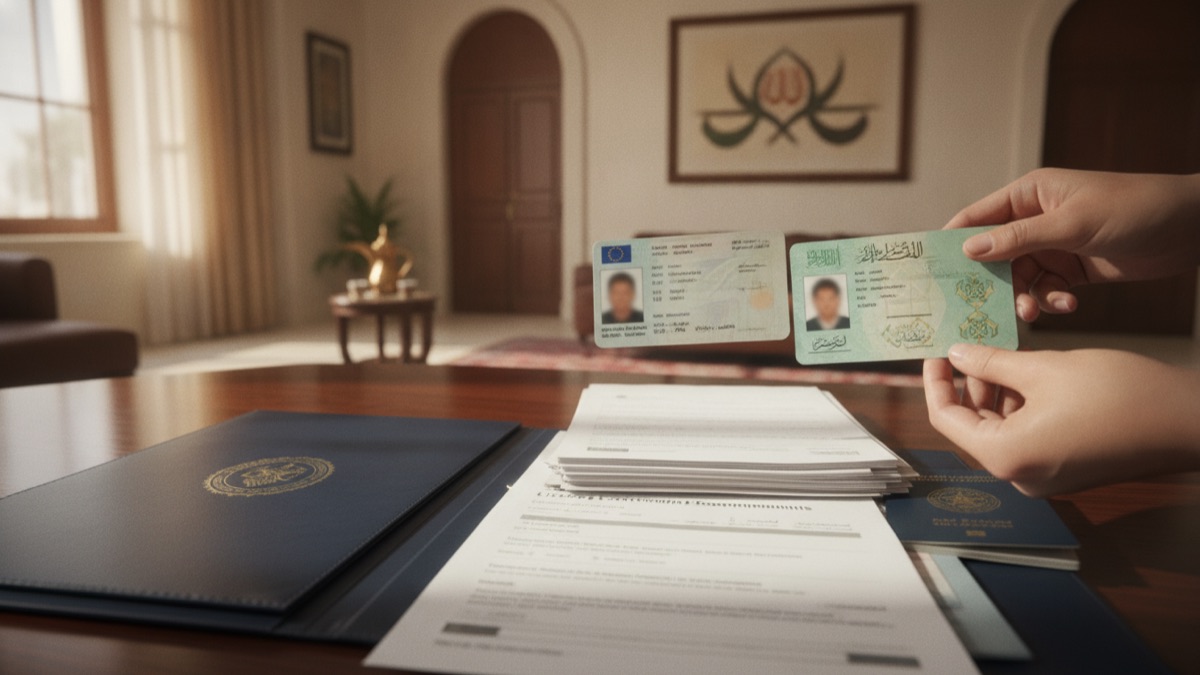
Editorial note: This guide was checked against official Saudi government sources and service portals on 2026-07-09. Fees, procedures, and eligibility rules can change, so confirm details through the official channels linked below before acting.
Why Convert a Foreign Driving License
Saudi Arabia has one of the most ambitious infrastructure programs in the region, and a car is the most practical way to get around in many cities. If you already hold a valid driving license from your home country, you may be able to convert it to a Saudi driving license instead of starting from scratch. The conversion route saves time, reduces the number of lessons you need, and lets you join Saudi traffic with a license that local authorities recognize.
The process is managed by the General Department of Traffic under the Ministry of Interior, but much of the practical work happens through Absher, approved medical centers, and licensed driving schools such as Dallah. Before you begin, you need a valid iqama. If you are still sorting out your residency status, read our Saudi iqama guide first, because you cannot apply for a Saudi driving license on a visit visa.
This article explains who can convert a foreign license, which countries are normally recognized, what paperwork to prepare, how Dallah driving school fits into the process, what the theory and practical tests involve, how much it costs, how long it takes, and the mistakes that cause the most delays. For residents who prefer a complete overview of getting licensed from zero, we also have a Saudi driving license step-by-step guide.
Eligible Countries and License Recognition
Saudi Arabia recognizes driving licenses from a wide range of countries that have traffic systems and safety standards similar to its own. If your license was issued in one of these countries and is still valid, you can usually apply for a direct conversion or a shortened testing path. The list is not fixed forever; authorities update it as agreements change, so always check the latest version on the Ministry of Interior or Absher portals before making decisions.
Historically, licenses from Gulf Cooperation Council countries have been the easiest to convert because traffic rules are closely aligned. Licenses from many European countries, the United States, Canada, the United Kingdom, Australia, New Zealand, Japan, South Korea, and Singapore have also been accepted for conversion or exemption from parts of the test. Some Asian, African, and South American licenses may not be on the recognized list, which means the holder must enroll in a driving school and pass both the theory and practical examinations.
There are a few conditions that affect eligibility regardless of nationality. Your foreign license must be valid, or recently expired only by a short grace period depending on current rules. It must be the full license for the vehicle category you want to drive, not a learner's permit or a restricted temporary license. The license must also match the category you are applying for in Saudi Arabia; for example, a motorcycle license cannot be converted into a private car license without additional training and testing.
If your country is not on the recognized list, do not assume the door is closed. You can still obtain a Saudi driving license by completing the standard training program at a licensed school and passing the required exams. The rest of this guide applies to both conversion candidates and those who need full training, because even conversion applicants often have to take a theory test or a short practical assessment.
Required Documents for License Conversion
Gathering the right documents before you start will prevent repeated trips to service centers. The exact list can vary slightly by city and by the specific school or traffic office handling your application, but the following items are almost always required.
First, you need a valid iqama. Your residency permit proves that you are legally resident in Saudi Arabia and it is linked to your national information record. You will also need your original passport, plus a copy of the relevant pages. Some offices ask for a copy of your visa page as well, even if your iqama is already issued. Make sure your passport has at least six months of validity to avoid administrative blocks.
Your original foreign driving license is the centerpiece of the application. It must be valid and clearly show your name, license number, issue date, expiry date, and the categories you are allowed to drive. If the license is not in Arabic or English, you will usually need an official translation attested by an approved translation office. Keep both the original and the translated copy together when you visit the school or traffic office.
A medical report from an approved medical center is mandatory. The medical check is quick and covers general fitness, vision, and conditions that could affect safe driving. Some centers issue the report electronically, which makes it easier for the traffic system to retrieve. In addition to the general medical report, an eye test is normally required; some driving schools can perform the eye test on site, while others send you to an approved clinic.
You will also need passport-sized photographs. The number varies, but four to six photos is a safe amount. Some applicants need a no-objection certificate from their sponsor or employer, although this is less common than it used to be because many services are now linked directly to the iqama. Finally, print your Absher appointment confirmation and any payment receipts. Payments are usually made through SADAD or Absher, and the traffic system needs to see proof that the fees have been settled.
Dallah Driving School and Registration
Dallah Driving School is one of the largest and best-known driving schools in Saudi Arabia. It operates training centers in major cities including Riyadh, Jeddah, Dammam, and other locations. The school offers packages for beginners, refresher courses, and conversion candidates who need only the theory test and a short practical assessment.
The first step is to create an account on the Dallah portal or mobile application. You will enter your iqama number, mobile number, and basic personal details. The system will verify your identity against national records. Once your profile is active, you can choose the service package that matches your situation. If your foreign license qualifies for conversion, select the conversion or transfer package. If you need full training, select the beginner or comprehensive package.
After choosing a package, you pay the fee online. The portal then lets you book appointments for theory classes, theory tests, practical training sessions, and practical tests. Many centers offer instruction and test interfaces in Arabic and English, and some locations provide support in other languages. Pay attention to the location you select, because your training and tests must usually be completed at the same branch unless you explicitly transfer your file.
Dallah facilities typically include classrooms, computer labs for the theory test, practice vehicles, and simulated road environments. For conversion candidates, the school acts mainly as a testing and certification center rather than a long-term training provider. However, even experienced drivers benefit from reviewing local traffic laws before attempting the theory exam, because Saudi sign conventions, speed limits, and right-of-way rules may differ from those in your home country.
The Theory Test
The computer-based theory test is one of the main gateways to a Saudi driving license. It is designed to confirm that you understand traffic signs, road markings, driving etiquette, safety rules, speed limits, and the penalties for common violations. The test is normally available in Arabic and English, and some centers may offer it in additional languages.
The question bank covers a broad range of topics. Expect questions on identifying road signs, understanding traffic light sequences, knowing who has the right of way at intersections and roundabouts, recognizing safe following distances, and responding to emergency situations. There are also questions about the legal responsibilities of drivers, such as stopping for school buses, giving way to pedestrians, and using seat belts.
The exact number of questions and passing score can vary, but a common format is around twenty questions with a required passing mark of at least seventy-five percent. You usually have a limited time to answer each question, and the system gives your result immediately after you finish. If you fail, you can reschedule after a short waiting period and pay a retest fee.
Preparation is the key to passing on the first attempt. Dallah provides practice materials and mock tests through its portal and mobile app. You can also find official traffic handbooks and practice quizzes linked from government portals. Study regularly for a few days rather than cramming in one session, and pay special attention to signs and rules that differ from your home country. Many candidates fail because they assume their existing knowledge is enough and skip the local details.
The Practical Driving Test
The practical test evaluates whether you can operate a vehicle safely in real or simulated traffic conditions. Even if you have years of driving experience, it is worth practicing the specific maneuvers that Saudi examiners look for, because the test format and scoring can differ from what you are used to.
When you arrive for your appointment, check in at the reception and present your iqama and appointment confirmation. The examiner may ask you to adjust your seat and mirrors before starting. Common test elements include starting and stopping smoothly, changing lanes with proper signaling and mirror checks, navigating a roundabout, making left and right turns, reversing in a straight line, parallel parking, and angle parking.
Examiners pay close attention to observation habits. Before every maneuver, you should check your mirrors and blind spots. Failure to signal, rolling through stop lines, crossing lanes improperly, or driving too slowly or too quickly can lead to immediate failure. You should also show confidence with the controls; stalling the engine repeatedly, harsh braking, or poor clutch control can cost points.
If you pass, the examiner records the result in the system and you can proceed to license issuance. If you fail, the examiner will explain the main reasons and recommend additional training. You must book another test, pay the retest fee, and sometimes complete a minimum number of extra practice hours before trying again. Patience and practice make a big difference; many people fail once and pass easily on the second attempt.
Fees and Payment Methods
The total cost of converting a foreign driving license depends on your starting point. If your license qualifies for direct conversion and you only need to pay administrative fees, the cost is relatively low. If you need training and tests at Dallah, the cost rises accordingly.
Typical fee categories include the driving license issuance fee, which is usually charged per year of validity, the theory test fee, the practical test fee, and the driving school package fee. Medical examination and eye test fees are paid separately to the approved clinic. Some centers also charge small fees for file opening, photograph printing, or certificate issuance.
As a rough guide, license issuance can cost around eighty Saudi riyals per year of validity. Each test may cost between forty and one hundred riyals, and Dallah packages can range from a few hundred riyals for conversion candidates to over a thousand riyals for full beginner courses. Medical checks are typically under two hundred riyals. These numbers change over time, so treat them as estimates and confirm the current amounts through Absher, the Ministry of Interior fee schedule, or the Dallah portal.
Payments are almost always cashless. You can pay through SADAD, Absher, Mada cards, or the driving school portal. Keep every receipt and screenshot the payment confirmation. If the traffic system does not show your payment immediately, the receipt is your proof. Some payments may take a few hours to reflect, so try to pay at least one day before your appointment.
Timeline and Step-by-Step Process
Most applicants complete the conversion process within one to three weeks if their documents are in order and they pass each test on the first attempt. Here is a typical sequence.
First, confirm your eligibility through Absher or by checking the current list of recognized countries. Second, gather your documents and obtain a medical report and eye test from an approved center. Third, register on the Dallah portal and choose the appropriate package. Fourth, pay the fees and book your theory test. Fifth, study and pass the theory test. Sixth, complete any required practical training and book your practical test. Seventh, pass the practical test. Eighth, pay the license issuance fee and collect or download your Saudi driving license.
Each step has its own timing. Medical checks can often be done the same day. Theory test appointments are usually available within a few days. Practical training may take one to two weeks depending on your schedule and the school's availability. The practical test is often scheduled after training is complete. Once both tests are passed, license issuance can take from a few hours to a couple of working days.
If you fail a test, add the waiting period and any extra training to the timeline. Public holidays, school closures, and peak periods can also cause delays. Starting the process as soon as you receive your iqama gives you flexibility and reduces stress.
Common Mistakes and How to Avoid Them
Many delays are caused by simple errors that are easy to prevent. The first mistake is applying on the wrong visa status. A visit visa or expired iqama will block your application immediately. Make sure your residency permit is active before you spend money on medical checks or school packages.
The second mistake is bringing an expired or invalid foreign license. Check the expiry date before you start. If your license expired recently, ask whether a grace period applies or whether you need to renew it in your home country first. A learner's permit or restricted license usually cannot be converted.
The third mistake is skipping the translation step. If your license is in a language other than Arabic or English, get an official translation early. Some applicants arrive at the traffic office only to be told that their translation is not acceptable because it lacks the required stamp or attestation.
The fourth mistake is underestimating the theory test. Experienced drivers sometimes fail because they do not study local signs and penalties. Use the official practice materials and take several mock exams before your appointment.
The fifth mistake is poor observation during the practical test. Many failures come from not checking mirrors and blind spots before lane changes, turns, and parking. Make your checks obvious so the examiner can see them. Smooth control, correct speed, and proper signaling are equally important.
The sixth mistake is ignoring appointment details. Double-check the date, time, and location. Arrive early, bring all documents in a folder, and dress comfortably. If you need to reschedule, do it as soon as possible because popular time slots fill quickly.
Sources
- Absher — official Saudi e-services portal
- Ministry of Interior — traffic and licensing information
- Dallah Saudi Driving School (DDC) — driving school and license test procedures
- Saudi Data and AI Authority — digital government services
Frequently asked questions
Can I convert my foreign driving license without taking a test in Saudi Arabia?
It depends on the country that issued your license. Licenses from many GCC and Western countries can be converted directly or with minimal paperwork, while others require a theory test, practical test, or both. Check the current recognized-country list on Absher or the Ministry of Interior portal.
Which countries' driving licenses are accepted for conversion?
The list changes, but it commonly includes GCC countries, the United States, Canada, the United Kingdom, many European Union countries, Australia, New Zealand, Japan, South Korea, and Singapore. Always confirm the latest list through official channels.
What documents do I need to convert my foreign license?
You normally need a valid iqama, original passport and copies, your original foreign license, an official translation if needed, passport photos, a medical report, an eye test, and proof of payment for fees.
How much does it cost to convert a foreign driving license?
Direct conversion fees are modest, often around eighty riyals per year of validity plus medical and test fees. If you need training at Dallah, total costs can range from a few hundred to over a thousand riyals depending on the package.
How long does the conversion process take?
Most applicants finish within one to three weeks if they pass every test on the first attempt. Medical checks and theory tests can be done quickly, while practical training and tests may take one to two weeks.
Can I drive while waiting for my Saudi license?
No. You must hold a valid Saudi driving license before you drive legally in Saudi Arabia. Your foreign license alone is not sufficient for residents once you begin the conversion process.
What happens if I fail the practical test?
You can book a retest after the required waiting period, pay the retest fee, and complete any recommended extra training. Most candidates pass on their second attempt with focused practice.