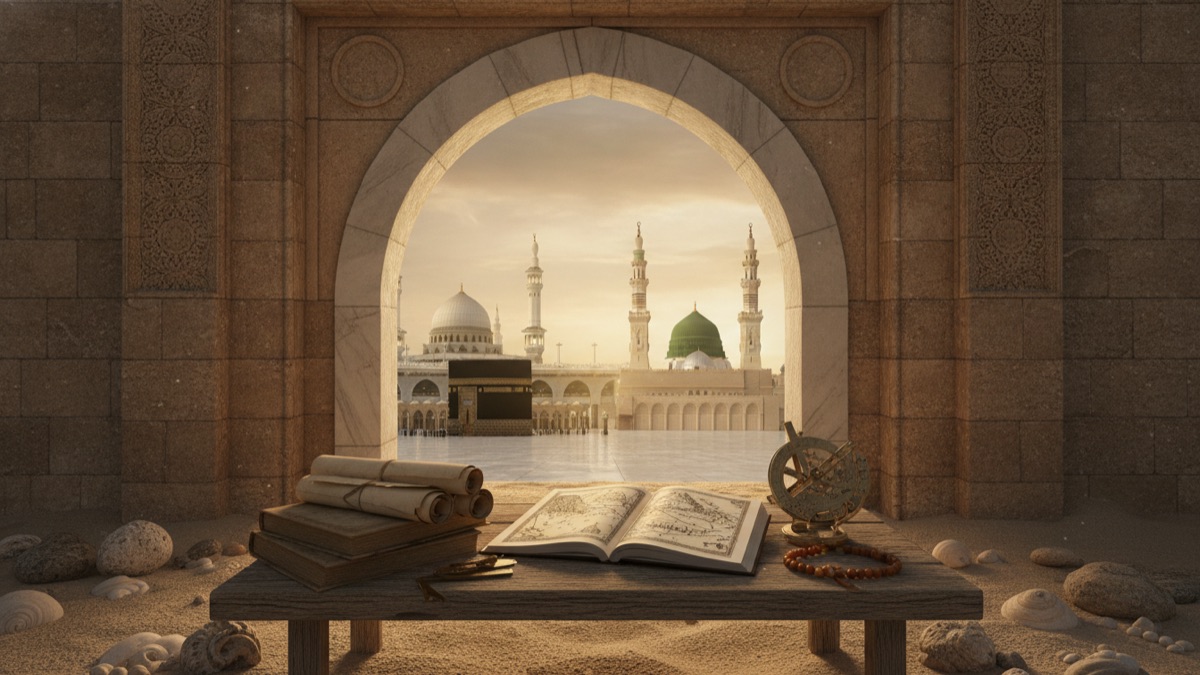
The Two Holy Mosques
The Two Holy Mosques are Masjid al-Haram in Mecca and Masjid an-Nabawi in Medina, the two most sacred sites in Islam and the principal destinations of Hajj, Umrah, and voluntary visitation throughout the year. Together they trace the arc of Islamic history from its earliest roots to the mission of the final Prophet.
Masjid al-Haram connects Muslims to the story of Prophet Ibrahim (Abraham) and his son Ismail (Ishmael), who, according to Islamic tradition, raised the Kaaba as the first house dedicated to the worship of the one God. Masjid an-Nabawi connects Muslims to the life of Prophet Muhammad (peace be upon him) directly, having been founded by him personally after his migration (Hijrah) from Mecca to Medina in 622 CE. Between them, the two mosques hold a unique status: no other mosque in the world carries comparable religious significance, and prayer performed in either is described in hadith literature as carrying substantially greater reward than prayer elsewhere.
Masjid al-Haram and the Kaaba
Masjid al-Haram ("the Sacred Mosque") surrounds the Kaaba, a cube-shaped structure draped in a black silk covering (the Kiswah) embroidered with Qur'anic calligraphy in gold thread, which is replaced annually. Muslims around the world, wherever they are, face the direction of the Kaaba — the qibla — during each of their five daily prayers, making it the single unifying physical focal point of Islamic worship globally. This orientation, known as facing the qibla, is determined today with the help of precise geographic calculation and compasses or apps calibrated to the Kaaba's exact coordinates, ensuring that mosques and individual worshippers anywhere in the world, from Southeast Asia to the Americas, align their prayer direction consistently toward the same physical point.
According to Islamic tradition, the Kaaba was originally built, or rebuilt, by Prophet Ibrahim and his son Ismail on the instruction of Allah, on a site tradition holds was already sacred from earlier times. Set into its eastern corner is the Black Stone (al-Hajar al-Aswad), which pilgrims attempt to touch or kiss during tawaf (circling the Kaaba) in emulation of the Prophet Muhammad's practice, though scholars emphasize that the stone itself has no independent power and the act is one of following prophetic example, not veneration of the stone. A well-known report attributed to the caliph Umar ibn al-Khattab has him state, upon approaching the stone, that he knew it was merely a stone that could neither benefit nor harm, and that he touched it only because he had seen the Prophet do so — a statement often cited by scholars precisely to guard against any drift toward treating the stone itself as an object of worship.
The Kaaba and the mosque surrounding it have been rebuilt or significantly repaired several times across history — following pre-Islamic reconstructions, a rebuilding during the time of the Prophet's early companions after flood damage, further reconstruction during the Umayyad period, and continual expansion under successive Islamic dynasties including the Abbasids, Mamluks, and Ottomans — culminating in the vastly larger modern structure developed under Saudi Arabia in the 20th and 21st centuries. Each historical expansion generally responded to two pressures: damage from fire, flood, or conflict that required rebuilding, and the steadily growing number of pilgrims that required more prayer space than earlier structures could accommodate — a pattern that continues into the present day, with ongoing Saudi-era projects still expanding capacity to meet record annual pilgrim numbers.
Masjid an-Nabawi: The Prophet's Mosque
Masjid an-Nabawi ("the Prophet's Mosque") was built by the Prophet Muhammad (peace be upon him) and his companions shortly after his arrival in Medina in 622 CE. It was originally a simple, modest structure with mudbrick walls, trunks of palm trees as pillars, and a roof of palm leaves and mud — a stark contrast to the vast marble-and-marble-domed complex that stands today.
Over the following fourteen centuries, the mosque grew through successive expansions by Rashidun caliphs, Umayyad and Ottoman rulers, and, most dramatically, the modern Saudi state, into one of the largest mosques in the world by covered prayer area. It contains the Rawdah (or Riyad al-Jannah), a relatively small area between the Prophet's former house (now his burial chamber) and his original pulpit, which the Prophet himself described in hadith as one of the gardens of Paradise — making it an area of intense devotion where visitors seek to pray, despite its limited space often requiring queuing and time-slot systems today. Adjacent to the Rawdah lies the Prophet's burial chamber, marked by the famous Green Dome, beneath which the Prophet Muhammad is buried alongside the early caliphs Abu Bakr and Umar ibn al-Khattab. The mosque also houses a substantial library and, in its historical layers, sections dating to distinct architectural periods — Ottoman-era columns and calligraphy alongside vast contemporary marble courtyards — giving visitors a rare opportunity to see over a thousand years of Islamic architectural history within a single, continuously functioning building.
The Custodianship of the Two Holy Mosques
Responsibility for the upkeep, security, and administration of the Two Holy Mosques has passed through numerous ruling dynasties over Islamic history, including the Umayyads, Abbasids, Fatimids, Ayyubids, Mamluks, and Ottomans, each contributing renovations, expansions, and religious endowments over the centuries. Since the founding of the modern Saudi state, the King of Saudi Arabia has held the official title "Custodian of the Two Holy Mosques" (Khadim al-Haramayn al-Sharifayn), a title formally adopted in 1986 replacing the previously used "His Majesty," reflecting the religious weight the role carries above and beyond ordinary political titles.
This custodianship encompasses not only physical maintenance and expansion of the two mosques but also organizing and funding the annual Hajj pilgrimage, managing pilgrim visas and logistics through dedicated ministries, and overseeing religious scholarship and services connected to both sites. The scale of this responsibility has grown enormously as global Muslim population and travel capacity have increased, transforming what was historically a regional undertaking into a logistics operation serving several million pilgrims annually. The Custodian also chairs or appoints leadership over dedicated bodies such as the General Presidency for the Affairs of the Two Holy Mosques, which handles day-to-day operations including cleaning, security, the distribution of Zamzam water, and coordination with pilgrim-facing ministries during peak seasons.
Architectural Scale and Modern Engineering
The most recent phases of expansion at both mosques rank among the largest religious construction projects in modern history. Masjid al-Haram's expansions have increased its prayer capacity to accommodate well over a million worshippers at peak times when combined with surrounding plaza areas, while Masjid an-Nabawi's expansions have similarly multiplied its original footprint many times over, with a distinctive system of retractable umbrella canopies installed in its courtyards to shade worshippers during the day and open at night.
Both complexes rely on extensive modern engineering to function at this scale: large-capacity air conditioning systems designed for extreme summer heat, extensive escalator and elevator networks, dedicated pilgrim transport systems including high-speed rail linking Mecca, Medina, and Jeddah, and sophisticated crowd-management technology used to monitor and direct the flow of pilgrims, particularly around the Kaaba and the Rawdah where congestion is highest. Saudi authorities have also invested heavily in real-time crowd density monitoring using cameras and sensor networks, allowing officials to temporarily redirect pilgrim flow away from overcrowded zones during peak Hajj days, a direct response to past crowd-related tragedies that prompted significant safety and infrastructure reforms in subsequent years. The Zamzam well, located within Masjid al-Haram, is also managed through a modern distribution system that supplies water to worshippers throughout the mosque and, in bottled form, to Muslims around the world. Security and civil-defense coordination during peak periods, particularly Hajj, involves tens of thousands of personnel managing everything from crowd flow at the Jamarat to emergency medical response, reflecting the scale of planning required to safely host one of the largest recurring human gatherings on Earth within a fixed, historically constrained physical footprint.
Expansion and Modern Care
Both mosques have undergone massive expansions, especially under the custodianship of Saudi Arabia beginning in the mid-20th century and continuing through ongoing projects today. The latest phases have added capacity for millions of additional worshippers, improved accessibility for elderly and disabled pilgrims, and introduced advanced climate control, lighting, and transport systems designed to handle the world's largest recurring religious gatherings.
These projects aim to serve the steadily growing number of pilgrims and visitors — driven by rising global Muslim population, increased travel capacity, and expanded visa programs — while preserving, as far as possible, the sanctity and historical identity of each site. Balancing large-scale modern construction with historical preservation has itself become an ongoing subject of discussion among architects, historians, and religious scholars. Some historic Ottoman-era sections and artifacts near both mosques have been preserved or relocated to dedicated museums rather than demolished outright, reflecting an attempt to reconcile the practical necessity of expansion with the historical weight attached to earlier structures, though debates continue among heritage specialists about how much of the older fabric of the two cities should ideally be retained alongside modern development.
Spiritual Significance
Prayer in Masjid al-Haram is described in hadith as carrying multiplied reward compared to prayer elsewhere, and prayer in Masjid an-Nabawi is similarly described as carrying substantially greater reward than an ordinary mosque, though scholars note the two are not considered equal to one another in the various narrations. The Kaaba itself symbolizes the unity of the global Muslim community, since all Muslims, regardless of nationality, language, or background, face the same physical point during prayer five times daily, an act of unified orientation with few parallels in other faith traditions.
Visiting these mosques is a core part of both Hajj and Umrah, and many pilgrims describe standing before the Kaaba for the first time, or praying in the Rawdah, as among the most emotionally powerful moments of their religious lives. Our Hajj guide and Umrah guide explain how to prepare for these journeys in practical detail.
Access Rules for Mecca and Medina
Under Saudi law, the city of Mecca itself — not only the mosque — is restricted to Muslims; non-Muslims are not permitted to enter the city, and checkpoints on approach roads enforce this restriction. Medina's access rules are more nuanced: the city of Medina as a whole is generally open to non-Muslim visitors and residents, but the core area immediately surrounding Masjid an-Nabawi, and the mosque itself, is restricted to Muslims, particularly during specific periods.
These restrictions are specific to the sanctity Islamic tradition assigns to these particular sites and should not be generalized to mosques elsewhere in the Muslim world, most of which welcome respectful non-Muslim visitors. Muslim visitors of any nationality are welcome, though all pilgrims — Muslim or not — are subject to standard visa, health, and logistical requirements set by Saudi authorities for entry to the Kingdom generally. Saudi Arabia has in recent years expanded tourist visa access to the country broadly, allowing non-Muslim visitors to explore many other regions and cities of the Kingdom, even as Mecca itself and the restricted core of Medina remain reserved for Muslims specifically, a distinction sometimes misunderstood by first-time visitors unfamiliar with the country's religious geography.
Visiting the Two Holy Mosques Today
Millions of Muslims visit the Two Holy Mosques each year, whether specifically for Hajj, for Umrah (which can be performed at almost any time of year), or simply to pray and reflect while in the region. Pilgrims need valid visas, confirmed travel and accommodation arrangements, and a working knowledge of mosque etiquette, particularly around the Kaaba and the Rawdah where crowding is heaviest. The Saudi Ministry of Hajj and Umrah, along with the Nusuk platform, provides official guidance, visa services, and permit systems designed to manage visitor volume, especially during peak Hajj season and the last ten nights of Ramadan.
Visitors are reminded to respect the sacred space, maintain patience and composure in dense crowds, dress modestly, and keep their focus on worship and reflection rather than photography or sightseeing, which is discouraged in the most sacred areas. Because crowd density can be extreme, especially near the Kaaba and the Rawdah, many pilgrims plan their visits for specific prayer times or overnight hours when conditions are somewhat less congested. First-time visitors are often advised to arrange their itinerary with the help of an experienced local guide or licensed tour operator, particularly for navigating the Rawdah's time-slot booking system in Masjid an-Nabawi and the different tawaf levels available around the Kaaba during exceptionally busy periods such as the days immediately surrounding Hajj.
Frequently Asked Questions
What are the Two Holy Mosques?
Masjid al-Haram in Mecca, which surrounds the Kaaba, and Masjid an-Nabawi in Medina, founded by the Prophet Muhammad (peace be upon him).
Who built the Kaaba?
According to Islamic tradition, the Kaaba was built, or rebuilt, by Prophet Ibrahim and his son Ismail on Allah's instruction, though it has been reconstructed several times throughout history.
Can non-Muslims enter the Two Holy Mosques?
Non-Muslims are not permitted to enter the city of Mecca at all. In Medina, the wider city is generally open to non-Muslims, but the core area around Masjid an-Nabawi and the mosque itself are restricted to Muslims.
What is the Rawdah?
It is a small, highly revered area inside Masjid an-Nabawi, between the Prophet's former house and his original pulpit, which he described as one of the gardens of Paradise.
How are the mosques managed today?
They are under the custodianship of the King of Saudi Arabia, who holds the official title "Custodian of the Two Holy Mosques," overseeing maintenance, expansion, and pilgrim services through dedicated government ministries.
What is the significance of the Black Stone?
The Black Stone is set into a corner of the Kaaba and is touched or kissed by pilgrims during tawaf in emulation of the Prophet's practice; scholars emphasize this is an act of following prophetic example, not veneration of the stone itself.
Why is the King of Saudi Arabia called "Custodian of the Two Holy Mosques"?
The title, formally adopted in 1986, reflects the religious responsibility of overseeing the maintenance, expansion, and administration of Masjid al-Haram and Masjid an-Nabawi, as well as organizing the annual Hajj.
Is prayer in Masjid al-Haram and Masjid an-Nabawi really worth more than elsewhere?
Hadith literature describes prayer in both mosques as carrying substantially multiplied reward compared to an ordinary mosque, though scholars note the two are not necessarily considered equal to each other in the various narrations.
Related Reading
- What Is Zakat and How to Calculate It
- Hajj: A Complete Guide for Pilgrims
- Umrah: A Step-by-Step Guide
- Fasting in Ramadan: A Health Guide from Medical Sources
- Islamic Finance: A Beginner's Guide
Sources
- Saudi Ministry of Foreign Affairs — Holy Mosques
- Arab News — Coverage of mosque expansions
- Encyclopaedia Britannica — Kaaba
- Encyclopaedia Britannica — Masjid al-Haram
- General Presidency for the Affairs of the Two Holy Mosques
About the author: The doyouknow.app editorial team writes clear guides that make complex topics easy. Have a topic idea? Get in touch.
📱 Tell a friend: Share on WhatsApp