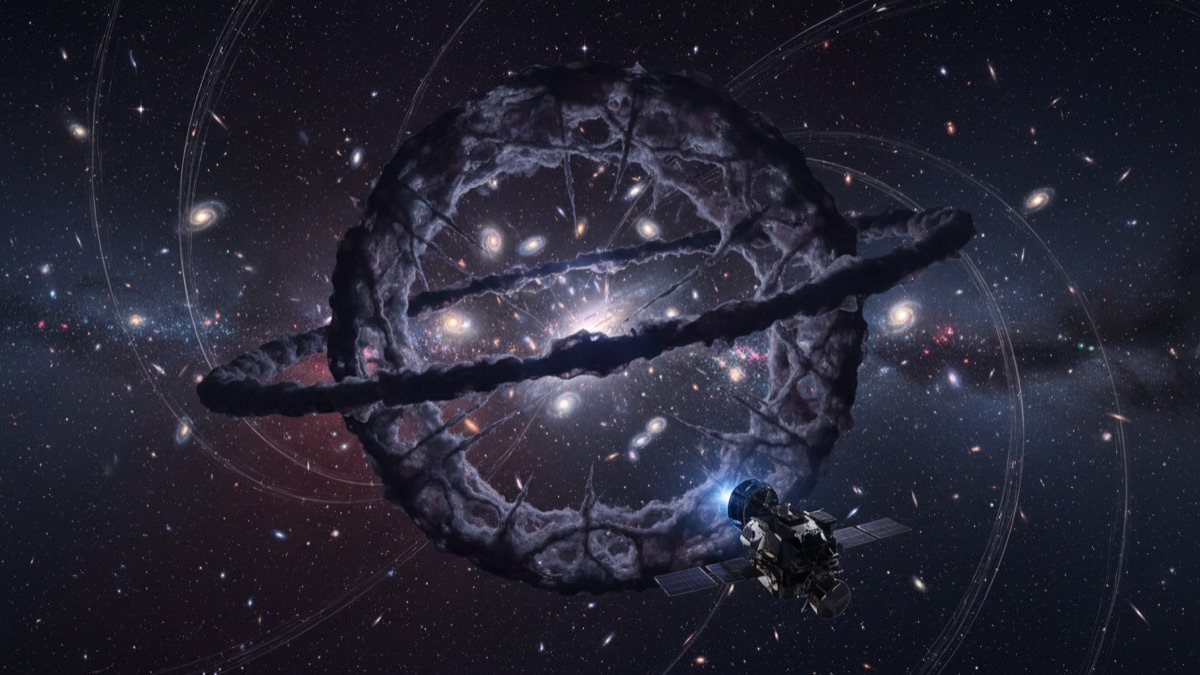
Dark matter is a form of matter that doesn't emit, absorb, or reflect light, making it completely invisible to telescopes, yet scientists believe it accounts for roughly 85% of all matter in the universe based on its gravitational effects.
Astronomers first suspected dark matter existed after observing that galaxies rotate faster than the visible matter within them could explain — without additional unseen mass providing extra gravitational pull, galaxies should theoretically fly apart.
Detected Through Gravity, Not Light
Why Scientists Are Confident It Exists
Further evidence comes from gravitational lensing, where the gravity of massive objects bends light from more distant sources passing by them, and observed bending is often far greater than visible matter alone could account for.
Despite strong indirect evidence for its existence, scientists still don't know what dark matter is actually made of, and detecting it directly, rather than inferring it through its gravitational effects, remains one of the biggest open questions in physics.
Sources
- Wikipedia — overview of dark matter and the evidence for its existence
- NASA — scientific background on dark matter research
- CERN — particle physics perspective on dark matter research
FAQ
Can dark matter be seen directly?
No — it doesn't emit, absorb, or reflect light, so scientists infer its existence indirectly through its gravitational effects rather than observing it directly.
How much of the universe is made of dark matter?
Scientists estimate dark matter accounts for roughly 85% of all matter in the universe, based on gravitational observations.
What first led scientists to suspect dark matter exists?
Observations that galaxies rotate faster than their visible matter could explain, suggesting additional unseen mass was providing extra gravitational pull.
About the Author
We reference Wikipedia, NASA, and CERN to explain the background and current understanding of this topic.
Loved This Article?
Share it on WhatsApp → Share it on WhatsApp
Get more guides in your inbox — Subscribe to our newsletter for weekly surprising stories from Egypt, Saudi Arabia, Dubai, and beyond.