Introduction
From the tilework of the Alhambra in Spain to the domes of Cairo's mosques and the mausoleums of Samarkand, Islamic geometric art is one of the most recognizable and mathematically sophisticated artistic traditions in the world. Built entirely from repeating circles, polygons, and stars, these patterns can seem to extend infinitely in every direction, drawing the eye into a meditative rhythm.
The tradition developed over roughly a thousand years across a vast geographic area, from Spain to Central Asia, and reflects both religious and philosophical ideas as much as pure decorative skill, becoming one of the defining visual languages of Islamic civilization.
Why Geometry Instead of Figures?
A common misconception is that Islamic art avoids figural representation entirely for religious reasons; in reality, figural art does appear historically in some contexts, particularly in secular settings like palaces and manuscripts. However, in religious architecture especially, artists gravitated strongly toward geometric, floral (arabesque), and calligraphic decoration, partly reflecting theological caution around images that might invite idol worship, and partly because geometric pattern offered a powerful way to express ideas about the infinite nature of the divine without any literal representation.
Geometric patterns, unlike a figure or scene, have no clear beginning or end — they can theoretically extend forever, which many scholars interpret as a visual metaphor for the boundlessness and unity underlying the created world in Islamic thought.
How the Patterns Are Actually Constructed
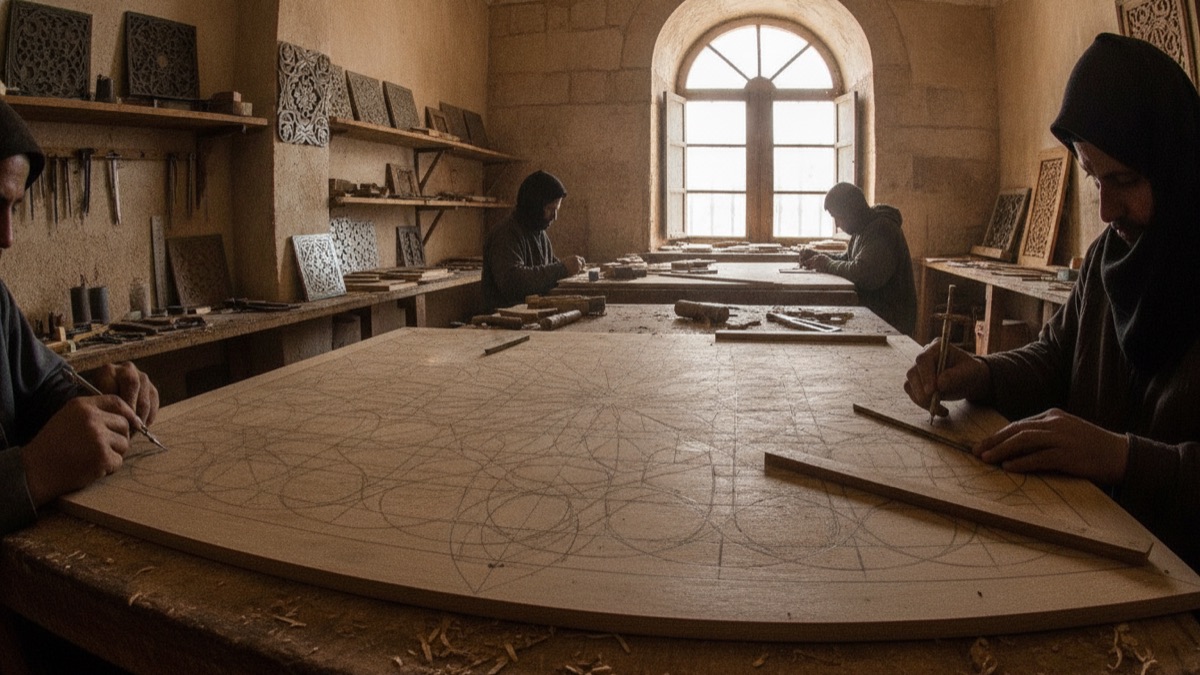
Despite their overwhelming visual complexity, most Islamic geometric patterns are built from surprisingly simple tools and steps: a compass and straightedge, following the same basic Euclidean geometry techniques used in ancient Greek mathematics. Artists typically begin by drawing a grid of overlapping circles, then use the intersection points of those circles to construct regular polygons, most often hexagons, squares, pentagons, or their combinations.
From this underlying polygon grid, artists draw connecting lines at specific angles to create the star and interlacing motifs so characteristic of the style — an eight-pointed star (khatam), for example, is constructed from two overlapping squares rotated 45 degrees from each other. The pattern is then typically repeated and tiled across the full surface, whether a wall panel, a dome, or a wooden door.
Famous Examples Around the World
The Alhambra palace in Granada, Spain, built primarily in the 13th and 14th centuries, is often considered the single most studied site for Islamic geometric tilework, its walls covered in dazzling zellij mosaic patterns that mathematicians have analyzed for their near-complete use of the mathematically possible wallpaper symmetry groups. In Cairo, the intricately carved wooden mashrabiya screens and mosque mihrabs showcase geometric pattern applied to architecture and functional design alike.
In Central Asia, the tilework of Samarkand's Registan complex and the shrines of Uzbekistan display particularly bold, large-scale geometric and calligraphic combinations, while in Morocco, cities like Fez and Marrakech remain living centers where craftsmen still hand-cut zellij tiles using techniques largely unchanged for centuries.
Why This Tradition Still Matters Today
Mathematicians have found genuine scholarly interest in Islamic geometric patterns, with some research suggesting medieval craftsmen intuitively discovered principles related to quasicrystalline geometry — patterns that never exactly repeat — centuries before Western mathematicians formally described such structures in the 20th century, most notably discussed in a widely cited 2007 study of girih tile patterns at monuments including the Darb-i Imam shrine in Isfahan.
Today, the tradition continues to influence contemporary architecture, digital art, and design worldwide, and remains an active craft practice in many Muslim-majority countries, where master artisans train new generations in the same compass-and-straightedge techniques used a thousand years ago.
Sources
- The Metropolitan Museum of Art — Curatorial essay on geometric patterns in Islamic art
- Encyclopaedia Britannica — Overview of Islamic art history and characteristics
- Science Magazine — Peer-reviewed research on girih tiles and quasicrystalline geometry in medieval Islamic architecture
FAQ
Does Islamic art completely avoid depicting people and animals?
Not entirely. Figural art does appear in some historical contexts, particularly secular settings like palaces and manuscripts, but religious architecture especially favored geometric, floral, and calligraphic decoration instead.
What tools are used to construct Islamic geometric patterns?
Most patterns are constructed using only a compass and straightedge, following classical Euclidean geometry techniques, starting from a grid of overlapping circles used to build regular polygons.
What does the eight-pointed star pattern represent?
The eight-pointed star, known as khatam, is constructed from two overlapping squares rotated 45 degrees from each other and is one of the most common motifs in Islamic geometric design.
Where can you see famous examples of Islamic geometric art?
Notable examples include the Alhambra palace in Granada, Spain, Cairo's mashrabiya screens and mosque mihrabs, and the Registan complex tilework in Samarkand, Uzbekistan.
Did medieval Islamic artisans discover advanced mathematics?
A widely cited 2007 study found that girih tile patterns at monuments like the Darb-i Imam shrine in Isfahan show principles resembling quasicrystalline geometry, centuries before Western mathematicians formally described such structures.
About the Author
doyouknow.app Editorial Team — We reference museum curatorial sources and peer-reviewed research to explain the history and mathematics behind Islamic geometric art.
Loved This Article?
Share it on WhatsApp → Share on WhatsApp
Get more guides in your inbox — Subscribe to our newsletter for weekly surprising stories from Egypt, Saudi Arabia, Dubai, and beyond.