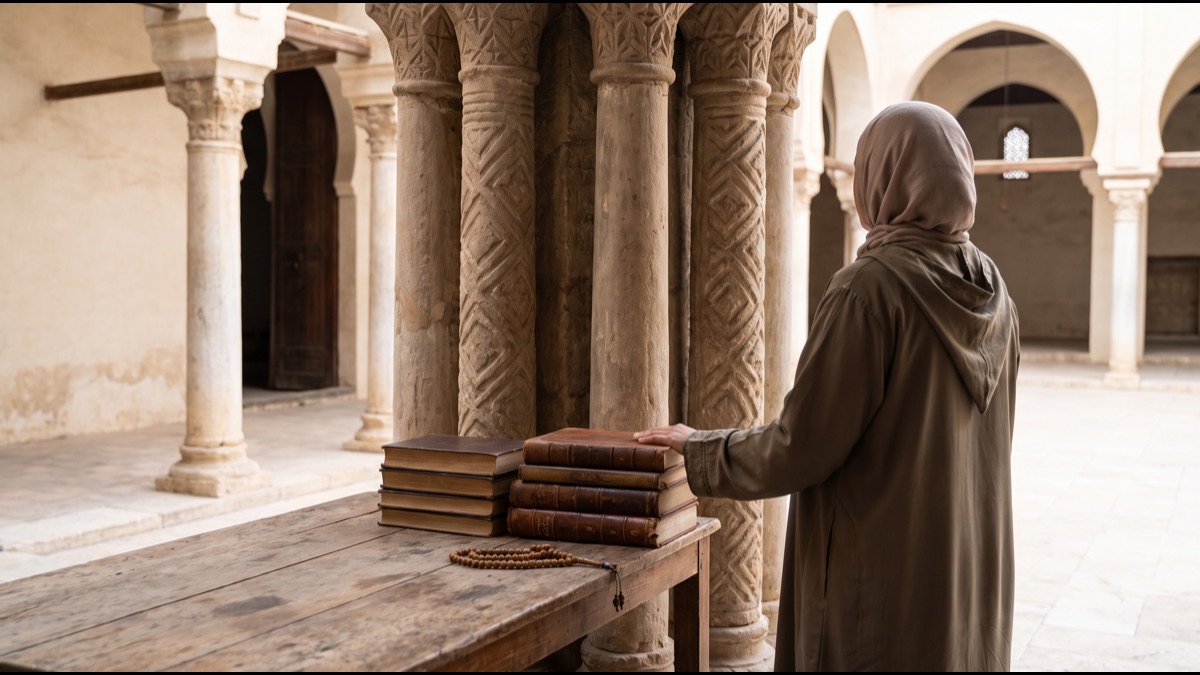
What Are the Five Pillars?
The Five Pillars of Islam are the framework of a Muslim's life. They are the declaration of faith, daily prayers, charity, fasting in Ramadan, and pilgrimage to Mecca. Together they shape belief, worship, ethics, and community.
These pillars are not optional cultural practices. They are explicitly named in the Qur'an and the authentic Sunnah, and they distinguish Islam as a comprehensive way of life. Every Muslim who is able is expected to uphold them, though the way each pillar is fulfilled can vary with a person's health, age, and circumstances.
Scholars often describe the pillars as the structure of a building: Shahada is the foundation, and Salah, Zakat, Sawm, and Hajj are the pillars that stand on it. Removing any one weakens the whole structure, which is why Islamic scholarship treats them as a connected system rather than five separate rules.
Where the Five Pillars Come From
The clearest statement of the five pillars comes from a well-known hadith in which the Prophet Muhammad (peace be upon him) was asked to describe Islam. He replied that Islam is built on testifying that there is no god but Allah and that Muhammad is His messenger, establishing prayer, paying Zakat, fasting Ramadan, and performing Hajj for those who are able. This narration, recorded in the major hadith collections of al-Bukhari and Muslim, is the basis scholars across all four Sunni schools of jurisprudence (Hanafi, Maliki, Shafi'i, and Hanbali) point to when explaining the pillars.
Each pillar also has its own basis in the Qur'an — prayer, charity, fasting, and pilgrimage are commanded in numerous verses, and the Shahada is the implicit foundation of the entire text. The pillars were not introduced all at once; obligations such as the five daily prayers and the Ramadan fast were established at different points during the Prophet's mission in Mecca and Medina, and Muslim scholars have documented this historical sequence in detail in the classical biographies (seerah) of the Prophet.
Shahada: The Declaration of Faith
The first pillar is the testimony that "There is no deity worthy of worship except Allah, and Muhammad is His messenger." This statement is the foundation of Islamic belief. Saying it with sincere conviction makes a person a Muslim.
The Shahada also implies rejection of all false gods and acceptance of the Prophet Muhammad (peace be upon him) as the final messenger. It is recited in prayers, at births, and near death.
The declaration has two linked parts. The first half, "there is no deity worthy of worship except Allah," affirms that worship belongs to God alone. The second half, "Muhammad is His messenger," affirms that Muhammad conveyed God's final revelation and that his example (the Sunnah) is a guide for how to live. Scholars traditionally list several conditions for the Shahada to be meaningful rather than a mere phrase — knowledge of its meaning, certainty, sincerity, truthfulness, love, submission, and acceptance. The Shahada is also woven into daily life: it is the first part of the call to prayer (adhan) heard from mosques five times a day, and it is whispered to newborns and encouraged as a person's final words.
Salah: The Five Daily Prayers
Muslims pray five times a day: Fajr (dawn), Dhuhr (midday), Asr (afternoon), Maghrib (sunset), and Isha (night). These prayers connect the believer with Allah throughout the day and night, and each one falls within a specific time window calculated from the sun's position — which is why prayer-time apps and mosque boards display slightly different minute-by-minute times across cities.
Prayer involves physical postures, recitation of the Qur'an, and supplication. It is performed facing the Kaaba in Mecca. Before praying, Muslims perform wudu, a ritual washing of the hands, face, arms, and feet, to enter a state of physical and spiritual readiness. Each prayer is made up of units called rak'ahs, combining standing recitation, bowing, and prostration.
Congregational prayer in mosques strengthens community ties, especially the Friday midday prayer (Jumu'ah), which includes a sermon and is considered obligatory for adult men who are able to attend. Travellers and the ill are given concessions: prayers can be shortened (qasr) or combined (jam') when travelling, and those unable to stand may pray sitting or lying down. This flexibility reflects a broader principle in Islamic law that worship should remain achievable rather than become a source of hardship.
Zakat: Purifying Wealth
Zakat is an annual payment of 2.5% of eligible savings and assets to those in need. It purifies wealth and reduces inequality. You can learn more in our guide to what Zakat is and how to calculate it.
Zakat is obligatory only for Muslims who own wealth above the nisab threshold — a minimum amount roughly equivalent to the value of about 85 grams of gold or 595 grams of silver, depending on which the calculation is based on — for a full lunar year. It is distributed to eight categories of recipients mentioned in the Qur'an: the poor, the needy, Zakat administrators, those whose hearts are to be reconciled, people in bondage seeking freedom, those in debt, those striving in the cause of God, and travellers in need.
Zakat is distinct from Zakat al-Fitr, a smaller, fixed charitable payment given before the Eid al-Fitr prayer at the end of Ramadan to ensure that those in need can also celebrate the holiday. Both are separate from Sadaqah, voluntary charity that can be given at any time in any amount, which is discussed in more depth in our comparison of Sadaqah and Zakat.
Sawm: Fasting in Ramadan
During the month of Ramadan, Muslims abstain from food, drink, and other physical needs from dawn until sunset. Fasting develops self-discipline, empathy for the poor, and spiritual awareness.
The fast begins with a pre-dawn meal (suhoor) and a conscious intention (niyyah) to fast for the sake of Allah. It ends each evening with iftar, traditionally broken with dates and water before a fuller meal, often shared with family, neighbours, or at community iftars organised by mosques and charities. Ramadan also includes additional night prayers (Taraweeh) and culminates in the last ten nights, which include Laylat al-Qadr, widely regarded as the most sacred night of the Islamic calendar — our guide to Laylat al-Qadr explains its significance in detail.
Those who are ill, travelling, pregnant, nursing, or elderly may be exempt. People who are only temporarily unable to fast are generally expected to make up the missed days later in the year (qada), while those with a long-term or permanent inability may instead feed a person in need for each missed day (fidya). Children are not required to fast and are gradually introduced to the practice as they approach puberty. Our Ramadan health guide offers practical advice on fasting safely.
Hajj: Pilgrimage to Mecca
Hajj is the pilgrimage to Mecca that every Muslim must perform at least once in a lifetime if physically and financially able. It takes place during Dhul-Hijjah, the twelfth month of the Islamic calendar, and traditionally traces its rites back to the Prophet Ibrahim (Abraham) and his family.
The rituals include entering a state of ritual consecration (Ihram), circling the Kaaba seven times (Tawaf), walking between the hills of Safa and Marwah (Sa'i), standing at the plain of Arafat, and the symbolic stoning of pillars representing the devil. Hajj is distinct from Umrah, a shorter pilgrimage that can be performed at any time of year and is not obligatory. Our Hajj guide and Umrah guide explain the steps in detail, and our guide to the history of the Two Holy Mosques covers the sites themselves.
The Pillars in Daily Life Across the Gulf
In the UAE, Saudi Arabia, and across the Gulf, the five pillars are visible in everyday infrastructure as much as in personal devotion. Prayer times structure the working day: many offices, shops, and government services pause briefly around Salah times, and mosques are within walking distance in almost every neighbourhood. Zakat is often channelled through organised bodies — for example, national Zakat funds and licensed charities in the UAE and Saudi Arabia — which collect and distribute contributions to verified recipients, alongside the option of giving Zakat directly.
Ramadan reshapes public life across the region: working hours are typically shortened, large-scale community iftars are common, and Gulf governments and municipalities support Hajj and Umrah logistics for millions of pilgrims each year through digital platforms such as Nusuk. This regional context is a useful reminder that the five pillars are not just individual acts of worship; they also shape how entire societies organise time, generosity, and travel.
Public infrastructure reflects this too. Mosques are built into master plans for new residential communities, prayer rooms are standard in shopping malls, airports, and workplaces, and Ramadan timings are published by municipal and religious authorities each year based on moon-sighting or astronomical calculation, depending on the country's practice. For visitors and residents alike, this makes the rhythm of the five pillars easy to observe even from outside the faith, and it is one reason first-time visitors to the Gulf often remark on how visibly the call to prayer and mosque architecture are woven into daily city life compared with cities elsewhere.
Sunni and Shia Perspectives on the Pillars
The great majority of Muslims are Sunni, and the "Five Pillars" framework described in this guide — Shahada, Salah, Zakat, Sawm, and Hajj — is the Sunni articulation drawn directly from the hadith of Gabriel. Twelver Shia Muslims, who form the second-largest branch of Islam, generally organise their practice under a related but differently structured framework, often described as the "Roots of Religion" (foundational beliefs) and the "Branches of Religion" (practical obligations). The Branches of Religion typically include Salah, Sawm, Hajj, and Zakat among ten or more listed practices, alongside Khums, an additional religious tax not generally observed in Sunni practice, and other obligations.
In everyday practice, the core acts of prayer, fasting, charity, and pilgrimage are shared across the overwhelming majority of Muslims worldwide, even where the formal enumeration of "pillars" differs between schools of thought. This guide follows the Sunni five-pillar framework because it is the most widely referenced structure, but readers researching Shia jurisprudence specifically should consult sources dedicated to that tradition for a fuller treatment of the Roots and Branches of Religion.
Living the Pillars Today
The pillars are not isolated rituals. They work together to build a life of faith, gratitude, and service. Prayer organizes the day, Zakat connects wealth to community, fasting builds character, and Hajj unites Muslims across cultures.
Modern tools such as prayer-time apps, Zakat calculators, and online Qur'an resources make it easier to maintain these practices. Yet the inner intention remains the heart of every pillar — scholars consistently emphasise that outward performance without sincerity falls short of what each pillar is meant to achieve.
For someone new to Islam or simply new to structured practice, the pillars are often approached gradually rather than all at once. The Shahada comes first, since it is the entry point to the faith. Learning the daily prayers typically follows, often with guidance from a local mosque or an experienced practitioner, since the physical movements and recitations take practice to learn well. Zakat becomes relevant once a person has held wealth above the nisab threshold for a full year, fasting is approached at the next Ramadan, and Hajj is planned for whenever the person becomes both financially and physically able. Many mosques and Islamic centres, including those across the UAE and Saudi Arabia, run structured classes specifically to help new and returning Muslims build these practices step by step.
With an estimated global Muslim population of close to two billion people spread across virtually every country, the five pillars function as a shared framework that transcends language, ethnicity, and national culture. A Muslim performing Fajr prayer in Jakarta, Marrakech, or Dubai follows essentially the same physical form and recitation, facing the same direction, at a time calculated the same way. Zakat calculations follow the same principles whether the currency is dirhams, riyals, or rupiah. This consistency, maintained across roughly fourteen centuries and vastly different cultures, is part of why the pillars are often described as the backbone of Islamic identity rather than a regional or cultural custom.
Frequently Asked Questions
Do the Five Pillars apply to all Muslims?
Yes. Every Muslim is expected to uphold the pillars according to their ability. For example, Hajj is only required once for those who can afford it, and Salah and fasting have recognised exemptions for illness, travel, and other hardships.
What is the most important pillar?
The Shahada is considered the foundation because it is the statement of faith that makes a person a Muslim. The other four pillars build on that foundational belief.
Can children be required to fast?
Children are not required to fast. They are gradually encouraged to practice as they approach puberty, often starting with partial days.
How is Zakat different from Sadaqah?
Zakat is a fixed obligatory payment with specific conditions and a set rate. Sadaqah is voluntary charity of any amount, given at any time. See our full Sadaqah vs Zakat comparison for details.
Why do Muslims face Mecca when praying?
The Kaaba in Mecca is the qibla, the unified direction of prayer appointed by Allah, symbolising the unity of Muslims worldwide in worship.
Can the five daily prayers be combined or shortened?
Yes, under specific circumstances such as travel or illness, Dhuhr and Asr, and Maghrib and Isha, may be combined, and prayers may be shortened while travelling.
Is Hajj required every year?
No. Hajj is only obligatory once in a lifetime for those who are physically and financially able. Muslims may choose to perform Hajj again or perform Umrah, which is not obligatory, in other years.
Are the Five Pillars the same as Islamic law (Sharia)?
No. The Five Pillars are the core acts of worship within Islam. Sharia is the much broader body of Islamic law and ethical guidance, covering worship, personal conduct, family matters, business transactions, and more. The pillars sit within Sharia rather than being equivalent to it.
What happens if a Muslim is unable to fulfil a pillar?
Islamic teaching distinguishes between inability and neglect. Genuine inability due to poverty, illness, or other hardship is generally met with exemptions, delayed obligations, or alternatives such as fidya. Scholars emphasise sincerity of intention and encourage seeking knowledge and gradual improvement rather than treating any single lapse as disqualifying.
Related Reading
- What Is Zakat and How to Calculate It
- Sadaqah vs Zakat: What's the Difference?
- Hajj: A Complete Guide for Pilgrims
- Umrah: A Step-by-Step Guide
- Fasting in Ramadan: A Health Guide from Medical Sources
- Laylat al-Qadr: The Night of Decree Explained
- Islamic Finance: A Beginner's Guide
Sources
- Al-Islam.org — Five Pillars of Islam
- Islamic Relief — Introduction to the Five Pillars
- Encyclopaedia Britannica — Five Pillars of Islam
- Al-Azhar Al-Sharif — guidance on the pillars of Islam and Islamic jurisprudence.
- IslamQA — Hadith of Gabriel and the foundations of Islam
About the author: The doyouknow.app editorial team writes clear guides that make complex topics easy. Have a topic idea? Get in touch.
📱 Tell a friend: Share on WhatsApp