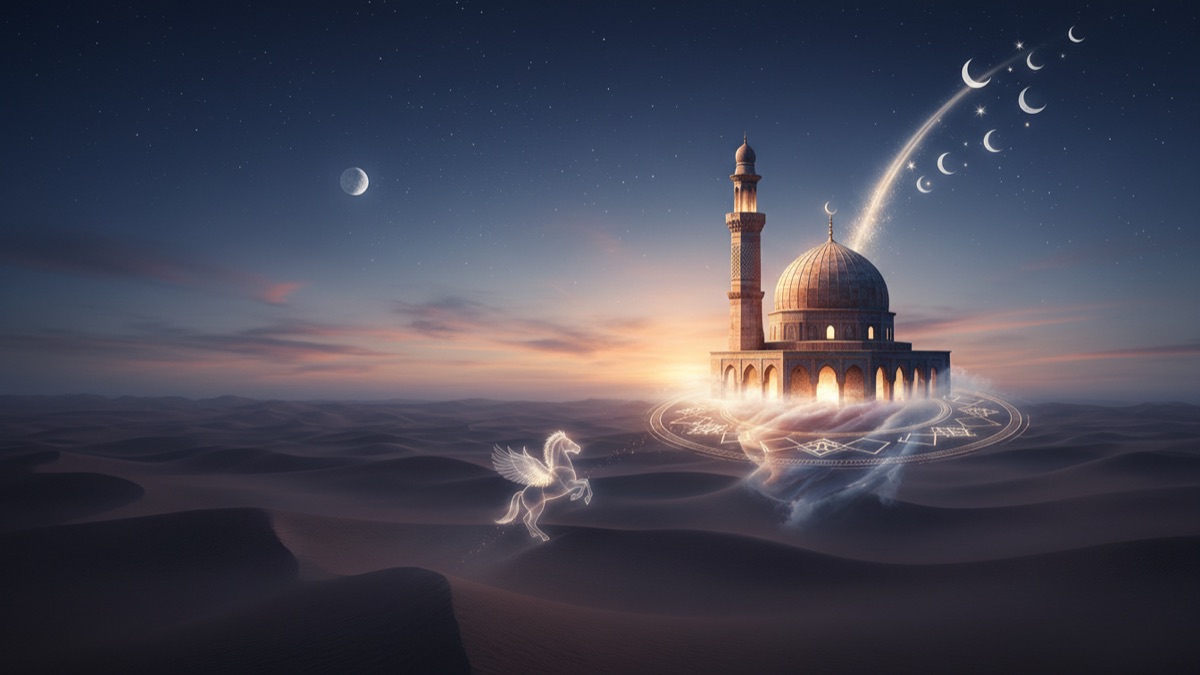
In Islamic tradition, one single night stands apart from every other in the Prophet Muhammad's life. On this night, described in the Quran and elaborated extensively in hadith literature, he is said to have travelled from Mecca to Jerusalem in an instant and then ascended through seven heavens, meeting earlier prophets and ultimately standing before God, before returning to his bed in Mecca the same night, his journey barely begun in worldly time.
The episode is known by two linked but distinct names. Isra names the horizontal journey from Mecca to Jerusalem, while Mi'raj names the vertical ascension that followed it. Together they form one of the most theologically significant and most debated episodes in the Prophet's biography, carrying implications for prayer, for the status of Jerusalem, and for how Muslims understand the boundary between the physical and spiritual worlds.
What Isra and Mi'raj Actually Describe
The traditional account, drawn primarily from hadith collections rather than a single continuous Quranic narrative, describes the Prophet being woken during the night by the angel Gabriel and transported on a miraculous mount to the "farthest mosque," understood by the overwhelming majority of Muslim scholars across history to mean Jerusalem, a city that had no standing mosque in the modern sense at that specific moment in history.
From that location, the account continues, the Prophet ascended through a series of seven heavens, at each level encountering a different earlier prophet recognised in the Abrahamic tradition, including figures such as Adam, Moses, and Abraham, before proceeding further to a station described as beyond the reach of even the angel guiding him, where direct communication with God is described as taking place.
How the Quran References the Night Journey
The Quran's own textual anchor for this event is comparatively brief. The opening verse of Surah al-Isra states that God took His servant on a night journey from the sacred mosque to the farthest mosque, whose surroundings were blessed, in order to show him some of God's signs, a single sentence that later hadith literature and scholarly commentary expanded into the far more detailed narrative widely known today.
Separately, Surah an-Najm is understood by many exegetes to describe elements of the ascension itself, referring to a vision near a lote tree at the furthest boundary, language that classical commentators have generally read as describing the culmination of the Mi'raj rather than an unrelated episode, though the precise correspondence between the two surahs has long been a subject of scholarly discussion.
Why Buraq Appears in the Traditional Account
Hadith narrations describe the means of the Prophet's transport as a creature called Buraq, traditionally depicted as swifter than any earthly animal, whose stride is said to have reached as far as the eye could see, carrying the Prophet the considerable distance between Mecca and Jerusalem within a single night rather than the weeks such a journey would ordinarily require by camel caravan.
Buraq has since become a recurring figure in Islamic art and popular imagery across many regions, frequently depicted with a human-like face and wings in later devotional and decorative traditions, even though the earliest textual descriptions are considerably sparser and scholars caution against treating later artistic elaboration as historically or theologically authoritative in the same way as the hadith text itself.
Why Jerusalem Comes First in the Journey
Jerusalem's inclusion as the first stage of the journey carries lasting significance well beyond the narrative itself, cementing the city and its al-Aqsa Mosque compound as Islam's third holiest site after Mecca and Medina, a status that continues to shape religious practice, pilgrimage aspiration, and geopolitical discussion around the city to the present day.
Early Muslims also prayed facing Jerusalem for a period before the direction of prayer, the qibla, was changed to face Mecca instead, a shift recorded in the Quran itself, and many scholars connect the symbolic weight of the night journey's Jerusalem stage to this earlier orientation, even though the qibla change is generally treated as a separate historical episode from the night journey.
How the Ascension Through the Heavens Is Described
The Mi'raj portion of the account describes a structured ascent through seven distinct heavens, a cosmological framework broadly consistent with other Abrahamic and late-antique traditions describing multiple heavenly tiers, though Islamic sources present the specific sequence of prophets encountered and the culmination of the journey as unique to this account.
At each level, the Prophet is described as exchanging greetings with the prophet stationed there, with the specific ordering varying somewhat between different hadith narrations, before ultimately reaching a point described as beyond even Gabriel's own capacity to proceed further, at which the Prophet alone continued toward the divine encounter that forms the theological climax of the narrative.
Why the Five Daily Prayers Trace Back to This Night
Perhaps the most practically significant element of the traditional account is its role in establishing the five daily prayers, one of Islam's central obligations. Hadith narrations describe the number of daily prayers initially being set considerably higher during the divine encounter, before being progressively reduced following repeated exchanges in which Moses, encountered during the ascent, urged the Prophet to request a lighter burden for his community.
The number is described as eventually settling at five daily prayers, though narrations add that the spiritual reward attached to observing them was preserved at a level equivalent to the original higher number, a detail scholars frequently cite when explaining why the prayers, despite the reduction in count, are still described in Islamic teaching as carrying substantial weight.
How Early Muslims Reacted to the Account
Early biographical sources describe the announcement of the night journey provoking sharp disbelief among many in Mecca, who considered a journey to Jerusalem and back within a single night to be plainly impossible regardless of any miraculous framing, and some accounts describe the episode being used specifically to test the conviction of the Prophet's closest companions.
Abu Bakr, according to widely repeated tradition, is said to have affirmed the account immediately and without hesitation upon hearing of it, an episode frequently cited as the origin of his honorific title as-Siddiq, meaning the truthful or the one who affirms, reflecting the significance early Muslims attached to accepting an account that defied ordinary physical explanation.
Why Scholars Disagree on the Exact Date
Despite the episode's centrality, classical scholars never reached firm consensus on precisely when it occurred within the Prophet's life, with proposed dates spanning several years before the migration to Medina, and even the specific year proposed varies meaningfully between different biographical and hadith compilations.
The widely observed commemorative date, the 27th night of the Islamic month of Rajab, reflects a later popular and devotional convention rather than a date established with strong historical certainty in the earliest sources, and a number of contemporary scholars are explicit in noting that this specific date functions primarily as a traditional marker rather than a documented historical fact.
How the Dome of the Rock Connects to the Story
The Dome of the Rock, completed on the Haram al-Sharif compound in Jerusalem in the late seventh century, stands over a rock formation that later Islamic tradition closely associates with the site from which the ascension is believed to have begun, though the structure itself postdates the Prophet's life by several decades and was not built specifically to mark the night journey.
Over subsequent centuries, the association between this particular rock and the ascension narrative became deeply embedded in popular devotion and in the religious geography of Jerusalem, reinforcing the compound's status as a focal point of Islamic pilgrimage and veneration alongside its continued significance to Jewish and Christian tradition regarding the same physical location.
How the Night Is Marked Today
Many Muslim communities mark Isra and Mi'raj with additional voluntary prayers, gatherings at mosques where the story is retold and its lessons discussed, and increased personal reflection, though practices vary considerably between regions and between different schools of Islamic thought, and the occasion is not treated as an obligatory religious holiday comparable to Eid.
Some scholarly traditions caution against elaborate ritual innovation around the date given the uncertainty over its precise historical timing, favouring simple remembrance and study of the episode's lessons over specific communal ceremonies, while other communities maintain long-established local customs of gathering and commemoration on the night.
Why the Story Still Shapes Muslim Identity
Beyond its historical and liturgical details, the night journey continues to function as a touchstone for discussions of faith under conditions of apparent impossibility, frequently invoked in sermons and religious education as an example of trust in revelation extending beyond what ordinary physical experience can independently confirm.
The episode also continues to anchor the enduring religious and emotional connection many Muslims feel toward Jerusalem specifically, a connection regularly cited in discussions of the city's contested status, and it remains one of the most frequently retold episodes in Islamic religious education for exactly this combination of theological, historical, and devotional significance.
How Islamic Scholarship Debates Literal Versus Spiritual Readings
Classical scholarship overwhelmingly favours a literal reading of the night journey, treating it as a real bodily event undergone by the Prophet rather than a purely visionary or symbolic experience, a position that most major schools of Islamic jurisprudence and theology have historically defended as consistent with the plain reading of the relevant hadith narrations.
A minority of early and later commentators, drawing on certain wordings in the sources and on philosophical considerations about the nature of prophetic experience, have argued for a spiritual or visionary interpretation instead, in which the Prophet's soul rather than his physical body undertook the journey, though this reading has never displaced the literal interpretation as the mainstream scholarly consensus across the major schools of thought.
The debate has rarely been treated as a matter threatening core belief either way, since the theological weight of the episode rests less on resolving the precise mechanics of the journey than on affirming its occurrence and its consequences, particularly the establishment of the five daily prayers, a point most scholars across both interpretive camps continue to affirm regardless of their position on the literal-versus-spiritual question.
How the Account Compares With Other Ascension Traditions
Narratives describing a righteous figure ascending through multiple heavens appear in several religious traditions predating Islam, including certain apocryphal Jewish and Christian texts describing visionary heavenly journeys, a pattern of literature scholars of comparative religion sometimes group under the broader category of ascension or apocalyptic literature.
Islamic scholars have generally treated these parallels as unremarkable rather than as evidence undermining the account's authenticity, noting that shared cosmological frameworks, including the notion of a multi-tiered heaven, were widely held across the late-antique Near East and would naturally surface in any religious narrative describing a journey through the heavens, regardless of that narrative's ultimate source.
What distinguishes the Islamic account within this broader literary landscape is less its basic structure than its specific content, particularly the direct encounter described between the Prophet and God, the meeting with a sequence of named earlier prophets, and its direct causal link to a concrete ongoing ritual obligation, the five daily prayers, a connection between a single narrated night and everyday religious practice that has few precise parallels elsewhere.
How the Journey Appears in Islamic Art and Literature
The night journey has inspired a substantial body of devotional literature across the Muslim world, including Persian, Ottoman Turkish, and Urdu poetic traditions that elaborate on the emotional and spiritual dimensions of the Prophet's ascent, often expanding considerably on the comparatively terse hadith accounts to produce richly imagined depictions of the heavens and their inhabitants.
Illustrated manuscripts depicting the Mi'raj were produced in several regions historically, particularly within Persian and Ottoman court painting traditions, despite general reservations in much of Islamic scholarship about figural depiction of the Prophet, with many such images either veiling his face or omitting his figure while still portraying Buraq and the surrounding heavenly scene in vivid detail.
This artistic and literary tradition sits somewhat apart from the more sober theological and legal treatment of the episode found in hadith commentary, illustrating how a single religious narrative can simultaneously anchor formal doctrine, ordinary ritual practice, and centuries of devotional creative expression across very different regions and periods of Islamic history.
Isra and Mi'raj occupies a distinctive place in Islamic tradition precisely because it compresses geography, cosmology, and religious obligation into a single narrated night, linking Mecca and Jerusalem, the earthly and the heavenly, and the practice of daily prayer that hundreds of millions of Muslims observe today back to one described encounter.
Whatever position a reader takes on questions of historical dating or literal versus symbolic interpretation, which have themselves been debated within Islamic scholarship for centuries, the narrative's lasting influence on prayer, on Jerusalem's religious significance, and on how the episode is taught and commemorated remains a defining feature of Islamic religious life to the present day.
For many Muslims, the value of the story lies less in settling every historical or interpretive detail than in what it is understood to communicate about the relationship between an individual believer and a reality that extends beyond ordinary sensory experience, a theme that recurs throughout Islamic devotional literature and continues to be taught to new generations through mosque sermons, religious schooling, and popular retellings during the month in which the night is traditionally commemorated.
Sources
- Wikipedia — overview of the traditional account and its sources
- Encyclopaedia Britannica — historical and theological background on the night journey
- Oxford Islamic Studies — scholarly reference on Islamic history and theology
- JSTOR — academic research on early Islamic biographical literature
FAQ
What is the difference between Isra and Mi'raj?
Isra refers specifically to the night journey from Mecca to Jerusalem, while Mi'raj refers to the ascension from Jerusalem through the heavens that followed it.
When is Isra and Mi'raj commemorated?
It is commemorated on the 27th night of the Islamic month of Rajab, though the exact historical date is not agreed upon by early scholars.
What is the significance of Jerusalem in this account?
Jerusalem's al-Aqsa Mosque is described as the first stop of the journey, cementing the city's status as Islam's third holiest site after Mecca and Medina.
What obligation is traditionally linked to Mi'raj?
Muslim tradition holds that the five daily prayers were established during this journey, making it central to the origin of one of Islam's core obligations.
Is Isra and Mi'raj mentioned in the Quran?
The opening verse of Surah al-Isra references the night journey explicitly, while the ascension narrative is developed further in the hadith literature.
About the Author
We reference Wikipedia, Encyclopaedia Britannica, Oxford Islamic Studies, and JSTOR to explain the background and current understanding of this topic.
Loved This Article?
Share it on WhatsApp → Share it on WhatsApp
Get more guides in your inbox — Subscribe to our newsletter for weekly surprising stories from Egypt, Saudi Arabia, Dubai, and beyond.